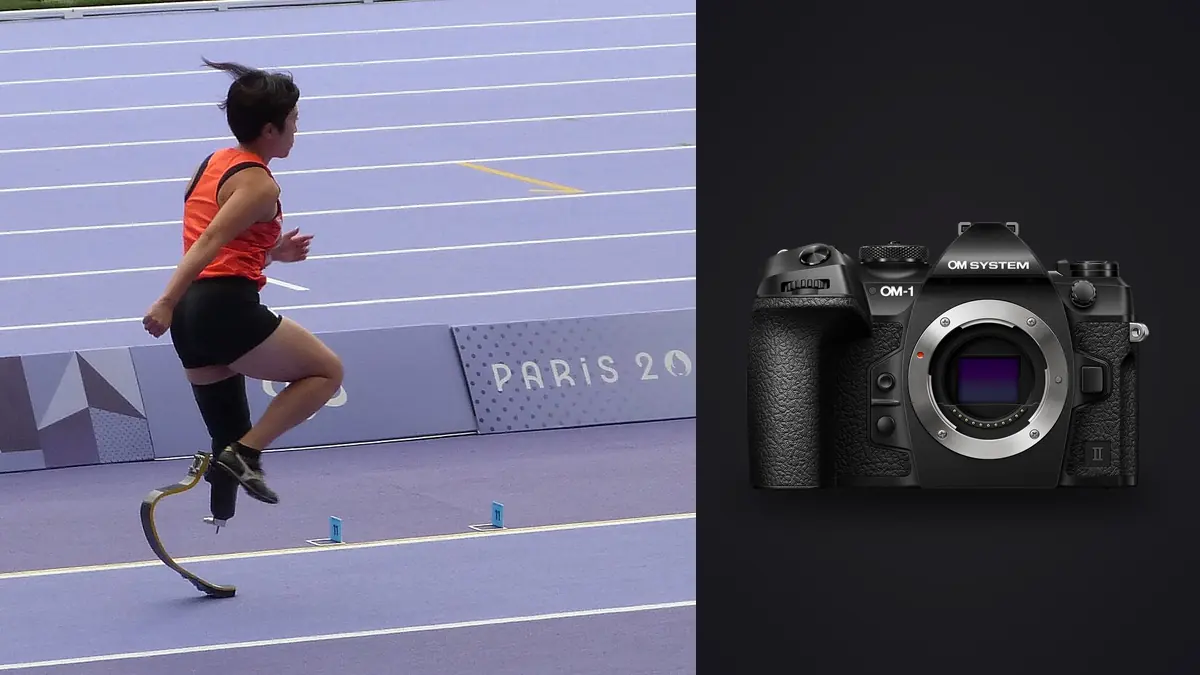
I shot a regional qualifying meet in April with an OM-1 Mark II hanging off a monopod for eleven hours, and by the end of the day my main takeaway wasn't about resolution or dynamic range. It was that this is a camera built by people who have actually stood on an infield rail at 7am with dew on the grass and a 400mm lens getting heavier by the hour. Track and field is a strange discipline to shoot. You've got a hundred meters of sprint that's over in ten seconds, a pole vault runway where the subject moves toward you and then straight up and away, and a distance race where nothing happens for four minutes and then the whole pack comes through the frame at once. No single camera setting survives contact with all of that. The OM-1 Mark II doesn't solve it for you, but it gives you enough tools that you can actually keep switching gears without missing the next event.
Why a Micro Four Thirds body still makes sense on the infield
The sensor size conversation around this camera gets tired fast, but for track specifically it's worth having honestly. A 2x crop factor means a 300mm lens shoots like a 600mm, which matters enormously when you're fenced off from the field and shooting sprinters from the far side of the track or a javelin thrower from the only angle the meet officials will let you stand. I've used the same focal lengths on full-frame bodies and Four Thirds, and the reach advantage on the M4/3 side is not subtle. You get to a 600mm-equivalent field of view with a lens and body combination that weighs less than half of what a full-frame 600mm prime weighs, and that matters when you're carrying it one-handed through a stadium concourse between events, or holding it up at your eye for a two-hour session of qualifying heats.
The tradeoff, and I'll say this plainly because too many gear write-ups skip it, is background separation. An f/2.8 on Four Thirds behaves more like an f/5.6 on full frame in terms of depth of field, so isolating a runner from a cluttered stadium background takes more distance and more focal length than it would on a bigger sensor. You compensate by shooting longer and further back, which the crop factor conveniently makes easier to do in the first place. It's a system that's internally consistent even if it wasn't the tradeoff I expected going in.
Autofocus and burst modes, and what they're actually good for
The stacked sensor and the 1053-point on-chip phase detection array are the parts of the spec sheet that get quoted the most, but the number that changed how I shoot track meets is the Pro Capture buffer. In SH2 mode the camera is continuously caching frames the instant you half-press the shutter, and when you fully commit it keeps roughly the last several dozen frames from before your reaction time. For a 100m start, that's the difference between capturing the gun and the actual break from the blocks versus capturing whatever your very human reflexes managed a quarter-second after the fact. I used to accept that sprint starts were a coin flip. They aren't anymore, not with this camera.
Subject detection AF added human and eye recognition in a firmware update after launch, and it's genuinely useful for track work, though I'll qualify that: it does best with a single runner isolated against a plain background, like a 400m hurdler with clear lanes on either side. Throw it into a bunched 800m field coming out of the first turn with six athletes overlapping and it starts hunting between subjects the way most detection systems do. For pack running I've had more consistent results switching back to a wide zone AF area and just tracking the lead group manually rather than trusting eye detection to pick the right person.
For events with a single fast-moving subject and a predictable line of travel, like pole vault or long jump, continuous AF with a small tracking cluster locked onto the athlete is reliable enough that I don't think about it anymore. That's the real compliment. Good autofocus should disappear.
Setting up for the events that actually happen at a meet
Track and field isn't one sport, it's about a dozen sports sharing a stadium, and each one wants a different camera configuration. Here's roughly what I run through in a typical meet, adjusted for whatever the light is doing that day.
| Event | Typical shutter speed | AF setup | Drive mode | Why |
|---|---|---|---|---|
| 100m / 200m blocks | 1/2500 to 1/3200 | Single small AF point, human detect on | Pro Capture SH2 | Buffers the break from the blocks before your reaction catches up |
| Long jump / triple jump | 1/2000 | Small tracking cluster, C-AF | SH1, ~25fps | Need continuous focus through the run-up, takeoff, and landing in sand |
| Pole vault | 1/3200 minimum | C-AF, human detect | Pro Capture, high buffer | Bar clearance happens in a fraction of a second and the athlete is moving toward then past you |
| 800m to 5000m pack | 1/1000 to 1/1600 | Wide zone, manual subject lock | 10fps mechanical | Detection struggles with overlapping runners; slight motion blur on legs is often fine |
| Throws (shot, discus, javelin) | 1/2000 to 1/2500 | C-AF, human detect, wide zone | SH2 burst on release | Reduces false AF triggers from the swinging implement itself |
None of that is exotic, but the point of the table isn't the numbers, it's that a meet forces you to change all four of those settings six or seven times an hour, and the OM-1 Mark II's control layout (two front dials plus the dedicated AF mode lever) makes those switches fast enough that you're not still fumbling through a menu when the gun goes off.
Glass that actually makes sense for this
If you're building a track kit around this body, the 40-150mm f/2.8 PRO is the lens I reach for most on a normal Saturday meet. At an 80-300mm equivalent it covers sprints, jumps, and most throws from a reasonable rail position, and at under 800 grams it doesn't wreck your shoulder over an eight-hour day. For the far side of a full stadium track, or shooting distance events where you want tight compression on the lead pack, the 100-400mm f/5-6.3 II gets you to an 800mm-equivalent reach without spending PRO-lens money, though you give up two stops of light, which matters under stadium floodlights at dusk.
The 150-400mm f/4.5 TC1.25x PRO is the dream lens for this work, with a built-in teleconverter that pushes it to a 1000mm-equivalent field of view, but it's genuinely a rental or a "once you're shooting this professionally" purchase rather than a starting point. I borrowed one for a conference championship meet and could shoot javelin throwers from behind the sector rope at a size and sharpness that the 40-150mm simply can't match at that distance. It's also nearly four times the weight and a lens most hobbyists won't need twice a season.
What holds up over a full day, and what doesn't
Weather sealing rated to IP53 has meant I don't think twice about a light rain delay, which happens more at outdoor track meets than anyone admits. Dual UHS-II SD card slots are fine for stills-only shooting, but if you're running raw plus a Pro Capture-heavy day, expect the buffer to take a real few seconds to clear before the camera is fully ready for the next burst. That's the one place a CFexpress-based competitor has a genuine edge, and it's worth knowing about before you're standing at the blocks for the next heat wondering why the buffer indicator hasn't cleared yet.
Battery life on the BLX-1 pack gets you comfortably through a normal half-day meet, but I still carry two spares for anything that runs past six hours, especially if you're chasing Pro Capture bursts, which drain faster than the CIPA rating suggests since the sensor is effectively always active while you're half-pressing the shutter. Indoor meets under mixed sodium and LED lighting are the other place to be careful. At very high shutter speeds you can catch banding from the lighting rig even with the electronic shutter's anti-flicker features engaged, so I'll drop to the mechanical shutter and accept a slightly lower top frame rate rather than fight visible stripes across every third frame.
The part nobody mentions: what happens after the meet
A single well-executed Pro Capture burst on a 100m start can hand you 60 to 80 frames from one race. Multiply that across twenty heats plus finals plus the field events running in parallel, and a full day at a meet routinely leaves me with four to six thousand frames to get through before I can even start picking favorites, let alone editing. This is the actual bottleneck of shooting a body this fast, and it has nothing to do with the camera itself.
This is where I stopped trying to review everything in Lightroom by hand and moved that first pass into imagic instead. It runs entirely on the laptop, no upload queue, which matters in a press tent with terrible stadium wifi. The sharpness scoring goes frame by frame through a burst and flags which one actually has the crispest focus on the athlete's face or foot-strike, because focus does drift a little across a fifty-frame sequence even with good tracking, and scrolling through all fifty at full zoom to find the best one is exactly the kind of task I don't want to do at 9pm after standing all day. The duplicate and burst clustering groups those near-identical frames together automatically so I'm reviewing maybe eight clusters from a race instead of eighty individual images.
Once I've got the keepers picked, I lean on the apply_my_style feature for the actual edit. Stadium lighting at a given venue tends to have a consistent color cast, and once I've manually graded a handful of shots from a meet to correct for it, training that look and applying it across the rest of the day's keepers saves the part of the workflow I like least, which is doing the same white balance and contrast correction fifty separate times in one sitting. If you want more on how the culling side of this actually works under the hood, this breakdown of AI photo culling covers the sharpness and clustering logic in more depth than I have room for here.
Frequently Asked Questions
Does the smaller sensor actually hold this camera back for track and field?
For reach and portability, no, it's an advantage. For background separation and extreme low-light indoor work, you do give something up compared to a full-frame body at the same aperture. In practice, for outdoor daytime meets where light is rarely the limiting factor, I notice the reach benefit constantly and the depth-of-field difference occasionally. Indoor winter meets under weak arena lighting are where I feel the sensor size most.
Is this a realistic replacement for a full-frame sports body, or a step down?
It's neither, it's a different set of tradeoffs. You're not going to out-resolve a 45-megapixel full-frame body for a magazine cover crop, but for the actual job of getting a sharp, well-timed frame of a hurdler clearing the last barrier from the far side of a stadium, the combination of reach, weight, and Pro Capture buffering makes this an easier camera to work fast with, not a compromised one.
What's the one lens to start with if budget is tight?
The 40-150mm f/2.8 PRO. It covers sprints, jumps, and most throws from typical rail distances, autofocuses fast enough for blocks and pole vault, and won't leave your neck wrecked by the fourth hour of a meet. Add reach later once you know which events you actually shoot most.
How much time should I budget for editing after a full day of shooting?
Assume several thousand raw frames if you're using Pro Capture through multiple events. Sorting that manually in a standard catalog tool is realistically a multi-hour task on its own before any actual editing starts. Building a faster first pass, whether through burst clustering software or just a stricter in-camera shooting discipline, is worth doing before your next meet rather than after your fifth one. There's a broader set of habits for this in these workflow tips that apply well beyond just track photography.