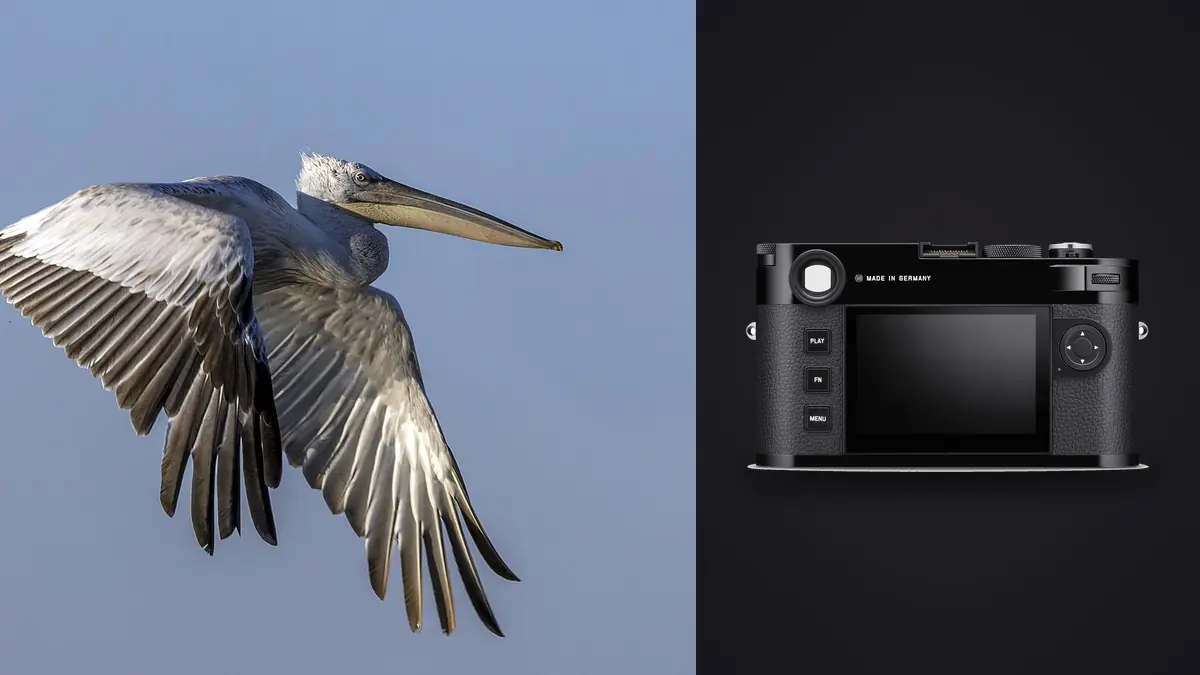
A rangefinder is about the last camera type any sane wildlife shooter would reach for when a tern folds its wings and drops on a sand eel. No autofocus, no continuous eye tracking, a viewfinder that doesn't show you the actual lens image, and a top mechanical frame rate that would embarrass a decade-old DSLR. And yet the Leica M11 has a small, stubborn following among birders who use it anyway, not because it's efficient, but because the limits force a different kind of attention. This is a practical look at what that actually involves: the mechanics that get in your way, the lenses that make it survivable, and the realistic hit rates you should plan around before you spend a whole migration season chasing swifts with a coincidence rangefinder.
Why this is a strange camera to bring to a hide
The M11 was designed around a 60-megapixel BSI sensor, a triple-resolution DNG option (60, 36, or 18 megapixels written natively rather than cropped), and a rangefinder focusing system that hasn't changed in principle since the M3. There is no phase-detect array, no subject tracking, no eye-AF, nothing. You focus by aligning a small bright patch in the center of the viewfinder with the actual optical image, twist the lens ring until the two images merge, then recompose if your subject isn't dead center. On a stationary object that takes a second or two once you know the camera. On a bird crossing your frame at 40 km/h it is a different problem entirely, because the coincidence patch has to be re-aligned continuously and there's no mechanism doing that for you. The full spec rundown on the M11's sensor, shutter, and body design is on the Leica M11 camera page.
None of this makes the M11 unusable for birds. It makes it unusable for the kind of bird photography most people mean when they say "birds in flight," which is really shorthand for erratic, fast, close subjects like swallows over water or a peregrine in a stoop. It's a genuinely different proposition for slower, more predictable flight, and that distinction is the whole article.
The mechanical limits that actually bite
Rangefinder base length and why distance kills accuracy
Focus precision on a rangefinder comes from triangulation: a fixed mechanical base length between the rangefinder window and the viewfinder, multiplied by the finder's magnification, gives you an effective base length somewhere in the 45-55mm range depending on the finder version you're using. That number stays constant no matter what lens is mounted, which is very different from an SLR or mirrorless focusing system where accuracy scales with the lens and the AF module working together. The practical effect: focus error grows with the square of the subject distance. At 8 meters on a 90mm lens you can nail feather-level focus by eye. At 30 meters on a 135mm lens with a bird moving through the frame, the margin for error narrows to something you'll only hit by luck a fraction of the time, even with a steady hand and a lot of practice.
Frame rate and buffer, the parts nobody mentions
The M11's mechanical shutter tops out at roughly 4.5 frames per second, and the buffer holds only around 15 frames at full 60-megapixel resolution before it stalls and makes you wait. Switch to the 18-megapixel DNG mode and you get noticeably more headroom in the buffer, which matters more for bird photography than the resolution loss does, because you're far more likely to be limited by how many frames you can fire off during a five-second pass than by pixel count on a keeper you'll crop anyway. There's also a silent electronic shutter capable of 1/16000s, useful for freezing wingtips in hard light, but it introduces rolling-shutter skew on fast-moving subjects, so a bird banking hard through the frame can come out with visibly distorted wings. Worth testing before you rely on it for anything you plan to print large.
Lenses: the actual bottleneck
Leica's M-mount lineup was built for street and documentary work, not wildlife, so your options for anything with reach are short. The table below covers what's realistically usable, including two R-mount telephotos that only work through an adapter and the Visoflex 2 electronic finder, since neither can use rangefinder coupling once they're on the body.
| Lens | Mount / Focus Method | Max Aperture | Approx. Combined Weight | Field Notes |
|---|---|---|---|---|
| APO-Summicron-M 90mm f/2 ASPH | Native M, rangefinder-coupled | f/2 | ~600g | Fast glass but genuinely too short for anything except large birds close in, herons on a shoreline, that kind of subject |
| APO-Telyt-M 135mm f/3.4 | Native M, rangefinder-coupled | f/3.4 | ~730g | The only M-mount telephoto with rangefinder accuracy that holds up past 15-20 meters; the realistic ceiling for coupled BIF work |
| APO-Telyt-R 280mm f/4 + R-Adapter M + Visoflex 2 | Adapted, manual focus via EVF only | f/4 | ~2,800g combo | No rangefinder coupling at all; you focus by magnifying the EVF image, which works for soaring or perched birds and basically nothing faster |
| APO-Telyt-R 400mm f/2.8 + R-Adapter M + Visoflex 2 | Adapted, manual focus via EVF only | f/2.8 | ~5,000g+ combo | Reach is there on paper, but the weight and EVF-only focusing make it a tripod lens for patient subjects, not a handheld flight rig |
The honest read: 135mm with rangefinder coupling is where the system actually still functions the way a rangefinder is supposed to. Past that you're either stepping outside the rangefinder entirely and focusing through a small electronic viewfinder image (workable, just slow), or you're carrying enough glass that the M11's whole size-and-discretion advantage disappears.
What kind of flight you can realistically shoot
"Birds in flight" covers a huge range of actual difficulty, and the M11 sorts subjects into categories far more sharply than an autofocus body does. The table below is built from repeated sessions with each type of subject, not a spec sheet guess.
| Flight Type | Typical Behavior | Realistic Keeper Rate | Technique That Works | Shutter Speed |
|---|---|---|---|---|
| Soaring raptors on thermals (buzzards, kites, vultures) | Slow, circular, altitude fairly constant | 25-35% | Pre-focus a distance band, wait for the bird to enter it, fire in short bursts | 1/1000-1/1250s |
| Gulls and herons in cruising flight | Linear, steady altitude, predictable wingbeat | 15-25% | Pan along the flight line, focus slightly ahead of the bird's position, fire on the beat | 1/1600-1/2000s |
| Terns and gulls diving on prey | Sudden vertical drop, unpredictable timing | 10-15% | Focus on the water surface where the dive will end, ignore the approach entirely | 1/2000-1/2500s |
| Swallows, swifts, and small passerines in flight | Erratic, constant direction changes | under 5% | Mostly abandon true tracking; shoot the launch from a perch or the final approach to a nest hole | 1/2500s or faster |
That bottom row is the honest answer to the question people actually ask, which is whether the M11 can do what a modern mirrorless body with bird-eye AF does for fast erratic flight. It can't, not reliably, and anyone telling you otherwise is either shooting a lot more frames than they're admitting or defining "keeper" loosely. Where the M11 earns its keep is in the top two rows, subjects with big, readable, repeatable flight patterns where the rangefinder's precision on a single well-timed frame beats out a tracking system's tendency to hunt on cluttered backgrounds.
Field technique that actually helps
Zone focusing beats tracking focus for almost every scenario above. Set the lens to a distance where you expect the bird to cross (a known perch-to-water line, a nest approach, a ridge a raptor rides on thermals) and let the subject arrive at your focus point rather than chasing it with the focus ring. This is the same logic street photographers use for candid work, just pointed at wildlife instead of pedestrians.
Depth of field is your safety margin, so don't fight it by shooting wide open out of habit. At f/5.6 on the 135mm, the zone of acceptable sharpness at 20 meters is noticeably wider than at f/3.4, and on a subject you can't re-focus mid-flight that margin is worth more than the extra stop of light most days. Stop down when the light allows it.
Panning smoothly matters more here than on an AF body, because you don't get a second chance if focus slips mid-pan the way autofocus would recover for you. Practice the pan on stationary reference points before the bird arrives, and commit to the arc rather than making small corrections once you're tracking.
Finally, shoot more than feels reasonable. A session at a tern colony that produces 400-600 frames across a few dozen short bursts is normal for this kind of work, and that volume is exactly where the workflow after the shoot starts to matter as much as the shooting itself.
The part after the shoot: culling a low hit-rate card
Manual-focus flight photography produces a very specific kind of mess: hundreds of frames that look identical at thumbnail size, where the difference between a keeper and a miss is whether the eye landed inside a few centimeters of true focus. Scrubbing that by eye at 100% zoom, frame by frame, is the part of this workflow that burns the most time, not the shooting.
This is where I actually rely on imagic rather than doing it manually. Its local sharpness scoring reads focus at the pixel level across a whole card and ranks frames instead of making you guess from a thumbnail, which matters enormously when the difference between two visually similar frames is exactly the kind of soft-focus error a rangefinder produces at distance. Because a single bird pass usually produces a burst of near-duplicate frames, the duplicate and burst clustering groups those together so you're comparing five or six frames from the same pass against each other rather than scrubbing an entire folder in sequence. And since everything runs locally with no upload step, a card full of 60-megapixel DNGs doesn't turn into an overnight cloud sync before you can even start reviewing it, which matters when you shot 500 frames for twelve real keepers and want the answer before the light changes for the next pass.
Once you've settled on the tonal treatment you like for feather detail and the slightly warm backgrounds this kind of light produces, the apply_my_style preset carries that look across a whole take instead of rebuilding the edit frame by frame, which is a meaningful time saver when you've culled fifty raptor-on-thermal frames down to eight and still have to process all eight before the post goes out. If you want the mechanics of how automated culling actually scores sharpness rather than just guessing at file size or metadata, the how AI photo culling works piece covers that in more depth than makes sense to repeat here.
Is it worth it
Depends entirely on what you're after. If the goal is a competitive bird-in-flight portfolio measured against modern AF bodies, the M11 is the wrong tool and no amount of technique closes that gap on fast erratic subjects. If the goal is a specific kind of quiet, deliberate wildlife photography where a soaring raptor or a heron's steady beat becomes an exercise in timing rather than tracking, the rangefinder's limits stop being a handicap and start being the point. The keeper rate is lower across the board than any autofocus system would give you, but the frames that do land tend to have a compositional intent behind them that comes from the extra thought each shot demands. That's a fair trade for some photographers and a frustrating one for others, and it's worth being honest with yourself about which camp you're in before you commit a migration season to it.
Frequently Asked Questions
Does the Leica M11 have any autofocus for tracking birds?
No. The M11 is a fully manual-focus rangefinder body with no autofocus module at all, not even a basic contrast-detect assist. Every frame is focused by hand through the rangefinder patch or, for adapted lenses, through the optional Visoflex 2 electronic finder. Anyone shopping the M11 specifically for tracking autofocus performance is looking at the wrong camera entirely.
What's the longest lens you can realistically use for bird photography on the M11?
Within the native M-mount lineup, the APO-Telyt-M 135mm f/3.4 is the practical ceiling for lenses that keep rangefinder coupling. Beyond that, Leica R-mount telephotos like the 280mm f/4 or 400mm f/2.8 can be adapted through the R-Adapter M, but they lose rangefinder coupling entirely and require focusing through the Visoflex 2's magnified electronic image, which is workable for perched or slow-moving subjects and much harder for anything fast.
Is the M11 better suited to perched birds than flight shots?
Yes, clearly. Perched and stationary subjects remove the timing problem entirely: you can focus carefully, recompose, and wait for the right moment without the rangefinder's distance-squared accuracy loss working against you. Flight photography on the M11 works best on slow, predictable patterns like thermal soaring, and gets progressively harder as the subject's speed and unpredictability increase.
How do you avoid losing hours to culling hundreds of near-identical manual-focus frames?
Shooting in short, deliberate bursts rather than holding the shutter down helps limit the raw volume in the first place, but even a disciplined session will leave you with dozens of visually similar frames to sort through. Running the card through imagic's local sharpness scoring ranks frames by actual focus accuracy rather than thumbnail impression, and grouping near-duplicate bursts together cuts the comparison down to a handful of frames per pass instead of an entire folder, which is the difference between a twenty-minute cull and a two-hour one.