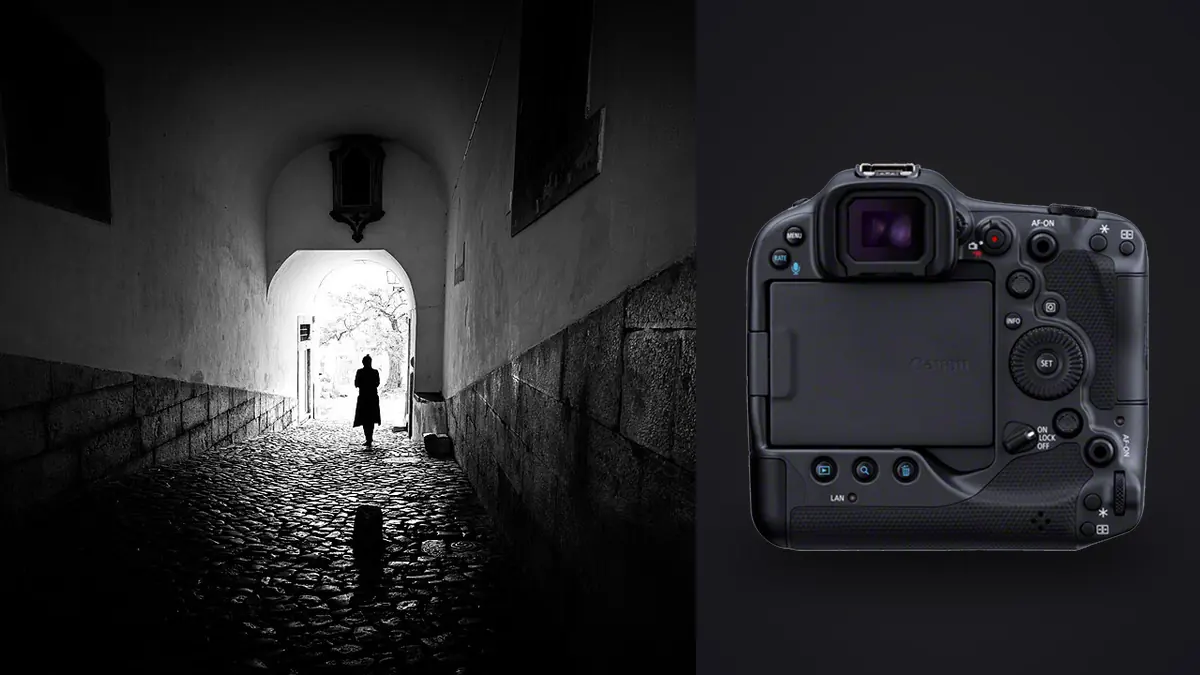
I borrowed a Canon EOS R3 for six weeks last spring, mostly out of curiosity about Eye Control AF, and ended up leaning on it for two documentary jobs I hadn't planned to shoot with it at all. My instinct going in was that a 1,015 gram flagship body with a battery grip built into the chassis had no business anywhere near street work. My instinct was only half right, and the half that was wrong surprised me.
Street and documentary photographers have historically gravitated toward small, quiet, unintimidating cameras. Leica M bodies, Fuji X100-series, even beat-up Ricoh GRs. The R3 is none of those things. It's a sports and photojournalism camera first, built around a stacked, back-illuminated 24.1MP sensor that reads out fast enough to shoot electronic-shutter bursts without the jello-vision rolling shutter distortion that plagues cheaper stacked and non-stacked sensors alike. The question worth asking isn't whether it's a "street camera" in the traditional sense. It's whether the specific things this sensor and this body do well actually translate into better documentary work, or whether they're solving problems street photographers didn't have.
The Weight Argument, and Why It's Only Half the Story
Body only, the R3 weighs 1,015g. Pair it with the RF 28-70mm f/2 (a lens I used for most of the six weeks) and you're carrying close to 2.5kg around your neck for eight, ten, sometimes twelve hours. That's a real cost. My trapezius muscles complained by day three of a documentary shoot following a small fishing crew, and I found myself reaching for a single prime more often than I would with a lighter kit, just to cut ounces.
But weight is only half the discretion equation on the street. The R3's shutter, when set to fully electronic, is silent. Not "quiet for a DSLR" silent, actually silent, no mechanical clack at all. On a crowded market street in Palermo I shot a sequence of a fishmonger arguing with a customer from four meters away and neither of them so much as glanced my direction, because there was no sound to react to. A Leica Q2's leaf shutter is famously discreet, but it's still audible up close. The R3 removes that variable entirely, which matters more for candid documentary moments than most spec sheets give it credit for.
Eye Control AF: I Was Skeptical, Then I Wasn't
Canon revived Eye Control AF from the film-era EOS-3, and on paper it sounds like a novelty: the camera tracks where your eye is looking inside the viewfinder and moves the focus point there. My first attempts were a mess. The calibration routine (you stare at nine dots in sequence, in three different lighting conditions, ideally) took real effort to get right, and even then it drifted if my grip on the camera shifted or my glasses slid down my nose.
Once dialed in, though, it changed how I worked a scene. Documentary photography is full of moments where you don't have time to thumb a joystick to the right AF point, you need focus to land on the person's face the instant they turn toward you. With Eye Control AF calibrated well, I could glance at a subject's eyes through the finder and the focus point would already be there before my finger reached the shutter. It's not perfect (busy backgrounds and low, dim indoor light both degrade tracking accuracy) but on outdoor street work in daylight, hit rate was noticeably higher than back-button AF-point selection ever gave me.
Blackout-Free Viewfinder and the Decisive Moment
The other feature that actually earns its place in a street shooter's kit is the blackout-free electronic viewfinder during continuous shooting. On a mechanical-shutter camera, or even most electronic-shutter mirrorless bodies, the viewfinder image freezes or blacks out for a fraction of a second on each frame. At 12fps or 30fps that adds up to real gaps in what you're seeing while you shoot. The R3's stacked sensor and dual-processor pipeline keep the finder live the entire time, so you're watching continuous motion, not a slideshow.
For documentary sequences where the exact peak of a gesture matters, a hand raised mid-argument, a child mid-leap off a wall, this is not a small thing. I could track a subject moving through a crowd and actually see them the whole time I was shooting, rather than guessing where they'd be when the finder came back.
Street and Documentary Cameras, Compared
None of this means the R3 is the obvious choice over the lighter, cheaper cameras this genre usually favors. Here's how it actually stacks up against four cameras I've shot the same kind of work with.
| Camera | Body weight | Max burst rate | Viewfinder blackout | Usable high ISO | Body-only price (launch) |
|---|---|---|---|---|---|
| Canon EOS R3 | 1,015g | 30fps electronic / 12fps mechanical | None (blackout-free) | ISO 25,600-51,200 | $5,999 |
| Leica Q2 | 734g | 10fps | Full blackout each frame | ISO 6,400-12,500 | $4,995 |
| Fujifilm X100V | 478g | 11fps (electronic, crop) | Full blackout (EVF mode) | ISO 6,400-12,800 | $1,399 |
| Sony A7 IV | 658g | 10fps | Full blackout each frame | ISO 12,800-25,600 | $2,498 |
| Canon R6 Mark II | 670g | 40fps electronic / 12fps mechanical | Full blackout (mechanical) | ISO 25,600-51,200 | $2,499 |
The R6 Mark II is the interesting outlier here. It's less than half the R3's price, weighs a third less, and actually out-bursts it at 40fps versus 30fps. What you give up is the blackout-free finder and Eye Control AF, both of which are genuinely R3-exclusive within Canon's lineup right now. If your documentary work leans more toward planned portraiture and environmental setups than fast candid sequences, the R6 Mark II probably serves you better and leaves money for glass.
The 30fps Problem Nobody Mentions in the Marketing
Here's the part of R3 ownership that doesn't show up in review videos: what 30fps electronic shooting does to your card, your hard drive, and your evening. A single three-second burst chasing a decisive moment produces roughly 90 RAW files. Multiply that across a full day of documentary shooting, where you're firing bursts constantly because the finder never blacks out and there's no mechanical reason to hold back, and you can walk away with four or five thousand frames from a single assignment.
Almost all of those frames are near-duplicates of each other, five or six versions of the same gesture separated by a thirtieth of a second, with maybe one or two where the expression, the hand position, and the focus all land at once. Sorting that by eye at the end of a twelve-hour shooting day is where I actually burned out during the six weeks I had the camera. I started running the day's cards through imagic specifically because of this camera. Its burst and duplicate clustering groups those 90-frame sequences automatically instead of leaving you to scroll through a folder of near-identical thumbnails, and the local sharpness and focus scoring flags which frame in each cluster actually nailed critical focus, which with Eye Control AF drifting slightly in some conditions is not always the frame you'd assume from a quick glance. It's local processing, so I could do this culling pass on a laptop in a hotel room with no signal, which matters more than it sounds like it should when you're on assignment somewhere without reliable internet.
If you're coming from a camera that tops out around 10-12fps, budget real time (and ideally a faster culling workflow, not just a bigger hard drive) before you commit to shooting the R3 the way its buffer lets you. Some of the workflow habits in our guide to a faster photo workflow become close to mandatory rather than optional once you're generating this much volume per day.
Weather Sealing and the Long Documentary Assignment
The R3's sealing is built to the same standard as Canon's 1-series DSLRs, which is to say it's meant to survive being rained on, dropped in dust, and generally abused on a multi-week assignment without babying. I shot through two genuine downpours during the fishing-crew story with no issues, wiping the body down with a cloth between squalls rather than reaching for a rain cover. That's a real advantage for documentary work specifically, where you often don't get to choose your weather and can't pause a shoot because the sky opened up.
The battery life that comes with the integrated grip is the other unglamorous win. I shot two full days on a single charge doing mixed stills and the occasional short video clip, which for documentary work in places without reliable power is worth more than most spec-sheet numbers suggest. The tradeoff, again, is the size and weight of carrying that grip everywhere, whether you need the extra battery capacity that day or not.
Lens Pairings That Actually Make Sense
The RF 28-70mm f/2 I used for most of the loan period is a phenomenal lens and a genuinely bad idea for street work, it weighs nearly a kilogram on its own and turns the whole rig into something you notice on your neck within an hour. For actual street shooting I'd point people toward the RF 35mm f/1.8 Macro IS STM, which is small, cheap by RF standards, and sharp enough that the R3's resolution isn't wasted on it. The RF 50mm f/1.2L is the other pairing worth considering if you want shallow depth of field for environmental portraits within a documentary sequence, though it adds its own considerable weight and cost.
If you already own EF glass from a 5D or 1D-series body, the EF-to-RF adapter works cleanly on the R3 and is a reasonable way to test the waters before committing to native RF primes, though autofocus speed with older EF lenses won't match what the stacked sensor is capable of with native glass. See the Canon EOS R3 camera page for full specs before deciding which lens budget to commit to.
Frequently Asked Questions
Is the Canon EOS R3 too heavy and conspicuous for candid street photography?
It's heavier and more visible than a rangefinder-style camera, no question, and some subjects will clock it as "professional gear" in a way they wouldn't a Fuji X100V. What offsets that is the fully silent electronic shutter, which removes the audible cue that makes people turn around mid-frame. For planned documentary work where you're already visible and known to your subjects, the size matters less. For pure candid street photography where blending in is the whole point, a smaller camera is still the better tool.
Does Eye Control AF actually work reliably, or is it more of a gimmick?
It works, but it demands a real calibration investment and degrades in dim or visually busy scenes. In good outdoor light with a proper calibration, I found it faster than manually selecting AF points for fast-moving candid subjects. Indoors, in low light, or with backgrounds full of competing detail, I fell back to standard subject tracking more often than not.
How much storage should I budget for a documentary shoot with this camera?
Plan for far more than you think. A single day of active street or documentary shooting at 30fps electronic can realistically produce 3,000 to 5,000 RAW frames, especially if you're chasing gestures in bursts rather than single frames. That's not unique to the R3, but the R3 makes it easy to generate that volume without noticing, since there's no mechanical shutter fatigue or viewfinder blackout to slow you down. A culling pass that groups burst sequences and flags the sharpest frame in each one, which is the specific thing I started using imagic for on this camera, turns that volume from a liability into just a slightly bigger initial sort.
Is the R3 worth it over a cheaper Canon body like the R6 Mark II for this kind of work?
Only if you specifically value the blackout-free viewfinder and Eye Control AF, both of which are genuinely unique to the R3 in Canon's current lineup and both of which matter more for fast-moving documentary sequences than most other specs. If your work is slower-paced, more planned, or budget-conscious, the R6 Mark II gets you similar burst performance and sensor capability for less than half the price and considerably less weight.