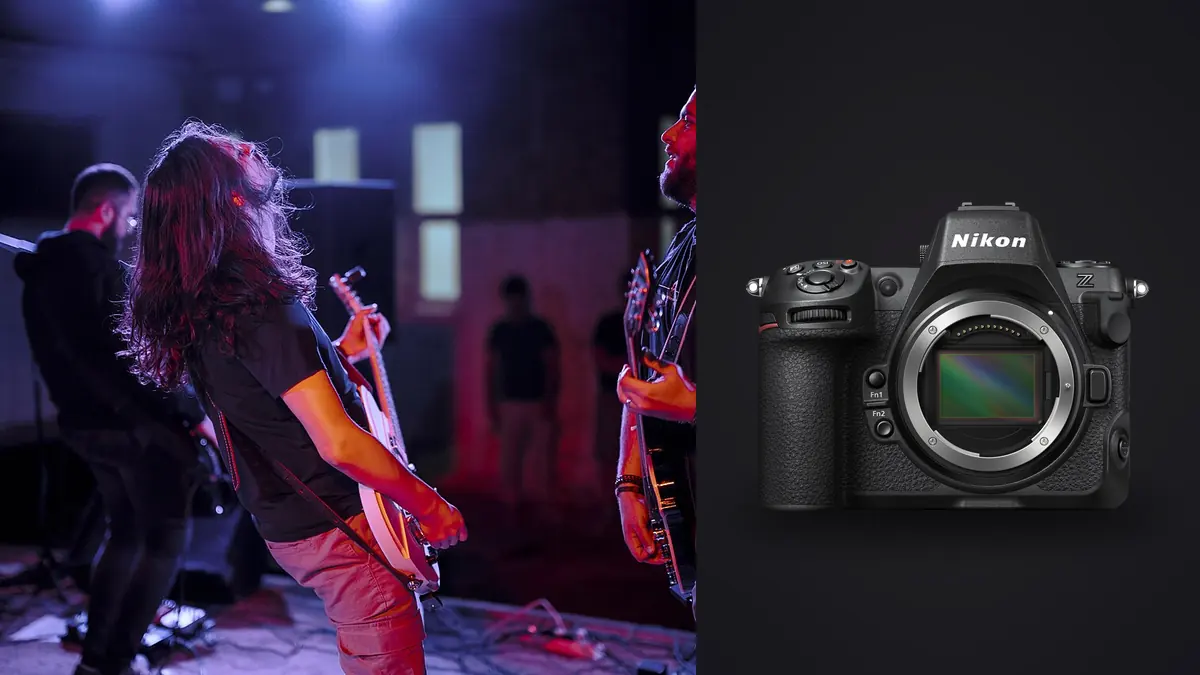
I brought a Nikon Z8 into a photo pit for the first time on a three-band bill at a 900-capacity room with a lighting rig that consisted of maybe eight moving heads and a haze machine that kept cutting out. No riser, no photographer's tape marking a safe zone, just the barrier and whatever gap the security guy left me between the crowd and the stage lip. That's a fairly normal night for anyone shooting live music regularly, and it's the kind of environment where a camera's spec sheet either holds up or it doesn't. Two years and probably 40 shows later, here's what actually matters about the Z8 for this work, not the marketing bullet points.
The Stacked Sensor Is the Whole Story
The Z8 borrows the 45.7MP stacked, backside-illuminated sensor from the Z9, and for concert work that's the single spec that changes how you shoot. A stacked sensor reads out fast enough that the electronic shutter doesn't need to hide behind a mechanical curtain to avoid rolling shutter smear. Practically, that means the viewfinder never blacks out during a burst. You can track a singer jumping off a monitor wedge and keep them framed through the whole sequence instead of losing them for a frame or two every time the mirror or shutter mechanism would normally interrupt your view. On a camera with a slower sensor readout, that blackout is exactly when a guitarist throws their head back or a drummer's stick catches the light, and you miss it because you were staring at a dark rectangle.
Unlike the Z9, the Z8 kept a small mechanical shutter unit inside the body. Nikon did this mainly for flash sync and to give the sensor some physical protection, but it's also a fallback if you ever hit a lighting rig with LED panels that band under the electronic shutter's rolling readout. I've run into banding maybe three times total, always with older LED wash lights running at an odd refresh rate, and switching to the mechanical shutter or nudging the shutter speed to something like 1/100 or 1/125 cleared it up both times.
Autofocus When the Room Is Basically Dark
Most clubs and mid-size venues sit somewhere between "dim" and "you can't read your own settings dial." The Z8's autofocus is rated down to -7 EV in its low-light AF mode, and in real terms that's the difference between hunting for focus during a quiet acoustic intro and just getting the shot. Where it gets less certain is fast-moving colored light. 3D-tracking and subject detection do a solid job locking onto a face when the wash is white or amber, but drop a hard magenta or deep blue gel across the singer's face and the eye-detect box will occasionally slide off to a shoulder or a mic stand. I've learned to keep a single AF point or a small dynamic-area cluster as backup during heavy-color songs rather than trusting full subject tracking the entire set.
Continuous shooting tops out at 20 fps in full-resolution RAW with full AF/AE tracking, which sounds like overkill until you're shooting a band that moves as much as a hardcore or funk act. At that rate a single two-second burst of a bassist's jump gives you six or seven frames to choose the peak from, rather than betting everything on a well-timed single press.
Matching Settings to the Lighting Rig, Not the Genre
Genre matters less than the actual rig in front of you. A folk duo under warm tungesten wash and a metal band under strobing white LEDs need completely different exposure approaches even if both are technically "concert photography." Here's roughly how I set up for the rigs I run into most often.
| Venue / Lighting Type | Typical Rig | Starting Settings | Notes |
|---|---|---|---|
| Small club, warm wash | Tungsten PARs, minimal movement | ISO 3200-6400, f/2.8, 1/250s | Skin tones read warm and clean; watch for orange color cast under Auto WB. |
| Mid-size venue, moving heads | LED moving heads, gobos, haze | ISO 6400-12800, f/2.8, 1/320s | Faster shutter needed to freeze headbanging or jump shots without motion smear. |
| Festival mainstage, daylight into dusk | Sun fading to stage lighting mid-set | ISO 400 to 6400, ramping through the set | Recompose exposure every 15-20 minutes as ambient light drops; Auto ISO with a shutter floor works well here. |
| Arena, strobes and hard backlight | High-output strobes, silhouette backlighting | ISO 800-1600, f/4, 1/500s | Meter for the strobe flash, not ambient; underexposing slightly protects highlight detail on the strobe hit. |
| Seated acoustic or orchestral show | Soft key light, quiet room | ISO 1600-3200, f/2, 1/160s | Electronic (silent) shutter is essential here; a mechanical shutter clack during a quiet passage draws stares. |
That last row is where the Z8 earns its keep in a way a lot of photographers underestimate. Fully silent electronic shooting means you can sit in the third row of a seated venue and fire off a burst during a hushed moment without the person next to you turning around. I've shot classical crossover shows where a mechanical shutter would have gotten me removed from the hall.
Lens Choices for the Pit, the Riser, and the Balcony
Most photo pits enforce the standard first-three-songs-no-flash rule, and you're usually working from a narrow strip between the barrier and the stage. For that distance, a 24-70mm f/2.8 S covers wide stage shots and tight face crops without a lens change, which matters when you've got roughly nine minutes total and security is already signaling you toward the exit. If the stage sits higher than the barrier, which happens constantly at bigger venues, I'll swap to a 70-200mm f/2.8 S for the back half of my pit time to compress the crowd out of frame and get genuinely tight performer shots.
For anything shot from a soundboard riser or a media platform further back, the reach matters more than the speed. A 100-400mm gets you frame-filling shots of a drummer forty rows back, though at f/4.5-5.6 you're leaning harder on the Z8's high-ISO performance to keep shutter speed up. Wide shots of the full stage and crowd, the kind that sell to the band's socials as much as the tight portraits do, work well on a 14-24mm f/2.8 S, especially with some haze in the room to give the light beams shape.
Buffer and Cards: What Actually Slows You Down
The Z8 takes one CFexpress Type B card and one UHS-II SD card. For anything shot at 20 fps in RAW, the CFexpress slot is not optional if you want the buffer to keep up through an entire song's worth of bursts. I run 12-bit lossless compressed RAW rather than 14-bit for shows, since the file size drop noticeably extends how long I can hold the shutter down before the buffer counter starts ticking toward zero, and I have never once needed the extra bit depth for a stage lighting shot that I didn't also have as a backup frame from the same burst. With a fast CFexpress card I can burn through a full three-song set shooting fairly aggressively and never actually hit a wall, which was not true of previous bodies I've used for this work. The SD slot I leave set to overflow, so if I do somehow fill the CFexpress card mid-set I don't lose the rest of the night.
In-body stabilization also does more work here than people expect. It's rated for several stops depending on the lens, and while it won't freeze a moving performer, it lets me hand-hold shots at 1/60 or 1/80 during slower, quieter moments (a ballad, a spoken intro) without needing to bump ISO further than necessary. That's a meaningful difference over a full set when you're chasing clean files at 6400 and up.
After the Encore: What a Full Card Actually Looks Like
The unglamorous part of concert photography is what happens after the show, and this is where a 20 fps stacked sensor becomes a mixed blessing. A three-song pit set shot the way I described above can easily produce 1,200 to 1,800 RAW files once you count every burst. Multiply that by a festival weekend with six bands a day and you're staring at tens of thousands of near-identical frames of people jumping, and most of them are two or three frames apart from the keeper.
This is genuinely where I stopped trying to cull by eye in a folder view. I run everything through imagic before I touch a grading tool, because it scores sharpness and focus locally on the machine and groups burst sequences and duplicates automatically, so a 40-frame burst of a guitar solo collapses down to the two or three frames that are actually sharp and well-timed instead of me scrubbing through all forty one at a time. Since it processes everything on-device rather than uploading a festival's worth of RAW files somewhere, I've been able to do a first pass on a laptop in a green room between sets without needing venue wifi, which at most of the places I shoot doesn't exist anyway.
Once the set is culled down, imagic's apply_my_style feature saves a real chunk of the editing session too. It's trained on my own past edits rather than a generic preset pack, so when I apply it to a fresh batch of stage-lit RAW files, the color correction for a particular venue's lighting temperament (that orange-heavy tungsten club, or the cool blue-magenta festival rig) lands close to where I'd take it manually, and I'm fine-tuning individual frames instead of starting every single one from a flat profile.
If you're building out a workflow around a camera that shoots this fast, it's worth reading through how AI photo culling actually works before you commit to a tool, since not every culling approach handles burst-heavy genres like live music the same way. And if your current routine is still mostly manual, a faster photo workflow is worth the hour it takes to set up, because the time saved compounds every single show.
Where the Z8 Falls Short for This Work
It's not a perfect tool for the genre. The body is smaller and lighter than a Z9, which is great for carrying it on a lanyard through a twelve-hour festival day, but the grip is shallower and with a 70-200mm attached for a long set my hand starts cramping well before the camera does. Battery life is solid on paper but a full festival day of continuous 20 fps bursts, chimping between songs, and reviewing shots between bands will burn through two batteries without much trouble, so I never go out with fewer than three. And subject tracking, while good, still occasionally locks onto a security guard's high-vis vest over the actual performer when the light is uneven, which is a small but recurring annoyance I've had to work around by staying more hands-on with focus point placement than the marketing suggests you'd need to be.
Frequently Asked Questions
Is the Z8's electronic shutter actually safe to use under club LED lighting, or will I get banding?
Most modern LED rigs are fine, since the stacked sensor's fast readout minimizes the rolling shutter window where banding shows up. Older or cheaper LED PAR cans running at inconsistent refresh rates are the main risk. If you see horizontal banding in a test shot, either switch to the Z8's mechanical shutter for that portion of the set or adjust your shutter speed slightly (try 1/100 or 1/125) until the banding disappears from your test frames.
Do I need the vertical grip for a full night of shooting?
Not for pit work, where you're usually shooting for a few songs at a time and moving between bands. For a full festival day carrying the camera for eight-plus hours, the grip adds welcome bulk to hold onto and roughly doubles your battery capacity, which matters more than the ergonomics on those long days.
What CFexpress card speed do I actually need for 20 fps bursts?
A CFexpress Type B card rated for sustained write speeds well above what a standard SD UHS-II card offers is what keeps the buffer from filling mid-burst. Cheaper CFexpress cards with lower sustained write ratings will still work but you'll notice the buffer counter dropping faster during long bursts, which matters most during extended sequences like a drum solo or an extended jump shot.
Can I realistically shoot RAW at ISO 12800 and still deliver usable images to a client or publication?
Yes, with caveats. Files at ISO 12800 hold detail well and clean up further with modern noise reduction tools, but you'll want correct exposure at capture rather than pushing shadows afterward, since underexposed high-ISO files fall apart faster than properly exposed ones. For editorial or print use I'd rather deliver a clean 12800 frame than a noisy, underexposed 6400 frame that needed heavy shadow recovery.