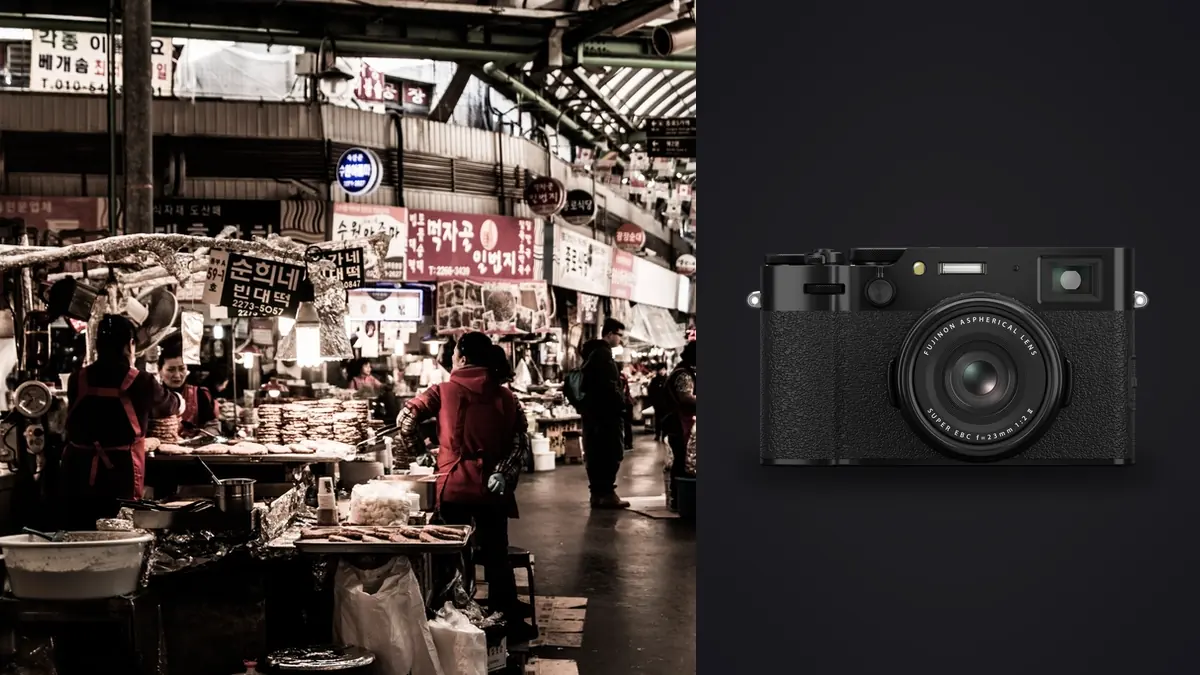
I sold my two-lens X-Pro3 kit about a month after picking up the X100VI, and I still second-guess that decision on the rare days I want a longer lens. Most days I don't, because most of what I shoot is close, fast, and over before a lens swap would ever finish. This is a camera built around a single 23mm f/2 lens (35mm full-frame equivalent), a leaf shutter, and a 40-megapixel APS-C sensor, and after using it through a winter of market days, a spring of protest coverage, and a run of café portraits for a local paper, I have a fairly clear picture of where it earns its reputation and where it makes you work for the shot.
This isn't a spec sheet rewritten in prose. It's what actually changes about how you shoot street and documentary work when the camera in your hands is this specific one, plus the parts of the RAW workflow that catch people off guard after the first big outing.
Why the Fixed 35mm Lens Changes How You Work
The 23mm f/2 (roughly 35mm equivalent) isn't a compromise you learn to tolerate, it's the reason the camera behaves the way it does on the street. At f/5.6 to f/8, hyperfocal distance sits close enough that you can pre-focus around 2 to 3 meters, tape your feet to that distance mentally, and just wait for something to walk into the frame. No autofocus hunting, no shutter lag between seeing the moment and capturing it. That's the entire zone-focusing method documentary shooters have used since rangefinders, and the X100VI's lens and control layout (a real aperture ring, a real shutter speed dial) make it faster to set up than menu-diving on most modern mirrorless bodies. The trade-off shows up the moment you need reach. There's no reaching for a second body or swapping glass mid-scene. You either move your feet, accept the 35mm framing, or crop later, and the 40MP sensor gives you enough resolution that a crop to roughly a 50mm field of view still holds up for web and moderate print use. I've done this on maybe one frame in twenty, never as a first choice, but it's a real safety net that a 24MP body wouldn't give you nearly as generously.
Handling It in Real Street Conditions
The hybrid viewfinder is the feature that actually matters day to day, more than the sensor bump gets credited for. Flip the lever on the front and you switch between an optical finder with a projected frame line (so you can see what's about to walk into your composition before it's in frame) and a full EVF with exposure preview. For documentary work in changing light, I default to the EVF because what-you-see-is-what-you-get matters more than the classic rangefinder look. For pure street candids in consistent daylight, the OVF lets you shoot with both eyes open, watching the whole scene rather than a small window of it.
The leaf shutter is genuinely quiet, quiet enough that in a library reading room or a quiet negotiation scene, nobody around you clocks the sound. Switch to the fully electronic shutter and it's silent, though you trade away flash sync and pick up a real risk of rolling shutter skew if your subject or your hand is moving fast. Burst shooting tops out at 11fps mechanical and up to 20fps electronic, and the buffer is deep enough for street work (short bursts of 5 to 10 frames chasing a gesture) but it will bog down if you try to spray-and-pray through a fast-moving scene the way you might with a dedicated sports body. In-body stabilization is new to this body versus the X100V, rated to 6 stops, and it's the difference between confidently handholding a market interior at 1/15s and needing to bump ISO to compensate. At 478 grams the camera disappears into a shoulder bag or a jacket pocket in a way a standard mirrorless-plus-lens combo never will, which matters more for documentary access than any spec on the page: subjects relax around a small camera that doesn't look like "press equipment."
RAW Files, Film Simulations, and the Culling Reality
The 40MP X-Trans 5 HR sensor produces compressed RAW files that land around 40 to 50MB each depending on scene detail. A three-hour walk that yields 300 to 500 frames, which is a normal take for a documentary day out, comes home as 15 to 25GB of RAW data. That's not a huge number by modern standards, but it adds up fast across a multi-day assignment, and it's the point where a lot of people either start shooting JPEG-only (losing highlight recovery latitude they'll want later) or start dreading the import.
The film simulations are genuinely good enough that I shoot RAW+JPEG and use the JPEG as a fast preview layer, particularly Classic Neg for street work and the newer Reala Ace when I want something closer to a clean, low-contrast documentary look without the heavy grain of Acros. But the JPEGs are previews, not final files. On a real edit pass I'm always back in the RAW, and that's where the file count problem actually lives. I run every session through imagic before I open a single frame in an editor. Its local sharpness and focus scoring flags the frames where a subject blinked or the leaf shutter caught motion blur at a marginal shutter speed, and the burst clustering groups the handful of near-identical frames from a fast sequence so I'm not scrubbing through eight versions of the same handshake or the same street crossing by eye. On a 400-frame day that's the difference between an hour of sorting and about fifteen minutes.
How It Stacks Up Against Other Street Cameras
None of these cameras are really interchangeable with each other, but they get cross-shopped constantly by people trying to decide what to carry for street and documentary work, so a direct comparison is more useful than another spec dump.
| Camera | Sensor / Resolution | Lens (35mm equiv.) | Viewfinder | Stabilization | Weight | Launch price |
|---|---|---|---|---|---|---|
| Fujifilm X100VI | 40MP APS-C X-Trans 5 HR | 23mm f/2 (fixed, 35mm) | Hybrid optical/electronic | In-body, up to 6 stops | 478g | $1,599 |
| Ricoh GR IIIx | 24MP APS-C | 26.1mm f/2.8 (fixed, 40mm) | None (rear LCD only) | Lens-shift, no IBIS | 262g | $1,049 |
| Fujifilm X-E4 + XF27mmF2.8 | 26MP APS-C X-Trans 4 | 27mm f/2.8 (interchangeable, 41mm) | Electronic only | None | ~445g combined | ~$1,150 combined (discontinued, used market) |
| Leica Q3 | 60MP full-frame | 28mm f/1.7 (fixed, 28mm) | Electronic | Optical, in-lens | 743g | $5,995 |
The GR IIIx wins on pure pocketability and is the better choice if you genuinely never want a viewfinder and shoot almost entirely at arm's length or from the hip. The X-E4 combo gets you interchangeable lenses for close to the same money but gives up the hybrid finder and IBIS, and it's no longer in production, so you're buying into a shrinking used market. The Leica Q3 outresolves everything here and has a faster lens, but it's nearly four times the price and 265 grams heavier, which matters after eight hours on your neck. The X100VI sits in the middle of that spread deliberately: closer to pocket-camera discretion than the Q3, but with a finder and stabilization the GR IIIx doesn't offer.
Building a Workflow Around One Camera
Shooting documentary work with a single fixed lens forces a different rhythm than a two-body, three-lens kit. You're not swapping glass to solve a framing problem, you're repositioning, waiting, or accepting the frame you've got. That means more frames per subject as you work an angle, which means more near-duplicates in the edit. A protest or a market scene shot over an afternoon regularly leaves me with clusters of 4 to 6 frames of the same gesture, taken half a second apart while I adjusted my footing. This is where I lean on imagic's duplicate and burst clustering rather than eyeballing thumbnails at 100% zoom. It groups those near-identical sequences automatically so I'm choosing between the two or three genuinely different frames in a cluster instead of scrolling past all of them individually, and because everything runs locally on the machine, none of it touches a cloud service, which matters when the subjects are people who didn't sign a release and the whole point of documentary work is discretion. I've also trained an apply_my_style preset in imagic on a batch of my own finished street edits, so a first pass across a day's RAW files already lands close to my usual contrast and color choices before I open anything in a dedicated editor, which cuts a meaningful chunk off the sit-down edit session. If you're new to this kind of pre-edit triage step, how AI photo culling works covers the mechanics in more depth than I can here, and these workflow tips are a decent companion for anyone still doing the whole pass by hand.
Weather Resistance, Battery, and Other Things Nobody Tells You Upfront
The X100VI is only weather-resistant with the optional adapter ring and a protective filter attached, which is an extra $70 to $100 purchase most people don't budget for at checkout. Shoot it bare in a drizzle and you're taking a real risk, not a marketed one. Battery life is rated by CIPA at around 310 shots through the EVF, closer to 450 if you shoot mostly through the optical finder, and in practice a full documentary day means carrying at least one spare NP-W126S battery, sometimes two if you're chimping the rear screen a lot or shooting a lot of video. The camera also doesn't have a traditional handgrip, and the body is slim enough that extended handheld shooting sessions benefit from a third-party thumb rest or half-case, which isn't a flaw so much as a fact of the design. And worth saying plainly since it shaped a lot of people's first year with this camera: supply was tight enough after the 2024 launch that used prices briefly ran above retail. That's mostly settled now, but it's part of the camera's story if you were shopping for one in its first year.
Frequently Asked Questions
Is the X100VI's fixed 35mm-equivalent lens too limiting for documentary work?
It's limiting in the sense that you can't zoom out of a bad position, but most documentary and street work happens in that 28mm to 40mm range anyway because it keeps you physically close to the story. The real adjustment is mental: you stop thinking about focal length choices and start thinking entirely about distance and timing. The 40MP sensor also gives you real cropping room for the occasional frame where you genuinely needed more reach.
How quiet is the leaf shutter compared to a standard mirrorless body?
Noticeably quieter in mechanical mode, and silent in electronic shutter mode. For indoor documentary situations (courtrooms, quiet ceremonies, small rooms) that's a real practical advantage over a focal-plane shutter body, though the electronic mode's rolling shutter can distort fast horizontal motion, so it's not the right choice for every scene.
Does the in-body stabilization actually matter with a wide, fast lens like this?
Yes, more than I expected going in. The 23mm focal length is already forgiving of camera shake, but the 6-stop IBIS is what lets you handhold interiors and dusk scenes at shutter speeds like 1/8s or 1/15s without pushing ISO into visibly noisy territory, which matters a lot for indoor documentary work where you can't always add light without changing the scene.
What's a realistic way to handle RAW files from a full day of shooting?
Budget for 15 to 25GB per multi-hour session and don't try to sort it by eye. Import everything, run it through a culling pass that flags focus and sharpness issues and groups burst duplicates (this is exactly what imagic is built for), pick your keepers from each cluster, and only then move into your main editor. Trying to review 400 full-resolution RAW files one by one after a long shooting day is where most people's backlog actually starts.
Is It Worth Building a Kit Around
Six months in, the X100VI hasn't replaced every camera I own, but it's replaced the one I reach for by default. The fixed lens stops being a limitation once you accept it as the whole premise of the camera, the hybrid finder earns its keep on nearly every outing, and the stabilization and file quality mean I'm not compromising on image quality to get that size and discretion. The part that surprised me most wasn't anything about the camera itself, it was how much the editing side of the workflow needed to change to keep up with 40-megapixel files arriving in batches of several hundred. If you're weighing this camera for street or documentary work, plan for that part of the process as seriously as you plan for the lens.