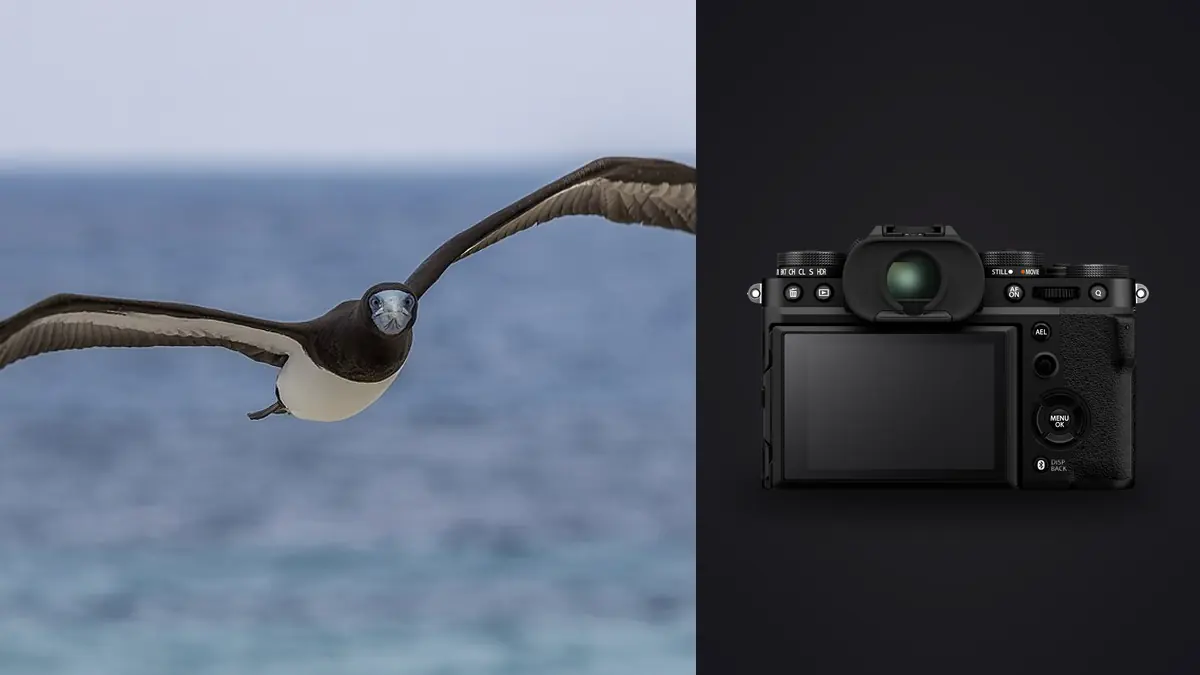
A lot of birders wrote off the Fujifilm X-T5 the day it landed, on the assumption that a 40-megapixel APS-C body wrapped in a retro, dial-covered shell was built for street shooters and landscape people, not someone lying in a ditch waiting on a kingfisher to dive. That assumption doesn't survive contact with the camera. I've had one in a blind more mornings than I'd like to admit this spring, mostly paired with the 100-400 and occasionally the 150-600, and the combination is genuinely competitive with larger, pricier systems for anything short of a peregrine stoop. It isn't perfect: the buffer empties faster than you'd like, the body feels oddly light hanging off a 1.6kg lens, and Fujifilm's autofocus menu takes real time to learn properly. But set up correctly, it holds focus on a bird against a shifting cloud background about as well as anything in this price bracket, and the files it produces have enough resolution to survive a hard crop.
The crop factor is doing you a favor here, not costing you one
Full-frame shooters like to remind APS-C owners that a smaller sensor means less light-gathering area and worse high-ISO performance, and in isolation that's true. But for birds in flight the conversation is really about reach, and the X-T5's 1.5x crop factor is the whole reason this body earns a place in a wildlife kit at all. Mount the XF150-600mm and you're framing at an effective 225-900mm without adding a gram of extra glass. A soaring buzzard that would be a speck on a full-frame 600mm becomes a usable subject at 900mm equivalent, and that difference is the gap between "identifiable species in the frame" and "actually fills a third of it."
The 40.2-megapixel sensor compounds the advantage. Birds rarely fill the frame edge to edge, even with the extra reach, so you're cropping in post almost every time regardless. Forty megapixels gives you room to cut a distant osprey down to a tighter composition and still print it, or push a mediocre-composition frame into something usable, without the file falling apart at the pixel level the way a 24-megapixel crop would. The tradeoff is noise at high ISO past about 6400, which matters if you're shooting a woodland understory at dawn, but for open-sky flight shots in daylight it rarely comes into play.
Getting the autofocus to actually hold a bird against open sky
Out of the box, the X-T5's AF is tuned for general use, and general use is not what you want for a swift cutting sideways across a gray sky. Two settings do most of the work. First, under the AF/MF menu, turn on Subject Detection and set it to Bird rather than leaving it on Auto or off. This isn't cosmetic: Fujifilm's bird-detection model looks for the head and eye shape specifically, and it will lock onto a perched bird's eye far more reliably than the general-purpose face/eye detection built for people. Second, don't leave the focus area on Wide/Tracking for anything other than a bird against a clean, uncluttered background. Wide/Tracking hunts across the whole frame and is prone to snapping onto a branch or a bright patch of sky the moment the bird's silhouette gets thin (a wing edge-on, for example). Zone AF, sized to a 3x5 or 5x5 cluster centered on where you expect the bird to travel, keeps the search area tight enough that it doesn't wander.
For the AF-C custom settings (the six presets Fujifilm buries in the AF menu), I start from Set 4 for most flight work and drop to Set 3 for anything genuinely erratic, like swallows working a pond surface. Pull Tracking Sensitivity down toward 1 or 2 so the AF doesn't jump to a closer object crossing behind the bird, and push Speed Tracking Sensitivity up if you're working raptors that accelerate hard out of a stoop. It's worth burning an afternoon on non-critical subjects, pigeons in a park are fine, just to feel the difference between these presets rather than guessing from the manual's descriptions, which are vague. One more setting worth flipping on for a serious session: Boost mode in the power management menu sharpens EVF refresh and AF response noticeably, at the cost of battery life that will have you swapping cells by early afternoon. Carry spares.
Mechanical, electronic, or pre-shot: matching the burst mode to the situation
The X-T5 gives you more than one way to shoot fast, and they aren't interchangeable. Electronic shutter buys you frame rate at the cost of a sensor crop and rolling shutter distortion on fast-moving wings, which shows up as a subtly warped or "melted" leading edge on quick wingbeats. Mechanical shutter avoids that but tops out lower and drains the buffer faster. Here's how I actually choose between them in the field:
| Shooting mode | Max frame rate | Sensor crop applied | Rolling shutter risk on wings | When I reach for it |
|---|---|---|---|---|
| Mechanical shutter | 15 fps | None (full 40.2MP) | Low | Perched-to-launch sequences, slower fliers like herons |
| Electronic shutter (cropped) | 20 fps | 1.29x (~26MP effective) | Moderate to high on fast wingbeats | Peak-action bursts where I've already got the wider shot covered |
| Pre-shot ES | Up to 20 fps | 1.29x | Moderate to high | Unpredictable takeoffs, a raptor that might bolt off a perch with no warning |
| Electronic shutter (uncropped) | 8 fps | None | Low to moderate | Slow, soaring subjects where I want the full 40MP file |
Pre-shot ES is the setting most people skip past and shouldn't. Half-press the shutter and the camera starts buffering frames continuously; a full press then saves a run of frames from just before you actually pressed, along with what comes after. For anything that launches off a perch with no warning tell (most small passerines), that half-second of pre-roll is the difference between missing the takeoff entirely and having it. The catch is that it eats buffer and battery fast, so I only enable it once I'm actually watching a bird that looks ready to move, not as a default.
Glass is the limiting factor, so choose deliberately
Fujifilm's X-mount doesn't have the third-party telephoto ecosystem that Sony E or Nikon Z enjoy. Sigma and Tamron haven't brought their long primes or 150-500-style zooms to X-mount, so for practical purposes you're choosing between two Fujifilm options: the XF100-400mm F4.5-5.6 R LM OIS WR (150-600mm equivalent) or the XF150-600mm F5.6-8 R LM OIS WR (225-900mm equivalent). The 100-400 is the more versatile pick if you also shoot other subjects, and it accepts Fujifilm's 1.4x and 2x teleconverters, stretching it to an effective 840mm or 1200mm equivalent at the long end (with real light loss and a noticeable autofocus speed penalty at 2x). The 150-600, notably, does not officially support those teleconverters, so what you buy is what you get: more built-in reach, but no way to stretch further on a day when the birds are staying distant.
Weight matters more than people expect going in. The X-T5 body is small and light for what it does, around 557 grams, and mounting a lens over a kilogram on it changes the balance more than a similarly light body on a full-frame mirrorless with a bigger grip. I add a hand strap rather than relying on the neck strap alone, and for anything longer than an hour of handheld work I'd rather have a monopod under the lens's own tripod foot than fight the imbalance all morning. The vertical battery grip helps the ergonomics slightly but, unlike on the X-T4, it doesn't unlock any extra frame rate on the X-T5, so buy it for comfort and battery life, not for speed.
Exposure for wings, not just eyes
Metering for a bird in flight is really metering for a moving subject against a background that's usually two or three stops brighter (open sky) or darker (a tree line) than the bird itself. Spot or small-zone metering locked to the subject beats matrix metering here, because matrix metering will happily average the sky and blow your bird into a silhouette. Shutter speed depends heavily on what you're chasing: a hovering kestrel or a small songbird beating its wings fast enough to freeze needs 1/2500 or faster to stop the wingtips crisply; a large soaring raptor barely moving its wings can look sharp down at 1/1600. If you want intentional wing blur for a sense of motion, which some editors actually prefer for smaller birds, dropping to 1/500 or 1/250 while panning smoothly can produce a sharp head against blurred wingtips, though it takes more misses to get one keeper.
The X-T5's in-body stabilization is rated to 7 stops, which is genuinely useful for handheld long lenses at rest, but for BIF work you'll typically be shooting fast enough that IBIS isn't doing much of the heavy lifting; it matters more for keeping your composition steady while you track and reframe between bursts than for freezing motion blur in a single frame.
The pile of RAWs waiting for you at home
A morning session at 15 or 20 fps adds up fast. Four or five real flight sequences, each running two to four seconds, and you've shot six hundred to a thousand frames before lunch, most of them near-duplicates of the same three or four seconds of wingbeat. Scrolling through that in a traditional catalog, clicking through nearly identical frames one at a time to find the one where the eye is sharp and the wings are in a good position, is the part of this hobby nobody enjoys.
This is where I lean on imagic before anything touches a permanent catalog. It runs entirely on the machine, nothing gets uploaded anywhere, which matters to me for privacy and for my own peace of mind, and it scores sharpness frame by frame so the one image in a twelve-frame burst where the eye is actually in focus rises to the top instead of getting buried between ten near-identical rejects. It also groups those bursts automatically, so a sequence of a heron taking off shows up as one cluster with its best frame flagged rather than fifteen separate thumbnails you have to compare by eye. If you want the mechanics of how that scoring and grouping actually works, our breakdown of how AI photo culling works covers it in more depth than makes sense to repeat here.
Once the keepers are picked, I run them through a saved apply_my_style preset, which imagic built from a folder of my own finished edits rather than a generic wildlife preset pack, so the color and contrast choices already lean the way I actually edit instead of something I have to fight frame by frame. It won't replace fine-tuning on a hero image you're printing large, but for getting sixty keepers from a morning shoot to a consistent, deliverable state, it saves real time. Our tips for a faster photo workflow has a few other habits worth pairing with this if the culling stage is where your evenings keep disappearing.
Weather sealing and the parts nobody photographs
Bird photography happens in weather that discourages most other genres: pre-dawn cold, drizzle, and the kind of humidity that fogs a lens the moment you step outside. The X-T5 carries Fujifilm's usual weather-resistant build with sealing at the body joints and dials, rated to work down to -10 degrees C, and paired with either weather-resistant zoom it holds up fine in a steady drizzle or a cold morning on a mudflat. What it doesn't fix is battery performance in the cold; the NP-W235 loses capacity fast below freezing, and I've had a fully charged battery read half-empty after ninety minutes standing in a February hide. Keep spares in an inside pocket, not in the bag, and swap before the meter hits red rather than after, because it tends to drop off a cliff rather than fade gradually.
Frequently Asked Questions
Is the X-T5's smaller sensor actually a disadvantage for birds in flight?
Not for reach. The 1.5x crop factor turns a 600mm lens into an effective 900mm, which matters more for distant birds than the modest high-ISO penalty a full-frame body would avoid. The tradeoff shows up mainly in low light, like a shaded woodland canopy at dawn, where a full-frame sensor pulls ahead noticeably above ISO 6400.
What AF-C custom setting should I start from for erratic fliers like swallows?
Set 3 or Set 4 from Fujifilm's six AF-C presets, with Tracking Sensitivity pulled down toward 1 or 2 so the camera doesn't jump focus to something crossing behind the bird. Push Speed Tracking Sensitivity higher only for subjects that accelerate hard, like a stooping raptor, since it makes the AF twitchier on subjects that just glide.
Can I use teleconverters with either wildlife zoom on this body?
The XF100-400mm accepts Fujifilm's 1.4x and 2x teleconverters, extending it to roughly 840mm or 1200mm equivalent with a real autofocus speed penalty at 2x. The XF150-600mm does not officially support either teleconverter, so its built-in 900mm equivalent reach is the ceiling.
How does imagic handle a folder of mixed bird bursts and static perched shots?
It processes the whole folder locally, scoring each frame for sharpness and grouping visually similar frames (like a burst of the same takeoff) into clusters with the sharpest one surfaced first, whether the shot is a fast flight sequence or a single still portrait of a perched bird. Nothing leaves your machine during that process, which matters if you're culling client or agency delivery work rather than personal shots.