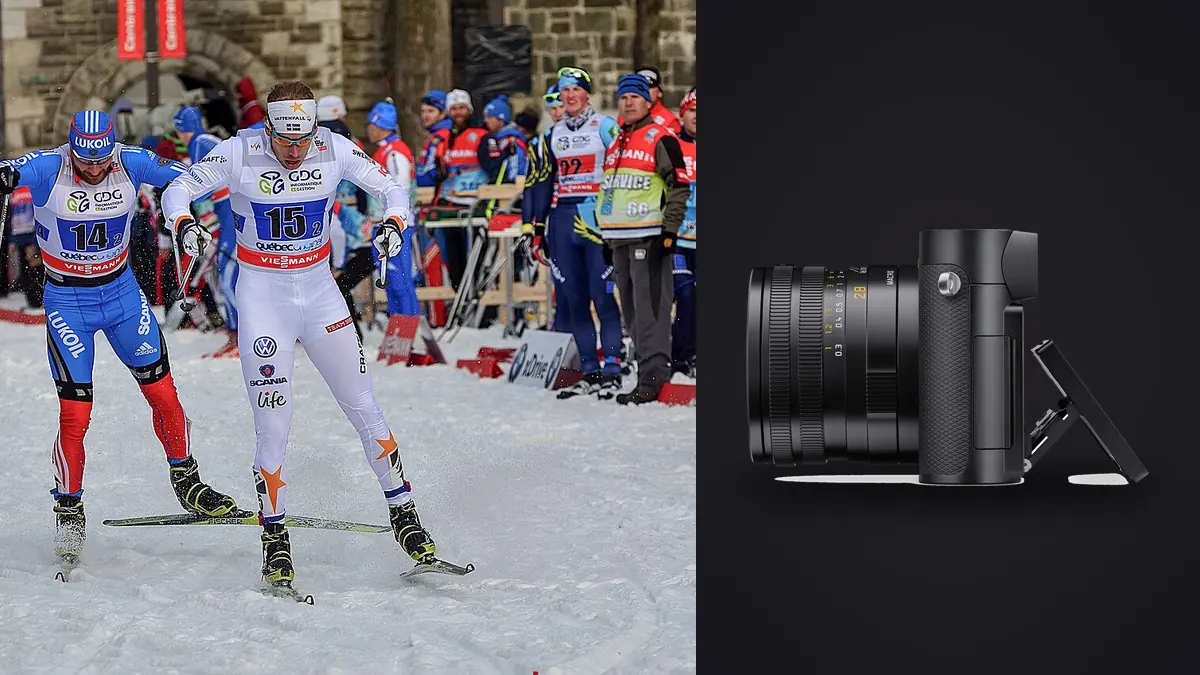
Bringing a Leica Q3 to a track meet gets you a look somewhere between amused and concerned from the parents lined up along the fence with their 600mm zooms. A fixed 28mm lens on a camera built for slow, deliberate street work is not what anyone expects to see pointed at a 4x100 relay. I brought mine to three meets this spring anyway, partly out of curiosity and partly because I was tired of hauling a second body just to catch the wide environmental shots between sprint events. What I found is that the Q3 is genuinely useful at a track meet, just not for the reasons most sports shooters assume, and not for every kind of shot you'd want to come home with.
This isn't a claim that the Q3 replaces a long lens on a dedicated sports body. It doesn't, and pretending otherwise would waste your time and mine. It's a breakdown of where the Q3's specific combination, a fast wide prime, a 60-megapixel sensor with digital crop modes, and a leaf shutter, actually earns a spot in your bag on race day, and where you should just leave it in the car.
Why a Fixed 28mm Lens Isn't as Crazy as It Sounds
Track and field gets photographed the same way at almost every level of meet, and it gets repetitive fast: a long-lens shot of a sprinter crossing the line, shallow depth of field, blurred crowd behind them. It's a good shot and worth having, but if that's the only shot you bring home, you've missed most of what actually happened. Baton handoffs happen at arm's length between two runners who are both moving. Coaches react from three feet away, out of breath themselves. A pole vaulter chalks their hands right next to the standards before a run-up. None of that needs 400mm. It needs you standing close, and the Q3's f/1.7 Summilux at 28mm is built for exactly that kind of proximity work. Some of my favorite frames from this season came from standing right at the exchange zone for the 4x400, close enough that the incoming runner's exhausted face fills a third of the frame while the outgoing runner is still a blur of motion beside them. A 70-200mm physically cannot make that photograph from that distance; you'd be cropping their face out of the frame entirely just to keep the shot centered. The Q3 puts you in positions a long-lens shooter would never bother taking, and track meets reward that kind of proximity more than people expect once they see the results.
Where the fixed lens actually hurts is anything happening more than roughly 15 meters away with no ability to reposition: mid-lane shots of a 100m field from the stands, distance events on the far side of an oval, field events cordoned off well behind a rope line. For those, no amount of digital cropping fully saves you, and it's worth understanding exactly why before you count on it.
What the Crop Modes Can and Can't Do for You
The Q3's 60-megapixel sensor is the reason the fixed lens is survivable at all. Leica built in digital crop modes, 35mm, 50mm, 75mm, and 90mm equivalent, that use the sensor's native resolution to simulate longer glass. Because the file starts at 60 megapixels, cropping to a 90mm field of view still leaves you with a usable image instead of a scrap of a few hundred thousand pixels.
The honest caveat: these are still digital crops, not optical zoom. You are throwing away resolution and, more importantly, you are not gaining any actual reach in terms of subject-to-background compression or light gathering. A runner at 75mm-crop distance still needs the same amount of available light as they would uncropped, because you haven't added glass, you've just kept fewer of the pixels you already captured. On a bright afternoon meet this is barely noticeable. Under the sodium-vapor lighting of an indoor February meet, the 90mm crop starts showing its seams the moment you push shadows in post.
In practice I treat the crop modes as a framing tool I decide on before I press the shutter, not a safety net I lean on afterward. Shooting native 60MP and cropping later in software gives you more flexibility, but the electronic viewfinder crop overlay at the moment of capture helps you actually compose tighter shots correctly instead of guessing where the frame edges will land.
Autofocus: Solid at Walking Pace, Honest About Its Limits at Sprint Speed
The Q3's autofocus is a hybrid system, phase detection combined with contrast and depth mapping, and it's a real step up from the contrast-only system in the original Q2. It locks confidently on a walking subject, on a javelin thrower mid-approach, on a long jumper standing at the board before their run. Where it gets honest with you is continuous autofocus during a fast burst: turn on continuous AF and the Q3's frame rate drops to around 4 frames per second, which is not fast by sports standards and leaves real gaps in a sprint sequence.
You can push the burst rate much higher, up toward 15 fps, but only by locking focus after the first frame rather than tracking continuously. That's a meaningful tradeoff to understand before race day rather than during it. For a 100m sprinter closing distance at roughly 10 meters per second, a locked-focus burst only stays sharp for as long as the runner stays inside your depth of field, which at f/1.7 wide open is thin enough that you'll lose the far end of the burst to soft focus.
My workaround: stop down. I rarely shoot track wider than f/4 with the Q3, both because it buys back depth of field to cover focus drift during a burst, and because at f/1.7 the corners get noticeably softer on a subject that isn't dead center in frame, which sprinters rarely are. For sprint starts specifically, I pre-focus on the blocks themselves before the gun goes off and use the high burst rate with locked focus, since the runners haven't moved far enough in the first half-second to fall out of your depth of field anyway. For distance events and field events where subjects move at a walking or standing pace, continuous AF at 4 fps is genuinely fine and I use it without thinking twice.
| Crop Mode | Effective Focal Length | Approx. File Size | Where It Earns Its Keep at a Meet | AF Confidence in Practice |
|---|---|---|---|---|
| Native (uncropped) | 28mm | ~60MP | Exchange zones, blocks, coach reactions, warm-up area | Strong, largest AF coverage area |
| 35mm crop | 35mm | ~39MP | Field events from the infield rail, mid-distance runner groups | Strong |
| 50mm crop | 50mm | ~19MP | Single athlete on the runway or in a lane, moderate distance | Moderate, more sensitive to subject drift |
| 75mm crop | 75mm | ~8MP | Tight portrait-style frames from the rail, occasional finish shots | Weaker, best with locked pre-focus |
| 90mm crop | 90mm | ~6MP | True reach shots, last resort when you can't move closer | Weakest, noticeable resolution and noise cost indoors |
The Leaf Shutter Is the Underrated Part of This Whole Setup
One spec that doesn't get talked about enough for this use case: the Q3 uses a leaf shutter built into the lens, not a focal-plane shutter. That means flash sync at any shutter speed the camera offers, up to 1/2000s, instead of being capped at the 1/200s or so you'd get on most interchangeable-lens bodies. For an indoor winter meet where the fluorescent or LED bank lighting is inconsistent across the track and a bit of fill flash would help freeze motion cleanly, that's a legitimate advantage most sports shooters bringing a DSLR or standard mirrorless body simply don't have. I don't use flash at every indoor meet, but on the ones where I do, the difference in freezing a mid-stride runner without shutter drag is obvious in the files.
The leaf shutter is also whisper-quiet compared to a mechanical shutter slapping away at 8 or 10 fps next to a starting official, which matters more than people expect at smaller meets where you're standing close enough to be part of the ambient noise around the blocks.
Getting Through the Take Without Losing an Evening to It
A meet with six or seven events you're actually trying to cover, shot in bursts because of how the AF and shutter tradeoffs work, adds up fast. Locked-focus bursts at 15 fps during a single relay leg alone can leave you with 40 or 50 near-identical frames where only two or three have the exchange in sharp focus and clean framing. Multiply that across a full afternoon of heats, and you're looking at a genuinely large take to sort through before you can send anything to a coach, a parent, or a client.
This is where I've started leaning on imagic to get through the files instead of clicking one by one at full size in a folder. It runs entirely on the laptop, no upload step, which matters at a lot of track facilities where the wifi is either nonexistent or locked down for meet officials only. It scores sharpness locally across a burst and groups near-duplicate frames from the same sequence together, so instead of scrolling through 50 versions of the same handoff I'm looking at maybe six real candidates with the sharpest one already flagged. For someone shooting a full day of events back to back, that alone probably saves an hour of desk time that used to happen after everyone else had gone home.
The other feature that's become part of my actual workflow is apply_my_style, which trains a preset off a batch of your own previously edited images rather than a generic filter. Track photos have a consistent look I want across a meet, warmer skin tones under stadium lights, contrast pulled back slightly on the shadow side of the track, and once that style is trained on a handful of frames I've already graded by hand, it applies consistently across the rest of the take instead of me re-adjusting sliders on every single image. If you haven't looked into how AI-assisted culling actually scores a burst under the hood, our piece on how AI photo culling works goes into more detail on the mechanics, and the broader workflow speed tips post covers more of what to change before you even get to sorting files.
Where to Stand When You Can't Reach for a Longer Lens
Positioning does more work than gear here. At the infield rail near the start blocks, 28mm covers the full width of a sprinter's stance from about four to six meters back, close enough to catch the tension in a runner's shoulders before the gun. At relay exchange zones, standing just past the takeover mark rather than at it gives you the incoming and outgoing runner in the same frame without either one being cut off by the edge of the lens's field of view. For field events, long jump and triple jump runways let you stand near the pit itself if officials allow it, close enough that the 35mm crop covers a full approach without needing the softer 75 or 90mm modes at all.
Distance events are the one category I've mostly given up trying to shoot well with the Q3. A runner on the far straight of a 400m oval is 60 to 80 meters away with no legal way to get closer during the race, and even the 90mm crop mode doesn't close that gap to anything resembling a usable frame. I bring a second, longer lens on a different body specifically for those events now rather than fighting the Q3 to do something it was never built to do.
Frequently Asked Questions
Is the Leica Q3 fast enough to freeze a 100m sprinter?
At a fast shutter speed, 1/2000s or quicker, yes, motion blur isn't the problem. The problem is continuous autofocus dropping burst speed to around 4 fps, so you get fewer attempts per second than a dedicated sports body would give you. Pre-focusing on a fixed point, like the blocks or a specific lane marker, and using the faster locked-focus burst mode gets around this for short, predictable moments like a start.
Should I shoot the crop modes live or shoot wide and crop later in editing?
If you know your composition ahead of time, like a fixed shot of the exchange zone, using the in-camera crop mode helps you frame correctly through the viewfinder rather than guessing. If you're unsure what you'll want afterward, shoot native 60MP and crop in post, since you keep more resolution to work with and can decide the framing once you've actually reviewed the sequence.
Does the leaf shutter actually matter for outdoor daytime meets?
Less than it does indoors. Outdoor daylight rarely needs fill flash for track action, so the high flash-sync speed goes mostly unused there. It becomes genuinely useful at indoor winter meets under mixed or dim lighting, where a touch of flash at a fast shutter speed keeps runners sharp without the shutter-drag look you'd get from a focal-plane shutter capped at a slower sync speed.
Is the Q3 worth carrying as a second body for track and field, or is it a novelty?
As a second body specifically for close, wide storytelling shots, exchanges, coach reactions, warm-up areas, start-block tension, it's genuinely useful and not just a novelty. As your only camera for a meet where you need reliable reach on distant lanes or far-side field events, it will frustrate you. The honest answer depends on whether you're trying to cover an entire meet with one camera or add a second perspective to a kit you already have.