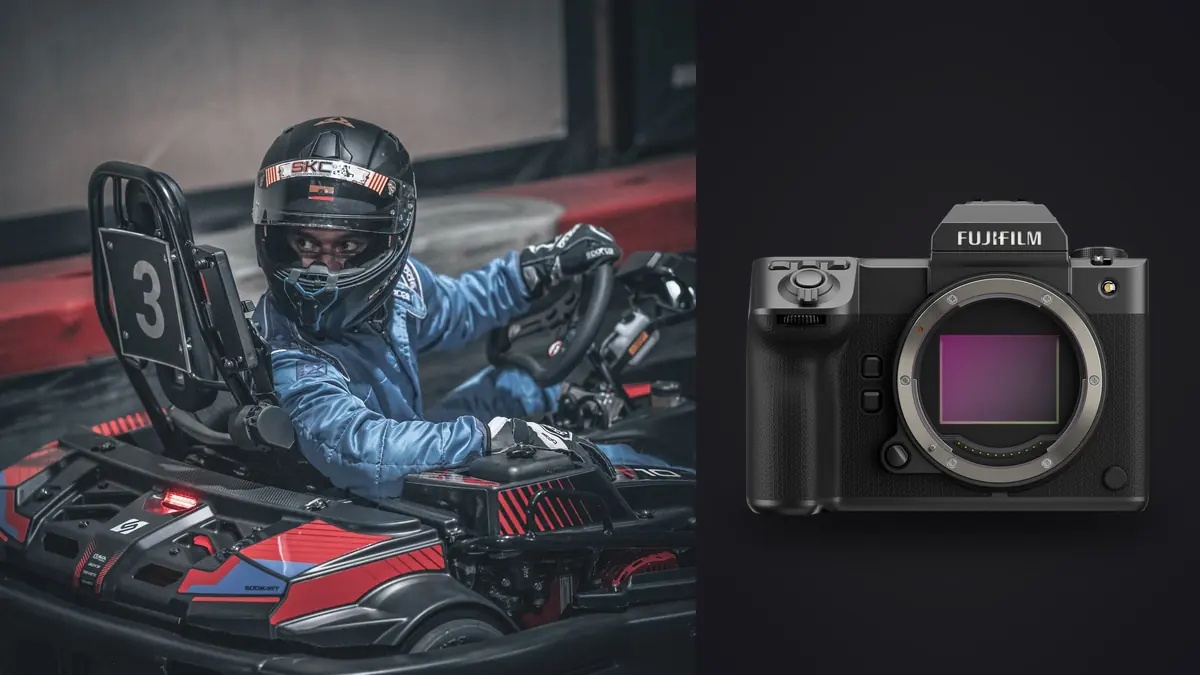
A 102-Megapixel Body Is Not the Obvious Choice for a Relay Final
Bring a Fujifilm GFX 100 II to a track meet and you will get questions. Most of them start with "why." Medium format cameras exist, in most people's minds, for tripod-bound landscape work and studio portraits where nothing moves faster than a softbox recycling. Track and field is the opposite of that: bodies crossing the frame at 10 meters per second, unpredictable lane changes at the handoff, a discus that leaves the hand at speeds no continuous AF system was originally designed to track. So why haul a 1,030-gram body with a 102-megapixel sensor into that environment instead of a dedicated sports camera with a stacked sensor and blackout-free EVF built for exactly this job?
The honest answer is resolution insurance. When a client wants a 40-inch print of a 400m hurdler clearing the last barrier, or a wire service wants the option to crop a wide shot down to a tight portrait after the fact, having 102 megapixels of real detail changes what's possible in post. I have shot three regional meets with the GFX 100 II now, alongside a second body running a conventional APS-C sports setup, and the two cameras solve different problems. This piece is about what actually happens when you point Fujifilm's flagship medium format camera at fast action, not the marketing version.
What the "II" Actually Changed for Action Work
The original GFX 100 topped out well short of what most photographers would call usable for sports. The GFX 100 II moved the needle in three specific ways that matter for track: an 8fps mechanical shutter (up from a much slower ceiling on the original), a subject-detection autofocus system borrowed and adapted from Fujifilm's X-series development, and a faster processor pushing through the huge 102MP files without the viewfinder lagging noticeably behind reality. None of that makes it a sports camera in the traditional sense. It makes it a medium format camera that no longer disqualifies itself outright.
Eight frames per second sounds slow next to a 30fps electronic shutter on a flagship mirrorless body, and it is. But for track specifically, 8fps is workable if you understand where the gaps in coverage will land. A sprinter's stride cycle at full speed repeats roughly every 0.3 to 0.35 seconds. At 8fps you're getting a frame every 0.125 seconds, which is enough to catch the extended stride, the crossover, and the drive phase across a burst, just not with the same density of options a 20fps body gives you for picking the exact peak of extension.
The Real Bottleneck Isn't the Sensor, It's the Buffer
Every GFX 100 II review focuses on dynamic range and color depth. Nobody warns you clearly enough about what happens forty frames into a continuous burst on the back straight. Medium format RAW files at 102 megapixels are enormous even compressed, and the buffer fills faster than you expect if you're used to a smaller-sensor body. Running a fast CFexpress Type B card, I get somewhere in the neighborhood of 40 to 55 uncompressed RAW frames before the camera visibly throttles and you start losing the effective frame rate while it clears. On a slower UHS-II SD card in the second slot as backup, that number drops hard, closer to 15 to 18 frames before things bog down.
What that means practically: you cannot spray-and-pray a full 100m final expecting the buffer to keep up the way it would on a camera built for exactly this. You have to time your bursts. I start the trigger a beat before the gun rather than holding it down from the blocks through the tape, because I know the buffer will choke somewhere around 5 to 6 seconds of sustained 8fps shooting, and the finish is the part I actually need clean.
Autofocus: Where It Holds Up and Where It Doesn't
Fujifilm's subject-detection AF on the GFX 100 II handles faces and eyes competently once a runner is inside roughly the middle third of the frame and moving in a relatively consistent lane. It's the edges of the frame and sudden direction changes where it shows its limits. Long jump and triple jump, where an athlete changes their body angle sharply on takeoff, exposed more missed frames than sprinting did in my testing. Relay handoffs were the toughest single event: two bodies converging, a baton crossing between them, and the AF system occasionally locked onto the trailing runner instead of the one receiving the stick.
Compare that to what I'd expect from a camera built specifically around eye-detection tracking for erratic subjects, and the GFX loses that comparison every time. But compare it to what medium format autofocus looked like even two generations ago, and it's a different category of usable. For field events with more predictable motion (shot put, discus release, high jump approach), the hit rate climbed noticeably because the subject's path is more linear and repeatable than a sprint pack.
Lens Reach for a Track Environment
Track photography from a fixed shooting position (infield rail, finish line photo box) demands real reach, and this is where the GF lens lineup either helps or hurts you depending on what's in your bag. Fujifilm's GF 500mm f/5.6 R LM OIS WR was clearly built with exactly this kind of use in mind, and paired with the GFX 100 II's 1.53x crop mode it gets you into genuinely long territory without needing a teleconverter for most track events. The GF 100-200mm f/5.6 is the more practical all-day lens if you're covering both track and field events and need to reposition often, since the 500mm is heavy enough that a full meet on foot with it becomes a shoulder workout.
| Setup | Approx. 35mm-Equivalent Reach | Resolution Output | Buffer Depth (field-tested, CFexpress) | Best For |
|---|---|---|---|---|
| GF 500mm f/5.6, full sensor, mechanical shutter | ~395mm | 102MP | ~40-45 frames before slowdown | Finish line, maximum detail for print crops |
| GF 500mm f/5.6 + 1.4x teleconverter | ~553mm | 102MP | ~35-40 frames, AF hunts more in low light | Far lane coverage, distant field events |
| GF 500mm f/5.6, 1.53x crop mode | ~604mm | ~44MP | ~90-100 frames, noticeably deeper | Sustained bursts, lower rolling shutter risk |
| GF 100-200mm f/5.6, full sensor | ~158-237mm (zoomed) | 102MP | ~40-45 frames | Infield events, mobile coverage of throws and jumps |
The crop mode row is the one most GFX owners never touch, and it's the one that actually matters most for burst-heavy track work. Dropping to the 1.53x crop cuts the file size enough that the buffer clears meaningfully faster, and because the sensor is reading out fewer lines per frame, the electronic shutter's rolling shutter distortion also improves, which matters more than people expect once you're shooting anything moving laterally across the frame at speed.
Rolling Shutter Is the Trap Nobody Warns You About
Medium format sensors are physically large, and reading a full 102-megapixel frame off that sensor electronically takes real time, measured in tens of milliseconds rather than the near-instant readout you get on smaller stacked sensors built for exactly this purpose. Practically, that means the electronic shutter on the GFX 100 II will skew fast lateral motion (a sprinter crossing the frame close to the lens, a relay baton in mid-pass) into a slight lean or warp if you're not careful. I default to the mechanical shutter for anything within about 15 meters of the lens on the straightaway, and only lean on the electronic shutter for silent operation at a distance, field events, or when I've dropped into crop mode specifically to reduce the readout time.
This is one of those things that doesn't show up on a spec sheet comparison and only becomes obvious once you've pulled up a frame at 100% and noticed a runner's leading leg looks subtly bent in a direction their actual stride never went.
What Happens After the Meet: The File Size Reality
A four-hour meet with the GFX 100 II easily produces 40 to 60GB of RAW files once you add up warm-up shots, heats, finals, and field events across an afternoon. At 102 megapixels per frame, scrolling through a card of several hundred images in a standard RAW converter is slow enough to be genuinely annoying, and picking the sharpest frame out of a burst by eye, at that resolution, on a laptop screen, is where most of the wasted time in this workflow actually lives.
This is the part of the process where I lean on imagic instead of doing it manually. It reads local sharpness and focus data across a burst and ranks frames instead of me squinting at eight nearly identical 102MP files trying to guess which one has the cleanest eye focus, and because it runs entirely on the machine rather than uploading anything, a 50GB card from a meet doesn't turn into an overnight cloud sync before I can even start sorting. The duplicate and burst clustering also earns its keep specifically on a body like this: an 8fps burst of a hurdle clearance generates a stack of frames that are visually near-identical at a glance but wildly different in actual sharpness once you're at full resolution, and having those grouped automatically instead of scrolled through one by one saves real time on a shoot day this data-heavy. If you're new to how that kind of automated ranking actually works under the hood, the breakdown in how AI photo culling works covers the mechanics in more depth than I will here.
Once the culling pass narrows a few hundred frames down to the handful worth editing, I run the survivors through a saved apply_my_style preset built from my own past sports edits rather than starting color and contrast from a flat baseline every time, which matters more than it sounds like when you're trying to keep 40 images from one meet looking consistent for a team gallery delivery. For anyone shooting high-volume events regularly and still hand-culling everything, the workflow changes covered in 10 tips for a faster photo workflow are worth a look before your next meet, not just for medium format shooters.
Where I'd Steer Someone Away From This Combination
If you're shooting a meet solo and need to deliver same-day web galleries, I would not recommend the GFX 100 II as your only body. The buffer discipline it demands, combined with file sizes that slow down even a fast import and cull pass, makes it a poor fit for anyone who needs speed over ultimate resolution. It's also not the right tool if you're chasing the tightest possible autofocus tracking through a crowded, chaotic scene like a cross country pack at the start gun, where a dedicated sports body with faster, more aggressive subject tracking will simply put more usable frames in front of you.
Where it earns its place is as a second body for the events and moments where resolution genuinely pays off later: a portrait-style crop of the state champion at the tape, a large-format print order from a parent, or field events where the motion is slower and more linear and the AF system isn't being asked to do anything heroic. Used that way, alongside a conventional sports setup rather than instead of one, it's a legitimately useful tool. Used as your only camera for a fast, chaotic meet, it will frustrate you.
Frequently Asked Questions
Can the GFX 100 II actually keep pace with 100m sprinters?
It can produce usable, in-focus frames of sprinters, but at 8fps you get meaningfully fewer options per stride cycle than a camera shooting 20-30fps. Expect solid coverage of the drive phase and finish, not a dense sequence to pick the single best moment from.
Is 102 megapixels overkill for track and field photography?
For web galleries and standard prints, yes, it's more resolution than most deliverables need. It pays off specifically when someone wants large prints or heavy crops after the fact, which happens often enough at the meets I shoot for myself that I still bring it.
What card setup avoids buffer lockups mid-race?
A fast CFexpress Type B card in the primary slot is close to mandatory. A UHS-II SD card as backup will slow you down noticeably if you're relying on it for the burst itself rather than just as a safety copy.
Does culling software actually help with files this large?
It changes the math on shoot days that produce 40-60GB of RAW files. Manually reviewing several hundred 102MP frames at full resolution to find sharp eyes in a burst is slow enough that automated sharpness ranking and burst clustering, done locally without uploading the card anywhere, turns a multi-hour sort into something you can finish before you've even left the venue.