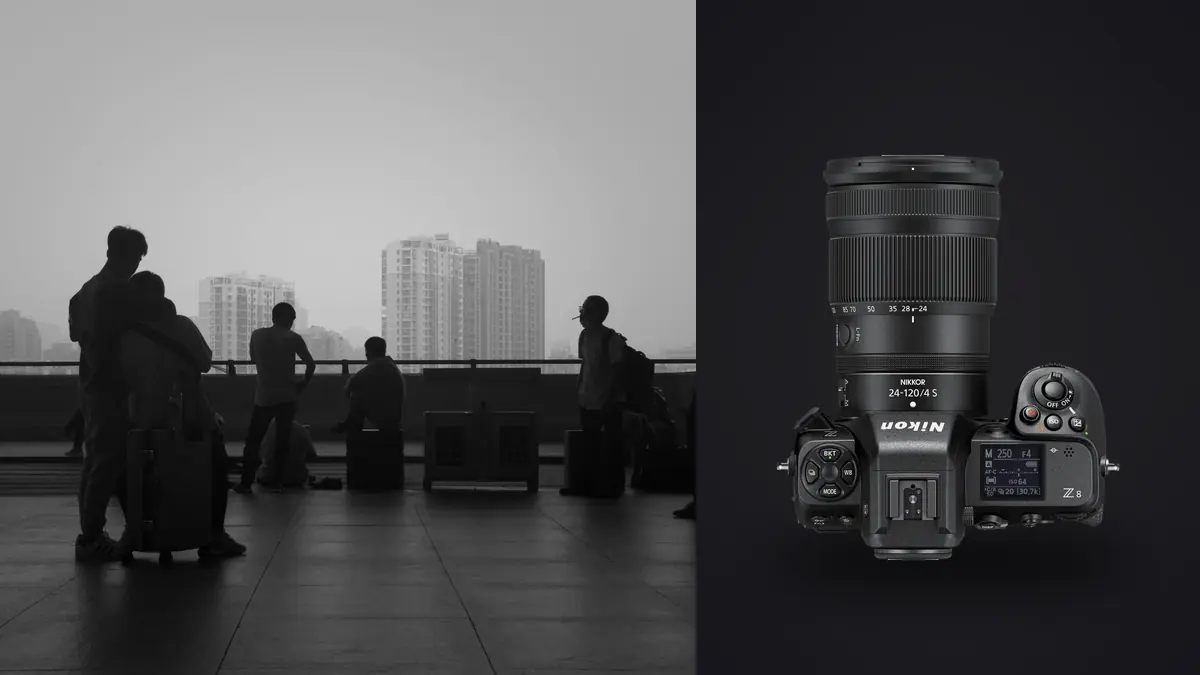
I picked up the Z8 about eight months after it launched, mostly because I was tired of carrying a Z9 around a city all day. The Z9 is a phenomenal camera for a lot of work, but on foot, for ten or twelve hours, its size stops being a strength and starts being a tax on your shoulder. The Z8 promised the same sensor and most of the same brain in a body that actually fits in a smaller bag. That's the whole pitch, and for street and documentary work specifically, it mostly delivers, with a few caveats nobody puts in the marketing copy.
Why the Z8 fits documentary work in the first place
Street and documentary shooting has a specific set of demands that don't line up neatly with "best camera" lists built around studio work or wildlife. You need a body that's quiet, fast to react with, forgiving in mixed light, and light enough that you'll actually carry it on the days nothing happens (which is most days, until it isn't). The Z8 checks those boxes better than almost anything else in Nikon's current lineup, and honestly better than most of the competition too.
The 45.7-megapixel stacked sensor is the same one in the Z9, which means no mechanical shutter is even necessary for most situations. Electronic shutter with essentially no rolling shutter distortion at normal shutter speeds means you can shoot a subject walking briskly past a vertical lamppost or a bus shelter frame without it turning into a slanted mess. I've tested this specifically by panning on cyclists in Lisbon's Alfama district, where the light is patchy and people move fast downhill, and the rolling shutter artifacts that used to plague electronic-first mirrorless bodies just aren't there in any way that matters for editorial or personal work.
Silence matters more on the street than almost any spec sheet number. A DSLR mirror slap, or even an older mirrorless mechanical shutter, changes how a scene reacts to you. People notice the sound before they notice the camera. With the Z8 in fully electronic mode I've shot inside small shops, in quiet waiting rooms, and a few feet from someone praying in a church nave, without a single head turning toward me. That's not a small thing if your work depends on unposed moments.
Autofocus in real street conditions
Nikon's subject-detection autofocus gets talked about mostly in the context of sports and wildlife, birds in flight and all that, but it's arguably more useful for documentary work because the situations are messier. A kid running between two adults, a hand reaching into frame, someone half-turned away with their face at a weird angle. The Z8's people-detection tracks eyes and faces through partial occlusion better than any Nikon body I've used before it, including through chain-link fences, market stall awnings, and the kind of crowd density you get at a protest or a festival.
Where it struggles a little: fast, chaotic scenes with multiple faces of similar size and distance, like a group of people crossing an intersection toward you. The camera sometimes hunts between subjects for a beat before committing, and if you're using a single AF-C burst with 3D tracking rather than manually placing your focus point, you can end up with a sharp shoulder and a soft face on the frame you actually wanted. My workaround has been to use a smaller, semi-fixed AF area (Nikon calls it Wide-Area AF S/M with subject detection on) rather than the widest auto-area mode, so I retain some control over which person in a cluster the camera locks onto.
Low light is where the Z8 genuinely surprised me. Shooting handheld at ISO 6400 to 12800 under sodium streetlights, autofocus still locks reliably down to roughly -7 EV with an f/1.8 lens attached, according to Nikon's own spec, and in practice I've found that number believable rather than inflated. It hunts occasionally under flickering neon signage specifically, where the light itself is pulsing at a frequency the sensor picks up, but that's a light-source problem more than a camera problem.
Buffer, cards, and the part nobody enjoys talking about
The Z8 takes one CFexpress Type B slot and one SD UHS-II slot, and for documentary shooting where you're firing bursts to catch a decisive moment, that pairing matters more than people expect going in. Shooting 20fps electronic (blackout-free, which is genuinely useful for tracking a subject through a gesture) fills the buffer fast if your SD card is the bottleneck. I run CFexpress in slot one for active shooting and SD as backup, and I've learned to just accept that if I'm shooting a fast-moving scene, I'm shooting to the CFexpress card alone, backup be damned, because dual-slot RAW writes at 20fps on a UHS-II card will stall the buffer within a couple of seconds.
Realistically, for street work you don't need 20fps very often. Most of what I shoot is single frames or short two-to-four-frame bursts around a gesture, a look, someone stepping off a curb. Where the high frame rate earns its keep is genuinely unpredictable stuff, kids playing, dogs, a street performer mid-spin, where you don't know which fraction of a second is the one.
The tradeoff of high burst rates plus 45.7-megapixel RAW files is obvious once you get home: card dumps that used to take ten minutes now take forty, and folders that used to hold a day's shooting comfortably now choke a laptop's Finder or Explorer window scrolling through thumbnails. This is the actual bottleneck of shooting a high-resolution stacked sensor camera for documentary work, not the camera itself but what happens after you turn it off. I've settled into running a first pass through imagic before I open anything in Lightroom, since it scores sharpness and groups near-duplicate burst frames locally on the machine, no upload, which matters when you're working through a day that might include people's faces you don't necessarily want sitting on someone else's server. It doesn't replace judgment on which frame has the better expression, but it cuts an 1,800-frame day down to something you can actually look at without losing the afternoon.
Lens pairings that actually make sense for this kind of work
The Z8 body is compact for what it does, but Nikon's Z-mount lens lineup skews toward big, heavy glass built for studio and sports shooters, and pairing the body with the wrong lens defeats the purpose of choosing it in the first place. A few pairings I've used enough to have opinions on:
- Nikkor Z 40mm f/2: cheap, small, plastic-feeling but optically fine. This is the lens I reach for when I want to disappear into a crowd. Not fast enough for genuinely dark interiors but perfectly adequate for daytime and dusk street work.
- Nikkor Z 28mm f/2.8: my actual daily lens for documentary assignments. Wide enough to include context and environment, not so wide that it distorts faces if you get close, which you will need to.
- Nikkor Z 35mm f/1.8 S: heavier and pricier, but the f/1.8 aperture and faster, more confident autofocus motor make it the better choice once light drops. Worth the extra weight for evening work.
- Nikkor Z 50mm f/1.2 S: gorgeous glass, genuinely one of the best 50mm lenses Nikon has ever made, but it's heavy enough that after four hours of carrying it around your neck you'll question your choices. I use it for planned documentary sessions, not spontaneous street wandering.
If I had to keep exactly one combination for a week of street shooting in an unfamiliar city, it'd be the Z8 with the 28mm f/2.8. It's the pairing where you stop thinking about the gear entirely, which is really the whole point of choosing a smaller body in the first place.
Comparing burst-heavy Nikon bodies for this kind of work
People considering the Z8 for street or documentary shooting are usually comparing it against one of two other Nikon bodies: the flagship Z9, or the older, cheaper Z6 III. Here's how they actually compare on the things that matter for this specific use, not the general spec sheet.
| Factor | Nikon Z8 | Nikon Z9 | Nikon Z6 III |
|---|---|---|---|
| Body weight (body only) | 910g | 1,340g | 760g |
| Sensor resolution | 45.7MP stacked | 45.7MP stacked | 24.5MP partially-stacked |
| Max blackout-free burst | 20fps RAW | 20fps RAW | 14fps RAW (mechanical-equivalent) |
| Card slots | 1x CFexpress B + 1x SD UHS-II | 2x CFexpress B | 1x CFexpress B + 1x SD UHS-II |
| Low-light AF rating | -7 EV | -7 EV | -8 EV |
| Discretion on the street | Good, no built-in grip bulk | Poor, very visible/large | Very good, smallest body |
| Typical street kit weight (body + 28mm f/2.8) | ~1,180g | ~1,610g | ~1,030g |
The Z6 III is lighter and arguably more discreet, and its lower resolution means smaller files that are easier to cull and store, which matters if you're shooting daily and your storage budget isn't infinite. But it gives up dynamic range headroom in shadow recovery, which matters a lot in high-contrast street lighting, doorways, underpasses, that kind of thing. The Z8 sits in the sensible middle: nearly Z9-level image quality and autofocus performance without Z9-level bulk or price. Unless you specifically need the Z9's integrated grip for vertical shooting comfort or its dual CFexpress slots for redundancy on paid assignments, the Z8 is the better documentary tool of the three. For full specs, see the Nikon Z8 camera page, and for more on shooting this genre, see imagic's street photography guide.
Settings I actually use, not the default menu
A few specific configuration choices that made a real difference once I stopped using the out-of-box defaults:
Silent mode locked to electronic shutter, always on for street work. There's genuinely no reason to use the mechanical shutter unless you're photographing something with extreme motion under artificial light where banding could be an issue (some LED signage flickers at frequencies the electronic shutter's readout can catch as banding). For 95 percent of daylight and streetlight shooting, electronic is silent and clean.
Auto ISO with a minimum shutter speed tied to focal length, capped at ISO 12800. The Z8's high-ISO files hold together remarkably well through about ISO 6400, get noticeably noisier by 12800, and I'd rather have a slightly noisy but sharp frame than a clean but motion-blurred one. Noise reduction in post handles the rest.
Back-button AF-on separated from the shutter release. This isn't Z8-specific advice, I'd say it for any camera, but it matters more here because of how good the subject tracking is. Letting the shutter button also trigger focus means you sometimes re-trigger tracking on the wrong subject mid-burst. Separating them gives you a moment of deliberate control over what the camera locks onto before you fire.
Custom function button mapped to AF-area mode toggle. Being able to flip between wide-area subject tracking and a small single-point focus area with one press, without going into a menu, saves real moments. I use wide tracking for open scenes and snap to single-point the instant I'm working a cluttered frame with multiple people.
What the files look like once you're home
This is the part that camera reviews tend to skip, but it's genuinely where a lot of documentary photographers lose time. A single day wandering a market or covering an event on the Z8 easily produces 1,500 to 2,500 RAW frames once you count near-duplicate bursts around fleeting expressions. Multiply that across a multi-day assignment and you're looking at a genuinely unmanageable pile of 14-bit RAW files, each one 55 to 65MB, sitting in a folder that Lightroom's grid view chokes on rendering previews for.
The way I've settled on handling it: dump the cards, run the folder through imagic first for a rough pass, its local sharpness scoring flags the technically soft frames (motion blur, missed focus) and its burst/duplicate clustering groups the four or five near-identical frames from a single gesture into one stack so I'm not manually comparing them one by one. From there I do a second manual pass on the survivors, because no automated tool understands which half-closed eye is a natural blink and which is genuinely the worse frame, that's a judgment call software shouldn't be making alone. Where it's actually saved me real time is the "apply_my_style" preset, which trained on a batch of my own finished street edits rather than a generic film-emulation preset, so the starting point for a new folder already looks close to how I'd grade it rather than a flat, neutral RAW conversion I have to build up from scratch. It's a starting point, not a finish line, but it's a much better starting point than "none" was.
If you're coming from a lower-resolution body and haven't dealt with 45-megapixel file volume before, it's worth reading up on how automated culling actually scores sharpness versus how a human eye does, because they don't always agree, and knowing where the disagreement tends to happen (mostly around intentional motion blur and shallow depth-of-field portraits) saves you from either trusting the software blindly or ignoring it entirely.
Frequently Asked Questions
Is the Nikon Z8 too heavy to carry all day for street photography?
At 910g body-only it's noticeably lighter than the Z9 (1,340g) but heavier than something like a Fujifilm X100VI or a Z6 III. Paired with a compact prime like the 40mm f/2 or 28mm f/2.8, the total kit sits around 1.1 to 1.2kg, which is manageable for a full day if you're using a proper strap rather than the stock one. It's not a pocket camera, but it's not a burden either.
Does the electronic shutter cause visible distortion on moving subjects?
Not in any way that's noticeable for typical street subjects, people walking, cyclists at normal speeds, cars in city traffic. The stacked sensor's fast readout keeps rolling shutter artifacts to a level you'd only catch pixel-peeping on something moving genuinely fast across the frame, like a car at speed close to the lens. For everyday documentary pacing, you won't see it.
What's the realistic battery life for a full day of street shooting?
Nikon rates the EN-EL15c around 340 shots on the standard CIPA test, but that number badly undersells real-world use since it assumes heavy chimping between every shot. In practice, shooting mostly through the viewfinder with the screen off between frames, I've gotten 900 to 1,200 frames from a single charge on a mixed day. Carry a spare if you're doing a multi-day trip without reliable charging access, but a single battery covers a normal working day.
Should I shoot RAW or JPEG for fast-paced documentary work?
RAW, without much hesitation, given how often street and documentary shooting involves recovering shadow detail or correcting exposure after the fact when you didn't have time to dial in settings perfectly before a moment passed. The file size and storage cost is real, but the Z8's dynamic range gives you genuine recovery latitude that a compressed JPEG simply doesn't preserve. If storage or culling time is the concern, that's a workflow problem to solve with better software and organization, not a reason to shoot a lossier format.