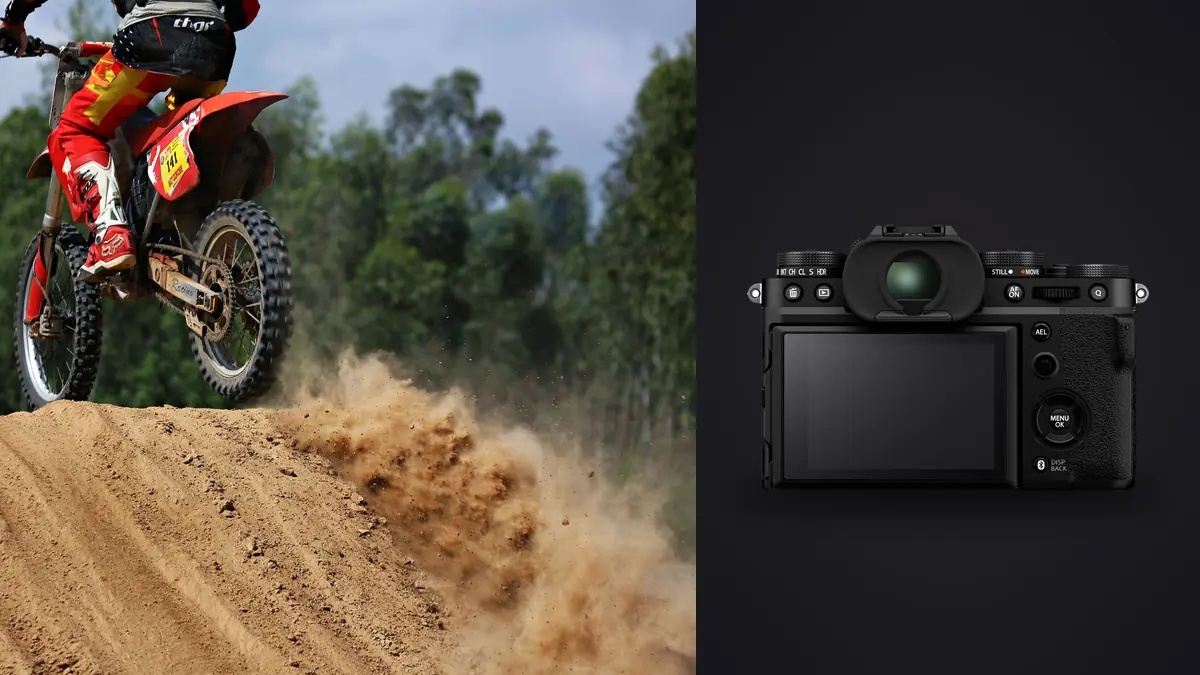
The Fujifilm X-T5 combines a 40.2-megapixel APS-C sensor with subject-detection autofocus, in-body stabilization, fast drive modes, and two UHS-II-compatible SD card slots. A track meet can turn those capabilities into thousands of RAF files across heats, lanes, jumps, throws, relays, portraits, and ceremonies. The post-event problem is not simply finding the sharpest runner. It is preserving card safety, identifying the correct athlete and event, choosing the peak action, and delivering a varied, accurate set.
This workflow begins at capture because camera time, slot behavior, file format, and short-burst discipline determine how easy the ingest will be. It then separates technical screening from sports judgment and ends with exports checked for identity, crop, and color.
Troubleshoot an event folder without losing context
Troubleshooting an X-T5 track workflow starts by tracing the visible delivery error to its earliest stage. A missing athlete may be filed under the wrong heat, hidden by a rating filter, or absent because one card folder was not copied. Duplicate selections usually mean bursts were compared in separate views. Unexpected crops can come from inconsistent aspect handling, and color shifts can follow edits copied across sun and shade. Confirm both card manifests, return filters to an all-files view, and inspect neighboring frames before changing ratings. Keep event, athlete, and sequence context attached while resolving the problem so technical cleanup does not remove the strongest sporting moment.
Set up card recording for an event that cannot be repeated
Choose whether both slots record the same RAF files, one receives JPEG, or the second provides overflow. Simultaneous RAW recording gives immediate media redundancy, but the slower card can affect sustained sequences. Use tested, compatible cards with matching performance when backup matters.
Format approved cards in the camera after previous work has been verified elsewhere. Label card pairs and note which camera uses them. Synchronize time across bodies and confirm the date before the first event. A few minutes of clock drift can scramble two angles of the same finish.
Use short bursts around predictable action. The X-T5's high-resolution files make indiscriminate continuous capture expensive in both storage and review. Begin before the peak, cover it, and release. The finish lean, hurdle clearance, baton handoff, jump takeoff, and throw release each have a narrow action window.
Create an ingest structure that matches the schedule
Before inserting a card, create a job folder with subfolders for originals, selection data, edits, and exports. Within originals, retain card identity. A practical structure is date_meet/camera/card. Event labels can be added after ingest using the schedule and timestamps.
Copy each card in full, verify file count and representative RAF files, and make a second copy on a separate physical device. Do not format either card merely because thumbnails appeared. If both slots contain duplicates, ingest one as the primary source and keep the second card intact temporarily rather than importing two identical sets into one folder.
Record any clock error, card swap, or camera reset in a text note outside the photo metadata. That note can explain an apparent break in sequence later. Keep start lists and event schedules with the job so bib identification does not depend on memory.
Divide the take before assigning ratings
Separate warm-ups, track races, field events, reactions, and ceremonies. Then divide races by event and round. This stops a visually dramatic sprint from dominating a delivery that also requires field-event and team coverage.
Within each event, group captures by action sequence. A finish-line burst is one decision unit. A high-jump attempt is another. Compare frames within that unit for focus, body geometry, obstruction, expression, and peak. Do not compare a clean portrait directly with a chaotic relay exchange; they serve different roles.
Use a coverage checklist before rejecting alternates. Confirm required teams, named athletes, events, sponsor marks, horizontal and vertical frames, and any publication-specific need. A slightly less dramatic frame of a missing athlete can be more important than another exceptional picture of the winner.
Run a technical first pass
The first pass removes files that clearly cannot serve: accidental ground frames, severe focus misses, blocked faces, empty sequences, and unusable exposure. Keep intentional pans and experimental motion in a separate group so ordinary sharpness criteria do not erase them.
imagic can scan RAF folders locally, score sharpness, exposure, closed eyes, and composition, and group near-duplicate or burst frames. Its culling changes status rather than deleting originals. That makes it practical to review rejects when an event appears underrepresented.
Automated analysis should not choose the sports moment. A technically sharp hurdle frame may show an awkward blocked face, while the adjacent image has cleaner form. Eye state during exertion is not the same as a portrait blink. Use scores to prioritize review, then make the event decision manually.
Compare burst frames efficiently
First view the whole sequence quickly and identify the action peak. Then inspect only a small neighborhood around it at magnification. Check face or bib focus, hand and foot position, equipment shape, and background overlap. Eliminate frames where another athlete or official cuts through the main subject.
For finish lines, include the immediate reaction when it adds narrative. For hurdles, compare both facial visibility and lead-leg form. For jumps, leave enough space around the bar and landing direction. For throws, verify that the implement is visible when safe and compositionally relevant.
Keep no more near-duplicates than the delivery justifies. Editorial clients may need a small choice around a decisive moment; a public gallery may benefit from one clear frame. Preserve alternates in the archive even when only one enters the export set.
Handle X-T5 resolution and crop consistently
Forty-megapixel RAF files provide useful crop latitude, especially when safety barriers prevent ideal distance. Cropping does not change perspective or replace a longer lens, and a severe crop exposes noise and focus error. Set a minimum output dimension and reject crops that fall below it.
The APS-C frame already narrows the angle of view compared with full frame for the same focal length. Avoid double-counting that as added optical reach. Judge the actual subject pixels and lens detail. When an athlete is small in the frame, an environmental composition may be stronger than forcing a tight portrait.
Apply one crop language within an event: consistent headroom, direction space, and horizon. Track markings can reveal a one-degree tilt immediately. Correct horizons before making multiple output ratios so each derivative shares the same visual baseline.
Establish color from RAW, not a changing preview
Fujifilm film simulations can provide useful camera previews and JPEGs, but the RAF remains the flexible source for a mixed-light event. Choose a stable starting profile and white balance, then correct groups made under the same light together. Do not let one shaded heat drift cooler than the next without reason.
Protect bright uniforms, lane markings, and reflective bibs while retaining faces. Raise shadows selectively rather than flattening the entire scene. Excessive clarity can make track texture and distant spectators compete with the athlete. Keep local contrast focused on the subject.
A personal learned style in imagic can be applied to selected files as a starting point. Because the profile comes from the photographer's own edits, it can support consistency, but sun, shade, stadium LEDs, and team colors still need manual review. Edits remain non-destructive until JPEG or TIFF export.
Add identity and event metadata before filenames lose context
Use the official start list to identify athletes, teams, event, round, and result where required. Do not infer identity solely from lane if substitutions or schedule changes are possible. Keep sensitive information and minors' details within the event's publication policy.
Rename approved exports with a unique job code and sequence number. Preserve original filename in metadata or records so the delivered image can be traced back. Captions should distinguish heats from finals and avoid claiming a record or result without an official source.
For team galleries, organize by event or athlete according to the recipient's needs. A filename structure helpful to an editor may differ from one helpful to parents or organizers. Agree before export rather than creating several conflicting schemes.
Export and inspect the actual deliverables
Create separate presets for editorial full-size JPEG, web gallery JPEG, and TIFF only when requested. Define dimensions, color space, compression, sharpening, and metadata deliberately. Do not resize the only master; derive each delivery from the approved RAW edit.
Open exported files outside the editing view. Inspect one bright uniform, one dark uniform, an extreme crop, a portrait orientation, and the first and last filename. Check that no rejected image, duplicate suffix, or wrong event label slipped into the folder.
The desktop workflow explains local processing from ingest to export. More organization guidance appears under Workflow and Editing.
Audit shutter artifacts before rating athletic form
The X-T5's electronic shutter can distort fast lateral movement because the sensor is read over time. A runner may appear to lean unnaturally, a pole may bend, or lane markers may slant. Stadium LEDs can also create bands or frame-to-frame brightness changes. These are capture artifacts, not examples of poor athletic technique.
During ingest, label sequences by shutter mode if metadata makes that practical. Compare repeated straight lines in the background and the shape of rigid equipment. When distortion affects the story or body geometry, lower the rating even if eye focus is excellent. Do not attempt to "correct" an athlete's form based on a readout artifact.
Use this audit to improve the next event. Record which venues, lights, shutter speeds, and action directions caused problems, then start future coverage with a mechanical-shutter test or a different electronic setting. A local note tied to the job is more reliable than remembering a vague failure months later.
Keep correction requests versioned after delivery. If an editor changes an athlete name, event round, or crop, update the master delivery record rather than overwriting an unlabeled folder. A clear revision suffix and a short change note prevent an older miscaptioned file from being sent again.
Retain the unaltered approved master beside each derivative. When a new platform requests a different ratio or size, generate it from that master instead of repeatedly resizing a previous JPEG and compounding compression and crop errors.
Track-meet workflow checklist
- Synchronize camera clocks and verify dual-card behavior before competition.
- Copy by camera and card, verify RAF files, and make a separate second copy.
- Divide captures by event, round, athlete, and action sequence.
- Remove clear failures while preserving intentional motion work.
- Compare a narrow neighborhood around each peak action at magnification.
- Check coverage against the shot list before tightening the selection.
- Apply consistent RAW color and crops by lighting group.
- Verify identity and event metadata from official information.
- Export purpose-specific files and inspect the rendered delivery.
Frequently asked questions
Should both X-T5 slots record RAF files?
It is a useful redundancy choice for non-repeatable competition when both cards support the selected mode. Test sustained shooting with the exact pair before the event.
Can automated culling identify the decisive sports moment?
No. It can surface sharp, well-exposed candidates and group bursts, but body position, identity, obstruction, event significance, and reaction require human judgment.
Should film simulations be used for the final delivery?
They can be a valid creative starting point, especially for JPEG workflows. For mixed-light RAF delivery, keep the choice consistent and verify skin, uniforms, and sponsor colors manually.
How many frames should be kept from one finish?
Keep enough to satisfy editorial choice and narrative, usually a clear peak plus a meaningfully different reaction when available. Near-identical technical variants do not all need to enter delivery.