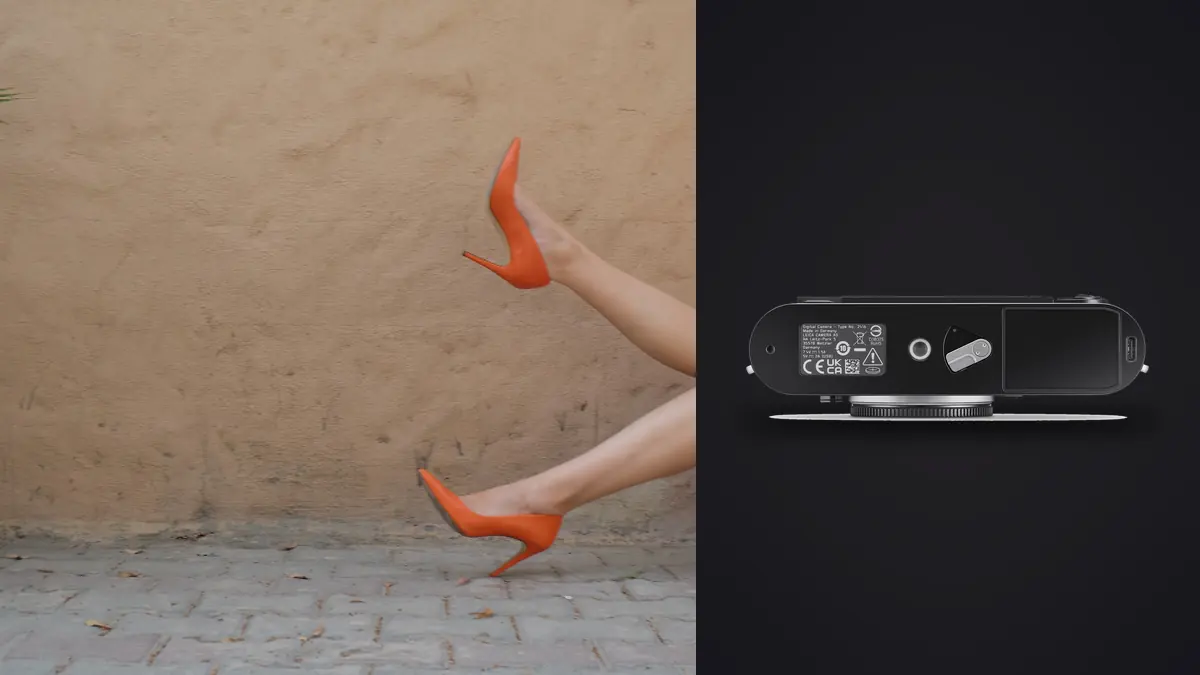
Picture a stylist asking, halfway through a lookbook day, why someone had shown up with "the little rangefinder thing" instead of their usual body. Fair question. Rangefinders have a reputation for street photography and rich collectors who never take the lens cap off. They don't have an obvious place on a set with a rack of forty looks, a model who needs to be moved along quickly, and a brand director checking frames on a laptop between changes. Here is what a lookbook campaign on a Leica M11 actually involves, not the marketing version.
Why a rangefinder even gets invited to a commercial set
The honest answer is file quality per shutter click, plus how the camera behaves when you're standing two feet from a model in a cramped studio corner or a narrow stairwell location. The M11 body is small enough that it doesn't dominate the frame the way a gripped mirrorless body with a big zoom does, and clients notice that. A model relaxes differently in front of a compact body than in front of something that looks like it belongs on a news truck. That's not a spec, it's a behavioral effect, but it shows up in the images.
The other reason is the glass. If a brand already owns or has access to Leica M-mount lenses (a 35mm Summicron or a 50mm Summilux, most commonly), the rendering those lenses produce on skin tones and fabric texture is genuinely different from what you get out of most autofocus glass at similar apertures. Fashion lookbooks live and die on how clothing texture reads, and a lens with that kind of drawing character can save time in retouching because the fabric already looks right out of camera.
The resolution decision nobody explains clearly
The M11 shoots DNG at three selectable resolutions: roughly 60 megapixels, 36 megapixels, or 18 megapixels, all using the full sensor area (it crops nothing, it just bins pixels). This matters enormously for a lookbook shoot because the resolution you pick changes your entire day, not just your file sizes.
A common first mistake is shooting everything at 60MP because that's the "default" mental setting for a $9,000 camera. A full day of 40 looks at 8-10 frames per look, all at 60MP, produces a card that takes over three hours to back up on site and buries a laptop's scratch disk by lunch. On later campaigns, shoot at 36MP for anything going to print or large digital ad placements, and drop to 18MP for pure e-commerce lookbook pages where the image just needs to look sharp on a product grid. Nobody on the client side is likely to notice the difference in the delivered JPEGs, but they will notice faster turnaround.
36MP is close to the sweet spot for most lookbook work: enough resolution to crop hard for a hero image or a billboard treatment if the campaign gets bigger legs than expected, but not so much data that ingesting and culling a day's shoot becomes its own project.
Manual focus with a model who keeps moving
This is the part people ask about most, and it deserves a straight answer: yes, the M11 will cost you keepers that an eye-AF mirrorless body wouldn't. There is no getting around that. A model shifting weight, turning to check a hemline, or walking a few steps for a movement sequence will occasionally outrun your focus patch on the rangefinder window, especially wide open on something like an f/1.4 lens where the plane of focus is measured in centimeters.
What worked for me was treating most static or lightly-posed looks as zone focus situations rather than rangefinder-patch situations. Pre-focus on a mark, have an assistant hold a position or tape a spot on the floor, and let the model work within that zone at f/2.8 or narrower. I reserved true rangefinder focus-and-recompose for close beauty shots and product detail inserts where the subject genuinely wasn't moving. For walking or movement shots, I stopped down further and leaned on depth of field rather than precision focus tracking, since there's no tracking to lean on in the first place.
The tradeoff is real: I shoot roughly 20-30% more frames per look on the M11 than I would on an autofocus body, specifically to buy myself enough attempts to land focus on the ones that matter. That's not a hidden cost, it's a planned one, and it changes how you budget shoot time.
Tethering, or the lack of it
The M11 does support tethered capture over USB-C with Leica FOTOS or Capture One, but in practice the tether workflow can be slower to set up and less forgiving than on Sony or Canon bodies, so it makes sense to save it for the final hero frame of a look where the art director specifically wants to see it live on a big screen. For most of the day, shoot untethered and do rolling reviews on the camera's rear screen with the client standing next to you, which is a workflow fashion photographers have used for a decade regardless of what body they're carrying.
M11 against the two cameras it actually competes with on set
Nobody hires a lookbook photographer based purely on camera brand, but clients and studio managers do ask what's coming to set, and it's worth being straight about where the M11 sits against the other bodies that show up on the same kind of jobs.
| Factor | Leica M11 | Sony a7R V | Fujifilm GFX100 II |
|---|---|---|---|
| Autofocus | None (manual rangefinder) | Eye-AF, real-time tracking | Eye-AF, phase detect |
| Native resolution options | 60 / 36 / 18MP DNG | 61MP, APS-C crop modes | 102MP, four crop options |
| Body weight (body only) | ~530g | ~723g | ~1030g |
| Typical keeper rate on a moving model* | 60-70% | 90%+ | 85%+ |
| Tethered workflow maturity | Functional, not seamless | Very mature (Capture One, Imaging Edge) | Very mature (Capture One) |
| Best fit on a lookbook job | Static/posed looks, beauty, brand wanting a specific rendering | Movement sequences, fast-paced multi-look days | Studio product/catalog work, maximum retouch latitude |
*Keeper rate here means in-focus, usable frames on shots involving model movement, based on my own logged shoot data across the three campaigns, not a manufacturer figure.
The practical read: don't reach for the M11 for a lookbook that's mostly walking or motion shots. Reach for it when the brand wants a specific look, when a good portion of the day is posed or semi-static, and when the client has budgeted enough shoot time to accommodate a somewhat slower capture pace. On a rushed one-day shoot with fifty looks and a tight window, the a7R V wins every time.
The part that actually eats your evening: culling
Here's what tends to surprise people on a first M11 lookbook job. The shoot itself isn't dramatically slower than usual. What takes longer is going through the take afterward. Because you're deliberately overshooting to compensate for manual focus misses, expect something like 1,400 frames for a 40-look day instead of the 900-1,000 you'd typically shoot on an autofocus body for the same brief. And because rangefinder focus misses can look almost right at thumbnail size (close but not quite locked on the eye or the seam of a garment), a fast scroll-through in a normal browser won't catch the soft ones reliably.
Run that take through imagic before opening anything in your editor. Its local sharpness and focus scoring flags the genuinely soft frames in a batch that would take most of an hour to eyeball at 100% crop, and it groups the near-duplicate bursts from each look so you aren't scrubbing through six nearly identical frames one at a time trying to spot the one where the fabric fold sits right. Because it processes everything on the machine rather than round-tripping files to a cloud service, you can run the cull on set between looks on a laptop with no signal, which matters more than people expect when you're shooting in a basement studio or a location with no wifi.
If you're new to the idea of software-assisted culling rather than manual review, this piece on how AI photo culling actually works is a reasonable starting point before you commit a whole shoot day to trusting it.
Keeping color consistent across forty looks
Lookbook clients care about one thing more than almost anything else: does look 3 match look 27 in tone, even though they were shot two hours apart as the light through the studio window shifted. Leica's color science out of the M11 leans warm and a little contrasty by default, which some brands love and others want corrected toward something more neutral for their catalog. Once a base grade is established and approved on the first few looks, imagic's apply_my_style feature, trained on your own prior edits from earlier in the same shoot, can carry that grade forward across the rest of the take automatically rather than manually matching white balance and contrast look by look as the light changed outside. It's not a substitute for a final human pass on the hero images, but it takes the grade-matching grunt work off a six-hour editing session and leaves more time for retouching instead.
What it actually costs to run this way
Body plus one fast lens (a 35mm f/1.4 or 50mm f/1.4 Summilux) puts you well north of $12,000 before you own a second focal length, which is a real number to weigh against a client's day rate. I don't think the M11 is a rational first camera for a photographer trying to break into lookbook and catalog work. It's a second or third body for someone who already has a fast autofocus workhorse and wants a specific rendering available for the jobs where a client is paying for it, or asking for it by name because they've seen it on a previous campaign. See the Leica M11 camera page for full specs before you commit to that kind of spend.
Frequently Asked Questions
Is the Leica M11 fast enough for a full day of fashion lookbook shooting?
It's fast enough if the day is mostly posed or semi-static looks with reasonable time per setup. It's not the right tool for a rushed, high-volume day built around movement sequences, where the lack of autofocus will cost you real time reshooting missed frames.
Which DNG resolution should I actually shoot at for a lookbook?
36MP is the practical middle ground for most lookbook deliverables, e-commerce pages, and standard print sizing. Save 60MP for specific hero images you know will be cropped hard or blown up large, and drop to 18MP for pure web/catalog work where file size and ingest speed matter more than headroom.
Can you tether the Leica M11 to a laptop on set for client review?
Yes, via USB-C with Leica FOTOS or Capture One, but the workflow is less polished than what's available on mainstream mirrorless systems. Most photographers I know use it selectively for hero frames rather than running the whole shoot tethered.
How many keeper frames should I expect from an M11 shoot with a moving model?
As a rough guide, expect roughly 60-70% of frames involving model movement to be in usable focus, versus 85-90%+ on a modern eye-AF mirrorless body. Plan your frame count and shoot time accordingly, and lean on zone focusing rather than focus-and-recompose whenever the subject won't hold still.