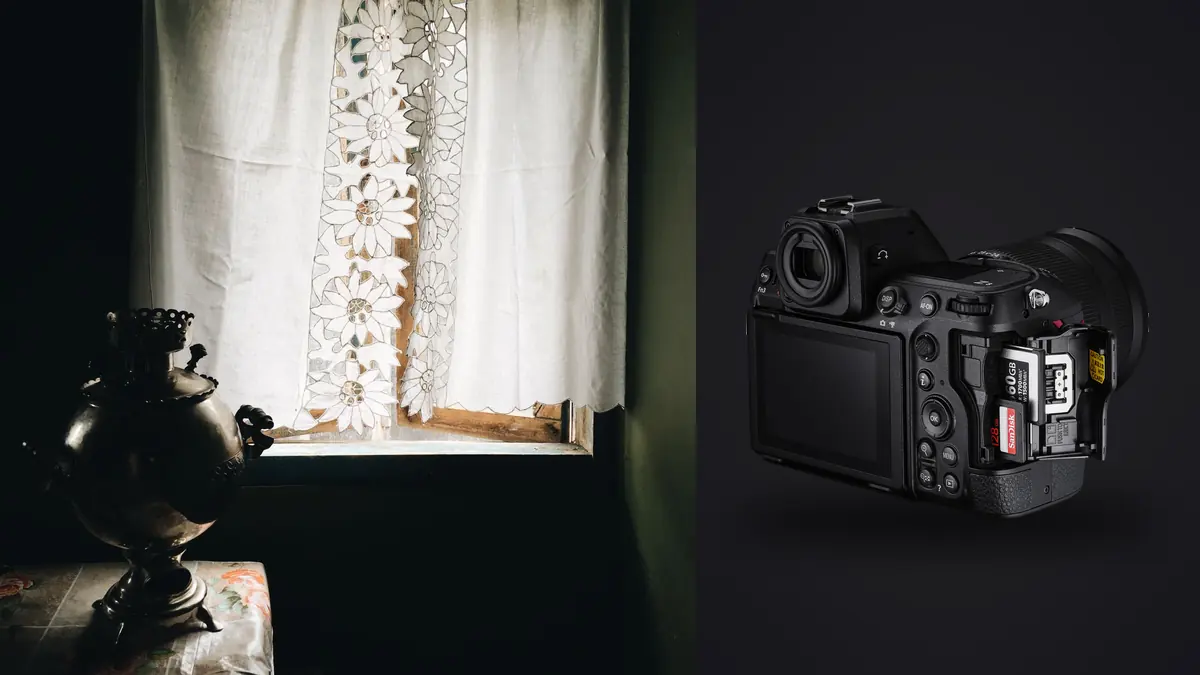
Boudoir work happens in small rooms. A hotel suite, a spare bedroom staged for the day, sometimes a walk-in closet doubling as a changing area with a mattress dragged six feet to catch window light. None of that is a studio, and none of it forgives gear that draws attention to itself. I switched my boudoir kit over to the Nikon Z8 about a year and a half ago, mostly because I was tired of hauling a Z9 up narrow Airbnb staircases, and it turned out the smaller body changed more about how sessions feel than I expected going in.
The body traits that actually matter in a bedroom
A lot of camera reviews talk about the Z8 in terms of sports and wildlife: 20fps electronic, deep buffer, subject tracking that locks onto a bird mid-turn. Almost none of that is why it works for boudoir. What matters here is quieter.
First, the fully silent electronic shutter. Mechanical shutter clack in a small, carpeted room with one nervous client and no ambient noise to mask it is genuinely disruptive. It breaks the rhythm you're trying to build, and for a first-time client who is already self-conscious, every audible click is a small reminder that a machine is recording them. Set the Z8 to its silent electronic shutter mode and the room goes quiet except for your voice. I talk through poses constantly during these shoots, adjusting a shoulder angle or asking someone to drop their chin, and not fighting shutter noise to be heard makes that conversation easier to keep natural.
Second, the tilting rear screen. Boudoir compositions lean heavily on low, close angles, shooting from near floor level up along a bed, or from a kneeling position at the foot of a chaise. Doing that through the viewfinder means either lying on the floor yourself or shooting blind. The Z8's screen tilts down far enough that I can hold the camera at knee height, angle the screen up toward me, and frame properly while staying at eye level with the subject rather than hovering over her. That sounds like a small ergonomic detail. In practice it changes the power dynamic of the room, and clients notice.
Third, eye-detection autofocus that holds through hair, blankets, and awkward eye lines. A lot of boudoir posing involves the subject looking away from camera, over a shoulder, down at the sheets, three-quarter profile with one eye mostly obscured by a fringe of hair. The Z8's human eye-AF picks up the visible eye reliably even in that half-hidden state, and it doesn't hunt when a hand or a strand of hair crosses the frame mid-burst. I don't recall the last time I checked a boudoir gallery and found a soft-focus miss that I could blame on the autofocus rather than my own aperture choice.
Fourth, in-body stabilization that lets me work handheld at shutter speeds I wouldn't trust on an older body. A lot of these sessions run on window light or a single continuous source, and I'd rather hand-hold at 1/60 than set up a tripod that turns the room into something closer to a clinical set. The Z8's IBIS gets me clean frames at 1/40 to 1/60 with the 50mm fairly consistently, which keeps the whole session mobile.
Lenses I actually reach for
Room size dictates lens choice more than anything else in this genre, more than aesthetic preference. Three lenses cover almost every boudoir setup.
50mm f/1.2 S as the default
This is on the camera more than any other lens I own for this work. In a typical bedroom, 50mm gives me working distance that doesn't back me into a closet door, and wide open it renders skin with a softness in the falloff that I find more flattering than the 85mm's harder compression. It's heavy, close to a kilo, and after a two-hour session my wrist knows it. Worth it for the rendering.
85mm f/1.2 S for tighter, quieter frames
When the room allows four meters of working distance, which is more often than you'd think in a proper primary bedroom, the 85mm gives a compression and background falloff that feels more intimate, ironically, because you're physically farther from your subject and the lens does the isolating. I use it for closer crops, hands, collarbone, the curve of a shoulder, where I want almost nothing else in the frame in focus.
35mm f/1.8 S for the rooms that fight you
Some spaces just don't give you four meters, or even three. A tucked-away reading nook, a small ensuite with good tile and bad light, a walk-in with a full-length mirror I want to use creatively. The 35mm keeps me shooting in spaces the two bigger primes simply can't work in, and I've stopped treating it as a backup lens. It's in the bag on every booking now.
Real lighting setups and the settings that hold up
Boudoir sessions rarely happen in controlled studio light. You're working with whatever window the room has, sometimes a single continuous LED you bring yourself, occasionally a small strobe if the client booked an evening slot. Here's roughly what I dial in for each, based on the sessions I actually shoot.
| Scenario | Lens / aperture | ISO | Shutter speed | White balance |
|---|---|---|---|---|
| Morning window light, sheer curtains | 50mm f/2.0 | 400 | 1/250 | Auto, or 5600K manual |
| Overcast window, diffused, north-facing | 85mm f/1.8 | 800 | 1/160 | 6500K manual |
| Single continuous LED through a shoot-through umbrella | 50mm f/2.2 | 320 | 1/125 | 3200K manual (gelled warm) |
| Evening booking, single off-camera strobe (small softbox) | 35mm f/2.8 | 100 | 1/200 sync | 5500K manual |
| Late-night ambient only, bedside lamp practicals | 50mm f/1.4 | 3200 | 1/60 | 2800K manual |
The ISO 3200 row is the one people ask about most. The Z8's stacked sensor holds detail in skin tones well past that point, but I keep the aperture at f/1.4 rather than pushing wider specifically to keep enough of the face in focus at close working distances, since a nose-to-ear focus plane at f/1.2 handheld in low light is a coin flip even with good eye-AF. I'd rather sacrifice a stop of light than gamble a whole frame on depth of field that thin.
One habit worth mentioning: I lock white balance manually in almost every one of these scenarios rather than trusting auto, because boudoir galleries get scrolled through quickly by the client and any temperature drift between frames from the same setup reads as sloppy, even if no single image looks wrong on its own.
What client trust actually looks like through the camera
This genre runs on trust more than any other kind of portrait work I do. People are nervous walking in, and the camera itself is part of what puts them at ease or doesn't. A few things about how the Z8 behaves have mattered more than I expected.
The silent shutter again, but for a second reason beyond noise: minimal viewfinder blackout means I can keep looking at the subject between frames rather than staring into a dark eyepiece after every shot. Eye contact and steady conversation matter enormously in directing someone through poses that feel vulnerable, and a camera that doesn't force me to break that contact every time I press the shutter helps more than any lens choice does.
Dual card slots matter differently in this genre than in most others. I record simultaneously to both CFexpress and SD, not for the usual "protect against a corrupt card" reason, but because a reshoot is basically never happening for these sessions. Someone books a boudoir session once, sometimes as a gift for a partner or for themselves after a major life change, and there's no version of that where I ask them to come back and do it again because a card failed. Redundant recording isn't a nice-to-have here, it's closer to a professional obligation.
I also shoot noticeably fewer frames per pose than I used to on my old DSLR kit. Part of that is confidence in the autofocus, but part of it is intentional: less machine-gunning the shutter means less time spent with the camera between me and the subject, which changes the energy of the room for the better.
Sorting the gallery without living in it for a week
A two-hour boudoir session on the Z8 easily produces 1,200 to 1,800 frames once you count every burst and pose variation. That volume, combined with how visually similar consecutive frames in a burst are (a shoulder drops two centimeters, an expression shifts slightly), makes culling the slowest part of my week if I do it manually.
I run these galleries through imagic before I touch Lightroom. Its local sharpness and focus scoring flags which frame in a ten-shot burst actually has the sharpest eye, which matters a lot more than it sounds when six near-identical frames all look acceptable at thumbnail size. The duplicate and burst clustering groups those near-identical sequences together automatically instead of making me scroll past frame after frame of the same pose, so I'm reviewing maybe 150 clustered groups instead of 1,500 individual images. That alone has probably cut two to three hours off every gallery I deliver. If you want the mechanics of how that scoring actually works, I wrote more on it in how AI photo culling works.
The part I actually care about more than the time saved, though, is that imagic processes everything locally on my machine. Nothing gets uploaded anywhere. For most photography that's a nice bonus. For boudoir it's closer to non-negotiable. These are people trusting a photographer with genuinely intimate images, and a culling workflow that never routes those files through a third-party server, even briefly, is something you can say to a nervous subject with a straight face.
Once the culling pass is done, I lean on the apply_my_style feature to carry a consistent warm, low-contrast grade across the whole finished set, since it's trained on my own past edits rather than a generic preset pack. Keeping a signature look consistent across four hundred finished images without manually grading each one from scratch is where that feature earns its keep. I go into the broader color pipeline in this color grading guide if you want the fuller version of that workflow.
Frequently Asked Questions
Is the Z8 quiet enough for a first-time, nervous client in a small bedroom?
Yes, with the caveat that you need to actually switch it into silent electronic shutter mode rather than assuming it's on by default. Once enabled, there's no audible click at all, which matters more in this genre than almost any spec on the sensor.
Do I really need the 85mm f/1.2 S, or will a cheaper lens do the job?
Plenty of solid boudoir work gets shot on the 50mm f/1.8 S or even the 40mm f/2, both far cheaper. The 85mm f/1.2 is a rendering choice, not a requirement, and if your bookings tend to happen in smaller rooms you'll get more consistent use out of a 35mm or 50mm anyway simply because you'll have the working distance for them.
How high can I push ISO before skin texture starts falling apart?
On the Z8 I'm comfortable keeping frames shot at ISO 3200 in a final set, and I'll go to 6400 for a handful of moody, low-key frames per session if the look calls for it. Past that, noise reduction starts smoothing skin texture in a way that reads as artificial rather than filmic, so I treat 6400 as a hard ceiling for anything in a final set.
What's the safest way to store and cull boudoir images given how sensitive they are?
Keep the workflow off the cloud wherever you can. I cull locally through imagic specifically because nothing leaves my machine during that process, then encrypt any drive that gets shared and use a password-protected gallery link for review rather than a shared cloud folder. The fewer hops these files take between camera and client, the fewer places something can go wrong.