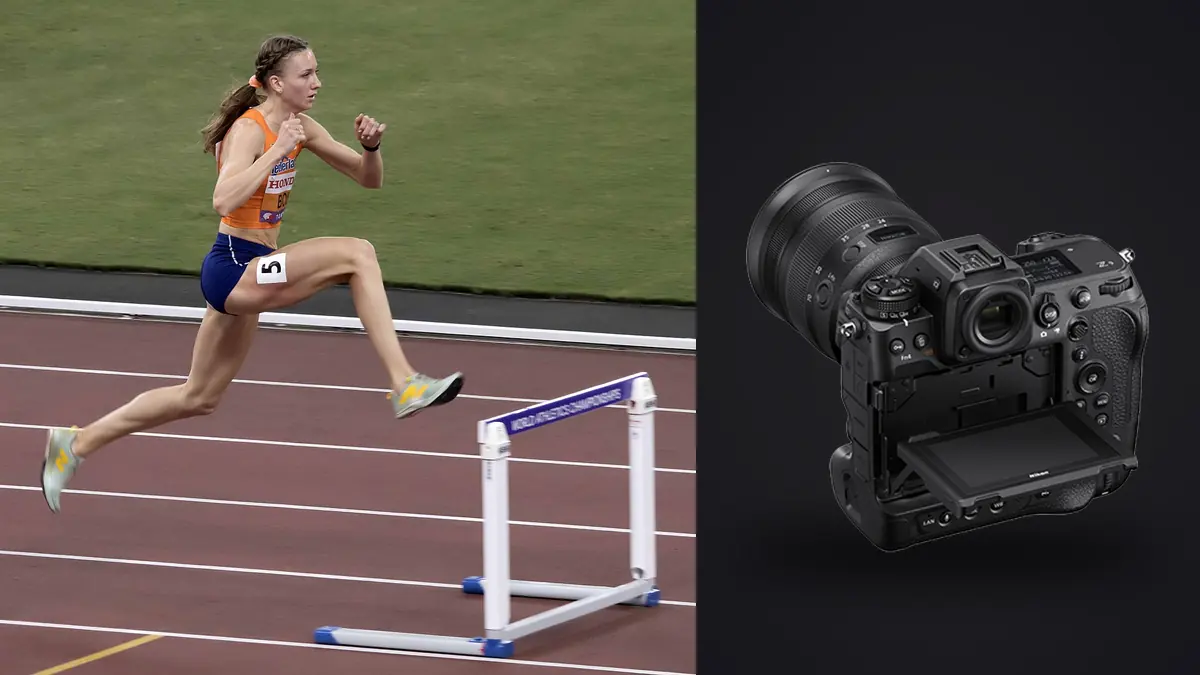
A track meet is one of the least forgiving environments you can bring a camera into if you actually care about your keeper rate. The light shifts every twenty minutes as the sun clears the stands, the sprinters come straight at you before curving away on the bend, and there are usually six or seven events happening at once between the infield and the oval. I've covered age-group meets with a borrowed 70-200mm propped on a bag and I've covered conference finals with 600mm on a monopod, and the single upgrade that changed my hit rate wasn't a lens. It was moving my body to a Nikon Z9. Not because it's magic, but because two specific things about it, the shutter mechanism and the subject tracking, solve problems that are particular to running and jumping events rather than photography in general.
The shutter is the whole story
The Z9 has no mechanical shutter at all. There's no curtain to close between frames, which means the viewfinder never blacks out, not even for a fraction of a second, while you're firing at 20 frames per second. For a stationary subject that's a nice-to-have. For a 110m hurdler where you're trying to catch the exact moment a trail leg clears the barrier, it's the difference between actually seeing the moment happen and guessing where it was based on the frame before and after. You keep the athlete in the frame through the whole sequence instead of losing them during blackout and re-finding them mid-stride.
The obvious worry with any electronic-only shutter is rolling shutter skew, the "jello" effect where fast horizontal motion during readout skews verticals. On cheaper stacked sensors this shows up as leaning fence posts or bent starting blocks when you pan hard. The Z9's sensor reads out fast enough (Nikon quotes roughly 1/250 of a second for a full readout) that I've genuinely never seen it distort a sprinter's frame, even panning full speed through a 100m finish. Where I have seen it: whip-panning during a relay baton exchange when I'm moving the camera unusually fast to keep two runners in frame at once. It's subtle, a very slight lean on the lane lines, and it only shows up if I go looking for it at 100% crop. For everyday meet coverage it's a non-issue.
What does bite people is banding under certain indoor arena lighting. A lot of fieldhouses still run older fluorescent or cheap LED fixtures that flicker at a frequency the sensor's rolling readout can catch mid-scan, leaving horizontal bands of uneven exposure across a burst. The fix is Nikon's flicker reduction setting, or better, locking your shutter speed to a value that syncs with the local mains frequency (1/100 or 1/125 in most of Europe, 1/60 or 1/120 in North America). I check for banding on the first test burst of every indoor meet before I trust the rest of the session to it.
Getting autofocus to behave differently for different events
The Z9's subject detection is genuinely good at recognizing a human body and locking onto it, but "good at finding a person" and "good at the specific way you need it to track that person" are different problems depending on what event you're shooting.
Sprints and hurdles
For the 100m and 200m I run 3D-tracking with people detection set to the whole body rather than eye or head only. At full sprint an athlete's limbs are moving independently and fast enough that eye detection alone will occasionally jump to a competitor's arm or another runner entering frame from the side. Body-priority tracking holds onto the torso, which barely changes shape stride to stride, and gives a steadier lock through the whole run. For hurdles I actually switch to Wide-area AF (L) with subject detection rather than 3D-tracking, because the athlete's height changes dramatically clearing each barrier and I've found the box-based mode recovers focus faster after each jump than pure point tracking does.
Field events
Long jump, triple jump, and pole vault are a different problem: the subject is often side-on, moving toward you on a fixed runway, and the background (sand pit, padding, crowd) rarely changes. Here 3D-tracking is more reliable because there's less risk of the tracking box snagging on a passing official or another athlete warming up in the background. For discus and shot put, where the thrower rotates and the release happens in under two seconds, I preset the AF area to a fixed spot roughly where I expect the release point to land and let single-point or a small dynamic-area group do the work rather than chasing the rotation.
None of this is set-and-forget. I keep two of the Z9's custom AF-area presets saved so I can flip between "body tracking, wide zone" for the track and "tight zone, fixed point" for the field events without digging through menus between events.
Frame rate and buffer: what a session actually costs you
The Z9 will happily shoot faster than 20fps if you ask it to, but the higher-speed modes trade away either bit depth or resolution, and knowing which mode earns its keep saves you from a full memory card by the third final.
| Mode | Resolution | File type | Max fps | What I actually use it for |
|---|---|---|---|---|
| C20 (standard continuous) | 45.7MP full frame | 12-bit lossless RAW | 20 fps | Every final I plan to actually deliver or print |
| High-speed frame capture+ (30fps) | 45.7MP full frame | JPEG only | 30 fps | Relay exchanges, where I'll crop hard anyway and don't need RAW latitude |
| High-speed frame capture+ (120fps) | 11MP, DX crop | JPEG only | 120 fps | Pole vault bar clearance and long jump takeoff only, nowhere else |
| Single or low-speed continuous | up to 45.7MP | RAW | up to 10 fps | Field event approach runs, warm-ups, anything I'm shooting to save card space |
In practice I leave the dial on C20 RAW for probably 80% of a meet and only drop to the 120fps crop mode for the two or three seconds around a vault clearance where I genuinely need that resolution in time. Nikon's spec sheet claims over a thousand consecutive frames in 12-bit lossless compressed RAW to a fast CFexpress Type B card, and while I've never counted that high in the field, I have run a full 4x400m relay (call it fifty seconds of intermittent bursts) without hitting a buffer wall on a 325GB Sony Tough card. Slower CFexpress cards, or god forbid an SD card in the second slot for overflow, will absolutely choke you mid-race, so this is not a place to save money.
Matching glass to where you're actually standing
Track meets have fixed shooting positions, usually dictated by meet officials or a media credential, and the right lens changes completely depending on whether you're on the backstretch rail, at the pit, or behind the vault bar.
| Event | Typical shooting position | Lens I'd bring | Working settings |
|---|---|---|---|
| 100m / 200m sprints | Backstretch rail, level with the runners | Z 400mm f/2.8 TC, or Z 100-400mm zoomed to 400mm | f/4-5.6, 1/2000s |
| Hurdles | Infield, roughly hurdle six or seven | Z 100-400mm, or 70-200mm f/2.8 with 1.4x | f/5.6, 1/2500s |
| 4x100 / 4x400 relay exchange | Trackside at the exchange zone | Z 70-200mm f/2.8 | f/2.8-4, 1/2000s |
| Long jump / triple jump | Pit side, low angle | Z 100-400mm | f/5.6, 1/2000s |
| Pole vault | Behind and below the bar | Z 70-200mm f/2.8 (or 24-70mm for the crowd reaction) | f/2.8, 1/1600s |
| Discus / shot put / hammer | Outside the safety cage | Z 400mm f/2.8, or a budget 180-600mm | f/4-6.3, 1/2000s |
| Distance (1500m and up) | Backstretch, general oval | Z 100-400mm | f/5.6, 1/1600s while panning the lead pack |
If I had to own exactly one lens for this genre it would be the 100-400mm. It doesn't have the light-gathering of the 400mm f/2.8 and it's noticeably slower to autofocus in dim indoor arenas, but it covers sprints, jumps, and distance events from a single fixed position, which matters when you don't have credentials to move around the infield. The 400mm f/2.8 earns its weight (and its price) at high-level meets shot in low evening light, where the extra two stops let you keep shutter speed up as the sun drops behind the stadium roof.
Indoor meets are a different sport entirely
Outdoor track photography is mostly a light-and-distance problem. Indoor meets add a banked, tighter oval, ceilings that keep even bright arena lighting well below what direct sun gives you, and a much narrower field of view because you're often shooting from a fixed media riser rather than walking the rail. I typically run ISO 6400 to 12800 indoors without much hesitation, since the Z9's stacked sensor holds detail reasonably well through that range and a slightly noisy sharp frame beats a clean blurry one every time. Shutter speed is the real compromise: I want 1/1000s minimum to freeze a sprinter's legs, but the tight banked turns mean I'm also panning much faster than outdoors, so I'll sometimes drop to 1/500s deliberately to get motion blur in the background and a sharper subject through the pan rather than fighting for a fully frozen frame I can't get enough light for anyway.
Turning three days of meets into a folder you can actually deliver
Here's the part nobody warns you about before you own a camera that shoots 20 frames a second: a single weekend invitational can leave you with twelve or fifteen thousand RAW files by Sunday night, and most of those are five or six nearly identical frames of the same stride. I used to lose entire evenings just scrolling through bursts trying to pick the one frame where the athlete's front foot was fully planted and their face wasn't mid-blink. That's the exact workflow problem imagic was built around for me: it scores focus and sharpness locally on the machine, so it can tell me which frame in a twenty-shot burst is actually the sharpest one rather than me eyeballing thumbnails at 2am, and it clusters near-duplicate bursts together so I'm reviewing one representative frame per stride sequence instead of all twenty. Everything runs on my laptop with no cloud upload involved, which matters more than people expect when half your subjects are minors at a school meet and a parent asks where their kid's photos are actually being processed.
The other piece that's saved me real time across a season is training imagic's apply_my_style preset on a batch of meets I'd already graded by hand. Track photos have a fairly specific look I want consistently, punchy but not oversaturated, skin tones that hold up under mixed stadium lighting, and once that preset is trained on my own edits it applies a consistent starting point across a new set of bursts instead of me re-inventing the grade meet to meet. If you haven't sat down and actually mapped out a culling routine before, it's worth reading through how AI photo culling actually works before you build a habit around it, and if a weekend meet is eating your whole week afterward, these workflow changes are the ones I'd prioritize first.
Frequently Asked Questions
Do I need the 400mm f/2.8, or is a zoom enough for a track meet?
For most club and high school meets, a 100-400mm or a budget 180-600mm covers you fine, especially since you'll often be repositioning between events anyway. The big primes earn their cost at higher-level meets shot late in the day or indoors, where the extra stop or two of light keeps your shutter speed up without pushing ISO into territory that costs you detail. I'd rent a 400mm f/2.8 for a big regional final before I'd buy one for a season of dual meets.
Will the Z9's electronic shutter cause banding under stadium lights?
It can, mainly at indoor meets under older fluorescent or cheap LED fixtures that flicker at a frequency the sensor's readout can catch. Turning on flicker reduction in the menu, or manually setting your shutter speed to match local mains frequency, clears it up in almost every case I've run into. Outdoor daylight meets essentially never show this.
Is a body like the Z9 overkill for a single school-level track meet?
If you're shooting one meet a season, probably. Where it earns its cost is volume: if you're covering a full outdoor and indoor season across multiple teams, the combination of blackout-free tracking and a buffer that doesn't choke mid-relay adds up fast in keeper rate. For an occasional meet, a body with 10-12fps and decent subject tracking will get you most of the same shots with a lot less money spent.
How do you realistically get through the number of frames a meet produces?
Cull in passes, not all at once. I do a fast first pass in-camera or on the plane home to kill obvious misses (blinks, false starts, backs turned), then run the survivors through imagic to rank by sharpness and collapse duplicate bursts before I sit down to actually edit. Trying to grade every frame at full resolution the way it comes off the card is how a weekend meet turns into a lost week.