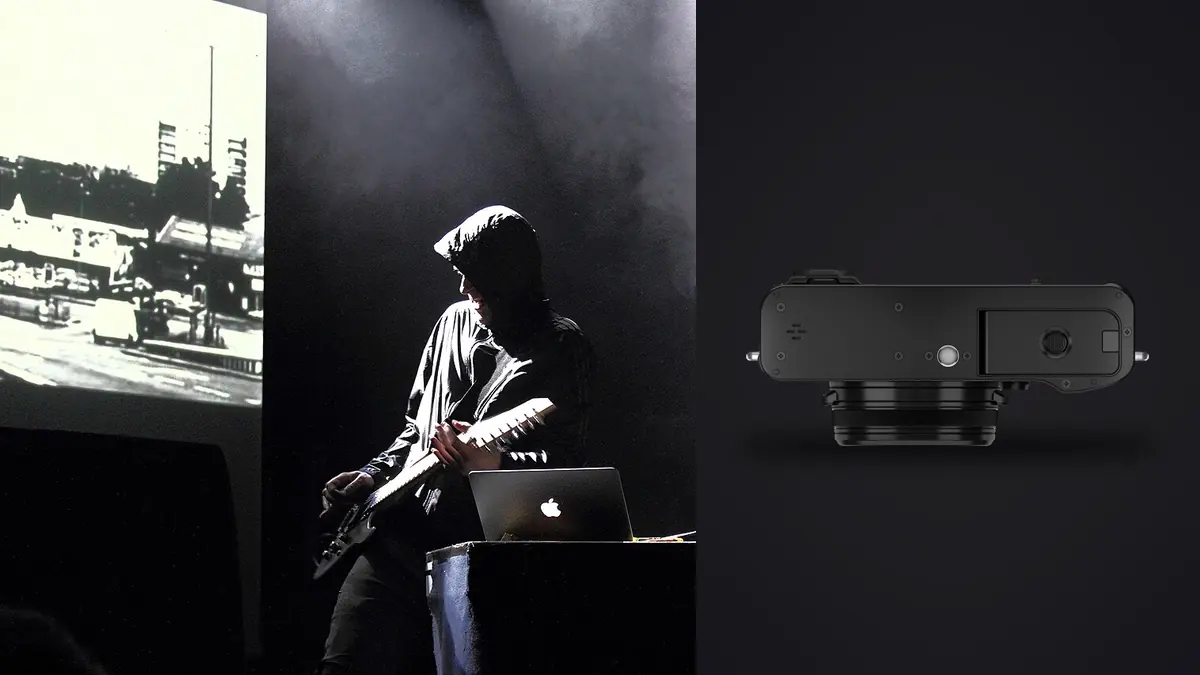
I got asked at a merch table in March whether the X100VI was "a real option" for shooting a friend's band, and I gave the annoying photographer answer: it depends what you mean by real. If real means competing with a 70-200mm f/2.8 from a photo pit at an arena, no, obviously not, you have one lens and it's a 23mm. If real means coming home from a 200-cap club show with usable, printable frames of the singer's face lit by one gelled par can, then yes, it's more than real, it's arguably a better tool for that specific job than most of what I've carried into venues over the last decade.
I've now taken the X100VI to eleven shows since picking one up in the spring, ranging from a seated jazz trio in a wine bar to a sweaty hardcore set where I got elbowed twice. This isn't a spec sheet regurgitation. It's what actually happened with the autofocus, the ISO ceiling, and the fixed 35mm-equivalent framing when real bodies were moving under real stage lighting.
The framing problem nobody warns you about
The X100VI's lens is a 23mm f/2, which gives you a 35mm-equivalent field of view on the APS-C sensor. That's a fine focal length for environmental portraits, for capturing a guitarist and half the crowd in one frame, for the kind of documentary wide shot that shows where you were, not just who you were pointing at. It is a genuinely bad focal length for isolating a singer's face from twenty feet back, which is exactly the distance most venues force on you once security or the crowd draws a line.
What this means practically: you either get close (and at small venues, "close" is achievable in a way it never is at a 15,000-seat arena with a three-song pit rule), or you accept that most of your frames will include mic stands, other band members, and a fair chunk of stage. I stopped fighting this around show four and started shooting for it instead, using the wide field of view to include the drummer's cymbal spray or the guitarist's pedal board as compositional elements rather than cropping them out mentally and being disappointed later. The digital teleconverter modes (50mm and 70mm equivalent crops) help in a pinch, but you're just cropping into the sensor, and past ISO 3200 that crop starts showing its seams.
ISO ceiling: where I actually draw the line
Fujifilm rates the X100VI's sensor as the same 40.2MP X-Trans unit in the X-T5, and in daylight or well-lit interiors that resolution is a genuine asset for cropping later. In a dark club, resolution stops being the story and noise floor takes over. Here's where I've landed after enough shows to stop guessing:
| ISO | Usable for what | My actual keep rate |
|---|---|---|
| 800-1600 | Well-lit stages, festival mainstage, daylight outdoor sets | Nearly everything sharp keeps |
| 3200 | Standard club lighting, one or two spotlights | Most frames fine after modest noise reduction |
| 6400 | Dim bars, single-color wash lighting | Roughly half, grain becomes a stylistic choice |
| 12800 | Genuinely dark rooms, backlit silhouette shots | A handful per set, mostly for mood not detail |
| 25600+ | Emergency only | I don't bother anymore, JPEG color starts smearing |
That 6400 line is really the working ceiling for me. Fujifilm's in-camera noise reduction on JPEGs gets a little waxy past that point, and if you're shooting RAW (which I do, always, for shows) you're fighting chroma noise in Lightroom that eats fine detail in skin and hair. The f/2 aperture helps more than you'd expect at these ISOs because it's a full stop faster than most kit zooms, but it's still not an f/1.4, and I've genuinely missed the extra half stop on the darkest sets.
Where the leaf shutter actually pays off
One thing I didn't expect to matter as much as it does: the X100VI uses a leaf shutter built into the lens, which means it's nearly silent and syncs with flash at any shutter speed up to 1/4000. I don't often flash a live set (most venues don't love it and it kills the mood lighting anyway), but the silence matters constantly. Shooting a hushed acoustic set or the quiet bridge of a song, a mirrorless body with even a soft electronic-first-curtain click draws eyes. The X100VI in fully mechanical or electronic shutter mode is dead silent, and nobody three feet away from you notices you're shooting.
Autofocus: honest assessment, not marketing copy
The subject-detection autofocus on the X100VI (inherited from the X-T5/X-H2 generation of Fujifilm's processor) has a human/face/eye detection mode, and it's genuinely decent in front-lit conditions. Point it at a singer under a stable spotlight and it locks convincingly and holds through moderate head movement. Where it falls apart, predictably, is exactly the environment most club shows live in: rapid, saturated color washes (deep red and blue lighting confuses contrast-detect AF badly), strobing effects during a chorus hit, and backlit silhouettes where there's no face contrast to grab onto at all.
My workaround has been to switch out of face detection and back to a single, small AF point for anything with erratic lighting, pre-focusing on where I expect the singer's head to be and waiting for the moment rather than trusting continuous tracking to follow a moving target through a red wash. It's a step back to how I shot fifteen years ago, but it's more reliable than trusting an algorithm confused by saturated stage light. For steady mid-tempo songs with consistent lighting, though, face detection genuinely works and I let it drive.
Burst shooting and the mess it leaves you with
Live music is one of the few genres where you genuinely need burst mode, because expressions and hand positions change in fractions of a second and you rarely get a second take. The X100VI can do 8fps mechanical and up to 20fps electronic (with a crop), and I lean on mechanical burst for anything I plan to actually use, since the electronic mode's rolling shutter shows up as skew on fast-moving guitar necks and drumsticks.
The problem with burst shooting a two-hour set isn't the camera, it's what happens after. I came home from a three-band bill in June with just under 1,400 frames, and sitting down to cull that by eye, one at a time, at midnight after standing for four hours is nobody's idea of fun. This is honestly the single biggest quality-of-life change in my live music workflow this year: I run the whole card through imagic before I touch Lightroom. It scores focus and sharpness locally on the laptop (no upload, which matters when venue wifi is nonexistent anyway), and because a huge fraction of a burst sequence is nearly identical frames of the same gesture, its duplicate and burst clustering groups those near-twins together so I'm picking one keeper from a cluster of twelve instead of scrolling past all twelve individually. What used to be ninety minutes of culling is closer to twenty five now, and I'm not doing it half-asleep at 1am anymore, which means I actually catch the genuinely sharp frame instead of the first acceptable one I stumble across scrolling too fast. If burst-heavy shooting is new to your workflow, this guide to managing burst photography covers the basics of clustering and culling at scale.
Battery life and the boring logistics of a full set
The NP-W126S battery in the X100VI is not generous. Fujifilm quotes around 310 shots per charge under CIPA testing, and with an EVF running, image review after every burst, and cold venue air conditioning, I've seen real-world numbers dip under 250 on a rough night. For a single 45-minute opening slot that's not a concern. For a three-band bill where I'm shooting all night, I carry two spares and swap at the venue's merch table between sets, which takes about as long as walking there and back. It's a minor annoyance compared to the camera's other tradeoffs but worth planning around if you're used to a body with a bigger grip and a bigger cell.
Why I still bring it over a mirrorless kit with a fast zoom
I own an 18-55mm f/2.8-4 and a 50-140mm f/2.8 for the X-mount body I also shoot. Neither comes with me to small shows anymore, and the reason is almost entirely about how the venue reads you. Show up to a 150-capacity room with a big zoom on a gripped body and a strap of gear, and you read as press, which changes how staff and the crowd treat you (sometimes better, often worse, always differently). Show up with the X100VI and you read as someone with a nice compact camera, closer to a fan with a good eye than a photographer working the room. I get waved past doors that would've stopped a bigger rig, and I get closer to the stage before anyone decides I need a lanyard.
That access advantage is the whole case for the camera at this scale of show. It's not a technical argument, it's a social one, and it's real enough that it's changed which shows I'm willing to shoot solo.
A realistic packing list for a night of shows
- X100VI with a fresh battery, two spares charged and in a jacket pocket, not a bag you'll set down
- A UV filter on the lens, non-negotiable in a room full of elbows and spilled drinks
- One fast SD card (UHS-II, at least 64GB) rather than several slow ones, because swapping cards mid-set means missing the bridge of a song
- Earplugs, obviously, but also a small flashlight for checking settings between songs without lighting up your whole face
I don't bring a second lens because there isn't one to bring. That's either a limitation or a relief depending on your mood that night, and after a season of shows I've mostly landed on relief. Fewer decisions on the fly means more attention on the actual moment happening six feet in front of me.
Frequently Asked Questions
Is the X100VI fast enough autofocus-wise for mosh pits and fast movement?
It handles moderate movement fine, a singer pacing the stage or a bassist headbanging on beat, but it's not built for erratic, close-range chaos the way a sports-oriented body with phase-detect tuned for that use case is. In an actual pit, at close range, in strobing light, I've missed more frames with the X100VI than I have with a dedicated mirrorless body and a 50mm f/1.2. For anything calmer than that, it's plenty capable.
Should I shoot RAW or JPEG for concert work with this camera?
RAW, always, for anything above ISO 3200. Fujifilm's film simulations look great straight out of camera in good light, but at high ISO under mixed stage color the in-camera JPEG engine crushes shadow detail more aggressively than I want, and you lose the ability to pull back a blown-out spotlight highlight later. I shoot RAW+JPEG so I have a quick preview to share that night and the RAW to actually edit from once I'm home.
How does the fixed 35mm-equivalent lens compare to renting a zoom for one show?
If it's a one-off arena show with an assigned photo pit and a three-song window, rent or borrow a longer lens, the X100VI's field of view genuinely won't get you a usable headshot from pit distance. If it's a club circuit or a residency you're shooting repeatedly, the fixed lens forces a documentary style that, once you adapt to it, produces a more consistent and distinctive body of work than switching lenses show to show.
What's the fastest way to get through hundreds of burst frames after a long set?
Don't scroll a folder of a thousand-plus images one at a time, that's how you end up quitting the culling process halfway through and never finishing the edit. I run the card through imagic first since its local sharpness scoring and burst clustering group near-duplicate frames together, so I'm choosing one keeper per burst instead of evaluating every single frame. It runs entirely on the laptop with nothing uploaded anywhere, which also matters when you're editing on a bus or in a venue with no signal. From there it's a much shorter list to bring into actual color grading in Lightroom.
None of this makes the X100VI a replacement for a proper telephoto kit at big-stage shows. But for the club and small-venue circuit, where access and discretion matter more than reach, it's earned a permanent spot in my bag, and it's changed how I shoot rooms I used to walk into with three times the gear and half the mobility.