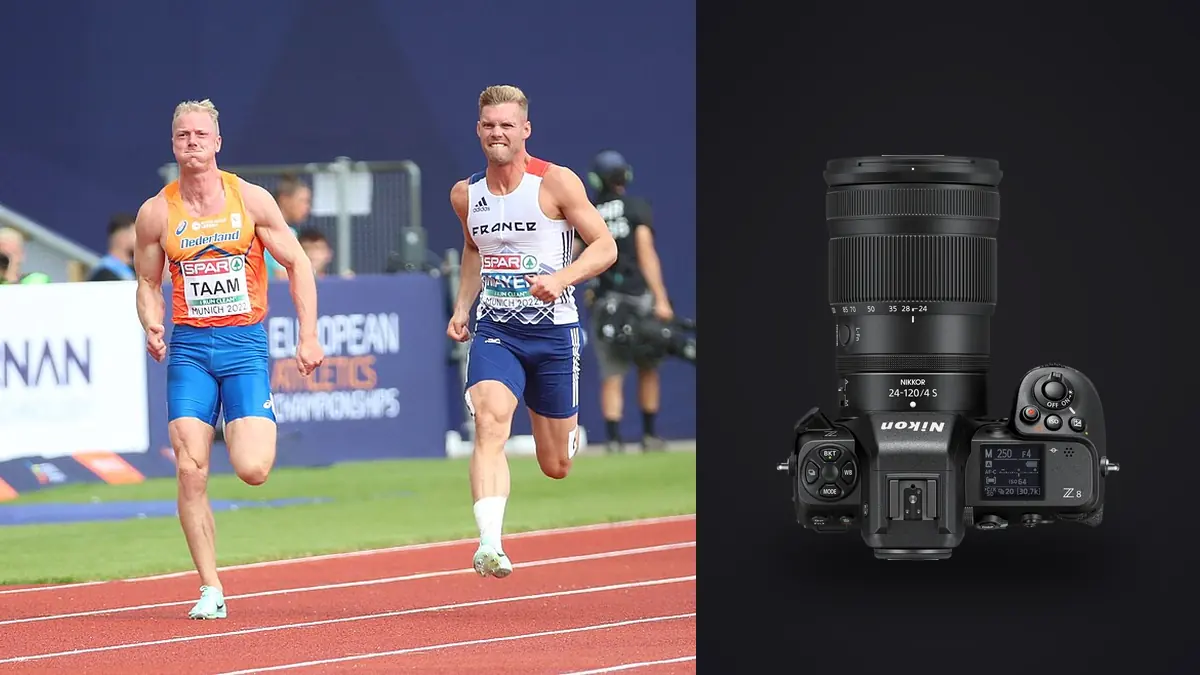
The first track meet I shot with the Z8 was a rainy regional qualifier in April, the kind of meet where the infield turns to mud by the third heat and nobody's paying you to be there, you're just building a portfolio. I'd been shooting a D850 for meets like that for years, guessing at focus tracking and hoping the buffer would hold through the 400m final. The Z8 changed the math almost immediately, and not because it's flashy new gear. The specific combination it brings together, a stacked sensor readout, genuinely reliable subject detection, and the total absence of a mechanical shutter, solves problems that are particular to track and field rather than sports photography in general. A football sideline and a 100m final are not the same problem, and this camera happens to be built for the second one in ways that aren't obvious until you've stood at the finish line with it.
Why a stacked sensor actually matters on an oval track
Track photography has a specific failure mode that field sports don't: you're often panning at high angular velocity across a short, predictable path (the finish line, the top of the hurdle, the plant foot in the long jump pit), and any lag between what the sensor is reading and what's actually happening in front of you shows up as skew. On a rolling-shutter sensor with a slow readout, a sprinter's legs can smear or lean at an angle that never existed in reality, especially if you're panning with them rather than holding the frame static. The Z8's 45.7-megapixel stacked sensor reads out fast enough that this distortion is, for practical purposes, gone. I've pixel-peeped hurdle clearances shot at 1/2000s while panning hard and the verticals stay vertical.
The other piece is that the Z8 has no mechanical shutter at all. That sounds like a spec-sheet footnote until you're shooting a 200m and realize the viewfinder never blacks out, not once, through the entire race. You're not watching a strobing slideshow of the runner, you're watching continuous motion with frames being pulled out of it. For following a athlete through a bend, where you need to anticipate where their head will be a half second from now, that continuity is worth more to my hit rate than any single autofocus improvement.
Autofocus settings I actually leave in place meet to meet
I run AF-C with back-button focus on a custom button, full stop, always. The variable is which area mode and which subject-detection setting I pair with it, and that changes by event.
Sprints and hurdles
For anything on the straight, I use 3D-tracking with People detection turned on and set to prioritize the head and eye when it's available. Starting blocks are chaotic, eight athletes crouched in a line, and Auto-area AF with detection will sometimes grab the wrong lane if you don't initialize the tracking box on your intended runner before the gun. I place the tracking point on the athlete's hip or torso at "set," not the head, because that's the part of the body that's most stable in the crouch and the detection engine locks onto the person as a whole from there.
Jumps and throws
Field events reward a different approach. For long jump and triple jump I switch to Wide-area AF (S) rather than 3D-tracking, because the athlete is approaching from a fixed, known direction and I'd rather have a tight, predictable focus box than let the camera decide who the subject is among officials and other athletes standing near the pit. For throws (shot put, discus, javelin) I go back to People detection but drop the frame rate expectations, since the moment you actually want, the instant of release, happens fast but the athlete isn't covering much ground, so tracking drift is less of an issue than timing.
Distance races under stadium lights
Evening meets under sodium or LED stadium lighting push ISO up into the 3200 to 6400 range even at f/2.8, and detection accuracy does soften slightly in that light. I've found dropping AF-area to a smaller Wide-area box and manually re-placing it every lap works better than trusting 3D-tracking to hold on to a runner who's now one of a pack of six all wearing similar colors. The -7 EV low-light detection floor on this body is genuinely useful here; it's the difference between a camera that hunts under mixed sodium-vapor light and one that doesn't.
Which release mode I reach for, and when
The Z8 gives you more continuous-shooting options than you'll actually use on a normal meet, but three or four of them earn a permanent spot on the mode dial rotation. Here's how I actually split them across a typical evening of events, along with what I've measured on my own card in practice.
| Mode | Frame rate | File output | When I use it | Buffer runway (325GB CFexpress B) |
|---|---|---|---|---|
| CL (adjustable) | 1 to 9 fps | 14-bit RAW, full resolution | Warm-ups, team portraits, awards | Effectively unlimited for the shot count involved |
| CH (extended) | Up to 20 fps | 14-bit RAW, full 45.7MP | 100m/200m finals, hurdle clearances | Well past 1,000 frames before any slowdown, I've never hit the wall mid-race |
| C30 | 30 fps | JPEG only, full resolution | Long jump take-off, denser sampling of foot plant | Card fills on shot count faster than RAW would, but rarely a concern for a single jump |
| C120 | 120 fps | JPEG, reduced resolution (roughly 11MP) | Discus and javelin release point only | Not for keepers, purely a dissection tool for the exact instant of release |
Pre-Release Capture is the setting most people skip in the manual and shouldn't. In the C30/C60/C120 modes it buffers up to a second of frames before you fully press the shutter, which has saved more than one hurdle clearance where my reaction time lagged the actual jump. It's not something I'd use for a whole race, but for a single decisive moment in a field event it's close to cheating.
Lenses that actually earn their keep trackside
Camera bodies get the attention but glass decides what you can cover from where you're allowed to stand, and most meets restrict photographers to specific zones outside the track surface.
- 70-200mm f/2.8 S: my primary lens for anything happening on the near straight or in the infield close to the photographer positions. Wide enough at 70mm to catch a full jump arc, long enough at 200mm for a tight finish-line frame.
- 100-400mm S: covers the far turn and the far side of the field from a fixed photo position, which at most stadiums is where you're stuck for throws and jumps happening away from the home straight.
- 400mm f/4.5 PF S: the one I'd buy first if budget were the constraint. It's light enough to hand-hold through an entire meet without a monopod, and at f/4.5 with the Z8's high-ISO handling, evening light stops being the limiting factor it was on older bodies.
A 1.4x teleconverter on the 100-400mm gets you to 560mm for a distant field event, but autofocus speed drops noticeably in anything but good light, so I only reach for it in daylight meets, never under stadium lighting.
Cards, buffer, and battery reality
The Z8 has two card slots, one CFexpress Type B and one SD UHS-II, and if you're shooting anything near 20fps you need the CFexpress card doing the heavy lifting. I made the mistake early on of setting RAW to overflow onto the SD card as backup and watched the buffer choke mid-burst because the SD write speed couldn't keep pace, even though the CFexpress slot alone would have sailed through. Now I record RAW to CFexpress only and JPEG backup to SD, which keeps both slots within their actual throughput.
Battery life on the EN-EL15c is rated conservatively by CIPA standards (a few hundred shots), but that number assumes single-frame shooting, not bursts. In real meets, where most of my frame count comes from a handful of 20fps bursts rather than steady single shots, one battery routinely gets me through a full evening of events with a spare in my pocket I rarely need. The optional MB-N12 grip adds a second battery and, more usefully for a long meet, a proper vertical shutter release that saves your wrist during the hours of holding a long lens level with the track.
What happens after the last event: four thousand frames and one deadline
This is the part that doesn't make it into gear reviews but eats more of my evening than the shooting does. A single meet with six or seven finals I actually cared about shooting can leave me with three to five thousand frames once you add up the 20fps bursts, and most of those frames are near-duplicates of each other, three or four near-identical shots of the same stride. Going through that manually in a hotel room or press box after a nine-hour meet is how photographers burn out on this kind of work.
This is where imagic actually changed my evening routine rather than just my shooting settings. It runs entirely on my laptop, no upload queue, no waiting on a venue's terrible press-room wifi, which matters at half the stadiums I shoot because the wifi genuinely doesn't work. It scores sharpness locally across a burst and groups the near-duplicate frames from a single sprint or jump sequence so I'm picking from six real options instead of scrolling past forty look-alikes. Once I've hand-edited a handful of frames to match the look I want for a given meet (usually a bit more contrast and warmth than stadium lighting gives you straight out of camera), I run apply_my_style across the rest of the folder so the edit carries through consistently instead of me redoing the same adjustment four hundred times.
If you want the deeper mechanics of how that local sharpness scoring actually works, I go through it in how AI photo culling works. And if turnaround time between the last event and a delivered gallery is your actual bottleneck rather than the shooting itself, that's covered more broadly in 10 tips for a faster photo workflow.
Frequently Asked Questions
Does the Z8's lack of a mechanical shutter cause any problems at track meets?
Not in my experience. The concern people raise is usually about flicker under certain artificial lighting or banding at very high shutter speeds under LED stadium lights, but at the shutter speeds you'd actually use to freeze a sprinter (1/1600s to 1/2000s) I haven't seen banding become an issue. What you gain, a fully blackout-free viewfinder through every burst, outweighs the theoretical downside for this specific sport.
What card do I actually need to keep 20fps RAW bursts from stalling?
A CFexpress Type B card rated for sustained high write speeds, not just a high advertised peak. I use a 325GB card from a brand that publishes sustained write numbers rather than only burst numbers, and I've never had the buffer catch up to me mid-race, even through a full 400m at 20fps.
Is 3D-tracking or Wide-area AF better for field events like the long jump?
For the long jump and triple jump specifically, I get more consistent results from Wide-area AF (S) with the box placed on the runway rather than 3D-tracking, since the athlete's approach direction is fixed and predictable and you don't want the camera's subject detection second-guessing which person in the frame is your subject.
How many usable frames should I expect from one meet, realistically?
From three to five thousand raw frames across a full evening, I typically deliver somewhere between eighty and one hundred fifty final images once duplicates and soft frames are culled out, so the keeper rate sits well under five percent. That ratio is normal for 20fps burst shooting and is exactly why a fast local culling pass matters more here than in most other genres of photography.
None of this makes the Z8 a magic fix for bad positioning or a missed peak-action moment, that part is still on the photographer standing at the rail. What it does is remove the excuses that used to come from the gear itself: the blackout, the buffer stall, the rolling-shutter skew on a pan. On a track, where the whole event is over in ten seconds and there's no second take, that's the difference that actually shows up in the gallery.