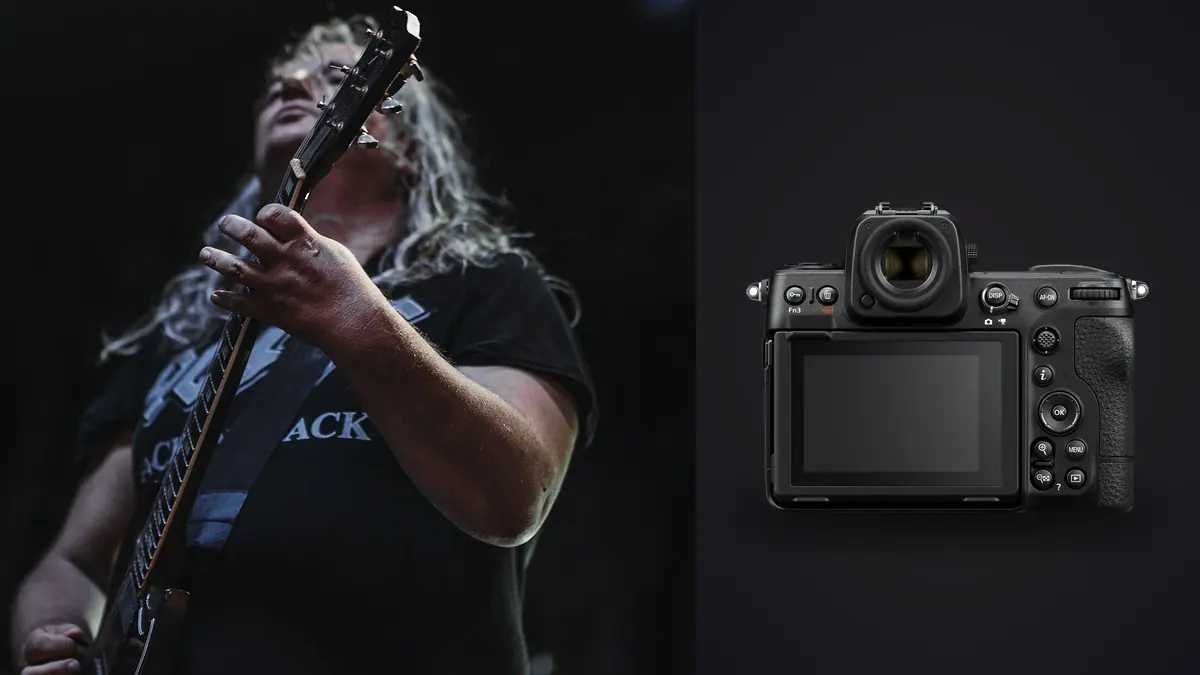
The Z8 shows up in a lot of photo pits for a simple reason: it borrows most of the professional media body's autofocus system and burst rate but weighs close to 350 grams less, which starts to matter around hour three of standing at a barricade with a 70-200mm hanging off your shoulder. I've shot club nights, a couple of mid-size theater bills, and one outdoor festival where the lighting rig probably cost more than my entire kit combined. None of that tells you much about settings, though. This is what actually changes when you bring this specific camera into a photo pit instead of reading its spec sheet.
What the sensor and shutter actually change at a show
The 45.7-megapixel stacked sensor is the headline spec, but the part that matters more in a pit is readout speed. Rolling shutter distortion under LED stage lighting used to be the reason a lot of photographers avoided fully electronic shutter modes at concerts; a whipping guitar neck would skew, a drumstick would smear at an odd angle. The Z8 reads out fast enough that I run electronic (silent) shutter for most of a set now, partly because plenty of venues genuinely enforce a no-mechanical-noise policy during quieter songs. You still get occasional banding under cheap flickering LED par cans at high shutter speeds, so I check the rear screen on the first few frames of any new lighting cue rather than trusting it blind.
Buffer depth is the other quiet win. With a fast CFexpress Type B card in the primary slot, 20fps raw bursts don't choke the way they would on an older body, which matters on a three-song pit set where you're often chasing one specific expression or a jump at the right height rather than shooting continuously. The SD card in the second slot is fine for backup but noticeably slower to write, so if you're recording raw to both cards for redundancy, plan for the buffer to clear at the SD card's pace, not the CFexpress card's.
Exposure before the first song starts
Manual mode with a shutter floor, not aperture priority
I shoot manual exposure with auto ISO and a minimum shutter speed set in the menu, not because it's more professional but because stage lighting swings several stops between a static verse and a strobe-lit chorus, and I don't want the camera compensating with aperture while I'm mid-track on a moving singer. A minimum shutter of 1/320s keeps most guitarists and drummers sharp; a vocalist parked at the mic stand can drop to 1/250s if the ISO ceiling is getting uncomfortable. Wide open at f/2.8, ISO commonly lands in the 6400 to 12800 range under typical club lighting, and the raw files still hold up reasonably well through noise reduction afterward.
Fighting mixed and moving light
White balance is where I stop trying to be clever in camera. Stage rigs mix tungsten wash, colored LED, and a haze machine turning everything a shade of blue, and no auto white balance setting tracks that consistently from frame to frame. I shoot raw and leave white balance on a flat daylight preset so the color shift stays relative and consistent across a sequence, then correct properly afterward instead of fighting it live. Chasing white balance per song in the pit spends attention you need for framing.
Autofocus that holds up under strobes
Subject detection set to People, with eye detection active, tracks a singer reasonably well until the light cuts to black between beats or a hard spotlight silhouettes the face, at which point the camera occasionally grabs a mic stand or a raised phone in the crowd instead. I keep AF-ON on a back button and a second custom button mapped to jump quickly between wide-area tracking and a single point, because there are moments (a guitarist's fretting hand, a drummer's stick mid-swing) where subject detection picks the wrong element in frame and you need to override it in under a second. The pre-release capture mode, which buffers frames from just before a full shutter press, is worth turning on specifically for a headliner's big jump; it's JPEG-only at that frame rate, but for one or two shots a night it's saved me from a peak moment I reacted to a beat late.
Lenses for three songs from the barricade
Most pits put you somewhere between one and three meters from the stage edge, close enough that a 24-70mm f/2.8 covers faces and mid-shots without much trouble. For a headline slot on a larger stage, or a barricade set further back than expected, a 70-200mm f/2.8 earns its weight, especially in DX crop mode where the extra reach helps without a teleconverter. Swapping lenses mid-set eats seconds you don't have during a three-song window, so on bigger nights I carry a second body instead, one lens mounted on each, and accept the extra shoulder weight for the tradeoff in speed. A fast prime, a 35mm f/1.4 or 50mm f/1.2, earns a spot in the bag for smaller rooms where you're close enough that the extra stop of light and the separation from a busy background actually shows in the frame.
Settings by venue size
| Venue type | Typical pit distance | Lens to start with | Shutter floor | ISO ceiling before I pull back |
|---|---|---|---|---|
| Small club | 1-2 m | 35mm or 50mm prime | 1/250s | 12800 |
| Mid-size theater | 2-4 m | 24-70mm f/2.8 | 1/320s | 8000 |
| Arena | 4-8 m | 70-200mm f/2.8 | 1/320s | 6400 |
| Festival mainstage | 6-15 m | 70-200mm f/2.8 (DX crop) | 1/500s | 5000 |
Pit etiquette that has nothing to do with settings
Most credentialed pits run on the first-three-songs, no-flash rule, and venue security enforces it more strictly than most bands' own teams would. You're usually sharing a narrow strip with anywhere from four to a dozen other photographers, all trying to get a clean angle on the same singer, so the practical skill is moving without blocking anyone's shot and knowing when your window has closed. I've had photo desks reject an otherwise good frame because a competitor's lens hood was visible in the corner, so awareness of who's beside you matters nearly as much as your exposure settings. None of this is specific to the Z8, but it's the part nobody mentions when the conversation turns to gear, and it shapes how much attention you actually have left over to think about the camera at all.
Battery and card logistics for a multi-band bill
The EN-EL15c gets talked up as a strong performer, and for a single headline set it usually is, but a full bill with an opener, a support act, and a headliner, each getting their own three-song pit window with gaps in between for reviewing frames on the rear screen, adds up faster than the CIPA rating suggests. I carry three batteries for anything longer than a single act and treat the in-camera charging over USB-C as a between-set top-up rather than a full recharge plan, since a quick fifteen minutes plugged in at the merch table rarely gets you back to full. Cards matter just as much: I've been caught out once running a slower UHS-I card as backup and watching the buffer stall mid-burst during exactly the chorus I wanted, which is a mistake I only needed to make once. A CFexpress Type B card in the primary slot and a fast UHS-II SD in the second is the combination that's stopped costing me frames.
Two mistakes that cost me usable frames early on
The first was trusting auto ISO without a shutter floor for longer than I should have. On aperture priority with a wide-open auto ISO range and no minimum shutter speed set, the camera will happily drop to a shutter speed that looks fine on the exposure meter but leaves a guitarist's headstock or a drummer's cymbal hand as a smear. It reads correctly exposed and wrong at the same time, and you don't catch it until you're looking at full-resolution files days later. Setting a hard shutter floor fixed this outright, and I haven't gone back to letting the camera choose shutter speed since.
The second was chasing subject-tracking AF into a scenario it wasn't built for: a singer walking directly toward a hard backlight during a costume change moment, silhouetted against a wall wash. The camera kept trying to find an eye that the light made functionally invisible, hunting instead of committing, and I lost the whole sequence to soft frames. Now, the moment I see a performer step into a silhouette, I switch to a single AF point on the outline of the shoulder or head rather than trusting subject detection to find a face that isn't really there to find.
Sorting a few thousand frames afterward
A single three-song set at 20fps, shot in short bursts chasing expressions and movement, can easily leave you with 800 to 1,500 raw files. Cover a five-band bill and you're looking at several thousand frames by the time the headliner finishes, most of them near-duplicates from the same burst, a good chunk soft because a strobe cut mid-exposure or an eye closed mid-scream. Doing that culling by eye at 100 percent zoom on a laptop at two in the morning after load-out is the part of concert photography nobody romanticizes.
This is where I run the card through imagic instead of straight into a raw catalog. It processes everything locally on the machine, which matters more than it sounds like on paper: a lot of pit contracts specify that images stay off any server until the artist's team has approved a select, and a tool that never uploads anything solves that without anyone having to think about it. The duplicate and burst clustering groups those repeated frames from a held note or a sustained jump so I'm choosing between five similar shots instead of forty, and the sharpness scoring flags the ones where a strobe hit mid-shutter or the subject blinked, which is genuinely hard to spot reliably at thumbnail size after midnight. Once I've built a concert look in apply_my_style, correcting for the green cast a lot of cheap stage LEDs leave and pulling back blown highlights from spotlights, I apply it across a whole night's keepers instead of redoing that color work show after show.
If the mechanics of AI-assisted culling are new to you, how AI photo culling actually works walks through what the sharpness and duplicate detection are doing under the hood. And if the bigger bottleneck in your workflow isn't the shoot itself but everything after it, these workflow tips apply just as well to a concert night as to a wedding or a portrait session.
Frequently Asked Questions
Is the Z8 overkill for someone just starting in concert photography?
Not really, though it's a real investment either way. The autofocus and buffer depth genuinely help in a photo pit's chaos, but a lighter, cheaper body run with the same settings approach will still get usable results. The bigger obstacle for a beginner is usually getting pit access and learning the etiquette, not the camera in your hands.
Should I shoot silent (electronic) shutter for the whole set?
I default to it, mainly because some venues ask for it during quieter songs, but I switch back to mechanical if I notice banding under a particular lighting rig or heavy rolling shutter skew during fast movement near the barricade. Test it in the venue rather than assuming one mode works everywhere you shoot.
What's the single most useful custom button setup for this kind of shooting?
A dedicated button to snap between wide-area tracking and a single focus point, kept separate from AF-ON. Subject detection is good but not perfect under strobes and hard backlight, and you need to override it fast without digging through a menu mid-song.
How do I stop the green or magenta color cast some venues' LED rigs leave?
Correct it once in post rather than fighting white balance live. Shooting raw with a flat, consistent white balance preset in camera makes that correction repeatable across a whole night instead of guessing song by song.