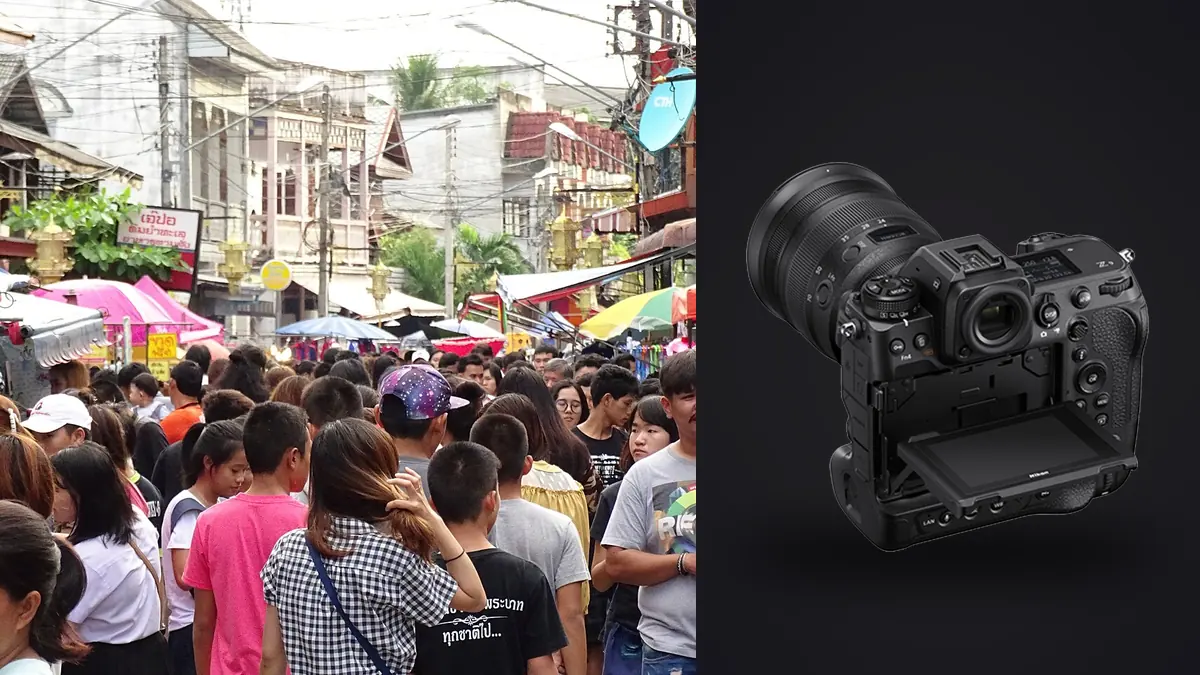
The first time I carried a Nikon Z9 into a market instead of a stadium, I expected to hate it within an hour. Everyone who has an opinion on street cameras has the same opinion about this one: too big, too heavy, too loud in the wrong ways (the shutter button click, the AF beep if you forget to kill it), too much camera for a genre that supposedly rewards disappearing. Some of that is fair. None of it is the whole story, and after two years of using the Z9 as my main body for documentary and street work, I think the reputation is judging it against the wrong job.
The size argument is half right, and worth being specific about
A Z9 body with battery and a card loaded weighs about 1340 grams. That is not close to a Leica Q2 at 638 grams, or a Fujifilm X100V at 478 grams, or even a Fuji X-T5 at 557 grams body-only. If your street practice depends on a camera that vanishes into a jacket pocket, the Z9 was never going to be your tool, and no amount of "actually it's fine" from me changes the math on your shoulder after eight hours.
But documentary work isn't always pocket work. A lot of it is a full day following one story, one family, one event, where the camera stays around your neck or on a strap the whole time and you need it to survive drops, dust, and rain without a second thought. In that context the Z9's weight buys you a sealed body that doesn't flinch at a sudden downpour mid-scene, a grip you can actually hold with cold hands for hours without cramping, and a viewfinder you can keep your eye against for an entire unfolding moment without it blacking out between frames. That last point matters more than people give it credit for. On a DSLR or a camera with a mechanical shutter, the viewfinder blacks out for the duration of the exposure and the mirror flip. On the Z9, because there is no mechanical shutter at all, you watch the scene continuously through the burst. You see the exact frame where the kid looks up, not an educated guess about when it happened.
If your version of street work is a quick unbothered wander with one prime lens for two hours, a Q2 or an X100V will serve you better and your back will thank you. If it's assignment-length documentary coverage where you need autofocus that won't quit and a body that won't die on you at hour six, the calculus flips.
What the stacked sensor actually buys you, beyond frame rate
Everyone talks about the Z9's 20fps blackout-free electronic shooting like the headline is speed. For street work the more useful part is what the stacked sensor does to rolling shutter and readout, and the fact that there is genuinely no mechanical shutter to fail or to make noise. In full silent mode the loudest sound the camera makes is the AF motor in the lens, which on the Z 28mm f/2.8 or the Z 40mm f/2 is close to nothing. I've shot inside a small chapel during a quiet ceremony and had nobody notice the camera was firing.
The tradeoff is rolling shutter artifacts under specific conditions: fast pans across strongly patterned backgrounds (chain-link fences, picket fences, escalator steps) will show mild skew, and shooting under flickering LED or older fluorescent light without the anti-flicker setting on will occasionally band a frame. Turn on flicker reduction (it's buried in the photo shooting menu, not somewhere you'd stumble on it) and the banding problem mostly disappears, at the cost of very slightly less predictable shutter timing at the highest frame rates. For anything below 20fps continuous it's a non-issue in practice.
Autofocus for unpredictable humans, not predictable athletes
The Z9's autofocus system was built and marketed around sports and wildlife, where the subject is doing something legible, running, jumping, flying in a direction. Street documentary subjects don't cooperate that way. Someone steps behind a pole, a second person walks into frame, a kid darts sideways. This is where I've found the subject-detection modes need active management rather than a "set it and forget it" attitude.
People detection with 3D-tracking is excellent when there's one clear subject and a relatively clean background, it locks onto a torso or head even in partial occlusion and holds through a surprising amount of interruption. In dense crowds it gets confused and will happily jump to the nearest stranger's face instead of the person you actually care about. My workaround has been to keep a custom button mapped to switch instantly between Wide-area AF (Small) for crowd scenes, where I pick my own point, and 3D-tracking for isolated single-subject moments. Switching costs a fraction of a second with the shooting bank set up right, and that fraction of a second matters less than picking the correct mode for the scene in the first place.
One thing worth knowing before you rely on it: pre-release capture (the buffer that records up to a second before you fully press the shutter) is genuinely useful for street work, catching the exact moment a hand gesture completes or a look happens, but it only works in specific high-speed frame-rate modes and it eats buffer and battery fast. I use it selectively, not as a default.
Settings by scene, not one universal recipe
The mistake I made early on was trying to find one "street setting" and leave it alone all day. Documentary work moves between wildly different light and subject conditions inside the same hour, so I keep three custom shooting banks and rely on Auto ISO with different caps rather than chasing exposure manually. Here's roughly what each situation calls for, based on what's actually worked across assignments rather than a manufacturer's suggested settings sheet.
| Scene | Shutter | Aperture | ISO approach | AF note |
|---|---|---|---|---|
| Sunlit market, moving crowd | 1/1000 | f/5.6 to f/8 | Auto ISO, capped 6400 | Wide-area AF (S), manual point selection over subject detection |
| Dim café or transit interior | 1/160 | Wide open (f/2 to f/2.8) | Auto ISO uncapped | 3D-tracking, People detection on, eye priority off |
| Backlit doorway or silhouette | 1/500 | f/8 | ISO 64 base, spot metering on highlight | Single point, zone-focus and wait rather than track |
| Walking alongside a moving subject | 1/250 | f/4 | Auto ISO, capped 3200 | 3D-tracking locked to torso, Continuous L (not H+) |
| Night market, mixed sodium/LED | 1/200 | f/2 | Auto ISO uncapped | Flicker reduction ON, single point, AF beep off |
The one row that surprises people is walking-alongside: I deliberately drop to Continuous L rather than the full 20fps electronic burst. At H+ speeds you generate an enormous number of near-duplicate frames of the same three seconds, and on a moving subject in mediocre light, most of them are motion-blurred anyway. Continuous L at a lower rate produces fewer, more deliberate frames, which turns out to matter a lot once you're sitting down to edit that night.
The lens kit that keeps the whole thing honest
A Z9 with the Z 24-120mm f/4 S mounted is a legitimately heavy combination, over 2kg, and it changes how people react to you on the street. Swap to the Z 28mm f/2.8 (which is small, cheap, and underrated) or the Z 40mm f/2, and the balance changes completely even though the body is identical. I've settled on carrying one prime for most of a day and only reaching for the 24-70mm f/2.8 when I know I'll need reach flexibility for a specific event, a parade, a protest, a crowded festival where I can't always move closer.
The FTZ II adapter opens up older manual Nikkors too, and for slower, more deliberate street work (the kind where you pre-focus a hyperfocal distance and wait for someone to walk into it) an old manual 35mm f/2 AI-S on the adapter is genuinely pleasant to use, if a little unbalanced on the big body. For a deeper dive into lens and location pairings specifically, see our Nikon Z9 street and documentary lens and location guide.
The file-volume problem nobody mentions in the reviews
Here's the part that camera reviews never talk about because it's not really about the camera, it's about what happens after. A full day of documentary coverage on the Z9, shooting bursts at 10 to 20fps whenever something interesting starts happening, easily produces four to six thousand frames. Most of those are near-duplicates of the same three or four seconds of a scene, five frames apart in expression and focus quality. Sorting that by eye at the end of a twelve-hour shoot day is its own kind of exhausting, and it's the actual bottleneck in a documentary workflow, not the shooting itself.
This is the specific problem I use imagic for. It runs entirely on the machine, no upload step, which matters more than convenience when the subjects in your frames are identifiable people in a documentary context you may not have full release paperwork for yet. It groups burst sequences and near-duplicates together automatically and ranks frames within each group by a local sharpness and focus score, so instead of scrolling through twenty frames of the same handshake looking for the one where nobody blinked, you're looking at the app's top pick per cluster and overriding it when you disagree. On a day where the Z9 generated close to five thousand frames, that cut my first-pass review down from most of an evening to under an hour.
Keeping a consistent look without re-editing every session from scratch
Documentary sequences read badly when the color and contrast wander from frame to frame within the same story, especially across mixed lighting like the sodium-to-LED transition you get walking from an outdoor market stall into a covered one. I used to rebuild my grading approach every session, eyeballing it fresh each time, which meant a Tuesday market story and a Thursday market story from the same location could look like they were shot by two different people.
What's fixed that for me is training imagic's apply_my_style feature on a batch of edits I was already happy with, so it learns the tonal and color decisions from my own past work rather than applying a generic preset. On a new set of Z9 RAW files, it gets the starting grade close enough to my usual look that I'm making small corrections instead of building the edit from zero, which matters a lot when you're trying to turn around a story same-day.
Battery, cards, and the unglamorous logistics
The EN-EL18d is rated around 700 shots CIPA, which understates real-world street use badly, since most street frames aren't single continuous-drive sports sequences, they're short one-to-five-frame bursts with long gaps of the camera sitting idle while you walk and look. In practice I get well past 1500 frames on a single charge on a normal documentary day, and I still carry a spare because a dead battery mid-story is not a risk worth taking. Dual CFexpress Type B slots mean I shoot RAW to one and a JPEG backup to the other, so a card failure doesn't cost me the day, which has happened to me exactly once, years ago, on a different camera, and was enough to make the habit permanent.
One practical note: CFexpress cards are not cheap, and the Z9's buffer is deep enough that a slower card becomes the actual bottleneck in long bursts. A 128GB Sony Tough CFexpress or equivalent is worth the money over a budget card if you're going to use the frame rate the camera is capable of.
Where it doesn't win
I want to be honest about the other side. If your street work is candid, close-range, and depends on the subject genuinely not clocking you as a photographer with a serious camera, the Z9 works against you. The size reads as "professional" to people in a way that changes their behavior, sometimes for the better (they trust you're legitimate at an event) and sometimes for the worse (they stiffen up, or they ask what you're doing). A smaller camera buys a kind of social invisibility that no amount of silent shooting mode replicates. For that specific style, I still reach for something smaller. The Z9 is my documentary and assignment camera, not my every-day quiet-observation camera, and I think pretending otherwise is how the "too big for street" complaints get started in the first place.
Frequently Asked Questions
Is the Nikon Z9 too heavy for a full day of street shooting?
It depends what "street shooting" means to you. For assignment-style documentary coverage where the camera stays around your neck and you need weather sealing and all-day AF reliability, most people adjust within a few outings. For quiet, pocket-friendly candid wandering for hours at a time, it's genuinely heavier than the genre traditionally calls for, and a smaller body will serve that specific style better.
Does the electronic-only shutter cause problems for street photography specifically?
The main risk is rolling shutter skew on fast pans across repeating patterns, and banding under flickering artificial light if you leave flicker reduction off. Both are manageable with settings changes rather than being fundamental limitations, and the upside, a completely silent shutter with zero moving parts to wear out, is a real advantage for documentary work in quiet or sensitive settings.
How do you deal with the number of frames a Z9 produces on a documentary shoot?
Shoot Continuous L instead of the full 20fps burst for anything that isn't genuinely fast action, since fewer, more deliberate frames beat a flood of near-duplicates at edit time. For the culling itself, I run everything through imagic afterward, which clusters burst sequences and ranks frames by a local focus score before I ever start manually picking, since sorting several thousand frames by eye after a long day isn't realistic.
Is the Z9's autofocus reliable for unpredictable street subjects, not just sports?
Reliable, but it needs the right mode chosen for the scene rather than one setting left on all day. 3D-tracking with people detection is strong for a single clear subject and gets confused in dense crowds, where a manually placed wide-area point works better. Treat it as a system you actively steer, not an autopilot.