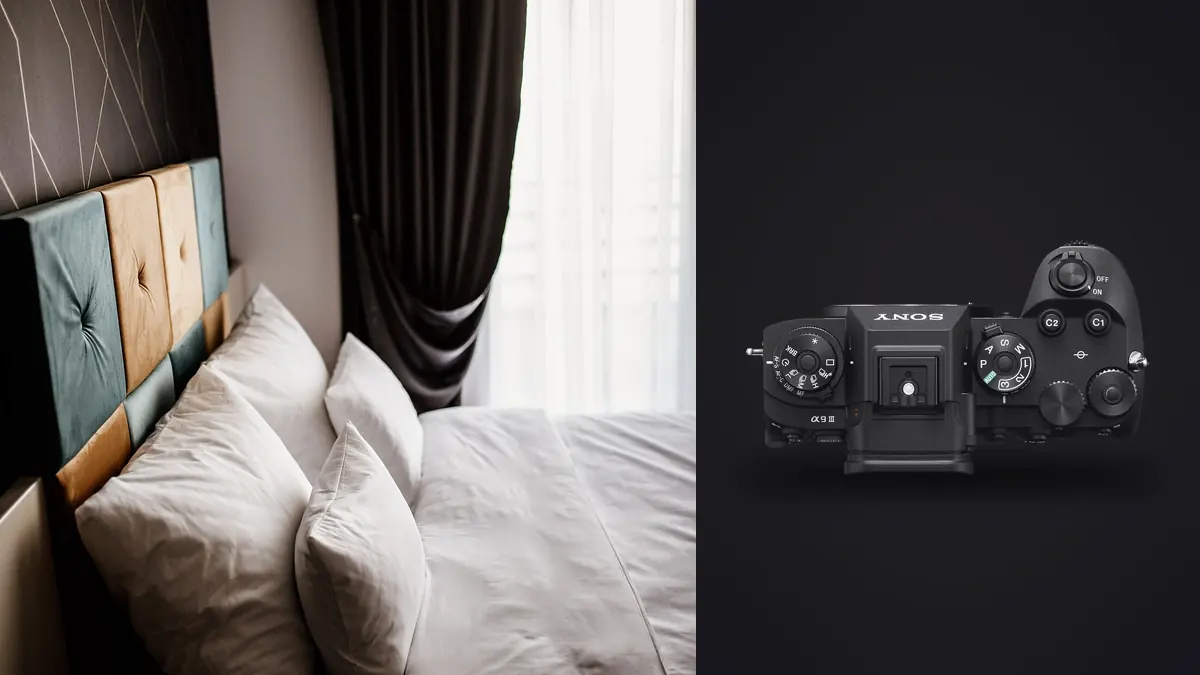
The first time I brought the Sony A9 III into a boudoir session, it was mostly out of convenience. I'd rented it for a motorsport job the week before and hadn't returned it yet, and my usual boudoir body was in for a sensor clean. I expected a fight. A camera built around 120fps blackout-free bursts and a stacked global shutter sensor didn't feel like it belonged in a quiet hotel room with one client, two softboxes, and a lot of gentle instructions about where to put her shoulders. Two hours in, some of what I was braced for turned out not to matter, and one thing I hadn't even thought about changed how I lit the whole session.
Why a sports camera keeps turning up in boudoir kits
The A9 III's headline feature is a stacked, global shutter sensor, which most people associate with the frame rate. For this genre, the frame rate is close to irrelevant. What matters is what a global shutter does structurally: it reads the entire sensor at once instead of scanning it top to bottom over a few milliseconds. On a rolling shutter camera, fast subject motion at a wide aperture and high shutter speed can skew or smear, hair mid-flip, a robe caught in a spin, a hand moving quickly past the lens. It's usually subtle enough that you only notice it when you're pixel-peeping a burst afterward and see one frame where an earring or a strand of hair looks stretched. On the A9 III that artifact doesn't exist. Every frame in a movement sequence is geometrically identical to a still frame, just with different motion frozen in it. For a genre that leans on flowing fabric, hair, and quick, natural gestures, that's a genuinely useful trait, even if nobody selling the camera markets it that way.
The flash sync trick nobody markets for this genre
This is the part that actually changed my lighting plan. Because the shutter is global rather than electronic-first-curtain, the A9 III syncs flash at any shutter speed, not just up to the usual 1/200 or 1/250 ceiling, and not through a power-robbing high-speed sync mode either. With a compatible flash you can sync as fast as 1/80,000. In practice that means I can shoot at 1/2000 and f/1.4 in a hotel room with a big window throwing hard afternoon light across the bed, and instead of stopping down to f/8 or bolting on an ND filter to tame that window, I just crank the shutter speed until the ambient light falls away to nothing, then bring the subject back up with a single strobe. I get to keep the shallow depth of field the whole point of this genre depends on, and I get to choose exactly how much window light survives in the frame instead of fighting a 1/250 ceiling for it. On my regular a7 body, doing this meant HSS and losing a stop or two of flash power for the privilege. Here it's just a shutter speed dial turn.
What the quiet buys you in the room
The A9 III has no mechanical shutter that moves during exposure. Even the older "silent mode" on other Sony bodies is an electronic simulation layered over hardware that's still physically there; this one has nothing to slap. For sports that's a nice-to-have. For a session where the client is nude or close to it, and already managing a lot of self-consciousness, it's more than that. A loud clack after every frame is a constant reminder that a machine is recording the moment, and people visibly brace before every shot on louder bodies, which shows up as stiffness in the final images. With the A9 III there's no sound cue at all, and sessions with it tend to settle into a rhythm faster, usually inside the first fifteen minutes instead of the usual thirty. It also means I can fire a short burst to catch a genuine exhale or laugh without that burst sounding like a machine gun going off in a quiet room, which matters more than it sounds like it should.
Where it actually gets in the way
None of this is a free win. The A9 III's native base ISO is 250, and unlike older Sony bodies there's no clean pull down to 100. In a moodier setup lit by window light and maybe one small continuous source, that puts you a stop and a third above where an A7 IV or A7R V would be starting, and shadow noise shows up sooner than I'd like on frames I'd normally lean into for a darker, more cinematic look. Weight is the second issue. The body alone is 703 grams, and with the 85mm f/1.4 GM II attached you're carrying close to 1.5kg one-handed for long stretches, often crouched in a bathroom doorway or leaning over a bed for an hour at a time, on a genre that's already slow and physically demanding to shoot well. And then there's the price. At launch this body ran $5,999, body only, which is a lot of sports-camera money for shutter behavior that a boudoir shooter can partly work around with a leaf-shutter lens or a well-timed HSS setup on cheaper gear. If 120fps tracking for an erratic subject isn't something your sessions ever need, and they usually aren't, you're paying for a capability you won't touch.
| Spec | Sony A9 III | Sony A7 IV | Sony A7R V |
|---|---|---|---|
| Native base ISO | 250 | 100 | 100 |
| Max flash sync (no HSS) | Up to 1/80,000 (global shutter) | 1/250 mechanical, 1/160 silent | 1/250 mechanical, 1/160 silent |
| Shutter sound at full speed | Silent, no mechanical curtain | Audible mechanical clack, silent mode risks banding | Audible mechanical clack, silent mode risks banding |
| Rolling shutter risk on fast fabric or hair | None (true global readout) | Moderate in e-shutter/silent mode | Moderate to high (61MP readout is slower) |
| Body weight (battery and card) | 703g | 658g | 723g |
| Launch price, body only | $5,999 | $2,499 | $3,899 |
Lenses that actually earn their place on this body
The 85mm f/1.4 GM II is the workhorse for this kind of session, close enough for the classic compressed, intimate framing without crowding the subject in a small hotel room. The 50mm f/1.2 GM covers the tighter, two-thirds framings where 85mm would push you into the hallway, and it's the lens I reach for most in cramped bathrooms and closets, which is where a surprising amount of boudoir actually happens. A 35mm f/1.4 GM earns its spot for the environmental frames, the ones that show the whole room, the unmade bed, the light through sheer curtains, context that a tighter lens throws away. For detail work, rings, lace trim, hands resting on skin, a 90mm f/2.8 macro is worth packing even if it only comes out for ten frames a session. I'd skip a standard zoom entirely here; a variable f/2.8 kills the exact shallow, separated look this whole setup is built around, and it wastes what you're paying the A9 III for in the first place.
Shooting around what the shutter is actually good at
Most of a boudoir session on this body should still be shot single-frame or on a modest 3 to 5fps burst, because most of the work is deliberate: posing, adjusting a hand, checking a chin angle, waiting for a natural expression rather than machine-gunning toward one. I save the high burst rates for the handful of movement-driven sequences a session usually has, a robe drop, a slow spin in front of a mirror, hair being pulled through fingers, walking toward the camera in something sheer. Across a typical ninety-minute session that's maybe eight to ten minutes of actual high-frame-rate shooting, but those minutes are where the global shutter's lack of skew earns its keep, because every one of those frames stays clean and usable instead of one in five showing a slightly warped hemline.
Turning three thousand near-identical frames into twenty deliverables
Here's the part nobody warns you about before you own one of these bodies. A single robe-drop sequence shot at 30 or 60fps can hand you 150 to 200 frames that are all technically sharp, because there's no rolling shutter smear to help you eliminate the obviously bad ones the way it might on another camera. The expression and the exact drape of the fabric are the only things separating a keeper from a throwaway, and picking that apart by eye at the end of a long shoot day is genuinely tedious. This is where I lean on imagic to get through the folder. Its local sharpness and focus scoring flags which frames in that burst are actually sharpest on the eyes, and its duplicate and burst clustering groups that 150-frame sequence down into the handful of genuinely distinct poses and expressions, so I'm choosing between six or seven clusters instead of scrolling through every single frame twice. Given that a lot of this material is intimate or nude, I also don't want it touching a cloud culling service at any point, so the fact that imagic processes everything fully offline, nothing leaves the machine, matters as much to me as the speed does. Once the keepers are picked, I run imagic's apply_my_style preset, trained on my own past edits rather than a generic filter, so a session shot half under window light and half under strobe still lands on a consistent tone across the delivered set. If you're new to this kind of AI-assisted sort, how AI photo culling actually works is worth a read before you trust it with a paid shoot, and these workflow habits pair well with a camera that's this good at generating volume.
Frequently Asked Questions
Is the Sony A9 III actually worth buying just for boudoir work?
Only if the flash sync range or the true silence solves a problem you're already running into, mixed hard window light plus strobe, or clients who visibly tense at a loud shutter. If neither of those describes your sessions, the 120fps tracking speed you're also paying for will sit unused, and a cheaper body with a leaf-shutter portrait lens gets you most of the sync benefit for a fraction of the price.
Does the higher base ISO of 250 actually hurt in dim bedroom setups?
Yes, measurably. Compared to a body with a native ISO 100 floor, you're starting a stop and a third hotter before you even account for a dim room, and shadow noise becomes visible sooner in low, moody lighting setups shot without flash. It's not disqualifying, but if you shoot a lot of candlelit or single-lamp scenes, plan on either adding a small fill light or accepting grainier shadows than you'd get on an A7R V.
Can you shoot boudoir on this camera with available light only, no flash?
You can, and the lack of rolling shutter distortion still helps with any hair or fabric movement. But you lose the camera's single biggest advantage for this genre, since the extended flash sync range only matters when you're actually using flash. Without strobes, you're mostly getting a very capable, somewhat noisy-at-the-floor full-frame body with excellent autofocus and nothing else this article talks about really applies.
What frame rate should you actually use during a boudoir session?
Single shot or a slow 3 to 5fps burst for the vast majority of posed frames, since most of a boudoir shoot is deliberate rather than reactive. Reserve the higher burst rates, 20fps and up, for genuine movement, a spin, a robe drop, a hair toss, where you're trying to catch one specific instant out of a continuous motion rather than refining a static pose.