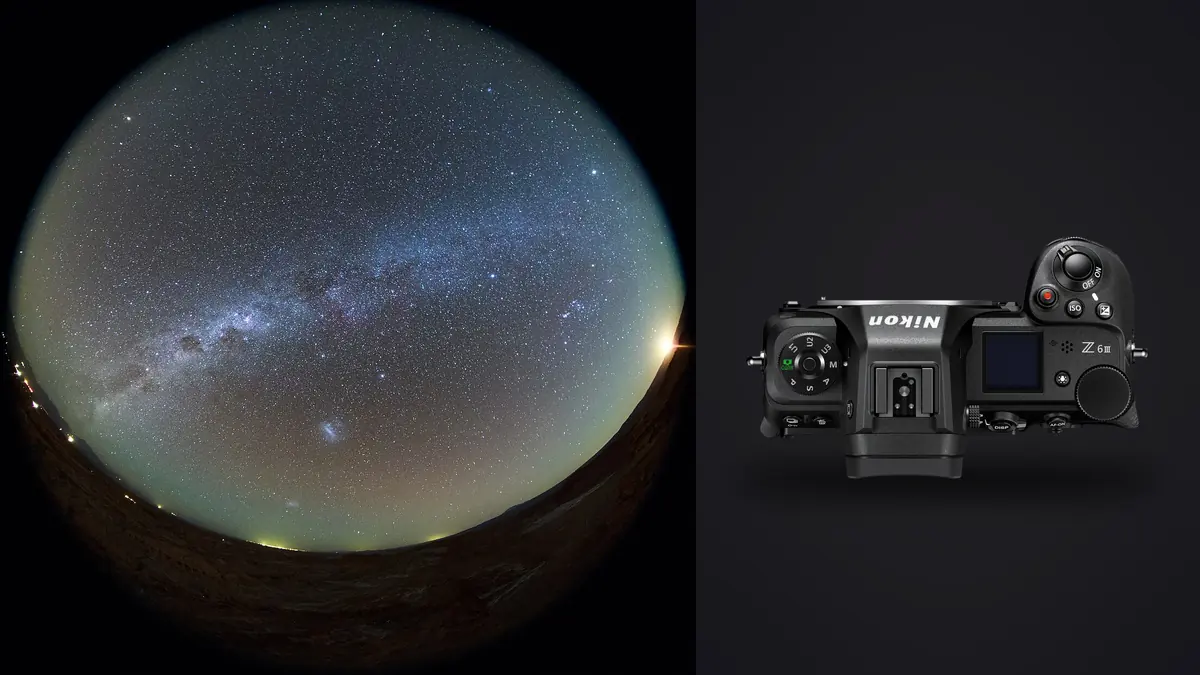
The Nikon Z6III pairs a 24.5-megapixel full-frame partially stacked sensor with in-body stabilization, a bright electronic viewfinder, an articulating screen, and long-exposure controls. For astrophotography, the quality of the night often depends less on the body's headline speed than on lens behavior at the corners, support stability, dew prevention, site access, moon and weather planning, and a repeatable sequence for later stacking.
This guide treats star stacking as a capture and logistics problem. The Z6III records the component RAW frames; dedicated software combines them later. The plan covers static tripod landscapes and tracked sky work without claiming that one accessory or exposure formula fits every focal length and sky.
Read star and foreground failures separately
Troubleshooting a Z6III astro sequence begins by comparing the center, corners, and foreground rather than applying global sharpening. Short trails across the full sky indicate exposure duration, tracking, or support movement. Wing-shaped stars confined to corners point toward lens behavior or focus, while a soft center suggests focus drift, dew, or vibration. One displaced frame in an otherwise aligned sequence may follow a tripod bump or tracker correction. A noisy foreground is not repaired by adding mismatched tracked sky frames; it needs its own exposure plan. Check the first, middle, and last RAW components before leaving, because temperature and condensation can change a sequence gradually.
Choose a site for darkness, safety, and foreground structure
Darkness alone does not make a useful location. Look for a legal place to stand, a stable surface, a safe route in and out, and a foreground that remains readable at night. Visit in daylight when possible. Note cliffs, water, loose ground, traffic, livestock boundaries, locked gates, and places where a tripod could obstruct others.
Check the direction of the intended sky feature relative to the foreground. A dark-sky map can suggest low light pollution, while a planetarium app can estimate orientation and timing. Treat both as planning aids, then account for local obstructions, haze, weather, and seasonal access.
Moonlight can reveal the landscape or overwhelm faint stars. Decide whether the goal is a silhouetted foreground, a naturally lit landscape, or a dark sky with separately prepared foreground exposure. Avoid inventing impossible illumination during processing; record enough notes to remember which sources were present.
Evaluate lenses by corner behavior, not maximum aperture alone
A fast lens gathers light, but stars near the corners reveal coma, astigmatism, field curvature, and decentering. Test the exact copy before travel. Photograph a star field at several apertures, focus carefully in the center, and inspect all four corners for matching behavior. If one corner is consistently worse, the lens or mount alignment may need attention.
A very wide lens makes tracking error less obvious and includes more foreground, but it also makes sky objects smaller. A moderate wide or normal lens records more structure in the Milky Way and constellations while demanding more accurate tracking or shorter untracked exposures. Build the composition first, then choose the focal length.
Stopping down slightly can improve corner stars and reduce vignetting, but it costs light. The useful aperture balances star shape, exposure time, ISO, and the number of frames available for stacking. Do not select the widest aperture from the lens engraving without inspecting real corners.
Build support for the type of stack
A static tripod supports untracked sky sequences and separate foreground exposures. Use sturdy legs, a head that locks without sag, and a quick-release plate that cannot twist under the lens. Extend thick leg sections first, keep the center column low, and avoid hanging a weight that can swing in wind.
A star tracker rotates the camera to follow the sky, allowing longer exposures before stars trail. It also causes the landscape to move relative to the camera, so tracked sky and static foreground are normally captured separately and combined in suitable software. Precise polar alignment and balanced load matter more as focal length increases.
For either setup, disable or configure stabilization according to Nikon and lens guidance on a fixed support, then inspect a test frame. Use a remote release, interval shooting, or a short delay. Shield the tripod from footfalls and do not touch it while a sequence runs.
Pack for dew, power, and visibility
- Dew heater and power: keep the front element slightly above the dew point without heating the lens excessively.
- Spare batteries: cold and long display use reduce practical endurance; keep spares protected and organized.
- Dim red headlamp: preserve working vision and avoid illuminating other photographers or the composition.
- Lens cloth and blower: remove condensation and dust only after checking that wiping will not grind debris.
- Warm clothing and water: plan for standing still longer than a daytime scout suggests.
- Offline map and contact plan: do not assume mobile service at a dark site.
Route heater and remote cables so they cannot pull the camera or snag a leg. Secure battery packs to a stable support rather than letting them hang. Check local rules before using lights, heaters, or equipment near protected habitats and historic sites.
Focus on a star and verify the whole frame
Autofocus may acquire a bright star or distant light, but manual magnified focus is more repeatable. Choose a bright star, magnify it, and adjust until it is smallest and most defined. Approach final focus from the same direction to reduce backlash, then secure the ring without shifting it.
Infinity markings are approximate and temperature can change lens focus. Recheck after the equipment cools, after a major temperature change, and after any contact with the lens. Do not tape a focus ring until the actual night focus is confirmed.
Inspect center and corners. If the center is sharp but all corners stretch similarly, aperture or lens design may be the issue. If only one corner is poor, check lens seating, support, and possible decentering. If every star elongates in the same direction, exposure time, tracker alignment, or vibration is more likely.
Design a stack with consistent component frames
Use manual exposure and fixed white balance so frames do not change as the sequence progresses. Record RAW. Select shutter time according to focal length, pixel scale, tracking accuracy, and acceptable star shape rather than a single simplified rule. Make a short test and inspect actual stars.
Stacking several consistent sky frames can reduce random noise compared with relying on one extreme exposure. It cannot repair clipped stars, drifting focus, cloud, dew, or a tripod bump. Capture enough frames for the intended software method while keeping gaps short and the setup untouched.
Calibration frames may be useful in some astrophotography workflows. Their type and capture method depend on the stacking software and optical setup. Follow the chosen software's current instructions; an incorrectly made calibration set can create artifacts instead of removing them.
Separate static foreground and tracked sky honestly
On a static tripod, a foreground and sky can sometimes share one short exposure, but each has different needs. A foreground may tolerate a longer exposure and lower ISO, while stars trail if the shutter remains open too long. Capture separate components from the same locked position when the scene requires it.
With a tracker, turn tracking off for the ground sequence or make the foreground before alignment changes. Keep lens, focal length, and camera position stable. Record notes about which frames are tracked and which are static so the sets are not mixed during ingest.
Combining components is compositing. Keep the horizon, time, light direction, and sky position credible, and disclose the method when context requires it. imagic does not merge star stacks, HDR brackets, or panoramas; use dedicated software for the merge.
Use the Z6III controls for night efficiency
Store a night setup with RAW capture, manual exposure, fixed white balance, long-exposure noise reduction chosen for the sequence plan, and display brightness reduced enough to preserve dark adaptation. A bright rear screen can make an underexposed frame look finished. Trust the histogram and magnified stars.
The articulating screen reduces the need to crouch behind a low tripod. Keep it angled so it does not cast light toward others. Turn off unnecessary wireless functions, review sounds, and indicator brightness while retaining enough status feedback to avoid recording mistakes.
The camera's CFexpress/XQD and SD-compatible slots can be configured for backup or overflow. Night sequences are difficult to repeat after focus or clouds change, so tested redundant media may be worthwhile. Confirm both destinations before walking away from an interval.
Ingest, sort, and prepare the components
Copy cards into folders for sky lights, foreground, tests, and any calibration frames. Keep original sequence order and make a verified second copy. Reject frames with aircraft or satellites only according to the stacking method; some software can remove transient trails, while a dense obstruction may need manual exclusion.
Use imagic only for the parts it actually provides: local library ingest, technical culling signals, non-destructive still adjustments, learned style application, and JPEG or TIFF export. A star field can challenge ordinary sharpness logic, so inspect focus and trailing manually. The desktop workflow remains local, and Lenses and Optics offers related gear planning.
Manage weather transitions and condensation
A clear forecast can still produce ground fog, high thin cloud, wind, or rapid humidity changes. Check the sky throughout setup rather than only before departure. Thin cloud may leave bright stars visible while spreading light pollution across the frame, and gusts can ruin a long sequence without visibly moving a heavy tripod.
When leaving a cold site for a warm vehicle or room, place the camera and lens in a closed bag while still outside. Let the bag warm gradually before opening it. Moisture then tends to form on the bag rather than immediately on cold optical and electronic surfaces. Do not detach a lens while condensation risk is high.
If dew reaches the front element during capture, stop the sequence, protect the camera, and dry it gently. Wiping repeatedly without controlling temperature treats the symptom only. Increase dew-heater support carefully, verify focus again after intervention, and discard compromised frames during review rather than stacking their blurred glow into the result.
Night-site checklist
- Confirm permission, weather, moon, access hours, and a safe return route.
- Scout the foreground in daylight and record the intended sky direction.
- Test lens corners and tracker capacity before travel.
- Pack stable support, dew control, power, a dim lamp, and offline navigation.
- Cool the equipment, focus on a star, and recheck all corners.
- Lock manual exposure and white balance for the full sky sequence.
- Label tracked sky, static foreground, tests, and calibration frames separately.
- Inspect for dew, trailing, cloud, and vibration before leaving the sequence unattended.
Frequently asked questions
Can the Nikon Z6III stack stars in this workflow?
No. The camera records component frames, and this app does not merge star stacks. Use dedicated stacking software, then manage or edit the resulting still as needed.
Is the widest lens aperture always best for stars?
No. A lens may show coma, soft corners, or heavy vignetting wide open. Test the exact lens and choose the aperture that balances star shape and light gathering.
Should stabilization remain on with a star tracker?
Follow Nikon and lens guidance for the fixed support and verify a test frame. Stabilization can be unnecessary or counterproductive when the camera is already moving in a controlled way on a tracker.
Why did focus change during the night?
Temperature, contact with the lens, zoom movement, or ring creep can shift focus. Recheck after the equipment cools and whenever conditions or the setup change.