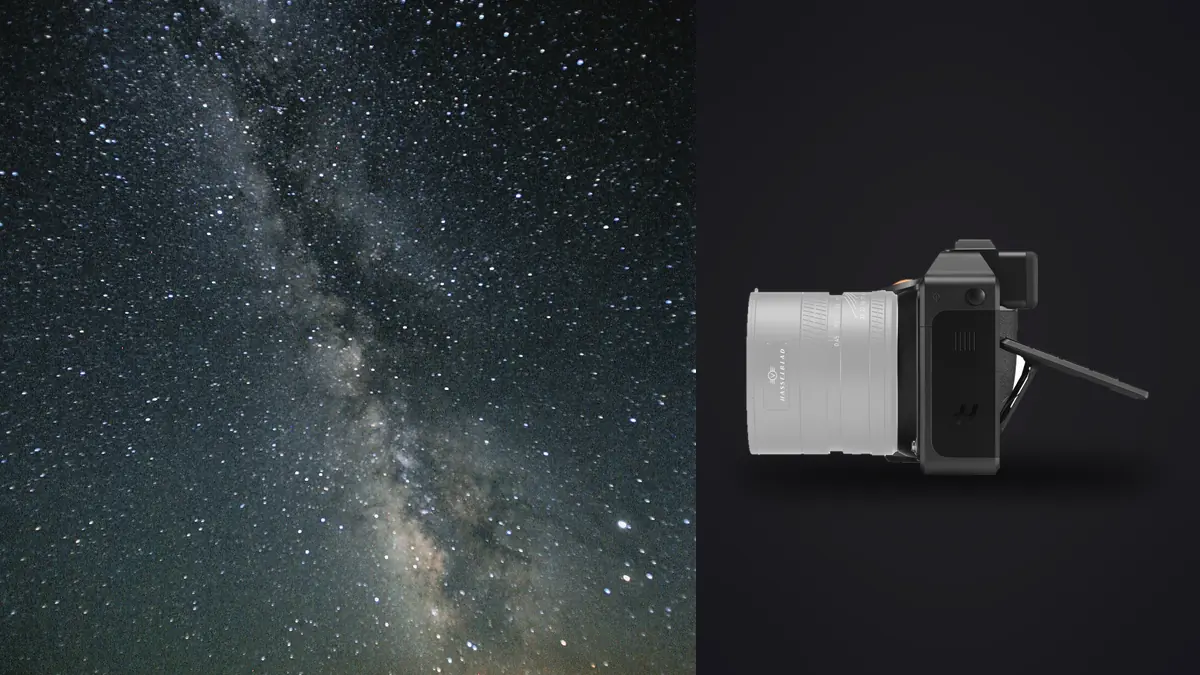
Medium format and astrophotography don't get talked about in the same sentence very often, and there's a reason for that. Big sensors, small apertures on most of the glass, and files that choke a laptop aren't exactly the recipe people reach for when they want clean Milky Way shots. But I spent four nights this summer running a Hasselblad X2D 100C through a star stacking workflow, first at a dark-sky site above 8,000 feet in the Eastern Sierra and then again on a much hazier ridge closer to home, and the results changed my opinion of the camera for this specific use case. Not because it's the obvious tool. Because the 100-megapixel sensor forces you to be more disciplined about exposure math than a full-frame body ever does, and that discipline pays off in the final stack.
This isn't a camera review. It's a walkthrough of what actually happens when you point a $8,200 medium format body at the night sky, stack forty-plus frames, and try to get a usable image out the other end without your storage drive filing a complaint.
The exposure math is different, and it matters more than you'd think
The X2D 100C's sensor is 43.8 x 32.9mm, noticeably larger than a full-frame 36 x 24mm chip. That changes the geometry of star trailing in a way most people gloss over. Because the sensor is physically bigger, a given focal length produces a wider field of view than it would on full frame, which is usually described with a "crop factor" of roughly 0.79x. A 30mm XCD lens behaves, in terms of framing, closer to a 24mm lens on a full-frame body. That wider effective field of view means stars have to travel less far across the frame, relatively speaking, before you notice trailing, so the classic "500 rule" gives you more headroom than it would on a smaller sensor at the same focal length. Divide 500 by the full-frame-equivalent focal length, not the lens's stated focal length, and you get a longer allowable exposure than intuition suggests. Here's where the 100-megapixel count bites back, though. Trailing that's invisible at the frame level shows up fast in a 100% crop, because each star is being resolved across more pixels than it would be on a 24 or 45-megapixel sensor. I found the textbook 500-rule number consistently optimistic once I started pixel-peeping stacked files at full resolution. In practice I ended up using a tighter divisor, closer to 300, any time I planned to crop in during editing.
| XCD lens | Actual focal length | Full-frame equivalent | Frame-level max exposure (500 rule) | Pixel-level max exposure (practical, 300 rule) |
|---|---|---|---|---|
| XCD 4/21 | 21mm | ~16.6mm | 30s | 18s |
| XCD 3.5-4.5/20-35 (wide end) | 20mm | ~15.8mm | 32s | 19s |
| XCD 3.5/30 | 30mm | ~23.7mm | 21s | 13s |
| XCD 2.5/55V | 55mm | ~43.5mm | 11.5s | 7s |
That last row is the one that trips people up. A 55mm lens still reads as roughly "normal" in medium format terms, and normal focal lengths are unforgiving for untracked astro work no matter what body you're using. If you're chasing wide starfields rather than a tight composition on a specific part of the sky, stay at 21 or 30mm and accept the field of view penalty.
Which XCD glass actually earns a spot in the bag
The XCD line isn't built with astrophotographers in mind, and it shows. There's no fast f/1.4 equivalent, and the widest prime available is the 21mm at f/4. That's a real limitation, because a slower maximum aperture means either higher ISO or longer exposures to hit the same signal, and both come with tradeoffs. I shot most of my sessions on the 21mm, stopped down half a stop to f/4.5 for corner sharpness, at ISO 1600. The 30mm f/3.5 came out for compositions where I wanted a foreground subject, like a rock formation or a tent, to read a bit larger relative to the sky. I did not bring the 55mm on the second trip. At that focal length you're better served by a full-frame or APS-C body with a fast prime unless you're specifically tracking and don't mind long single exposures. One thing I'll say in the X2D's favor: the files handle noise at ISO 1600 to 3200 better than I expected going in. Medium format sensors have historically lagged behind full frame in high-ISO performance because the pixel pitch trade-off works against them at 100 megapixels, but Hasselblad's backside-illuminated design closes a lot of that gap in high-ISO noise handling. It's not going to outshoot a modern full-frame body built for low light, but it's not embarrassing either.
Tracked stacks versus brute-force stacks
You have two real options for building a clean star stack with this camera: mount it on a tracker and take fewer, longer exposures, or leave it on a static tripod head and take a lot of short ones, then let stacking software average out the noise. I tried both. The tracked approach (an iOptron SkyGuider Pro, rated for a 5kg payload) handled the body and 21mm lens without complaint, total rig weight came in under 1.4kg, lighter than I expected for medium format. That gave me the option of 90-second subs at ISO 800 instead of 18-second subs at ISO 1600, and the resulting files had noticeably less shot noise to begin with. The untracked approach is more forgiving logistically. No polar alignment, no tracker to carry, no risk of the mount drifting mid-session because you bumped the tripod leg reaching for a headlamp. It just needs more frames to get to the same signal-to-noise ratio, and more frames means more storage and more culling.
| Approach | Typical sub length | Subs for a clean stack | Approx. session storage | Extra gear weight |
|---|---|---|---|---|
| Untracked, static tripod | 13-20s | 40-60 subs | 8-12 GB | None |
| Tracked, star tracker | 60-120s | 15-25 subs | 3-5 GB | ~1.1 kg (mount + counterweight) |
Storage matters more with this camera than with almost anything else I've shot astro on. A single 3FR raw file out of the X2D 100C runs 180-220MB depending on scene complexity. Sixty subs from an untracked session, plus darks and flats if you're bothering with calibration frames, adds up to a genuinely large folder before you've even started stacking.
What went wrong, because something always does
Autofocus on stars is a non-starter with this system, and I don't think that's unique to Hasselblad. I switched to manual focus, used the 3.6-inch rear screen's magnification to nail focus on a bright star or distant light, and taped the focus ring down with gaffer tape so it couldn't drift while I was swapping compositions. Skip the tape step at your own risk. I lost an entire twenty-frame sequence on night one to a focus ring that crept half a millimeter when I brushed it changing the tripod angle. Cold weather battery life was the other issue. Hasselblad rates the X2D 100C around 420 shots per charge under CIPA testing, and that number drops fast once the temperature gets below freezing, which is exactly when you're most likely to be out shooting clear winter skies. I carried three batteries for a planned four-hour session and used all three. Budget for more spares than you think you need. Condensation showed up on the second night when I moved the camera from a warm car into 20-degree air without letting it acclimate in the bag first. Nothing dramatic, just a faint fog on the front element for the first fifteen minutes that ruined a handful of subs before I caught it on the rear screen.
Getting from forty raw files to one clean image
This is the part that actually determines whether the shoot was worth the trouble, and it's the part most articles about this camera skip entirely. After a session you're sitting on a folder of 40 to 60 files, each nearly 200MB, and not all of them are usable. Some have wind-induced micro-shake from a gust hitting the tripod. Some have a plane or satellite trail cutting through the frame. A few will have that focus drift I mentioned. Sorting through that manually, at 100% zoom, on files this size, is slow enough that I stopped doing it by hand after the first session and started running the folder through imagic instead. It scores every frame for sharpness locally, without uploading a single 200MB raw file anywhere, which matters when you're dealing with a full night's shoot and a hotel Wi-Fi connection that can't be trusted with that kind of upload. I can flag the soft or trailed subs in a couple of minutes rather than an hour of squinting at a laptop screen at 2am. Once the good subs are isolated, I hand them off to dedicated stacking software. DeepSkyStacker and Sequator both handle 3FR files fine after a Lightroom or Capture One conversion to DNG or TIFF, and Starry Landscape Stacker is worth the money if you're doing untracked wide-field work with a foreground you want kept sharp while the sky gets aligned separately. None of these tools are things imagic replaces, and it doesn't try to. Its job in this workflow is entirely upstream: getting you from a messy folder of night-sky exposures to a small set of frames actually worth feeding into a stacker, all processed on the machine in front of you rather than round-tripped through someone else's server. The last step, once I have a stacked master file, is color and tone. Night sky files need a specific touch, usually a fair amount of shadow lift without crushing the black point, and a particular way of handling the transition between sky and foreground so it doesn't look like two separate photos glued together. I built an apply_my_style preset in imagic off a batch of astro edits I was already happy with, and now new stacked masters from this camera get that same grading pass applied automatically instead of me rebuilding it from scratch every time. It's saved real time across four separate outings, since the sky-to-ground blend and the shadow curve I like don't change much from location to location, only the composition does.
Is it worth it compared to a full-frame kit
Honestly, if star stacking is your only priority, a full-frame mirrorless body with a fast wide prime will get you there faster and cheaper. You'll shoot at f/1.8 instead of f/3.5-4, gather more light per second, and need fewer subs to hit the same noise floor. The X2D 100C's advantage shows up specifically when you also want the option to print large, or when the same trip needs to produce landscape and portrait work where medium format's rendering earns its keep during daylight hours. I wouldn't buy this camera for astro alone. I would, and did, bring it along on a trip where astro was one goal among several, and found the workflow more manageable than I expected going in, once I stopped fighting the file sizes and started culling before stacking rather than after.
Frequently Asked Questions
Does the in-body stabilization on the X2D 100C do anything for star stacking?
Not for the actual star exposures. IBIS is built to counter handheld shake at shutter speeds well under a second, and star stacking subs run anywhere from 13 seconds to two minutes on a tripod, far outside what stabilization is designed to correct. Where it helps is composing and checking focus handheld before you lock the camera onto the tripod head, and for any handheld foreground or reference shots you take during the same outing.
Can I get away with an untracked stack instead of buying a star tracker?
Yes, and I'd actually recommend starting there. Untracked stacking with 40-60 short subs produces genuinely clean results once averaged, and it removes an entire category of failure points (polar alignment, mount drift, cable snags) from a session that already has enough variables. Move to a tracker once you've got the culling and stacking workflow dialed in and you're specifically chasing longer single exposures or a narrower field of view.
Is the internal SSD fast enough for a full night of long exposures?
Yes, write speed was never the bottleneck in my sessions. Capacity was more of a concern than throughput. A long untracked session with darks and flats can eat several gigabytes fast given the ~200MB file size, so I'd treat the internal SSD as your working buffer for the night and offload to a laptop or portable drive before starting a second session rather than trying to fit multiple nights on the camera alone.
Do I need to shoot RAW, or is 16-bit compressed good enough for stacking?
Stick with the full 3FR raw files. Star stacking software is averaging subtle per-pixel signal across dozens of frames to pull faint detail out of noise, and any lossy compression step, even a mild one, throws away exactly the low-amplitude information that stacking is trying to recover. The larger file size is annoying but it's the whole point of shooting raw for this kind of work.