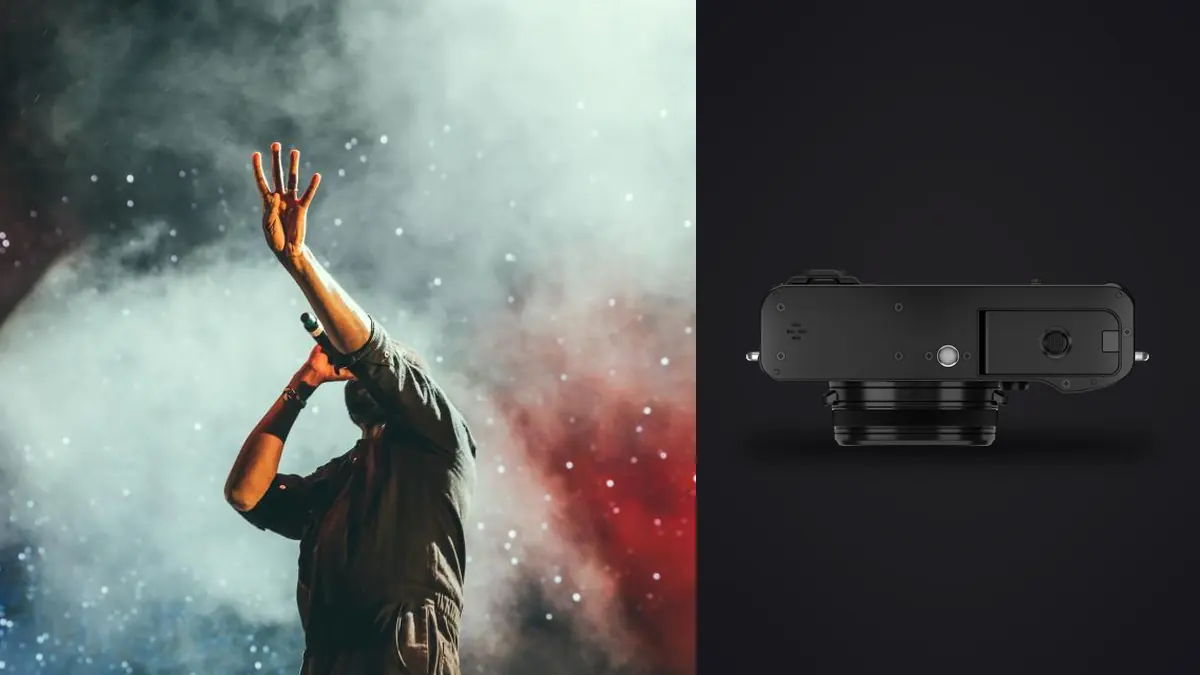
I brought the X100VI to a gig for the first time expecting to hate it by the second song. A fixed 23mm lens (35mm equivalent once you account for the APS-C crop) is not what anyone hands you when you ask for a "concert camera," and every instinct built from years of shooting photo pits with a 70-200mm screamed that I'd left the important lens at home. Three sets in, in a room that held maybe 150 people with a low stage and a singer who kept stepping into the crowd between songs, the calculation looked different. This is what actually happened across a dozen or so shows with it since, small clubs, one outdoor festival slot, and a couple of quiet acoustic nights where a shutter click carries across the whole room.
The Fixed Lens Is the Whole Story
Everything about how the X100VI performs at a gig traces back to one decision Fujifilm made years ago and never walked back: one lens, 23mm f/2, no zoom ring, no mount to swap. At a big venue with a photo pit twenty feet from the stage and a barrier between you and the band, that's a dealbreaker. You physically cannot get close enough for a usable frame without cropping so hard you lose the resolution advantage the 40-megapixel sensor is supposed to give you. I tried it once from a pit at a mid-size venue and came home with a card full of tiny, distant musicians that needed a 3x crop just to read as a portrait. Not the camera's fault. Wrong tool for that job.
Where it flips is anywhere you can actually get close: house shows, 200-cap clubs, backstage, the edge of the stage at a festival side-tent, or any situation where you're not fighting a barrier and a security guard for position. At that working distance, 35mm equivalent stops being a limitation and starts being the reason the photos look different from everyone else's telephoto-compressed stage shots. You get the drummer's kit, the amp stack, the three feet of sweaty floor between the singer and the front row, all in the frame, because you're standing where a bigger rig physically couldn't fit.
The digital teleconverter helps stretch the range without actually changing the lens. Fujifilm crops the 40MP sensor down to simulate 50mm and 70mm equivalent framing, and because you're starting from such a high native resolution, the 50mm crop still leaves you around 20 megapixels, plenty for anything short of a big print. The 70mm crop drops to roughly 10 megapixels, usable for web and social but not something I'd want to push much further. I use the 50mm crop probably a third of the time at gigs, mostly for a tighter vocal shot without physically closing the distance and breaking the moment.
Where the Leaf Shutter Actually Matters
This is the feature I undersold before I owned the camera and now bring up unprompted. The X100VI's leaf shutter, combined with the fully electronic shutter mode, lets you shoot in complete silence. Not "quiet for a mirrorless." Actually silent, no mechanical sound at all. For a loud rock show that's a nice-to-have. For anything quieter, an unplugged set, a jazz trio, a singer-songwriter with just a guitar and a room full of people leaning in to hear the lyrics, it's the difference between photographing the show and becoming part of it. I shot a solo acoustic set in a converted bookstore where you could hear a chair creak from across the room, and the only way I got close, usable frames without every head in the audience turning around was because the camera made zero noise doing it.
The tradeoff with fully electronic, fully silent shooting is rolling shutter. Stage lighting rigs that flash, strobe, or cycle through colored washes fast can produce banding or a warped frame if your shutter speed and the light's refresh rate land wrong relative to each other. I've had frames from strobe-heavy sections come back with a visible horizontal tear across the image, which the mechanical (leaf) shutter mode doesn't suffer from nearly as often. My rule of thumb ended up being: silent electronic shutter for quiet, steady-lit rooms, and the mechanical leaf shutter the moment the lighting operator starts throwing strobes or fast color changes, even though it means giving up the silence.
IBIS Changed What I'm Willing to Shoot Handheld
The X100VI is the first camera in this lineup with in-body stabilization, rated at up to 6 stops, and it's a genuinely bigger deal for live music than it sounds on a spec sheet. Concert lighting is unpredictable and often bad by any normal photography standard: single-source colored washes, backlighting that blows out a silhouette, long stretches where the only light on stage is a dim amber wash that meters two stops under anything you'd call comfortable. Before IBIS, that meant either pushing ISO uncomfortably high or accepting a shutter speed too slow to freeze a singer's hand on the mic.
With stabilization active I've held usable frames at 1/15s and occasionally 1/8s for a musician standing relatively still, which simply was not a realistic option on the previous generation without a tripod nobody would let you set up in a crowd. It doesn't help with subject motion, obviously, a drummer's hands blur at 1/15s no matter how stable the body is, so I still lean on higher shutter speeds for anything with fast physical movement and save the slow handheld work for moments where the performer holds still, a held note, a pause between songs, a quiet verse.
Autofocus in a Room That Won't Sit Still
Fujifilm carried over the subject-detection autofocus from the X-T5 and X-H2 generation, and for faces and eyes it's reliably good in venue lighting down to levels that would have hunted visibly on older X100 bodies. Where it gets tested is the same place every autofocus system gets tested at a gig: a backlit silhouette against a bright stage wash, or a performer moving fast across changing colored light where contrast keeps flipping. In those conditions I've had the camera lock onto a mic stand instead of a face, or hunt for half a second right as the shot I wanted happened. Nothing unique to Fujifilm here, every autofocus system struggles with the same scenario, but worth knowing going in rather than assuming subject tracking solves lighting problems it can't actually see through.
The hybrid viewfinder is worth a specific note too. In daylight or a well-lit room, flipping to the optical finder with the electronic overlay is genuinely pleasant to shoot with. In a dark venue it stops being useful, you can't see enough through the optical side to judge exposure or focus confidence, so I default to the electronic viewfinder the second the house lights go down and don't bother switching back until load-out.
How It Stacks Up Against What You'd Actually Bring Instead
The honest comparison isn't the X100VI against another fixed-lens compact. It's against the interchangeable-lens kit most people already own and would otherwise grab for a gig.
| Setup | Effective reach | Discretion | Best fit | Weight (body + lens) |
|---|---|---|---|---|
| Fujifilm X100VI | Fixed 35mm equiv. (crop modes to ~50/70mm) | Silent electronic shutter, small body, low profile | Small clubs, backstage, acoustic sets, house shows | ~478g |
| Fuji X-T5 + 16-55mm f/2.8 | 24-84mm equiv., true optical zoom | Mechanical shutter audible, larger silhouette | Mid-size venues, general coverage from the pit | ~557g + ~655g |
| Full-frame body + 70-200mm f/2.8 | 70-200mm, true telephoto reach | Loud shutter, large lens draws attention | Photo pits, arena and festival main-stage work | ~700-900g + ~1,480g |
The pattern that table makes obvious: the X100VI wins on discretion and loses on reach, every time, no exceptions. It's not a replacement for a telephoto body if your job is photo-pit stage coverage at a real venue. It's a second body, or the only body, for the kind of shows where getting close is possible and a big lens would actually work against you, either by drawing attention or by physically not fitting the space.
Battery Life and the Parts of Gig Shooting Nobody Mentions
The NP-W126S battery is rated around 450 shots by CIPA standard, and a real three-set night with the EVF running most of the time, chimping between songs, and a decent amount of burst shooting will eat through that faster than the number suggests. I carry two spares as a baseline and I'm usually into the second by the time the headliner starts. If you're the type to shoot doors-open through last song, budget for it rather than finding out at the worst moment.
Weather sealing is the other thing worth knowing before, not during, a show. The X100VI is only sealed when you've got the AR-X100 adapter ring and a protective filter mounted on the front. Venue floors are sticky with spilled drinks, load-in happens in the rain half the time, and a bare lens front with no filter is not something I'd trust on a regular gig-shooting rotation. It's a small, cheap fix, but it's an extra part you need to remember to buy and keep attached, not something the camera does for you out of the box.
Settings by Room, Not by Formula
I stopped trying to run one fixed set of settings across every gig once I noticed how much the room itself dictated what worked. A rough breakdown of where I actually land:
- Quiet acoustic room, steady warm lighting: silent electronic shutter, f/2 to f/2.8, ISO 800-3200 depending on how dim the room runs, shutter speed as low as 1/15s leaning on IBIS when the performer is relatively still.
- Mid-size club, moving colored stage lighting: mechanical leaf shutter to avoid rolling-shutter banding from strobes, f/2.8 to f/4 for a bit more depth given how much performers move around, ISO pushed up to 6400 when needed, shutter speed rarely below 1/125s.
- Outdoor festival, daylight or dusk: mechanical shutter, aperture stopped down to f/4-5.6 for more forgiving focus, ISO kept low, and the built-in 4-stop ND filter engaged so I can hold a wider aperture in bright sun without blowing highlights.
What Happens After the Show
A three-set night with a camera capable of 20fps electronic burst shooting produces a genuinely large number of near-identical frames, more than any manual review process handles well at midnight after load-out. I lean on imagic's local sharpness scoring to flag which frame out of a burst of a held guitar note actually has the crisp focus, since at 1/15s handheld even with stabilization there's real variance frame to frame, and the duplicate and burst clustering groups the repeated near-identical shots so I'm reviewing maybe fifteen clusters from a song instead of scrolling through two hundred flat frames one at a time. Because imagic runs entirely on the laptop with no upload step and no cloud processing, I can do that culling pass in the car in the venue parking lot on spotty signal, which matters more than it sounds like it should when you've got a client expecting a same-week turnaround. If you're new to the idea of quality-scoring a shoot instead of eyeballing every frame, how AI photo culling works covers the mechanics in more depth than I can here.
The other place the workflow actually saves time is consistency across a set list shot under three or four different lighting states in twenty minutes. Rather than manually matching white balance and exposure across a blue-lit ballad and a red-strobe closer, I lean on a preset trained from my own previous edits through imagic's apply_my_style feature, which gets me a consistent starting look across wildly inconsistent stage lighting before I go in and hand-adjust the frames that actually matter. It's not magic, it still needs a pass by eye, but it cuts the baseline work down by a lot on a night where you shot four hundred frames across an hour and a half. For more on tightening the post-show turnaround generally, these workflow habits apply just as well to a stack of gig photos as they do to any other shoot.
Frequently Asked Questions
Is the Fujifilm X100VI's fixed 35mm lens too limiting for concert photography?
It depends entirely on how close you can physically get to the stage. In a small club, house show, or backstage setting where you're within a few feet of the performers, 35mm equivalent works well and produces a different, more environmental look than a telephoto. In a real photo pit with a barrier keeping you well back from the stage, the fixed lens is a genuine limitation with no workaround beyond the built-in digital crop modes.
How high can you push ISO on the X100VI before noise becomes a problem at gigs?
Native ISO tops out at 12,800, and in practice I'm comfortable using files up to around ISO 6400 for delivery, with some noise reduction applied. Past that, into the extended range, detail loss and color noise get aggressive enough that I only reach for it as a last resort when there's genuinely no other way to get a usable shutter speed.
Does the leaf shutter's silent mode actually make a difference for photographing musicians up close?
Yes, more than any other single feature on this camera changed how I shoot quiet sets. A completely silent shutter means you can shoot from a few feet away during a hushed acoustic moment without the click drawing attention from the performer or the audience around you, which a standard mechanical shutter, even a quiet one, can still do in a silent room.
Should I bring a second body with a longer lens alongside the X100VI for a show?
For anything beyond a small club, yes. The X100VI is well suited to close, intimate coverage, but it has no answer for a stage you can't get near. Pairing it with a body carrying a 70-200mm equivalent for reach, and using the X100VI for the wide, environmental, and backstage frames, covers more of a real gig than either camera would alone.