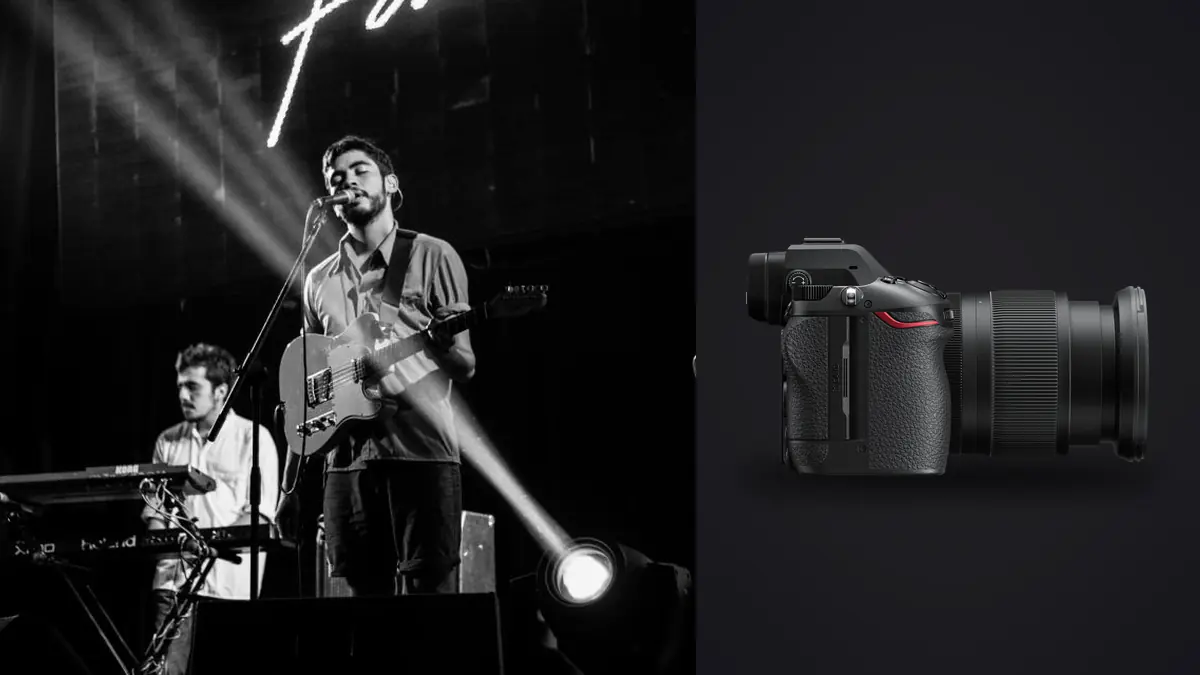
Three songs, no flash, and lighting that swings from near darkness to a blinding red wash in the space of one chorus. That is the brief every photo pit hands you, and it is exactly the kind of stress test that separates a camera that photographs well in daylight from one that actually earns its keep at a gig. I have shot enough club shows and a handful of arena dates with the Nikon Z6 III now to have opinions about where it helps and where it does not, and most of those opinions come down to three things: how fast the sensor reads out, how the autofocus behaves under strobes and haze, and how far you can push ISO before the files stop being usable on a tight deadline.
A partially stacked sensor changes what counts as a keeper
The Z6 III's 24.5-megapixel sensor is partially stacked, which is Nikon's way of saying it reads out faster than a conventional BSI chip without the cost (or the file sizes) of the fully stacked sensor in the Z9. In practice that means the electronic shutter is genuinely usable in a pit, not just a spec sheet checkbox. Rolling shutter skew shows up on fast-panning shots of a drummer's stick work, but it is mild compared to what I saw out of the original Z6 and Z6 II, and it rarely ruins a frame outright.
What that speed actually buys you is silence. Most venues give photographers the first three songs and then pull the pass, and a lot of tour managers are touchy about shutter clatter bleeding into a quiet acoustic break or a between-song moment where the singer is talking to the crowd. Switching to the electronic shutter on the Z6 III lets you keep shooting through those moments without anyone noticing a camera is even running. I would not trust electronic-only shooting under a fast-moving LED wall without checking for banding first (more on that below), but for spot-lit ballads it is the single feature I use most at shows.
Autofocus when the only light source keeps moving
Nikon rates the Z6 III's autofocus down to about -10 EV with a fast prime attached, which sounds like a marketing number until you are three songs into a set where the only illumination is a single moving-head fixture swinging across the stage. The subject-detection system, carried over from the Z8 and Z9 with some tuning changes, holds onto a singer's face through surprisingly aggressive color washes, magenta and deep blue included, which used to be a weak point for Nikon's older contrast-detect systems.
Where it still asks something of you is strobes and hard laser hits. A full blackout strobe effect will occasionally cause a half-second hunt as the AF system loses and reacquires, and I have learned to switch from subject tracking to a smaller single-point area when a band's lighting designer leans hard into strobe cuts, because a tight AF area recovers faster than the wide subject-tracking box does. Haze machines are less of a problem than I expected going in. The Z6 III seems to bias focus toward contrast edges rather than getting fooled by the haze itself, though I still keep an eye on the in-viewfinder focus confirmation rather than trusting it blind through thick fog.
How far you can actually push ISO
Native ISO tops out at 64000, with an expanded ceiling well beyond that, but expanded settings are mostly there for emergencies rather than anything you would deliver to a client. My working range for most club and mid-size venue shows sits between ISO 3200 and 12800. Files at 6400 clean up in about ninety seconds per image with modern noise reduction and still hold detail in a singer's eyes and stage makeup. Push to 25600 and you start losing fine texture in skin and fabric, which is fine for a wire-service action shot but not something I would print large.
The practical ceiling matters because shutter speed is non-negotiable at a show. A guitarist's strumming arm or a drummer's hi-hat hand needs at least 1/500s to freeze cleanly, faster if you want tack-sharp motion during a jump. That forces the ISO conversation whether you like it or not, and the Z6 III's noise floor at 6400 to 12800 is a real step up from what I got out of a Z6 II in the same rooms, roughly a stop and a half of usable headroom in my own side-by-side comparisons shooting the same act on different nights of a short run.
| Venue type | Typical light level | Starting ISO | Shutter speed | Aperture |
|---|---|---|---|---|
| Small club, stage wash only | Very low, single-color gels | 6400 to 12800 | 1/500s | f/1.8 to f/2.8 |
| Mid-size venue, follow spots | Low to moderate | 3200 to 6400 | 1/640s | f/2.8 to f/4 |
| Arena, full production rig | Bright but constantly shifting, haze common | 1600 to 4000 | 1/800s | f/2.8 to f/4 |
| Outdoor festival, daylight set | Ambient daylight | 200 to 800 | 1/1000s or faster | f/4 to f/5.6 |
| Backstage or acoustic set | Very low, single key light | 12800 to 25600 | 1/250s | f/1.4 to f/2 |
Lens choices that actually get carried into the pit
A 24-70mm f/2.8 S covers most of what happens in the first three songs from a standard barrier position, and I would put it on the body before anything else if I only had room for one lens. For festival slots where you are working from a raised riser further back, a 70-200mm f/2.8 S earns its weight, especially for tight facial expressions during a solo. The faster the Z6 III's autofocus and low-light detection get, though, the less I feel pressure to buy the absolute widest aperture glass Nikon sells. A 50mm f/1.8 S or f/1.2 S still helps in genuinely dark clubs, but at f/2.8 with ISO 6400 to 12800 available, the camera is doing enough of the low-light work that I no longer feel locked out of decent images with the zooms I already own.
Weight matters more than people admit when you are climbing over monitor wedges and shooting handheld for three songs straight. The Z6 III's body is noticeably lighter than a Z8, which sounds trivial until you have done back-to-back club shows on a Tuesday and Wednesday with a 70-200mm hanging off your shoulder the whole time.
The buffer holds, your card and your evening do not
Paired with a fast CFexpress Type B card, the Z6 III's buffer at 20fps RAW with full autofocus tracking lasts well past what a three-song set actually needs, and it clears fast enough between songs that I have never hit a wall mid-set. The second slot takes UHS-II SD, which is fine as a backup but noticeably slower to write to if you accidentally set it as your primary card, something I learned the hard way during a two-camera-body shoot when I grabbed the wrong card out of my bag.
The real bottleneck at a show is never the buffer anymore. It is what happens after you walk out of the pit with four thousand frames from a twelve-minute set and a publicist asking for a gallery in two hours. Sorting that volume by eye, flipping through burst after burst of near-identical frames to find the one where the singer's eyes are open and the guitar neck is not blocking their face, is where most of my post-show time actually goes. I run everything through imagic before I open an editor at all, letting its local sharpness and focus scoring flag the genuinely soft frames from a burst so I am not manually zooming into fifty near-duplicates to find the one in focus. The duplicate and burst clustering groups continuous-drive sequences together automatically, which on a 20fps body shooting through an entire guitar solo is not optional, it is the difference between a two-hour edit and a twenty-minute one. If sorting through huge burst sequences by hand is eating your evenings too, the workflow breakdown in how AI photo culling works covers the mechanics in more depth than I have room for here.
Because everything runs locally rather than through a cloud upload, it also fits how most tour contracts actually work. A lot of artist riders explicitly forbid sending unreleased show photos to any third-party server before the label or management has approved a selection, and I have had tour photographers tell me flatly they will not use a culling tool that touches the internet. Processing on the laptop in the green room, with nothing leaving the machine, sidesteps that problem entirely.
Keeping a consistent look across a whole tour
Color grading is its own headache on a multi-night run, because every venue's lighting rig throws a different color cast and you do not want opening night in Manchester to look like a different photographer shot it than closing night in Glasgow. I built a preset in imagic's apply_my_style feature early in one tour by training it on a handful of edits I was happy with from the first two shows, and it has held that look consistent across a dozen very different lighting setups since, without me rebuilding sliders from scratch every venue. It is not a substitute for actually looking at the color temperature reference in each room, but it cuts the baseline grading pass down to something I can do on a bus between cities. Photographers newer to grading concert work might also find the broader color workflow in the color grading guide useful for building that first reference edit.
Where it still asks something of you
The electronic viewfinder is genuinely bright, rated well past what most mirrorless bodies offer, and in a pitch-dark club that brightness can actually work against you. A blown-out spotlight on the singer's face looks perfectly exposed through the finder and turns out clipped on the histogram once you check it. I have started leaning on the highlight-weighted metering mode specifically for this reason rather than trusting what my eye sees through the viewfinder in a dark room. There is also no top-plate LCD, which the Z8 has, so checking your settings without raising the camera means glancing at the rear screen instead, a small habit change if you are coming from a Z8 or a D-series body.
Frequently Asked Questions
Do I really need f/2.8 lenses for concert photography with the Z6 III?
Not as strictly as you did with older bodies. The combination of a higher usable ISO ceiling and stronger autofocus detection means f/2.8 zooms produce usable files in most club and mid-size venues. Save the f/1.4 to f/1.8 primes for genuinely dark rooms or backstage acoustic sets where every stop of light matters.
How high can I push ISO before a concert shot stops being deliverable?
For editorial or web delivery, 12800 still holds up after noise reduction. Past 25600 you start losing fine detail in faces and fabric, which I would only accept for a wire-style action grab rather than anything going to print or a magazine spread.
Is the electronic shutter safe to use through an entire set?
Yes for most rigs, with one caveat. Under fast-refreshing LED walls or certain moving-head fixtures you can get faint banding at higher shutter speeds, so I test a few frames at the start of a set before committing to electronic-only shooting for the whole show.
Does the Z6 III handle rapidly changing stage colors well?
Subject detection holds up through most color washes, magenta and blue included, better than older Nikon bodies I have used. White balance is a separate problem entirely, since stage lighting rarely sits anywhere near a standard color temperature, which is why I shoot RAW exclusively at shows and settle color in post rather than trusting auto white balance under a moving rig.