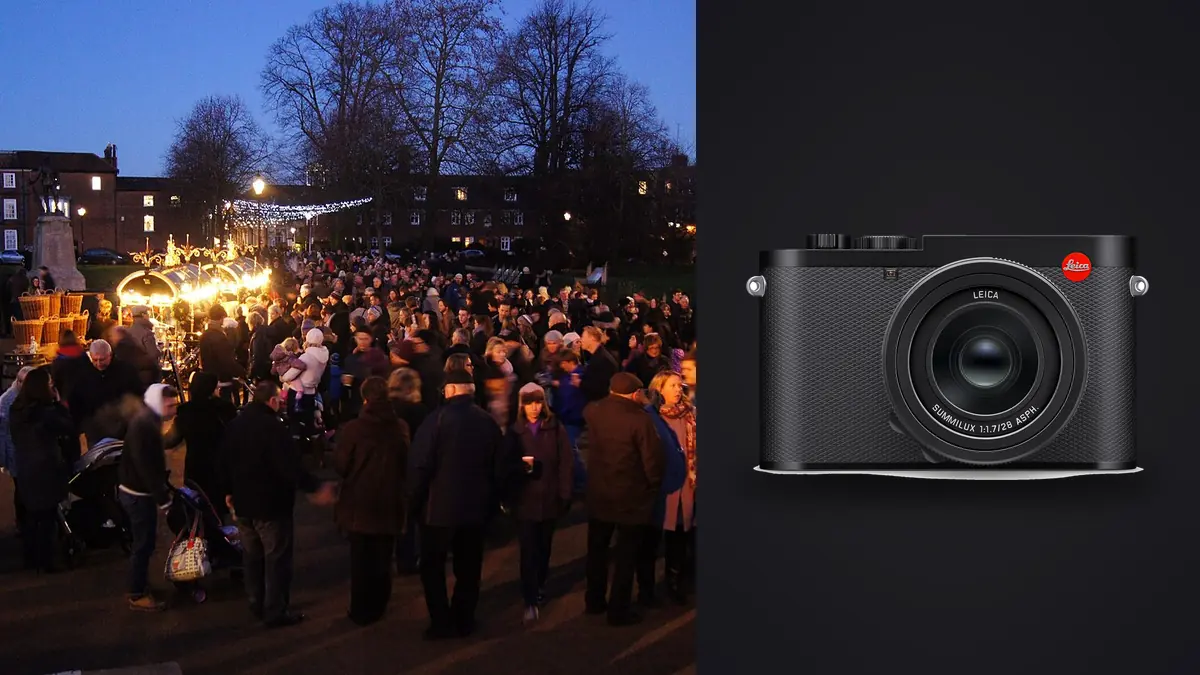
I carried a Leica Q3 through six weeks of street and documentary work this spring, from a market district in Palermo to a rain-soaked protest march at home, and it forced me to relearn some habits I'd built around zoom lenses and silent electronic shutters. A fixed 28mm lens on a full-frame sensor is not a neutral choice. It has opinions about how close you need to stand, how much context ends up in the frame, and how often you'll crop later rather than zoom in the moment. This isn't a spec-sheet review. It's what actually changes in your process when this specific camera becomes your only camera for a job.
The 28mm Problem, and Why It's Actually the Point
Everyone who picks up a Q3 for street work asks the same question first: why would you want a fixed 28mm when a zoom, or even a 35mm/50mm dual-lens kit, gives you more options? The honest answer is that the limitation is the feature. A 28mm forces proximity. You cannot photograph a street scene from across the block and expect it to read as anything other than empty pavement with tiny people in it. You have to walk into the scene, which changes your relationship to the subject and, more importantly, changes what the subject's face and body language look like when they clock you at three or four meters instead of fifteen.
For documentary work specifically, this matters because a lot of the emotional information in a frame lives in proximity. A wider lens shot from close range reads as immersive and honest. The same content shot from far away with a longer lens reads as surveillance. I noticed this most during the protest coverage: shots taken from the edge of the crowd with a longer lens felt like observation, while shots taken from inside the crowd with the Q3's 28mm felt like participation. That's a real stylistic difference, not a marketing line.
The tradeoff is real too. Environmental portraits where you want a subject isolated against a soft background are harder. You either get close and accept some background clutter, or you use the in-camera crop modes (35mm, 50mm, 75mm) which downsample the 60-megapixel sensor to simulate a longer field of view. Those crop modes are genuinely useful in a pinch, and because the files are still full-sensor RAW with the crop as metadata, you can pull back to 28mm later if the crop turns out to be the wrong call. That flexibility saved a handful of frames for me where I'd cropped to 50mm in the field and realized in the edit that the wider version told the better story.
Autofocus in a Crowd: Faster Than the Q2, Still Not a Sports Camera
Leica's phase-detection autofocus on the Q3 is a genuine step up from the contrast-only system in the Q2, and it shows most in exactly the situation street documentary work throws at you: someone walking toward you at an angle, partially occluded by another person, in changing light. It locks faster and holds better than I expected going in. That said, I want to be specific about where it still struggles, because I've seen other write-ups oversell this.
Continuous autofocus with subject tracking works well on a single clear subject crossing the frame at a normal walking pace. It gets less reliable the moment there are two or three people at different depths moving independently, which describes most interesting street scenes. In those situations I stopped trusting AF-C tracking and went back to an old habit: zone focusing at f/8 or f/11, using the depth-of-field scale, and pre-focusing on a spot on the pavement where I expected the moment to happen. The leaf shutter helps here because there's no mechanical shutter lag or mirror slap to fight, and the shutter itself is close to silent, which matters when you're that physically close to strangers.
One more thing worth flagging: because the sensor is 60 megapixels, autofocus hunting or a slightly missed peak is much more visible on a full-resolution pixel-peep than it would be on a 24-megapixel body. A frame that would pass as "sharp enough" from a lower-resolution sensor can look soft at 100% on the Q3's files. That raises the stakes on getting focus right in the field, and it raises the workload afterward when you're trying to tell which frames from a burst are actually sharp and which only look sharp on the rear screen.
A Full Day of Shooting: Battery, Buffer, and Card Realities
Leica rates the Q3 battery at roughly 350 shots per charge under CIPA testing, and in real documentary use, with the EVF on most of the time and a fair amount of chimping to check exposure, I got closer to 250 to 300 usable frames before needing a swap. On a slow news day that's fine. On a day with a march, a rally, and an evening event, I was carrying three batteries and still watching the percentage. The USB-C port charges in-camera, which is a real convenience if you're near a power bank between events, but it's slow enough that you shouldn't count on a fifteen-minute top-up doing much.
Buffer depth is the other practical constraint. Shooting compressed RAW plus JPEG at the higher continuous burst speed, the buffer fills faster than you'd think for a camera in this price bracket, and write-out to a fast UHS-II card takes a few seconds during which the camera is sluggish to respond. I learned to shoot shorter, more deliberate bursts (three to five frames around a peak moment) rather than holding the shutter down and hoping, both because of buffer limits and because a 60-megapixel burst eats card space fast. A single afternoon of loose burst shooting can produce 40 to 60GB of RAW files without much effort.
What That Means for the Edit
That data volume is exactly where the workflow problem starts. A week of Q3 street shooting routinely leaves me with two or three thousand frames, a meaningful chunk of which are near-duplicate bursts around the same three or four seconds of action, plus a handful of AF misses that look fine on the camera's 3-inch screen but fall apart at full resolution. Sorting that by eye, at 60 megapixels per file, is slow enough that it eats into the time you'd rather spend actually editing the keepers. This is the part of Q3 ownership nobody puts in the spec comparisons, and it's where I lean on imagic to do the first pass: it scores focus and sharpness locally on the actual pixel data rather than the thumbnail, and it clusters burst sequences and near-duplicates so I'm choosing between three grouped options instead of scrolling through forty similar frames one at a time. Because it runs entirely on my machine, none of that documentary material (some of which involves identifiable people in sensitive situations) ever leaves my laptop to get processed.
Handling and Discretion: The Camera You Cannot Hide
Street and documentary photographers who came up on Fuji X100-series bodies or a Ricoh GR are used to cameras that disappear in a crowd. The Q3 does not disappear. It's a full-frame body with a big, bright viewfinder hump and a lens barrel that reads as "serious camera" even to people who couldn't name the brand. The silver version is worse for this than the black; the black paint at least doesn't catch light. I found that the camera's size actually worked in my favor for a specific kind of documentary shot: people who notice a large, obvious camera pointed near them tend to either ignore it (because it clearly isn't a phone recording them) or acknowledge it openly, and both reactions are more useful for honest documentary work than the slightly cagey half-awareness people show toward a phone camera.
Where the size becomes a genuine liability is fast, reactive shooting from the hip or at odd angles. The Q3's tilting rear screen helps with low-angle and overhead shots without holding the camera up to your eye, which is a small thing that made a real difference during the protest coverage when I wanted frames from below the sightline of the crowd. But the body itself, at just over 700 grams with the battery, is not something you comfortably carry on a wrist strap for eight hours. A proper neck strap with the weight distributed, or a chest harness, is not optional gear for this camera on a long documentary day. It's a requirement.
| Camera | Lens / equiv. focal length | Sensor | Shutter type | Weight (body + battery) | Where it wins for documentary work |
|---|---|---|---|---|---|
| Leica Q3 | 28mm f/1.7, fixed | 60MP full-frame | Leaf (near-silent) | ~743g | File resolution and crop flexibility for reframing after the fact |
| Fujifilm X100VI | 23mm f/2 (35mm equiv.), fixed | 40MP APS-C | Leaf + electronic | ~521g | Size, weight, and a leaf shutter that syncs flash at any speed |
| Ricoh GR III | 18.3mm f/2.8 (28mm equiv.), fixed | 24MP APS-C | Electronic + mechanical | ~257g | Pocketability; genuinely disappears into a jacket pocket |
| Sony RX1R III | 35mm f/2, fixed | 61MP full-frame | Electronic + mechanical | ~498g | Full-frame detail in a body closer to Fuji-sized |
The table above isn't meant to crown a winner. Each of these cameras solves a different version of the same problem. The GR III wins on true pocket carry, which matters enormously for documentary work where the best moments happen when your hands are already full of something else. The X100VI splits the difference on size and gives you a genuinely useful hybrid viewfinder. The Q3 gives up pocketability entirely in exchange for full-frame files at a resolution that lets you crop hard in post without the image falling apart, which is its own kind of compositional freedom when you didn't have time to reposition your feet.
Macro Mode and the Missing Middle Focal Length
One underrated feature for documentary work specifically is the Q3's macro mode, engaged by a ring at the base of the lens barrel that shifts the minimum focus distance down to around 17cm. It sounds like a niche spec until you're covering something with small, telling details: a handwritten sign at a protest, a market vendor's scale, a child's hand holding a parent's sleeve. Being able to get genuinely close without switching lenses (there's nothing to switch) means those detail shots happen in the same rhythm as the wide environmental frames, rather than requiring you to stop, dig out another lens, and lose the moment.
What you don't get, and what I missed more than I expected, is anything in the 50 to 75mm equivalent range for a genuinely tight portrait without resorting to the digital crop. The crop modes work, and the sensor has enough resolution to make an in-camera 75mm crop still usable for web and reasonably sized prints, but it's not the same rendering as an actual longer lens. If your documentary work leans heavily on tight, isolated portraits as a recurring part of the story, the Q3's single 28mm optical path is a real constraint, not just a stylistic choice, and you should shoot a few days with a rental before committing.
Weather Sealing and the Days You Don't Get to Choose
Documentary work doesn't wait for good weather, and the Q3 is IP52 rated, which covers light rain and dust but not a genuine downpour or a dunking. I shot through a drizzly afternoon at the market and never worried about it. I would not have taken it out in the sideways rain I've shot through with a proper weather-sealed DSLR and a rain cover. If your work regularly puts you in genuinely bad weather, plan around that rating rather than trusting it as full protection, and carry a simple rain sleeve as cheap insurance regardless of what the spec sheet claims.
Frequently Asked Questions
Is the Leica Q3's 28mm lens too wide for most street photography?
It's wide enough that you'll need to change your habits if you're coming from a 35mm or 50mm background, but it's not too wide for street work generally. What it does is push you physically closer to your subjects than a longer lens would, which suits documentary and environmental street photography better than it suits isolated candid portraits from a distance. If your instinct is to shoot from far away, the 28mm will feel wrong on this camera no matter how good the lens is.
Can you shoot fast-moving street scenes with the Q3's autofocus?
Yes for single subjects moving at a normal pace, with caveats for busier scenes with multiple people at different depths, where tracking gets less predictable. Zone focusing with the aperture stopped down to f/8 or f/11 is a reliable fallback that experienced Q-series shooters lean on more than the marketing around the phase-detection system suggests they should need to.
How does the Q3 compare to a Fuji X100VI for a full day of documentary shooting?
The X100VI is meaningfully lighter and less conspicuous, and its hybrid optical/electronic viewfinder is a genuine advantage for anticipating action just outside the frame. The Q3 gives you a full-frame sensor at more than double the resolution, which matters if you crop aggressively or print large, along with a wider native field of view. Neither is strictly better; it depends on whether you value discretion and weight or file flexibility more on a given assignment.
What's the realistic way to manage the volume of files a Q3 produces on assignment?
Plan for large card capacities and a culling step before you touch full editing. At 60 megapixels, a week of active shooting easily runs into the thousands of frames and tens of gigabytes, and near-duplicate bursts pile up fast if you shoot in short continuous bursts around key moments, which most documentary photographers do. Running a local pass with something like imagic to score sharpness and group burst duplicates before you sit down in Lightroom or Capture One saves real hours, and because the culling runs offline on your own machine, it doesn't require uploading sensitive documentary material anywhere to get sorted. For a broader look at how automated culling actually evaluates focus, this piece on how AI photo culling works covers the mechanics in more depth, and these workflow tips are worth a look if the back end of your process is where the time is actually going.