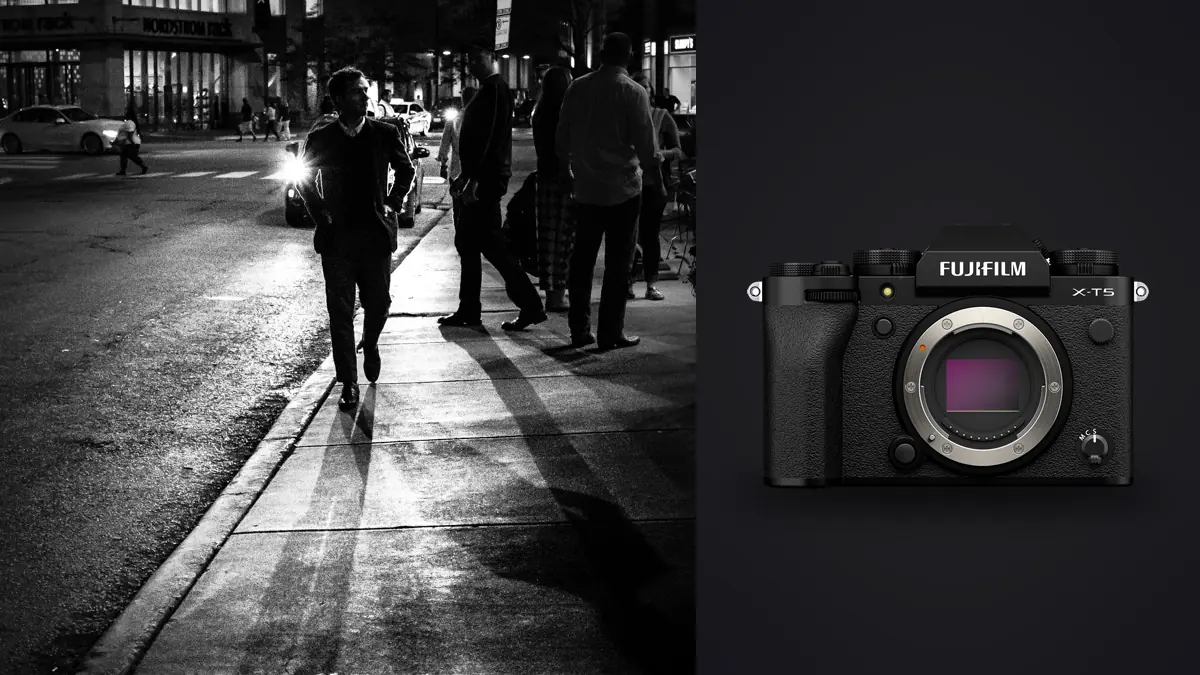
I picked up an X-T5 about eighteen months into a long-term documentary project on a fishing co-op that was slowly losing its lease to a marina redevelopment. I'd been shooting the story on an X-T4 and switched mostly because I wanted the extra resolution for a few wall prints the fishermen had asked for. What I didn't expect was how much the camera would change the rhythm of the shoot itself, not because of any headline spec, but because of small, almost boring things: where my thumb rests, how loud the shutter is at 6am on a dock, how long a battery lasts through a twelve-hour day I can't recharge during.
This isn't a spec sheet. Fujifilm's own page will tell you the pixel count and the shutter speed range better than I can. What I want to cover is what actually changes in practice when you take this specific body onto the street or into someone else's life for a documentary story, because those are two different jobs that happen to use the same camera.
Why the Dials Still Earn Their Keep
The X-T5 keeps the physical shutter speed dial, ISO dial, and exposure compensation dial that Fujifilm has carried since the original X-T1. On a spec sheet this reads as retro theater. On the street it does something specific: it lets you set your exposure before you raise the camera, by feel, without looking at a screen. For documentary work, where you're often building trust with a subject over minutes or hours before you shoot anything usable, not having to bury your face in a menu or a control wheel to check your settings matters more than it sounds like it should. I can glance down, confirm ISO 800 and 1/250 by dial position alone, and keep eye contact with whoever I'm photographing.
The trade-off is that the dials are unmarked once you're in auto-ISO territory, which is how most people actually shoot moving subjects. I mostly leave ISO on A and control exposure through a mix of shutter dial and the front command dial for aperture. It's a hybrid setup that took me a couple of weeks to stop fighting.
The 40-Megapixel Question Nobody Warns You About
The jump from the X-T4's 26.1MP sensor to the X-T5's 40.2MP X-Trans CMOS 5 HR is the headline change, and for studio or landscape shooters it's an easy win. For street and documentary work it's more complicated than "more resolution is always good."
First, the obvious upside: you can crop hard. A 35mm-equivalent lens becomes a workable 50mm or 85mm after the fact if you shot wide enough to preserve enough pixels, which is genuinely useful when you can't physically get closer to a subject without breaking the moment. I've salvaged frames from a wedding-adjacent street scene by cropping a 23mm frame down to something that reads like an 85mm portrait, and it held up fine printed at 16x20.
Second, the less obvious downside: file size and rolling shutter both get worse. RAW files run 70-85MB uncompressed, sometimes more with the higher base ISOs. A single afternoon of loose street shooting with a few bursts thrown in can produce 40-60GB without much effort. And because the sensor readout is slower than on the 26MP body, electronic shutter rolling shutter distortion on fast-moving subjects (a cyclist crossing frame, someone's arm swinging) is more visible than it was on the X-T4. If you're shooting silent electronic shutter specifically to stay unnoticed, which a lot of documentary shooters do in sensitive settings, that's worth testing before you rely on it for a moving subject.
Building a Lens Kit That Doesn't Get in the Way
The body itself is compact for its resolution, around 557g without a lens, but the lens you pair it with decides whether the whole rig disappears into a bag or announces itself. For documentary work specifically, where you sometimes need to hand the camera to a subject or set it on a table between you without it reading as intimidating equipment, weight and profile matter as much as optical quality.
| Lens | 35mm-equiv. focal length | Max aperture | Weight | Where it fits |
|---|---|---|---|---|
| XF27mmF2.8 R WR | 41mm | f/2.8 | 84g | Pancake profile, near-invisible on the body, my default for sensitive documentary settings |
| XF23mmF2 R WR | 35mm | f/2 | 180g | Classic street focal length, weather-sealed, fast enough for interiors |
| XF35mmF2 R WR | 53mm | f/2 | 170g | Portrait-leaning compression for one-on-one documentary moments |
| XF18mmF1.4 R LM WR | 27mm | f/1.4 | 370g | Environmental context shots, low light, heavier and more visible |
| XF16-55mmF2.8 R LM WR | 24-84mm | f/2.8 | 655g | One-lens assignment coverage, but it changes how people read you with a camera |
My actual kit for most documentary days is the 27mm pancake and the 35mm f/2, swapped depending on whether I'm working wide establishing shots or closer portrait-style frames. I own the 16-55mm and barely bring it on documentary work anymore. It's a genuinely excellent lens, but on this body it turns a camera that reads as "someone with a small camera" into "someone with professional gear," and that changes how subjects behave around you.
Autofocus When You Don't Get a Second Take
Fujifilm carried over the subject-detection autofocus system from the X-H2 series, which recognizes people, animals, and several vehicle types. For street work involving dogs, kids, and general chaos, animal detection catches more usable frames than I expected, though it occasionally locks onto a dog when a person crossing behind it was the actual subject I wanted.
For documentary shooting specifically, where you're often working close with one or two people over an extended period, face and eye detection is reliable enough that I trust it in single-AF-continuous hybrid mode rather than babysitting a single point. The one habit I had to unlearn from the X-T4 was recomposing after focus lock. With eye detection active and a subject that's talking, moving their head, gesturing, it tracks better if you let the camera keep hunting rather than locking and holding.
Where it still struggles: backlit scenes with a subject moving fast against a bright window or open doorway, which happens constantly in documentary interiors. I still miss frames there that I wouldn't have missed with a DSLR's phase-detect system in the same light.
Shooting Quiet Without Fooling Yourself
The mechanical shutter tops out at 15fps in a burst, and there's a fully silent electronic option that's genuinely silent, no simulated click, nothing. I use it constantly in courtrooms, religious services, and quiet interiors where a mechanical shutter would be the loudest thing in the room. The catch, tied back to the rolling shutter point above, is that silent shooting on fast subjects can produce a subtle skew that you won't notice on the 3-inch screen but will notice at full resolution later. For static or slow-moving documentary subjects it's a non-issue. For a kid running through frame, I switch back to mechanical and accept the click.
What Actually Happens After Dark
Base ISO native range runs 125-12800, extendable further, but the useful ceiling for documentary work where you actually want to print or publish the result sits lower than the spec sheet implies. Up through ISO 3200 the files clean up well with modest noise reduction and the X-Trans color response holds together. By 6400 you start losing fine texture in skin and fabric that no amount of sharpening brings back convincingly. I treat 6400 as the real practical ceiling for anything I'm going to print or publish, and I try to stay at or under 3200 whenever the light allows it, even if that means opening up to f/2 or f/1.4 instead of stopping down for depth of field I'd prefer.
In-body stabilization rated to 7 stops helps more than I expected for handheld available-light interiors, letting me hold 1/15s or slower on the 35mm without much drama, which keeps ISO down in situations where I'd otherwise have pushed it.
The Part Nobody Mentions: Getting Through the Files
A 40MP sensor shooting bursts on a documentary story generates a genuinely brutal amount of data to review. A single day covering an event can leave you with three or four thousand frames, a meaningful fraction of them near-duplicates from burst sequences where three or four frames capture essentially the same gesture a fraction of a second apart. Reviewing that manually, frame by frame, at full resolution, is where a lot of documentary shooters lose entire evenings they should be spending on the actual edit.
This is the part of the workflow I changed most after switching to imagic. It runs entirely on my machine, scores sharpness and focus locally across a folder of X-T5 RAWs without uploading anything, and groups burst sequences and near-duplicates together so I'm choosing between four frames instead of scrolling past all four separately looking for which one is sharp. On a 40MP file where a soft-focus miss is genuinely hard to spot on a laptop screen at 100% zoom, having the sharpness scoring flag the one usable frame out of a six-shot burst has saved me real time on deadline days.
The other piece that's become part of how I finish a story is the apply_my_style feature, which trains on edits you've already made and applies that same look to a new batch. For a documentary project shot over months, keeping the color and contrast consistent from session to session matters for how the final story reads as one piece, and doing that manually across hundreds of new frames every time you shoot another chapter gets old fast. If you're weighing culling tools generally rather than just this one, it's worth reading through how AI photo culling actually works before you commit to a workflow, since the local-versus-cloud distinction matters a lot once you're dealing with identifiable people in your frames.
Weather Sealing on Days You Can't Control
The body is weather-sealed at 63 points, but that only means anything when paired with a WR-rated lens, and Fujifilm is explicit that it's resistance to dust and light moisture, not a submersible rating. I've shot through steady rain on the docks with the 23mm WR without incident, wiped down, no drama. I would not trust it in a downpour without real cover, and I don't test that boundary on a documentary shoot where the story matters more than proving a point about weather sealing.
Battery life rated around 580 shots CIPA undersells real-world use somewhat, since CIPA testing cycles the screen and flash aggressively. On a documentary day with the EVF used most of the time and minimal chimping, I regularly clear 700-800 frames on one NP-W235 charge. I still carry two spares for anything longer than a half day, because a dead battery mid-interview is a worse outcome than a slightly heavier bag.
Frequently Asked Questions
Is the X-T5's tilting screen a real limitation compared to a fully articulating one for documentary work?
For street and documentary shooting specifically, I'd argue the three-way tilt is the better choice, not a compromise. A fully articulating screen that flips out to the side adds bulk and reads as more conspicuous when you're shooting low or at odd angles near a subject. The tilt screen lets me shoot from waist height or above a crowd without the screen becoming a separate moving part that draws attention. It's genuinely worse for vlogging or selfie framing, which isn't the job here.
Should I shoot JPEG with film simulations for documentary work or always RAW?
I shoot RAW+JPEG on every documentary project. The JPEGs with Classic Neg or Nostalgic Neg baked in are useful for quick previews and social posts same-day, but I never publish a finished story from the in-camera JPEG. The RAW file has the dynamic range headroom you need when a scene has both a shadowed doorway and a bright street behind your subject, which is most documentary interiors.
Does the X-T5's 40MP resolution actually help street photography, or is it wasted?
It helps in two specific situations: printing large, and cropping a wide frame into a tighter one after the fact when you couldn't physically move closer. Outside of those, most street work gets posted or published at sizes where a 26MP file would look identical. The cost is real too, in file size and in slightly worse high-ISO noise per pixel compared to the X-T4's sensor, so it's a genuine trade-off rather than a free upgrade.
What's a realistic single-lens setup if I only want to carry one lens for a documentary trip?
The XF23mmF2 WR is my answer for most assignments. It's wide enough to hold environmental context, fast enough for available light indoors, weather-sealed, and small enough that people stop noticing it after the first few minutes. If the story leans more toward portraiture of individual subjects than environments, I'd swap to the 35mm f/2 instead. I'd only reach for a zoom if I genuinely didn't know what the story needed before I arrived, which is rare once you've scouted a location or a subject even briefly.
Where This Leaves Me
After a year and a half shooting the fishing co-op story on the X-T5, my honest take is that the camera didn't change what I shoot so much as it changed how much I shoot, for better and worse. The dials keep me faster in the moment. The resolution gives me cropping room I didn't have before. And the file volume it produces means the edit afterward needs real tooling instead of good intentions, which is the part most gear reviews skip entirely. If you're deciding between this body and something smaller like an X100-series camera for documentary work specifically, it comes down to whether you need lens flexibility badly enough to carry the extra weight and the extra files that come with it. For a long-term story where I don't know what focal length tomorrow's scene will demand, I do.