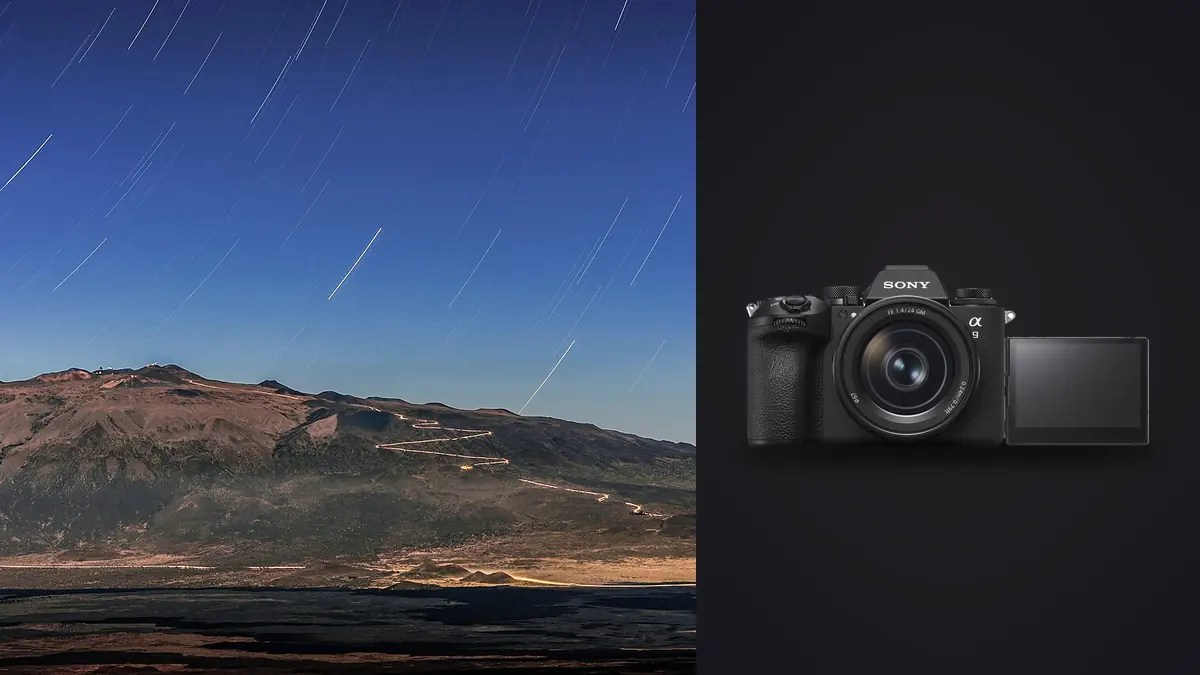
The Sony A9 III is built and marketed as a sports and wildlife camera: twenty four frames a second with no blackout, a global shutter that kills banding under stadium lights, and no rolling shutter skew from a swinging bat or a propeller blade. None of that reads like an astrophotography spec sheet. So when one landed in my bag for a two week gap between motorsport jobs, I pointed it at the sky instead of a racetrack and spent three clear nights finding out what a fully electronic, no-mechanical-shutter sensor actually does across a hundred and fifty frame star stack. Short version: it is a genuinely odd choice for night work, better than I expected in two specific ways, worse in a couple of others, and worth judging on its own terms instead of against the astro-dedicated bodies it was never built to compete with.
What a global shutter actually changes once the sun goes down
A global shutter reads every pixel at the same instant instead of scanning row by row the way a conventional rolling shutter does. For a static subject like the night sky, that distinction barely matters on its own, nothing in a stationary star field is moving fast enough during a normal readout window to produce skew either way. Where it starts to matter is in two quieter side effects of the sensor architecture Sony had to build to make a full-frame global shutter work at all.
First, the anti-blooming structures a global shutter sensor needs around each pixel eat into the space available for light-gathering, which lowers the full well capacity compared to a conventional sensor of similar size. In plain terms, each photosite tops out sooner. I expected that to mean blown, spreading star cores on anything bright, Jupiter wandering through a frame, a satellite flare, Sirius sitting low on the horizon. In practice the opposite happened more often than not: the anti-blooming margin kept the brightest points tighter and rounder instead of smearing into their neighbours, which is a genuinely useful trait for star stacking where you want pinpoint sources, not blobs.
Second, there is no mechanical shutter at all to fail, wear, or shock the camera on release, not even as a fallback option. For an unattended interval sequence running two or three hours in near-freezing air, that reliability difference is bigger than it sounds. I have had older bodies develop shutter friction in the cold and start clipping frame timing a couple hundred actuations into a long sequence. With the A9 III that whole failure mode simply is not in the system, and the silence of a fully electronic release is a nice bonus when you are standing next to the tripod trying not to spook whatever wildlife shares the field with you at 2 a.m.
The ISO story is not quite what Sony markets it as
The A9 III's native floor sits at ISO 250 (extendable to 125), which is already an odd starting point for astro math built around ISO 100 baselines. More interesting is a second, lower-noise readout gain step that independent studio scene tests have placed around ISO 4000, not an officially branded dual base ISO the way Sony sells the A7S III's 640/12800 split, but the noise floor behavior in the raw files tells a similar story once you go looking for it. For untracked Milky Way frames I settled on ISO 3200, one stop under that reported gain shift, and the shadow noise held up better than I expected from a 24.6 megapixel sensor built for speed rather than light-gathering. It was still visibly noisier per pixel, though, than files from an A7S III I ran alongside it on a second tripod that same night for comparison.
Pixel pitch is the other piece of this. At roughly 5.94 microns the A9 III's pixels are considerably smaller than the A7S III's chunky 8.4 micron wells, which means trailing shows up sooner at pixel level than the old "500 rule" would suggest. Running the numbers with the NPF rule for a 20mm lens at f/1.8, I landed at around 8 seconds before pinpoint stars started to smear when viewed at 100%, against roughly 13 to 14 seconds I would comfortably get from the A7S III at the same focal length and aperture. That gap has nothing to do with global shutter itself, it is simply the tax that resolution pays against pixel size.
What I actually shot with it
The test sequence, for anyone wanting the specifics rather than the theory: a moonless night, roughly minus two Celsius, a 20mm f/1.8 prime, ISO 3200, 8 second exposures, 120 frames for the untracked wide sky stack. Alongside that I ran a second sequence on a small star tracker at ISO 1600, 60 seconds per frame, 20 frames, purely for extra core detail to blend in later, plus a short foreground sequence at ISO 800 and f/4 for a cleaner base layer to composite against. None of that is exotic, it is the same skeleton I would use with almost any full-frame body. What changes is how forgiving each step is once you start pushing exposure time and ISO past where the sensor is comfortable.
| Body | Sensor type | Resolution | Native ISO floor | Reported low-noise gain step | Best role in a night kit |
|---|---|---|---|---|---|
| Sony A9 III | Stacked, global shutter | 24.6 MP | ISO 250 | ~ISO 4000 (unofficial, from studio tests) | Backup body, satellite/meteor streak work, unattended long intervals |
| Sony A7 IV | BSI, rolling shutter | 33 MP | ISO 100 | None officially branded | General astro-landscape work, more resolution for large prints |
| Sony A7S III | BSI, rolling shutter | 12.1 MP | ISO 640 (branded dual gain) | ISO 12800 | Dedicated Milky Way body, best per-pixel noise floor of the three |
| Sony A7R V | BSI, rolling shutter | 61 MP | ISO 100 | ~ISO 640 (unofficial reports) | Large-format star-scapes where you can afford to gather more light per pixel |
The part nobody mentions: reviewing 150 frames of near-identical stars
Compressed raw files off the A9 III run somewhere around 52 to 58MB each. Multiply that across a 120 frame sky stack, a 20 frame tracked sequence, and a foreground set, and a single night out generates several gigabytes of files that all look nearly identical to a tired set of eyes scrolling through a raw browser at one in the morning. This is the unglamorous half of star stacking that almost never makes it into camera reviews: not shooting the sequence, but finding the handful of frames that quietly ruined themselves. A plane crossing the frame. A satellite streak you may or may not want to keep for a specific creative reason. A gust catching a foreground tree mid-exposure. Dew creeping onto the front element two thirds of the way through a long sequence, which shows up as a slow, easy-to-miss softening rather than an obvious blur. Focus drifting slightly as the lens barrel contracts in the cold over forty minutes, something I have genuinely lost a stack to before by not catching it in time.
This is where I ended up leaning on imagic rather than eyeballing every frame at 100%. Its local sharpness and focus scoring flags the specific frames where focus measurably drifted or dew softened the image, instead of making you scrub through two hundred exposures that all look the same at a glance. Because the scoring runs entirely on the laptop, a several-gigabyte batch of astro raws does not need to go anywhere to get sorted, which is worth pointing out given that a dark sky site is usually exactly the place with no signal to upload anything to anyway. If you want the mechanics behind how that kind of scoring actually works frame to frame, it is covered in more depth in how AI photo culling works.
The second piece that matters for a sequence like this is duplicate and burst clustering. An interval run is, by definition, a deliberate burst: dozens of frames that are compositionally identical on purpose, because that repetition is the whole point of a stack. imagic groups that run together so the decision becomes "keep this full sequence for stacking, pick one frame from it for a standalone portfolio shot," rather than treating a hundred and twenty intentional near-duplicates as a hundred and twenty separate judgment calls. It sounds like a small thing until you have actually sat down after a long night and tried to do that sorting manually.
From stack to finished frame
Once the sequence is culled down to clean frames, the actual stacking happens outside imagic, in something like DeepSkyStacker, Sequator, or Starry Landscape Stacker depending on platform and whether you are aligning on stars or blending a static foreground underneath. That part of the workflow does not change because of which camera shot the source frames. What does change afterward is the grading, and this is where I found a genuinely useful shortcut. I trained imagic's apply_my_style feature on a handful of night sky edits I had already finished by hand, pulling color balance toward the actual green and magenta of real airglow instead of the default blue cast most raw converters push toward, and keeping star color intact rather than crushing every point source to white. Once that preset existed, it applied the same look automatically to the next trip's selects, which cut a genuinely tedious return-from-a-trip grading session down to a fraction of the time. It is a one-time purchase with no subscription sitting behind it, which matters when astro work tends to happen in occasional bursts rather than every week, and paying monthly for a tool you touch four times a year is its own kind of annoying. For the broader case on tightening up a workflow like this end to end, 10 tips for a faster photo workflow covers ground beyond just the astro-specific parts.
Where I would not recommend the A9 III for this
None of the above amounts to a recommendation to go buy an A9 III specifically for astrophotography. At roughly $5,999 body only, you are paying for a 120fps blackout-free stacked sensor and autofocus system built for tracking erratic subjects, features that sit completely idle on a tripod pointed at a fixed point in the sky all night. CFexpress Type A cards, which is what the body requires, are more expensive and lower capacity than the SD cards a dedicated astro body would happily use, so filling a card across a long multi-sequence night either means budgeting for more cards than usual or swapping them in the dark partway through. It is also simply heavier and bulkier than it needs to be for a job that is entirely stationary. If astrophotography is the primary reason for the purchase, an A7S III still delivers a cleaner per-pixel noise floor for less money, and even a used A7 III remains a genuinely solid, far cheaper starting point. The A9 III only makes sense here if you already own one for sports or wildlife work and want to put it to use on the clear nights in between, which, to be fair, is exactly the situation I tested it in.
Frequently Asked Questions
Does the A9 III's global shutter add more noise to star stacks than a normal sensor?
Not because it is a global shutter specifically. The extra noise you will notice compared to something like the A7S III comes from smaller pixel pitch and a sensor tuned for speed rather than light-gathering, not from the global shutter architecture itself. The anti-blooming structures that global shutter requires actually helped keep bright stars from spreading in my test frames, which was the opposite of what I expected going in.
What exposure length and ISO should I start with for untracked Milky Way shots on the A9 III?
With a wide prime around 20mm at f/1.8, 8 seconds and ISO 3200 was my starting point after running the NPF rule against the sensor's pixel pitch, then adjusting up or down half a stop depending on foreground light pollution. Because the pixels are smaller than on a lower-resolution body, you will see trailing at pixel level sooner than older exposure rules of thumb suggest, so it is worth testing at 100% zoom on the rear screen before committing to a full sequence.
Is it worth buying a Sony A9 III specifically for astrophotography?
Generally no. If night sky work is your main goal, an A7S III or a used A7 III will get you cleaner low-light files for meaningfully less money. The A9 III only earns its place in a night kit if you already own it for sports or action work and want to use it on clear nights in between paid jobs, which is a fine reason but not a case for buying one new for this purpose alone.
Does the lack of a mechanical shutter matter for long interval sequences?
Yes, more than I expected going in. Running two to three hour unattended interval sequences in near-freezing temperatures with no moving shutter part removes a failure mode I have run into on older bodies, where cold-weather shutter friction started clipping frame timing partway through a long run. It also means the camera is completely silent, which is a genuine plus if you are shooting somewhere shared with wildlife or other photographers.