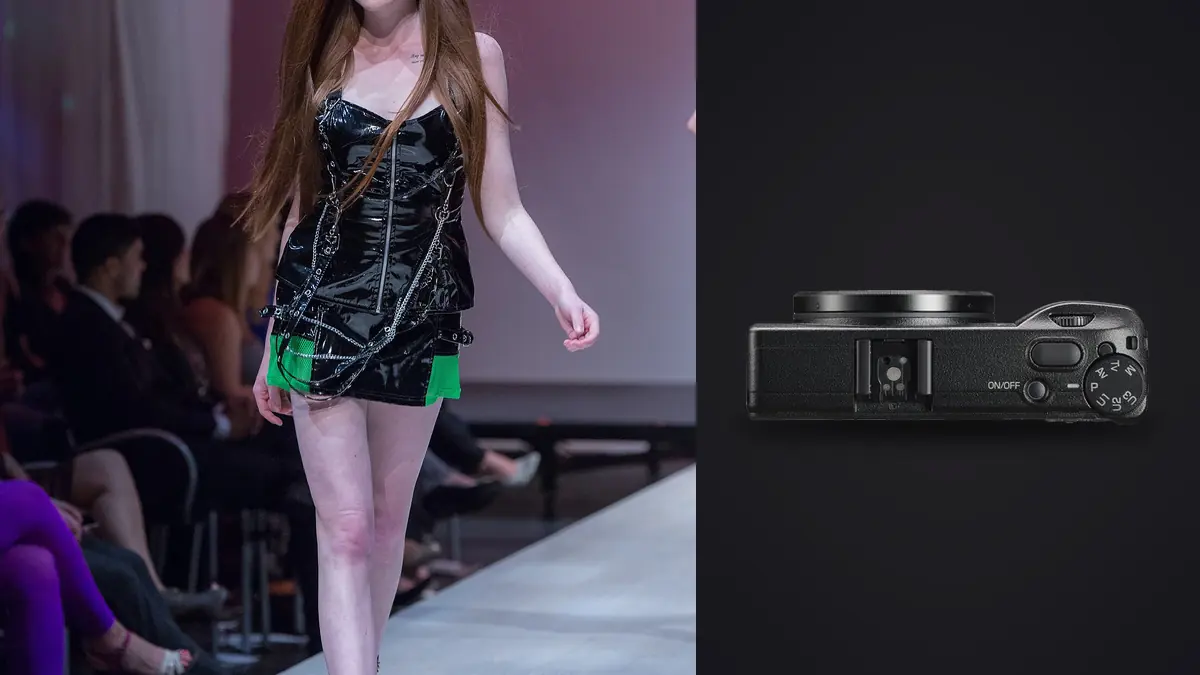
Nobody shoots a commercial lookbook on a Ricoh GR IIIx. Let's get that out of the way first. If a client is paying for a twelve-look e-commerce set with a full lighting rig, a tethered station, and a retoucher on call, the hero camera is going to be a full-frame body with interchangeable glass, not a pocket compact with one fixed lens. But walk onto almost any fashion set that still has a documentary or "in-between moments" component to the deliverable, and there's a decent chance someone on the team, often the photographer themselves, has a GR of some kind in a jacket pocket. The IIIx specifically has become the quieter, less-discussed sibling that a lot of lookbook photographers now reach for on purpose, and the reason comes down to one number: 40mm.
Why a fixed-lens compact ends up on a fashion set at all
The lookbook format changed over the last several years. Brands stopped wanting the flat, evenly lit catalog grid and started wanting something that reads as a document of a real day: a model adjusting a cuff between shots, someone laughing off to the side, a garment caught mid-movement instead of pinned flat against seamless paper. That look needs a second camera that isn't tied to strobes, isn't tethered to a laptop, and doesn't interrupt the flow of the main shoot every time someone wants a candid frame. A compact with a fast, quiet shutter and a lens wide enough to work in a cramped studio but not so wide it distorts a standing figure fits that role well.
A GR IIIx is easy to carry on lookbook days, mostly because phone HDR processing tends to flatten skin tone and fabric texture into mush. The GR makes sense as a personal street camera first, but it can also solve a real production problem: getting usable, editorial-feeling stills of the actual shoot day without adding a second lighting setup or a second full camera bag.
The 40mm equivalent framing, and why it beats the 28mm GR III here
Ricoh sells two versions of this camera and the difference matters enormously for this specific use. The standard GR III carries an 18.3mm lens (28mm full-frame equivalent), which is a reportage focal length, good for environments, groups, wide interiors. The GR IIIx swaps that for a 26.3mm lens, giving roughly 40mm equivalent. On paper that's a small change. In practice it's the difference between a candid shot that looks like a documentary photo and one that looks like a snapshot with a distorted subject standing too close to a wide lens.
40mm sits close enough to a natural, undistorted rendering of the human body that you can shoot a three-quarter length candid of a model from four or five feet away and the garment silhouette stays honest. That matters more on a fashion set than almost anywhere else, because the whole point of a lookbook is showing how a piece of clothing actually drapes and moves on a body. A 28mm lens used at close range starts stretching the nearest shoulder and compressing the far one in a way that reads fine for a street photo but reads wrong next to a hero shot from the main camera. I still bring the standard GR III sometimes for wider backstage environment shots (the rail of garments, the room, a group huddled around a mood board) but the IIIx is what stays in my hand once people start actually wearing the clothes.
Snap focus and shutter behavior in a room that won't hold still
Backstage on a fitting day is chaos in a way a controlled studio floor usually isn't. Stylists are pinning hems, someone's steaming a jacket six feet away, the model is mid-conversation and turning her head. Autofocus hunting kills more of these frames than bad light ever does. The GR IIIx's snap focus mode, which locks the lens to a preset distance (I run mine around 2.5 to 5 meters depending on the room) rather than hunting through the whole focus range, is the single feature that makes the camera usable in this environment. You point, you shoot, there's no shutter lag waiting for confirmation, and you get the frame on the first press instead of the third.
The trade-off is that snap focus isn't forgiving of distance errors. Move a foot closer than you planned and the frame goes soft. That's a real limitation, not a minor one, and it's part of why the take from a day like this needs a real look afterward rather than a quick scroll-and-delete on the back of the camera. I've shipped frames I thought were sharp on a 3-inch LCD that turned out front-focused once they hit a full-size monitor.
The leaf shutter is close to silent, close enough that models and stylists mid-conversation genuinely don't clock that a frame was taken, which is exactly what you want for the candid layer of a lookbook. A DSLR mirror slap or even a mirrorless electronic-first-curtain clack changes how people behave in front of the lens. Nobody performs for a camera they can't hear.
What actually comes off the card
The GR line has a specific color signature that a lot of people describe vaguely as "punchy" without saying what that means. What it actually means for lookbook work: the in-camera JPEG engine pushes contrast and saturation harder than a neutral profile would, with a slight warm bias in skin tones and a tendency to crush shadow detail a stop or so earlier than a full-frame sensor would. On a moody, editorial-leaning lookbook that's often exactly right straight out of camera. On a lookbook that needs to match a brand's established, more neutral color story, it's the wrong starting point and you need to shoot raw (DNG) and grade to match the primary camera's output.
Shoot raw on a job like this, specifically so the GR frames can be pulled into the same color pipeline as the main camera's files instead of living as a visually distinct island in the final gallery. That consistency matters more to art directors than photographers sometimes expect, because a lookbook that alternates between two different color languages frame to frame reads as unfinished even if each individual image is fine. If color matching across a mixed set of cameras and cards is new territory, this color grading guide is worth a read before your first mixed-camera shoot.
How it stacks up against the other cameras that actually show up backstage
This is the honest comparison, not a spec sheet exercise.
| Camera | Equivalent focal length | Max aperture | On-set shutter noise | Body weight | Best backstage role |
|---|---|---|---|---|---|
| Ricoh GR IIIx | 40mm | f/2.8 | Near silent | ~262g | Close candid portraits, fitting-room detail |
| Ricoh GR III | 28mm | f/2.8 | Near silent | ~257g | Room-wide backstage, group shots, rail and setup coverage |
| Fujifilm X100VI | 35mm | f/2.0 | Near silent (leaf) | ~521g | Hybrid stills/video, slightly more reach in low light |
| Sony RX1R II | 35mm | f/2.0 | Audible (focal-plane) | ~507g | Full-frame files when the candid layer needs print-quality resolution |
| Flagship smartphone | Variable, roughly 24-77mm | Variable | Silent (software) | ~190g | Same-day social content, not the archival candid set |
The X100VI is the closest real competitor and it's a genuinely good camera, but it's noticeably heavier and bulkier in a jacket pocket, and its hybrid switch dial and larger body draw more attention on set than the GR's slab shape does. The RX1R II gives you a full-frame sensor behind that 35mm lens, which matters if the candid frames might get printed large, but it's nearly double the weight and the shutter is audible enough that people notice it mid-conversation, which defeats a chunk of the point.
Where the GR IIIx genuinely falls apart on this kind of job
I don't want to oversell this camera, because it has real limits that matter for commercial work specifically. There's no tethering, so if a client wants live review of the candid layer during the day the way they'd review the main camera's tethered feed, that workflow simply doesn't exist here, you're shooting blind until the card comes out. The fixed 40mm means there's no reaching in for a tight beauty crop or pulling back for a wide establishing shot without physically moving, which is fine for a solo shooter but awkward if you're trying to cover multiple angles of the same fast-moving moment. Battery life is thin, I carry three spares on a full shooting day. And f/2.8 in a dim backstage room with fluorescent practicals pushes ISO higher than I'd like, which combined with the smaller APS-C sensor means noise shows up in shadow areas faster than it would from the main camera's files.
None of that is a knock on the camera doing its actual job. It's a reminder that it's a second, specific tool for a second, specific layer of the shoot, not a replacement for anything on the primary camera.
Sorting the take once you're back at the desk
Here's the part nobody warns you about before you start carrying a second camera on lookbook days: the candid layer generates a disproportionate amount of junk relative to the hero shots. Snap focus means a real percentage of frames are soft because the subject moved closer than the preset distance. The near-silent shutter means you end up firing off little three-and-four-frame bursts without quite realizing it, because there's no mechanical feedback telling you to stop. A single fitting-room session can leave two or three hundred GR frames mixed in with the main camera's five hundred, and picking through all of it by eye at the end of a long shoot day is where mistakes happen, soft frames get approved because they looked fine at thumbnail size, near-duplicate bursts all get kept because nobody wants to be the one who deletes the wrong take.
This is the actual reason to run the day's full take, GR frames included, through imagic before anything goes to the client or the retoucher. The local sharpness and focus scoring catches the front-focused snap-focus misses that look acceptable on a laptop screen but fall apart at full size, which matters a lot here given how easy that specific failure mode is with this camera. The burst and duplicate clustering groups those accidental three-and-four-frame sequences so you're picking one keeper per moment instead of scrolling past three near-identical frames wondering which one has the sharper eye. And because the whole pass runs locally with nothing leaving the machine, that matters on unreleased-collection work where a client's legal team has genuinely asked, before a shoot even starts, whether their images touch any cloud service along the way. For a lookbook covering a season that hasn't been announced yet, being able to say the whole edit stayed offline is not a small thing.
I've also started using the apply_my_style preset on the GR's raw files specifically to close the color gap described earlier, training it on a batch of GR frames I'd already graded to match the main camera's look, so new shoots come in closer to the target color story before I touch anything by hand. It doesn't replace a real grade on the hero images, but it cuts the GR batch from a full manual pass down to spot corrections, which matters when you've got two to three hundred extra frames added to an already long culling session. If you haven't sorted out a culling pass for a mixed-camera shoot before, this rundown of how AI photo culling actually works covers the mechanics in more depth than I can here.
Frequently Asked Questions
Is the GR IIIx sharp enough to use any hero shots straight from it, not just candids?
Occasionally, yes. Wide open at f/2.8 the center is genuinely strong, and two or three GR frames can make it into a final lookbook gallery as intentional "moment" shots rather than polished hero images. But it's not a lens built for the kind of controlled, evenly lit, tack-sharp product photography a client expects from the main set, and I wouldn't plan a shoot around trying to replace the primary camera with it.
Should I shoot JPEG or raw on the GR IIIx for commercial work?
Raw (DNG), almost without exception, once money is involved. The in-camera JPEG rendering is great for personal work and social posting where the punchy, contrasty look is the point, but it doesn't give you the latitude to match a brand's color story, and clients notice when the candid layer looks visually disconnected from the rest of the gallery.
Is snap focus reliable enough for a paying shoot, or should I just use autofocus?
Snap focus is more reliable in fast, close, low-predictability situations like a backstage fitting room, precisely because autofocus hunting costs you the moment entirely. Autofocus is better when subjects are moving unpredictably at varied distances, like a runway walk-through rehearsal. I switch between the two depending on what part of the day it is, rather than committing to one mode for the whole shoot.
How does the GR IIIx compare to just using the crop mode on the standard GR III?
The GR III's digital crop modes exist and technically get you to a similar field of view, but you're cropping into the sensor and losing resolution, and the lens itself is still optically a 28mm design being cropped rather than a lens built around a 40mm rendering. If 40mm is genuinely the focal length you want most of the time, the IIIx's dedicated optics are worth owning outright rather than relying on a crop mode from the wider body.