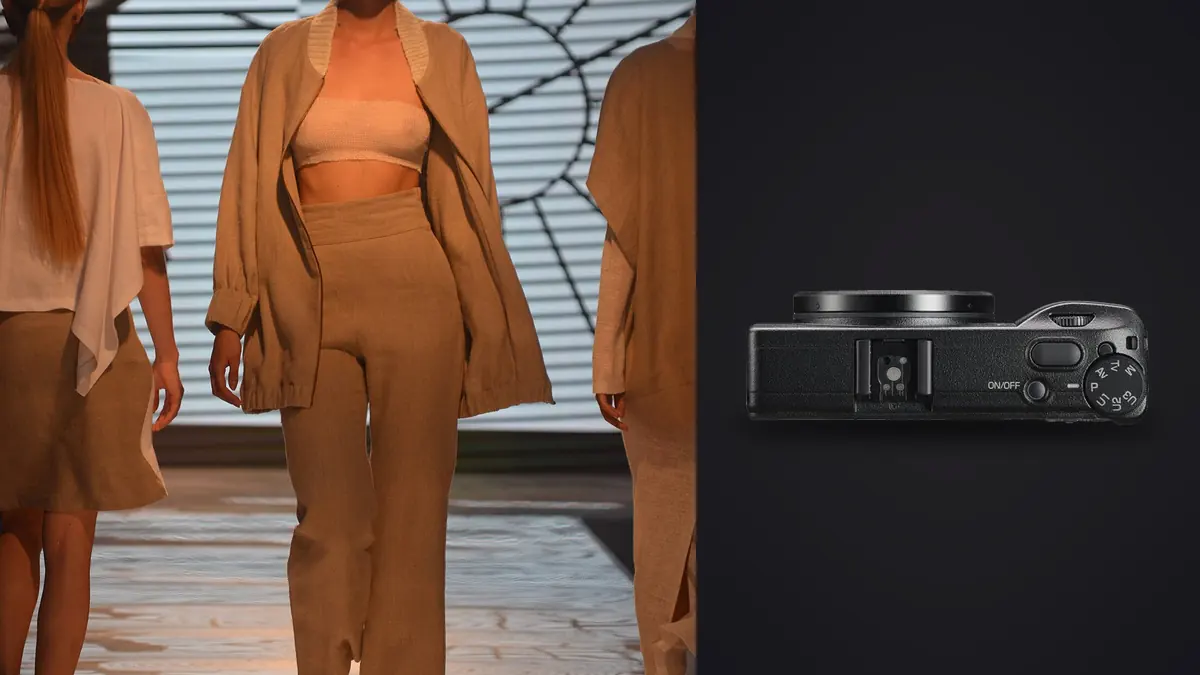
It's common to start carrying a Ricoh GR IIIx on lookbook days almost by accident. A stylist asks for a handful of behind-the-scenes stills for the brand's Instagram, and a phone isn't cutting it next to the polished hero frames coming off the main body. From there the GR IIIx tends to stay in a jacket pocket for every lookbook job, not because it replaces the primary camera, but because the 40mm-equivalent framing and the footprint of a deck of cards solve a problem a full rig can't: getting close, fast, without anyone on set clocking that you've picked up a camera.
This isn't a review in the usual sense. It's what actually happens when you point one of these at garments, models, and a moving production day, and what you do with the pile of files it leaves behind.
Why the 40mm crop matters more than people give it credit for
Ricoh sells two nearly identical bodies that differ mainly in lens: the GR III at 28mm equivalent and the GR IIIx at 40mm equivalent. Photographers debate this like it's a personality test, and on a lookbook set it kind of is. A 28mm lens wants you close and wide, which flatters environmental portraits and tight interiors but distorts a standing figure if you get within arm's reach. A 40mm lens sits almost exactly where a lot of commercial fashion photographers already compose in their heads: tight enough to isolate a look against a plain backdrop, loose enough to include hands, a bag strap, the way a hem sits on a moving leg, without stepping back into someone else's shot. That distance also matters logistically. Lookbook sets are cramped. You've got a stylist steaming a hem, a client on a monitor, an assistant bouncing a reflector, and maybe six people in a space built for two. A 40mm compact lets me stand roughly where I'd naturally stand to watch the shoot, rather than backing into a rack of samples to get a 24mm frame or crowding the model to get an 85mm one.
How it stacks up against the other compacts you'll see on set
I get asked fairly often whether the X100-series or a full-frame compact would just do the job better. Here's the honest comparison, based on what I've shot with on real production days, not spec-sheet reading.
| Camera | Equivalent focal length | Closest working distance | RAW buffer before it stalls | Body weight | Where it actually fits on a lookbook day |
|---|---|---|---|---|---|
| Ricoh GR IIIx | 40mm | ~12cm in macro mode | Roughly 10 frames at 4fps, then a noticeable pause | 257g | Fabric texture, candid movement, grab shots between setups |
| Ricoh GR III | 28mm | ~6cm in macro mode | Roughly 10 frames at 4fps, same as the IIIx | 257g | Tight interiors, environmental context, wider BTS |
| Fujifilm X100VI | 35mm | ~10cm | Materially deeper, holds a longer burst before it chokes | 521g | Hybrid stills and BTS video, when you need continuous AF tracking |
| Sony RX1R III | 35mm | ~20cm, not a true macro | Full-frame files fill it fast; a handful of shots before it drags | ~498g | High-resolution garment detail crops when you have time to slow down |
The pattern in that table is the point: nothing here wins outright. The GR IIIx wins on being genuinely pocketable and having a closer macro throw than the Fuji or the Sony, which matters more than people expect once you're photographing stitching, buttons, and label placement for a client who will zoom in at 100%. It loses badly the moment a shot needs tracked autofocus on a model who's actually walking, because the GR's contrast-detect system was never built for that.
Where it earns its place on the day
Garment texture without swapping lenses
Lookbook clients almost always want a handful of macro-adjacent shots: the weave on a linen shirt, a zipper pull, the way a knit cuff sits. On a main body that means either a dedicated macro lens sitting unused in the bag for 90% of the day, or awkward extension tubes. The GR IIIx's macro mode gets close enough, often close enough that you can skip the macro lens entirely on jobs where texture shots aren't the hero deliverable, just supporting content for a product page or an ecommerce gallery.
Snap focus for movement between takes
The GR series has a "snap focus" mode that locks focus at a preset distance (2.5 meters suits most lookbook work, sometimes 1.5m in tighter spaces) rather than hunting with contrast-detect AF. It sounds crude and it is crude, but it means zero shutter lag when a model turns to laugh at something off-camera or a stylist adjusts a collar mid-walk. Those are the frames that end up on the brand's Instagram Stories, not the catalog page, and they need to happen the instant they happen. Waiting on autofocus loses the moment.
The leaf shutter is the actual reason I bought it
This is the detail that gets buried under discussions of sensor size and lens sharpness, and it's the one that matters most on outdoor lookbook days. The GR IIIx has a leaf shutter built into the lens assembly, which means it can sync flash at its full shutter speed range, up to 1/4000s on some settings, without needing high-speed sync tricks that eat power and add lag. On an outdoor lookbook shoot at midday, where you're trying to overpower bright sun with a small strobe to get shape on a model's face, that's the difference between a clean exposure and fighting the camera. My main body needs HSS mode to do the same thing, which costs stops of power I don't have to spare from a battery-powered head.
Where it runs out of road
I want to be direct about the limits, because I've seen photographers buy one expecting it to be a lightweight primary camera for fashion work and get frustrated fast.
- No tracking autofocus worth trusting. If a model is walking toward camera and you need the eyes sharp on frame after frame, this isn't the tool. It's built for a photographer who moves and composes, not a camera that chases a subject.
- One lens, permanently. Forty millimeters is a fixed decision. If the art director suddenly wants a wide environmental establishing shot, you're either cropping hard in post or reaching for a different body.
- Battery life is genuinely short. I get roughly 180 to 220 frames per charge in real use, fewer if I'm chimping the screen constantly, which I always am. I carry three spares on a full shoot day.
- Dynamic range under mixed lighting is average at best. Pushing shadows hard on a frame shot half in window light, half in strobe fill, shows noise and color shift faster than the files from my main system. Fine for BTS and web use, less fine if a client suddenly wants to print one large.
What a lookbook day actually does to your GR IIIx file count
Here's the part nobody warns you about before you start carrying one of these on jobs: the ease of shooting means you shoot constantly. A typical eight-look lookbook day on the main system might produce 800 to 1,200 selects-worthy frames. The GR IIIx, riding along the whole time because it costs nothing to lift and fire, easily adds another 400 to 700 frames of its own. Snap focus means a real chunk of those are soft because you guessed the distance wrong, and burst shooting during movement means whole runs of six or eight nearly identical frames where only one has the right expression.
That's the situation I didn't have a good answer for until I started running everything through imagic at the end of the day. It's a local, one-time-purchase app rather than a subscription, which matters because client files from an unreleased collection often sit under an NDA and shouldn't touch a cloud upload step, even briefly. imagic's sharpness scoring runs entirely on my machine and flags which of those snap-focus grabs actually landed, so I'm not squinting at 600 thumbnails at 100% trying to tell a真 sharp frame from a near miss. The duplicate and burst clustering is the bigger time saver on GR IIIx files specifically, since it groups those runs of near-identical continuous shots so I'm choosing the best of six instead of scrolling past all six individually. If you haven't looked at how that kind of automated culling actually works under the hood, this piece on how AI photo culling works covers the mechanics better than I can in a paragraph here.
The other feature I lean on is apply_my_style, the preset trained on my own past edits rather than a generic filter. Lookbook candids and BTS shots need to sit close to the same color world as the hero images without manually grading a few hundred throwaway frames. Training it on a batch of previously graded lookbook-style work means the GR IIIx files come out looking like they belong to the same shoot as the main camera's output, instead of looking like a separate, undercooked set of snapshots. It's not a substitute for real retouching on the deliverables that matter, but for the volume of casual frames a lookbook day generates, it closes most of the gap in a fraction of the time. If you're weighing tools for this kind of high-volume sorting task generally, this comparison of photo culling software is a reasonable starting point before you commit to one workflow.
Practical settings I actually run
For anyone about to try this on their own shoot, the settings that made the biggest difference for me:
- Snap focus distance: 2.5m for open spaces where models are moving, 1.5m for tighter studio corners.
- Metering: Highlight-weighted rather than average, since blown fabric detail on white or pastel garments is much harder to recover than shadow.
- Auto ISO ceiling: capped at 3200. Above that the APS-C sensor's shadow noise starts fighting with skin tone accuracy, which matters more on fashion work than most genres.
- Custom white balance: set manually off a gray card whenever mixing with strobes, because the auto setting drifts warm under tungsten practicals that are often left on in a studio corner.
Frequently Asked Questions
Is the Ricoh GR IIIx sharp enough for the actual catalog images, or only BTS content?
In good light with snap focus disabled and real autofocus engaged on a static subject, the files are sharp enough for web catalog use and small print. I wouldn't use a GR IIIx frame as the hero image for a large-format campaign print, but for the ecommerce gallery, social content, and texture detail shots that make up most of a lookbook deliverable, it holds up fine.
Can it replace a full-frame body as the primary lookbook camera?
Not for me, and I'd be skeptical of anyone claiming otherwise. The fixed 40mm framing and the lack of trustworthy tracking autofocus rule it out as a sole system for a shoot where the client expects varied compositions and a model in motion. It's a second camera, deliberately, and trying to make it a first camera means fighting its actual design.
Does the leaf shutter flash sync actually make a visible difference outdoors?
Yes, and it was the single feature that justified the purchase for me. Being able to hit full sync speed without high-speed sync overhead means more usable power from a small strobe when you're trying to darken a bright sky and still put light on a model's face. On a mirrorless body without a leaf shutter, the same shot costs stops of flash power I usually don't have to spare on location.
How do you keep the casual GR IIIx frames from confusing a client mid-shoot?
I keep it on a completely separate card and never plug it into the same review station as the main camera during the shoot. Clients reviewing tethered images from the hero system shouldn't be scrolling through soft snap-focus candids while decisions are being made about the actual deliverable. Everything from the compact gets sorted and graded afterward, on its own timeline.