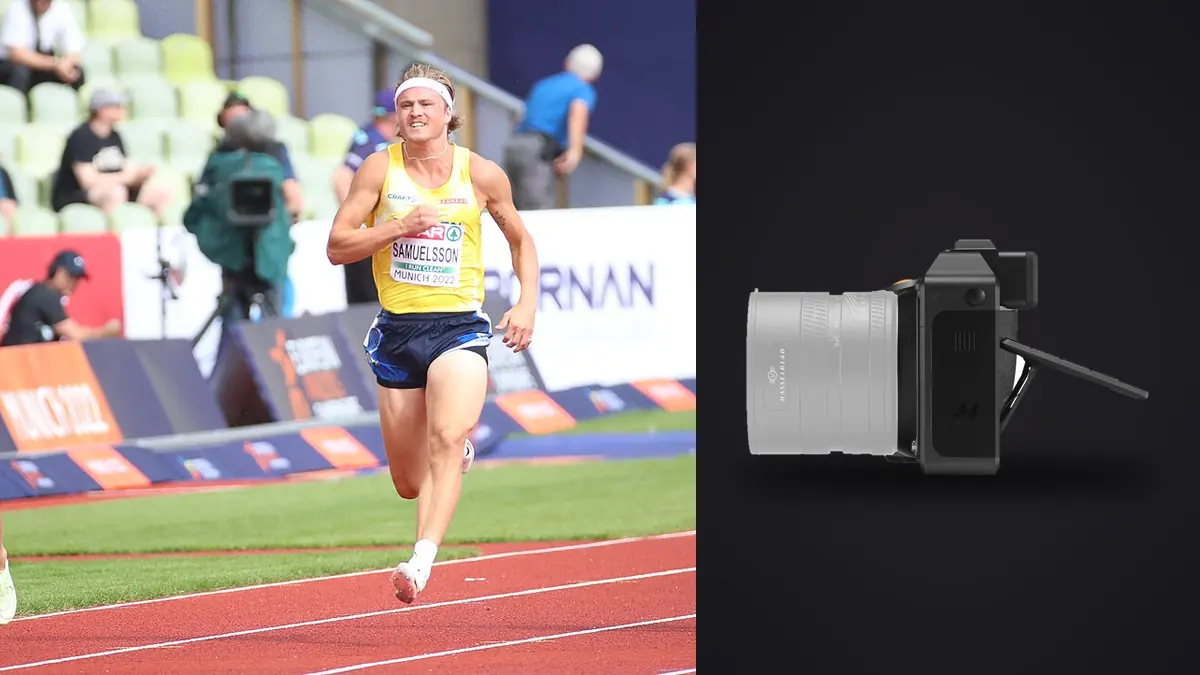
A meet director in Ohio once asked me, not unkindly, why I was walking the backstretch fence with a medium format body instead of the 400mm-and-monopod rig every other credentialed shooter had. It's a fair question. The Hasselblad X2D 100C was built for people who photograph buildings, dresses, and landscapes that hold still long enough to be composed. Track and field is the opposite of that brief: bodies moving at 20+ mph, decisive moments measured in hundredths of a second, and light that shifts every time a cloud crosses the stadium. Bringing a 100-megapixel medium format camera to cover a 100m final sounds like showing up to a boxing match with a view camera. Nobody would hand you this as a first recommendation. But there's a narrow, specific use case where it earns its place in the bag, and getting there means being honest about where it falls apart first.
Why This Camera Wasn't Built for a Cinder Track
The X system's lineage is portraiture, architecture, fashion, and landscape work, the kind of shooting where you have seconds or minutes to nail focus, not fractions of one. The original X2D 100C (2022) uses contrast-detection autofocus exclusively, no phase-detection pixels on the sensor at all. Hasselblad didn't add phase-detection AF to the line until the X2D II 100C arrived in 2024. If you're working with the first-generation body, which is still the one most people mean when they say "X2D 100C," you're focusing the way compact cameras did a decade ago: the lens hunts back and forth hunting for maximum contrast, then locks. That's fine for a static subject. It is not fine for a hurdler closing distance at speed.
Continuous shooting sits in the low single digits, closer to 3fps than anything a sports shooter would call "burst." The buffer is shallower than the spec sheet implies once you're actually writing 100-megapixel 3FR raw files, each one running close to 200MB. In practice you get somewhere around fifteen to twenty raw frames before the camera stalls to catch its breath, which is roughly what a modern sports body burns through in under a second.
Autofocus in Continuous Mode Is the First Wall You Hit
Lock onto a sprinter standing in the blocks and the X2D 100C nails it, the same as it would nail a portrait subject standing still. The moment the gun fires and that same athlete is at full stride, contrast-detection AF starts hunting, especially against a low-contrast background like a tartan track surface or an unmarked infield. There's no predictive tracking algorithm chasing subject velocity the way a stacked-sensor sports body does. You'll get a sharp frame at the start, a soft frame mid-race, and no reliable pattern connecting the two.
Shutter Behavior Under Stadium Lights
The X2D 100C has no focal-plane mechanical shutter in the body. Shutter duties fall to leaf shutters built into XCD lenses, which cap out anywhere from 1/1000s to 1/4000s depending on which lens you're using, or to the sensor's fully electronic shutter, which can hit faster nominal speeds but reads out slowly enough that fast horizontal motion, a sprinter's legs at the finish line, for example, can show visible skew. Neither option behaves like a global or stacked shutter. Indoor meets compound the problem: base ISO on this sensor is a gorgeous, low-noise 64, which is a gift outdoors at midday and a liability once you're bumping to ISO 3200 or 6400 under gymnasium lighting to get a usable shutter speed.
The Glass Problem Nobody Mentions
Medium format sensors are physically larger than full-frame, which means the math runs backward from what most people expect. A 300mm lens on the X2D 100C's 44x33mm sensor behaves like roughly a 237mm lens would on full-frame, because you need more actual focal length on the bigger sensor to match the same field of view. Hasselblad's longest native XCD lens, the 300mm f/3.2, only gets you there with the 1.7x teleconverter attached, and even then you're looking at an effective 400mm equivalent at a compromised f/5.6ish aperture, with autofocus hunting more with the teleconverter in the chain, not less.
Here's how that stacks up against what's actually usable from a stadium press box or general-admission stands:
| Lens / setup | Actual focal length | Full-frame equivalent | Effective aperture | Practical use at a track meet |
|---|---|---|---|---|
| XCD 90V | 90mm | ~71mm | f/3.2 | Warm-up area, athlete portraits, nowhere near the far turn |
| XCD 135mm | 135mm | ~107mm | f/2.8 | Field events viewed from close rail position only |
| XCD 300mm f/3.2 | 300mm | ~237mm | f/3.2 | Workable for the home straight, thin for the backstretch |
| XCD 300mm + 1.7x TC | 510mm | ~403mm | ~f/5.6 | Closest to real reach, AF hunts noticeably more often |
| Reference: 400mm f/2.8 (full-frame) | 400mm | 400mm | f/2.8 | The standard rail lens for a track final at most meets |
So the X2D 100C's longest practical combination just about matches what a single full-frame prime does natively, at two stops slower and with far less confident autofocus behind it. If your credential puts you on the infield rail rather than up in the stands, this stops mattering as much. If you're shooting from general admission, it matters a great deal.
Where the X2D 100C Actually Earns Its Spot in the Bag
None of this means the camera is useless at a meet, it means the job it's good at is narrower than "cover the race." Three things it genuinely does well:
First, resolution for print. A 100-megapixel file holds up at mural size or as a heavily cropped hero shot for a sponsor wall in a way a 24-megapixel sports body file simply can't. If a program only needs one extraordinary frame of a pole vaulter at the apex of a clearance, rather than a full sequence of the approach, this camera can deliver a frame that prints bigger and crops harder than almost anything else available.
Second, quiet operation. The leaf shutter is nearly silent compared to a DSLR's mirror slap or a mirrorless body firing at 20fps next to a finish line judge's ear. At meets where officials are sensitive about shutter noise near the timing equipment, that matters more than fps ever will.
Third, the 5-axis in-body stabilization is genuinely strong, rated around 7 stops, which opens the door to handheld slow-shutter panning shots, a relay handoff dragged at 1/30s for motion blur in the background while the baton stays crisp, for instance. That's a creative technique, not a documentary one, but it's a look full-frame sports shooters rarely bother chasing because their gear is optimized for freezing everything instead.
A Working Method If You Bring It Anyway
The approach that actually produces usable frames looks less like sports photography and more like the zone-focusing techniques large-format and rangefinder shooters have used for decades. Pick a fixed mark on the track, the shadow line of the last hurdle, the eighth-lane paint at the top of the home straight, the exact spot where a long jumper's foot hits the board, and pre-focus there manually or with AF-S locked via back-button focus before the athlete arrives. Wait. Fire a short two or three frame burst as the subject crosses the mark, not a continuous stream. Recompose only after refocusing, never mid-sequence.
Prioritize moments with near-zero vertical velocity over moments of peak horizontal speed: a pole vaulter suspended at the top of the bar, a long jumper at the highest point of flight, an athlete on the medal stand, a coach mid-instruction at the rail. These are the frames where a slower, more deliberate AF system isn't fighting physics it can't win. Trying to track a 400m runner's full lap with this body is fighting the wrong fight.
Sorting a Meet's Worth of 100-Megapixel Files
The workflow after the meet looks different from a typical sports shoot too. You'll come home with far fewer frames, maybe 300 instead of 4,000, but each one is enormous, and because contrast-detection AF misses more often than a phase-detection system would, you can't assume the first frame in a zone-focus sequence is the sharp one. Eyeballing focus on a laptop screen at less than 100% zoom across 200MB raw files, meet after meet, is how soft frames end up delivered to a client by mistake.
This is where I actually lean on imagic rather than trusting my own tired eyes at 11pm after a meet. Its local sharpness and focus scoring checks every frame on the machine itself, no upload, which matters twice over with files this size: nobody wants to push a folder of 200MB raws through a venue's guest wifi, and the scoring runs the same whether you're on a hotel connection or offline entirely. The culling process also clusters those two or three frame zone-focus bursts together automatically, so you're comparing near-duplicates against each other instead of scrolling past them one at a time looking for the sharp one. And because a single meet often mixes outdoor prelims at ISO 64 with indoor finals under a completely different color temperature, the apply_my_style preset, trained on my own past edits rather than a generic look, gets both sets close to a consistent grade without me rebuilding it from scratch each time the lighting changes. None of that fixes the autofocus. It just means the handful of frames that were actually sharp don't get buried under the ones that weren't, which matters more here than on a typical high-volume sports shoot, where you can afford to lose a few frames to noise. Here you often can't afford to lose any.
Frequently Asked Questions
Can the X2D 100C keep continuous autofocus locked on a running sprinter?
Not reliably on the original 2022 body. It uses contrast-detection AF only, with no predictive subject tracking, so it can lock onto a stationary or slow-moving subject well but tends to hunt once a subject is moving at sprint speed, particularly against a low-contrast track surface. The X2D II 100C introduced phase-detection AF in 2024 and handles moving subjects noticeably better, though still not at the level of a dedicated sports body.
What's the realistic maximum reach for shooting a track final from the stands?
The XCD 300mm f/3.2 paired with the 1.7x teleconverter gets you to roughly a 400mm full-frame equivalent field of view, at an effective aperture closer to f/5.6 and with more autofocus hunting than the bare lens alone. That's on par with a single 400mm full-frame prime used natively, not beyond it, so reach from general admission seating stays a real limitation.
Is the leaf shutter fast enough to freeze a sprinter's stride?
Leaf shutter speeds vary by lens, topping out anywhere from around 1/1000s to 1/4000s depending on which XCD optic is mounted. The faster telephoto lenses used for track work tend to sit toward the slower end of that range. The sensor's electronic shutter can go faster on paper but introduces rolling shutter skew on fast horizontal motion, so neither option matches the shutter behavior of a stacked-sensor sports camera.
Does bringing a medium format body to a track meet make any practical sense?
For full event coverage, no, a dedicated sports body with a longer native lens and phase-detection tracking will out-produce it every time. For a specific, planned hero shot destined for a large print or sponsor wall, where you can pre-focus on a fixed mark and wait for one moment rather than chase the whole race, the resolution and color the X2D 100C delivers can genuinely be worth the trade-off.
I still bring the 400mm body to cover the actual race. The X2D 100C rides along in a second bag for the one or two frames a meet, the vault clearance, the medal stand, the coach's reaction, where resolution and color matter more than frame rate ever will. Used that way, on its own terms rather than as a sports camera pretending to be one, it earns the extra weight.