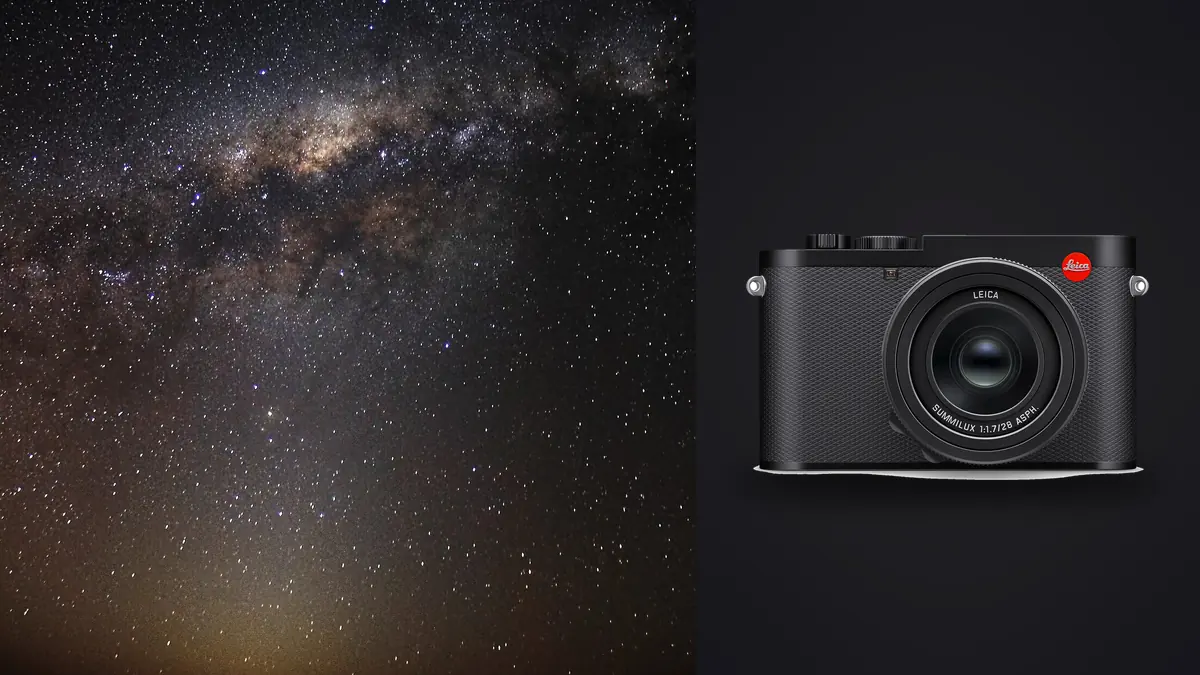
The Leica Q3 is an odd choice if you come at star stacking from the astrophotography side of things. No interchangeable lens, no cooled sensor, no autoguider, and a 28mm field of view that's wider than almost anyone would pick if the goal is isolating a nebula or a galaxy. I've still hauled mine out to three different dark-sky spots over the last two winters, mostly because it was already in the bag and I didn't want to carry a second body. What changed my mind about it wasn't deep-sky detail, it's not built for that, it was how well a stacked 28mm frame holds up as a wide nightscape: Milky Way arcing over a ridgeline, a lit foreground under a sky full of pinpoint stars, none of the speckled noise you'd get from a single 60-megapixel exposure at ISO 6400.
This is a field guide to actually doing that with this specific camera, not a general "how to shoot the night sky" piece. The Q3's fixed lens, its resolution, and its lack of any dedicated astro mode all change the workflow in ways that generic advice glosses over.
A fixed 28mm changes what stacking is even for
With a telescope or a long telephoto, stacking exists to pull faint structure out of a small patch of sky, a nebula's gas clouds, the spiral arms of a galaxy. At 28mm none of that is on the table. Stars are point sources scattered across a huge field, and stacking here is doing one job: fighting noise so the sky doesn't look like static once you view the file at full resolution or push shadows in post.
The Q3's f/1.7 Summilux gathers more light per frame than most 28mm lenses, which helps, but the sensor works against you a bit. Sixty megapixels on a full-frame sensor means smaller photosites than a 24MP body of the same size, and smaller photosites mean more visible noise per pixel at a given ISO. Downsampling for web or a smaller print hides a good chunk of that, but if you're cropping in at all, or printing large, single-frame noise reduction can't fully substitute for actually averaging fifty or a hundred exposures together. That's the whole case for stacking on this camera: it's not optional polish, it's what makes the file usable past a casual Instagram crop.
One thing that does work in the Q3's favor: at 28mm, depth of field at infinity is enormous. Nail focus once on a bright star early in the session and it holds for the rest of the night. You're not chasing focus drift the way you would with a longer lens on a telephoto rig.
Setting up before the sky goes fully dark
Lock focus manually. Switch the lens to manual focus, dial in the magnified live view (the Q3's EVF makes this easy, zoom in on Vega or Sirius while it's still visible in twilight), and turn the ring until the star collapses to its smallest, tightest point. I tape the focus ring down after that if there's any wind, because a stray brush against the barrel while you're fumbling with an intervalometer app in the dark is a real way to lose an hour of frames to soft focus. Aperture is a genuine tradeoff. Wide open at f/1.7 the corners show some coma, those little seagull-wing stars near the edges of the frame that a lot of fast wide primes suffer from. Stopping down to f/2 or f/2.2 tightens that up noticeably without giving away much light. I shoot most stacking sequences at f/1.7 or f/2 depending on how forgiving the composition is about corner stars.
For triggering the sequence, the Q3's photo menu has a built-in interval timer, which is enough for a basic stack. I've had better luck running it through the Leica FOTOS app instead, mostly because it lets me check focus and framing on my phone without touching the camera and risking a bump. Either way, turn off image stabilization for tripod work (the Q3's IS can actually introduce a very slight softness on a locked-down tripod if left active) and disable any auto power-off setting that might kill the session halfway through.
Battery life at night, especially in cold weather, is the other thing people underestimate. I bring three batteries for anything longer than a 90-minute stacking run and keep the spares in an inside jacket pocket, not in the camera bag, because cold cells drain fast and recover some charge once warmed back up.
How much exposure time you actually get at 28mm
The old "500 rule" (500 divided by focal length) doesn't hold up on a 60MP sensor. It was built for cameras with far larger pixel pitch, and the Q3's pixels are small enough that stars start showing visible elongation well before the 500 rule would predict trouble. The NPF rule, which factors in aperture and pixel pitch alongside focal length, gives a more honest number, and in practice I've found I need to shave a couple of seconds off whatever a basic focal-length calculator suggests. These are the numbers I've settled on through actual field testing, not a strict formula output, treat them as a starting point to fine-tune on your own tripod and location:
| ISO | Aperture | Max single frame (pinpoint stars) | Frames for a 12-min stack | Noise character before/after stack |
|---|---|---|---|---|
| 1600 | f/1.7 | ~8 sec | ~85 | Clean single frames, stack mainly smooths gradients |
| 3200 | f/1.7 | ~8 sec | ~85 | Visible grain per frame, disappears almost entirely stacked |
| 6400 | f/2 | ~6 sec | ~115 | Heavy grain per frame, stack recovers roughly 2 stops of cleanliness |
| 12800 | f/2 | ~6 sec | ~115 | Usable only if stacking, single frames are too noisy for anything else |
I default to ISO 3200 at f/1.7 for most sessions. It's the point where individual frames still look like photographs (useful if a stack fails partway and you need to fall back on one good exposure) while keeping shutter speed short enough that star trailing isn't a concern even on a slightly uneven tripod setup.
Shooting the actual sequence
More frames at a shorter exposure beats fewer frames at a longer one, for a fixed 28mm lens with a fast aperture. I aim for 80 to 120 light frames for a typical Milky Way sequence, which at 6 to 8 seconds each with minimal gap between shots runs somewhere between 10 and 18 minutes total, depending on write speed with the 60MP DNGs. I also shoot 10 to 15 dark frames at the very end, same ISO and shutter speed, lens cap on. The Q3's sensor runs warmer than you'd expect after a long stacking session in cold air, and hot pixels show up as tiny colored dots scattered across the stacked sky if you skip this step. It costs two extra minutes and saves a cleanup pass in post.
If you want the foreground sharp and properly exposed rather than a silhouette, shoot it separately. At 28mm you'll often have a decent amount of landscape in frame along with the sky, but the foreground almost always needs a longer exposure, a flashlight-painted pass, or a blue-hour exposure taken before the sky goes fully dark, then blended in later. Don't try to stretch one exposure setting to cover both; you'll compromise the sky, the ground, or both.
Culling a hundred nearly identical night frames before you stack
This is the part nobody mentions until you're actually doing it at 1am with cold hands. Stacking software wants clean input only, one soft or shaken frame in a batch of ninety can drag down sharpness across the whole average, or introduce a ghosting artifact in dense star fields. But at 28mm f/1.7 in the field you'll get dew fogging the front element halfway through a run, a car's headlights sweeping the horizon on frame 43, a gust catching the tripod, and reviewing a hundred-plus nearly-black frames on a laptop screen at a campsite is genuinely miserable work. I run the sequence through imagic before it ever touches stacking software. Its local sharpness scoring flags the soft frames (dew, wind-shake) without me squinting at thumbnails one by one, and because it's fully offline, that matters at actual dark-sky sites where there's no signal to speak of. The burst clustering also groups the interval sequence together instead of making you scroll through what looks like the same frame ninety times in a row, so pulling the two or three bad exposures out of a long run takes a couple of minutes instead of twenty. If you're new to how automated culling actually scores a burst like this, this breakdown of how AI photo culling works covers the mechanics in more depth than I have room for here.
Which stacking software actually handles Q3 files
DeepSkyStacker is built for deep-sky work and doesn't handle a landscape foreground gracefully, it'll try to align on stars across the whole frame and smear anything terrestrial in the process. For a nightscape with foreground in shot, Sequator (free, Windows) does a solid job with its sky/ground masking and reads the Q3's DNGs without complaint. On a Mac, Starry Landscape Stacker handles the foreground masking with a bit more finesse and is worth the license cost if you shoot this kind of frame regularly. Photoshop's Statistics stack (median blend across a layered sequence) is a manual fallback that works fine but gets slow once you're feeding it more than sixty full-resolution 60MP files, expect your machine to chug through it.
One practical note: new camera DNG variants occasionally lag behind in third-party software support. If you're heading out on a trip specifically to shoot this, update your stacking software and do a quick test stack with a handful of frames before you're relying on it in the field.
After the stack: grading a series shot across different nights
A clean stack still needs contrast and color work, it comes out flat and needs the same kind of grading a single long exposure would. If you're building a series shot across multiple nights or locations, keeping the color treatment consistent by eye gets tedious fast, night skies shift in tone depending on moon phase, light pollution, and how much you push the stack's exposure. I've been running the merged files through imagic's apply_my_style feature once I've settled on a look I like for a given series, since it's trained on my own past edits rather than a generic preset, and it keeps a set of stacked nightscapes from three different trips looking like they belong together instead of looking like three separate experiments. It's a smaller piece of the workflow than the culling step, but it saves real time once you've got more than a handful of stacked frames to grade the same way. For the wider editing pipeline this fits into, these workflow tips cover a few adjacent habits worth adopting if you're shooting sequences like this regularly.
Is the Q3 actually worth buying for this
Honestly, no, not if astrophotography is the primary goal. A camera with interchangeable lenses gets you a faster, wider prime built specifically for astro work, and a dedicated tracker mount opens up exposure times this setup simply can't reach without trailing. If you're starting from zero and astro is the main draw, that combination will get you further per dollar. Where the Q3 earns its place is if you already own one for everyday work and don't want to justify a second body just for the handful of clear nights a year when conditions line up. The fixed 28mm and the coma wide open are real limitations, but stacked and processed properly, the output holds up fine for the kind of wide nightscape work most people actually want out of a night sky shot.
Frequently Asked Questions
Do I need a star tracker for the Q3, or is stacking enough?
For wide nightscapes at 28mm, stacking alone is enough. A tracker becomes useful once you want longer individual exposures for deeper sky detail, but at this focal length you're not resolving faint structure anyway, you're fighting noise, and stacking short static exposures handles that without the added weight and setup time of a tracking mount.
Why does my stacked sky still look grainy when I zoom in?
Usually one of two things: not enough frames in the stack (under 40 or 50 rarely gets you a clean result at high ISO), or dark frame subtraction was skipped and hot pixels are being mistaken for grain. Check the actual stack count first, then confirm your stacking software applied the dark frames before averaging.
Can the Q3's built-in interval timer replace a separate intervalometer app?
For a straightforward sequence, yes, the menu-based interval timer is reliable and one less thing to carry. I still prefer triggering through the Leica FOTOS app because it lets me check exposure and framing on my phone screen without approaching the tripod, which matters more on uneven ground in the dark than it sounds like it would.
Does the 28mm Summilux really show coma at f/1.7?
Yes, in the corners, stars near the frame edges pick up a slight wing shape wide open. It's mild compared to a lot of fast wide primes and mostly a non-issue if your composition keeps the busiest part of the sky toward the center, but if corner stars matter to the shot, stopping down to f/2 or f/2.2 cleans it up noticeably.