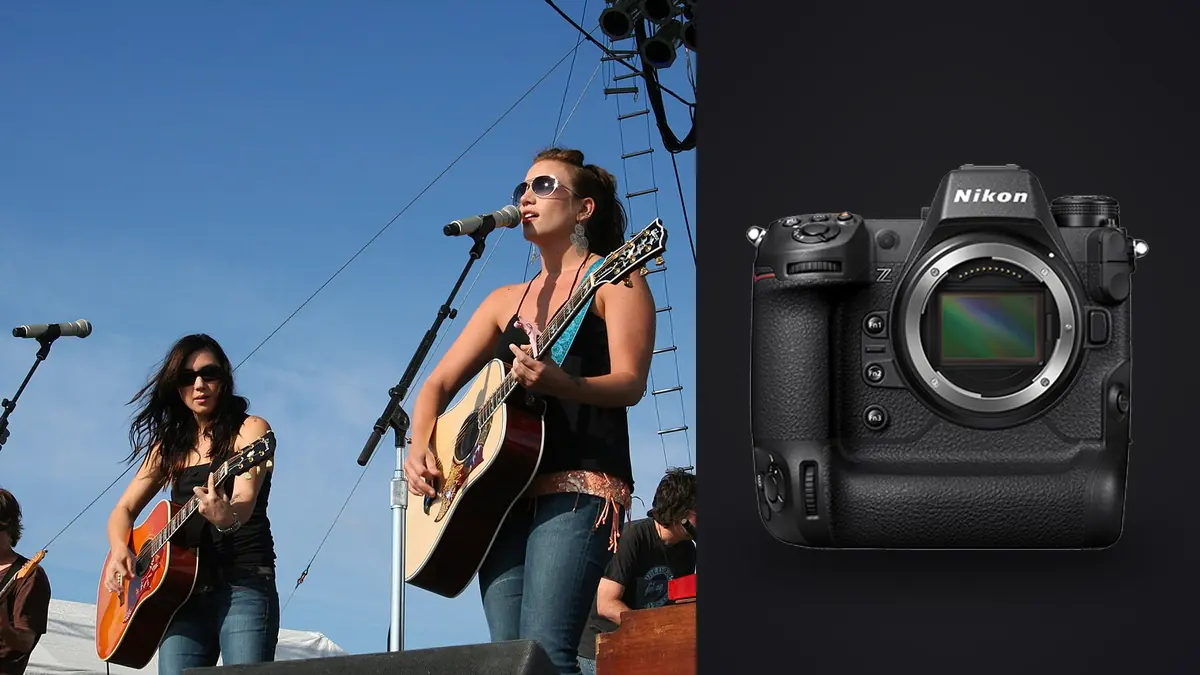
Picture the first three songs with a Z9 at a mid-size club where the lighting rig consists of two moving heads and a fog machine that clearly hasn't been serviced since 2019. Within about forty frames it becomes clear this body is going to change how you approach the pit. No blackout in the viewfinder means you never lose the singer's face mid-jump. That single thing, more than the resolution bump or the video specs anyone talks about, is what actually matters when you've got three songs and a photo pit barrier digging into your hip.
Why the Blackout-Free Viewfinder Is the Real Story
Every camera company markets frame rate and megapixels because those numbers fit on a spec sheet. What doesn't fit on a spec sheet is the feeling of tracking a drummer through a rim shot and watching the viewfinder flicker to black on every single frame, which is what happens with a mechanical shutter camera under continuous burst. The Z9 has no mechanical shutter at all. There's nothing to flap out of the way, so the finder just keeps showing you a live feed the entire time you're firing. You see the guitarist's pick hand mid-strum instead of guessing where it'll be when the mirror comes back down.
That matters more at concerts than almost anywhere else because the light is inconsistent and the subjects move unpredictably. A landscape photographer doesn't need continuous eye contact with the frame. A wedding photographer mostly doesn't either. But when a singer leaps off a monitor wedge and you've got maybe four frames before they're back down, watching the actual moment happen instead of a strobing approximation of it is the difference between nailing the shot and guessing.
Settings I Actually Dial In Before Doors Open
Autofocus: Wide-Area AF (C1) over Auto-Area
I don't run full Auto-Area AF at shows. With five or six people crowded on a stage, plus a lighting truss, plus a drum riser, the subject detection will happily lock onto whoever's closest to camera rather than whoever's actually performing. I set up Wide-Area AF (C1), shrink the box down to roughly a quarter of the frame, and steer it manually with the joystick onto the singer's face or the soloist's hands. Human/eye detection stays on within that zone, so I get the sensor's face tracking without handing it the whole frame to interpret.
Shutter Speed: I Rarely Drop Below 1/250
Stage lighting rigs cycle. LED washes and moving heads pulse, and if your shutter speed dips too low relative to that pulse rate you get banding or partial-exposure frames where half the singer's face is a stop darker than the other half. 1/250 is my floor for anything with movement (which is everything). For a guitarist doing a big windmill strum I'll go up to 1/500 or faster. The only time I go slower on purpose is for a deliberate blur shot on a static ballad moment, and even then I brace against the barrier rather than trust my hands at 1/30.
ISO: I Let It Float, Capped at 12800
The Z9's high-ISO files hold together well past where older bodies fell apart, but I still cap Auto ISO at 12800 rather than the ceiling. Past that point the shadow noise starts eating into skin tone detail in a way that's genuinely hard to recover, even with modern noise reduction. I'd rather come home with a clean 12800 frame and a slightly underexposed background than a noisy 25600 frame I have to fight in every single edit.
Frame Rate: 20fps Raw, Not 30fps JPEG
The Z9 can do 30fps in a cropped JPEG mode, but I shoot raw at 20fps almost exclusively. Losing full resolution and raw flexibility for a marginal frame rate bump isn't worth it for concert work, where the bottleneck is picking the right moment, not having more slightly-different moments to choose from. Twenty frames a second across a two-second burst already gives me forty frames of a single chorus hit. That's plenty.
How Lighting Conditions Actually Change My Settings
No two venues light a band the same way, and the gap between a 200-cap club and a festival main stage at dusk is bigger than most gear guides admit. Here's roughly how I adjust across the venues I shoot most often.
| Venue type | Typical shutter | ISO range | AF mode | Lens I reach for |
|---|---|---|---|---|
| Small club, single wash + haze | 1/200-1/320 | 3200-10000 | Wide-Area (C1), small box, manual steer | 50mm f/1.8 or 35mm f/1.4 |
| Mid-size venue, moving heads + strobes | 1/320-1/500 | 1600-8000 | Wide-Area (C1), eye detect on | 24-70mm f/2.8 |
| Arena, LED walls + pyro | 1/500-1/1000 | 800-6400 | 3D-tracking from locked start point | 70-200mm f/2.8 |
| Outdoor festival, dusk into dark | 1/250-1/800 (shifts through the set) | 400 to 12800 across one show | Wide-Area, re-centered between songs | 24-70mm f/2.8 + 70-200mm f/2.8 body swap |
The festival row is the one that trips people up. You'll load in at 6pm with the sun still up and shoot your first band at ISO 400. By the headliner at 10:30 you're at 12800 with the stage lit by nothing but LED panels. If your Auto ISO ceiling is set for the afternoon slot, you'll blow your evening frames. I reset ISO ceiling and shutter floor between every act rather than trusting one profile to cover a whole day.
Lens Choices: What Actually Earns Pit Space
Photo pits are small and access is usually first three songs, no flash. I carry two bodies rather than swapping lenses mid-set, because changing glass in a packed pit while a song is happening means missed frames and a security guard tapping your shoulder. One body wears a 24-70mm f/2.8 for wide stage context and environmental shots that include the crowd. The other wears a 70-200mm f/2.8 for tight face and hand shots from the barrier.
I know some shooters swear by the 400mm f/2.8 for arena work from a photo riser further back, and it's a legitimate choice if you're not in the pit itself, but for barrier-level access it's overkill and heavy enough to slow you down when you need to pivot fast between band members. The 85mm f/1.4 is my under-rated pick for club shows specifically because of how it renders stage haze; wide apertures in a smoky room produce a glow around light sources that a slower lens just doesn't give you.
The Three-Song Reality
Most photo pit credentials give you the first three songs, no flash, then you're escorted out. That's roughly ten to twelve minutes depending on setlist pacing. In that window I'm not composing carefully. I'm firing bursts on anything that looks like a peak moment (jump, guitar face, crowd interaction, drummer stick toss) and sorting the wreckage afterward. A single three-song set at 20fps easily produces 800 to 1,200 frames once you count every burst.
That volume is exactly why I stopped trying to cull concert shoots by eye at 1am after a show. I run the card through imagic when I get home, and its local sharpness scoring flags which frames in each burst are actually in focus on the eyes rather than the shoulder or the mic stand, which matters a lot when you're shooting wide open at f/1.8 in a dark room. It also clusters the duplicate-looking frames from a single burst so I'm not scrolling through forty near-identical jump shots one at a time. Everything runs on my laptop with no upload step, which matters when you're editing in a green room or a hotel with venue wifi that can't handle a gig-worth of raw files going anywhere.
Sorting and Editing After the Show
Once the culling pass is done I'm usually left with 60 to 100 keepers out of a thousand-plus frames. Concert galleries need a consistent look across venues that all lit the band differently, which is its own problem. I built out an edit in imagic once, from a batch of my best low-light frames, and now apply that same "apply_my_style" preset across new gigs as a starting point rather than re-inventing white balance and contrast curves from a blank slate every single time you open a new set. It's trained on my own prior edits rather than some generic preset pack, so it actually holds onto the way I like skin tones to sit under magenta stage light instead of flattening everything toward neutral.
If you're newer to sorting big concert batches, it's worth reading up on how AI photo culling works before you commit to a workflow, since the difference between a tool that just flags blur and one that understands burst context saves real hours on a heavy shoot week.
Mistakes I See Z9 Shooters Make at Shows
The most common one is leaving Auto-Area AF running the whole set and trusting subject detection to find the right face in a crowded stage. It works fine for a solo artist. It falls apart the moment there's a backup dancer or a second guitarist standing closer to camera than the singer. The camera isn't wrong, it's just picking the biggest, closest face, which usually isn't your subject.
The second is ignoring the mechanical shutter option entirely. Some Z9 owners assume electronic-only shooting is always correct because it's quieter and blackout-free, and for most concert work that's true. But under certain LED lighting rigs, particularly cheaper venue setups running older drivers, you'll get banding in electronic shutter that a slower flicker-reduction setting or, occasionally, the mechanical shutter avoids. I test a burst during soundcheck if I can get pit access early, specifically watching for banding across the top third of the frame where the lighting truss usually sits.
The third is buffer complacency. The Z9's buffer is deep enough that you can genuinely forget it exists for most of a shoot, which is exactly how people get burned during the one encore where a band does a five-minute jam and you've been holding the shutter the whole time. Dual CFexpress Type B cards clear fast, but they're not infinite, and I've watched a shooter miss the actual best moment of a set because the buffer finally caught up mid-song.
Frequently Asked Questions
Is the Z9 overkill for a photographer just starting out shooting local club shows?
Honestly, a little bit. The buffer depth and blackout-free finder are genuinely useful once you're shooting three or four gigs a week and can't afford to miss moments, but a smaller body with a fast f/1.8 prime will teach you more about reading stage light and anticipating movement than any amount of frame rate will. I'd rather see someone spend a year on a cheaper body learning to anticipate the beat drop than lean on burst rate to paper over timing they haven't developed yet.
Do I need flash for concert photography with this camera?
Almost every venue and artist contract bans flash in the pit, and the Z9's low-light performance makes that a non-issue anyway. I haven't used flash at a ticketed show in years. The only exception is small acoustic sets in venues with genuinely flat, dim house lighting where the promoter has explicitly cleared it, and even then I'd rather bump ISO than risk blowing out a performer's eyes mid-song.
What's the biggest adjustment coming from a DSLR to shooting the pit with this body?
Trusting the electronic viewfinder in changing light. DSLR shooters are used to an optical finder that never lags, so the first few shows with an EVF in a strobe-heavy room can feel disorienting, like the finder is fighting the lighting rig. It settles once you stop chimping the finder brightness and just trust the exposure meter and histogram instead of your eyes adjusting to flashing light.
How many raw files should I expect from a typical three-song pit set, and how do I get through them fast?
Between 800 and 1,200 is normal if you're firing bursts on every peak moment across three songs. Culling that by eye the same night isn't realistic after a long shoot day, which is the whole reason I run everything through a local cull pass before I even open an editor; it's covered in more detail in our piece on speeding up a photo workflow if you're building out your own process from scratch.