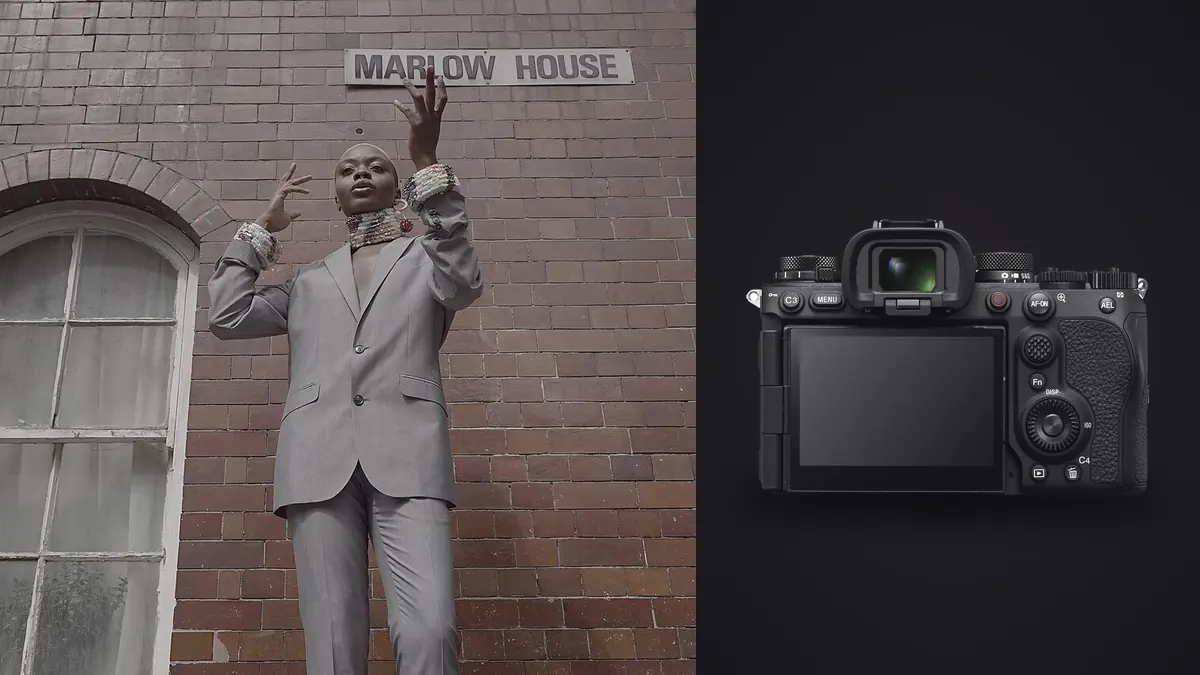
A stylist on a lookbook set has a way of cutting through camera talk on a call sheet. When a new body gets mentioned, her only question is "will it stop the fabric from smearing at 1/500?" That's the real test on a lookbook set. Nobody cares about frame rate numbers on a spec sheet. They care whether a skirt mid-spin reads sharp, whether the strobe can freeze a jacket being thrown over a shoulder, and whether forty outfit changes can happen without the lighting setup being rebuilt every time. The Sony A9 III launched as a sports and wildlife camera, global shutter sensor, absurd burst speed, built for people photographing birds in flight and Olympic sprinters. It has, somewhat unexpectedly, become a working tool on e-commerce and catalog lookbook sets. The reason has almost nothing to do with sports. It has to do with what a global shutter does to flash sync.
A sports camera that wandered onto a fashion set
Every camera with a conventional sensor, stacked or not, reads its pixels line by line. That's how rolling shutter artifacts happen: a fast-moving subject gets recorded slightly differently at the top of the frame than at the bottom, because a few milliseconds pass between the two. Most of the time this is invisible. On a lookbook set, where you're deliberately asking a model to spin, jump, flick their hair, or let a coat billow open, those few milliseconds show up as a lean or a wobble at the edges of motion. Shooters who've been doing movement-heavy fashion work for years have learned to just live with it, cropping tighter, shooting a few extra frames, hoping one lands clean.
The A9 III reads every pixel at the same instant. There's no line-by-line scan to skew. That single change is why a camera built for panning shots of Formula 1 cars turned out to solve a problem fashion photographers had quietly been paying a tax on for a decade.
What changes when the shutter is actually global
Flash sync without the HSS penalty
On a conventional body, if you want to shoot flash-lit fashion at a shutter speed fast enough to crush ambient daylight and freeze motion, say 1/2000s, you have to use High Speed Sync. HSS pulses the flash instead of firing a single burst, and that pulsing costs you one and a half to two stops of usable power. On a bright exterior lookbook shoot, that's the difference between a strobe that can dominate the sun and one that's fighting a losing battle. The A9 III doesn't need HSS at all. Because the whole sensor exposes at once, the flash can fire a single full-power pop at any shutter speed the camera supports, up to 1/80,000s. I've shot swim and activewear lookbooks outdoors at 1/4000s with a single small strobe doing work that used to require a much bigger pack running in HSS mode. That's not a marginal improvement, it changes what gear you need to bring to a location day.
No skew when the model actually moves
The other half of it is what I mentioned above: a spinning dress, a flicked scarf, a jump shot for a streetwear drop, none of it skews. On a recent shoot for a swimwear brand's summer lookbook, we had a model doing a fast hair flip under a mix of continuous LED (for behind-the-scenes video) and strobe (for stills). On the a7R V we'd used the previous season, the hair strands at the frame edges had a faint jello wobble on the fastest flips. Same setup, same light, on the A9 III, clean. No warping, no lean on the fabric hem. That's the kind of difference that doesn't show up in a spec comparison but absolutely shows up when a client zooms into a hero frame.
Where it doesn't help
I don't think the A9 III is a free upgrade for every fashion crew, and it's worth being honest about where it falls short. 24.6 megapixels is on the low end for anything that might get cropped tight or blown up for a large print or billboard. If a client wants full-length lookbook shots for a web store and also wants two or three hero images enlarged for in-store signage, you're already tight on resolution compared to a 45 to 61 megapixel body. Skin retouching at 100% has less room to work with too. And at roughly $5,998 body-only, it's not an easy purchase to justify unless movement-heavy, flash-lit work (fashion, sports crossover, events) is a meaningful part of your business. For a lot of studios doing mostly static product and portrait work, renting it for the handful of days a season that actually call for it makes more financial sense than owning one.
The frame-count problem nobody mentions in the marketing copy
Here's the part that doesn't get talked about enough. Because the A9 III can shoot up to 120fps completely blackout-free, once you put that in front of a fashion crew that likes movement shots, you generate a genuinely absurd number of frames. On a twenty-look lookbook day, if each look gets three or four short movement bursts, even a restrained shooter working at 20fps (well under the camera's ceiling) for a second and a half per burst will walk away with six to nine thousand frames before lunch. That's not hypothetical, that's roughly what happened on the swimwear job I mentioned above. The camera stopped being the bottleneck. Sorting through what it produced became the bottleneck.
This is the part of the workflow I've actually changed since picking up the A9 III. I run every card through imagic before I touch a single frame in an editor. The duplicate and burst clustering groups near-identical frames from a twirl sequence together, so instead of scrubbing through twelve almost-identical shots of a spin by eye, I'm picking the sharpest one or two from a cluster imagic has already grouped. The local sharpness and focus scoring is what actually matters here, because at 120fps a lot of frames in a burst are motion-blurred on the fabric even when the model's face is tack sharp, and eyeballing that difference across nine thousand frames is how you lose an afternoon. It runs entirely on my laptop with nothing uploaded anywhere, which matters when you are culling in a studio or venue with restricted wifi and no way to push files to a cloud service even if you wanted to.
How it stacks up against the other bodies actually used for this work
None of these numbers are official manufacturer figures, they're rounded from my own testing and from gear I've rented or borrowed, but they reflect what actually matters for flash-lit, movement-heavy lookbook shooting rather than a generic spec sheet.
| Camera | Flash sync ceiling | Rolling shutter risk (LED + strobe mix) | Blackout-free burst | Base resolution | Approx. body price |
|---|---|---|---|---|---|
| Sony A9 III | Any shutter speed, no HSS needed | None (global shutter) | 120 fps | 24.6 MP | ~$5,998 |
| Sony a1 II | 1/400s mechanical, HSS beyond that | Moderate under HSS with flickering LED | 30 fps | 50 MP | ~$6,499 |
| Sony a7R V | 1/250s mechanical, HSS beyond that | Higher, non-stacked sensor | 10 fps | 61 MP | ~$3,899 |
| Canon EOS R3 | 1/180s mechanical, HSS beyond that | Moderate, stacked but still rolling | 30 fps | 24.1 MP | ~$5,999 |
The a1 II and R3 both close some of the resolution or speed gap depending on what you weigh more, but neither removes rolling shutter entirely, and neither gets you out of HSS for high-shutter flash work. The a7R V remains the resolution king of that group by a wide margin, and for a lookbook that's 90% static hero shots with only the occasional movement frame, it's still a completely reasonable choice, arguably the smarter one given it costs two thousand dollars less.
Lenses that actually earn a spot in the bag
The body is only half the story on a lookbook day. The 24-70mm f2.8 GM II does most of the actual work, it's the lens I have mounted for probably 70% of a shoot day, covering hero full-length shots and group frames. The 70-200mm f2.8 GM OSS II comes out for compressed, flattering three-quarter shots where you want the background to fall away, and it pairs well with the A9 III's flash sync freedom because you can shoot it wide open at f2.8 to f4 with a fast shutter speed to control exposure instead of stopping down or reaching for an ND filter. The 50mm f1.2 GM is my pick for single-subject editorial-leaning frames where shallow depth matters more than catalog-style sharpness across the whole outfit. And the 85mm f1.4 GM II handles fabric texture and detail crops, the kind of tight product shot a client wants alongside the full-body looks for a garment's product page.
What a real shoot day looks like with it
On a typical lookbook day now, the lighting setup runs a two-light strobe kit alongside a continuous LED panel for behind-the-scenes video content, running at the same time, on the same shutter speed, without banding in either the stills or the video. That used to mean picking one lighting approach over the other, or running the continuous light at a much lower shutter speed and hoping it didn't clash with the strobe timing. Now it's a non-issue because there's no rolling readout for the LED's flicker to interact with. Midday, during the lunch break between outfit groups, you can run the morning's cards through imagic on a laptop while eating, since it needs no network connection to do the culling pass. By the time lighting is reset for the afternoon block, the morning's selects are already sorted down from a few thousand frames to a workable set. At the end of the day, when a same-day first pass is needed, the apply_my_style preset, trained on your own previously graded lookbook sets, can get a consistent color grade across the day's selects fast instead of hand-grading each look from scratch. It's not a replacement for a proper edit pass later, but it gets a same-day preview out the door looking like a finished set rather than raw camera files. If you're trying to shave time out of a shoot day generally, not just the culling step, it's worth reading through a few workflow habits that add up across a full shoot day, because the camera only solves one part of the time problem.
Frequently Asked Questions
Do I actually need HSS flash for movement shots with the Sony A9 III?
No, and that's the main practical win of the camera for this kind of work. Because the sensor is global shutter, the flash can fire a single full-power pop at any shutter speed the camera offers, including speeds well above a normal mechanical sync ceiling. You get to keep full strobe power at 1/2000s or faster instead of losing a stop and a half to HSS pulsing.
Is 24.6 megapixels enough resolution for lookbook and e-commerce catalog work?
For web galleries, product pages, and standard catalog sizes, yes, it's plenty. Where it gets tight is if a client also wants large prints, in-store signage, or heavy crops pulled from a full-length frame. If that's a regular part of the job, a higher-resolution body like the a1 II or a7R V is worth having available even if the A9 III stays the primary body for movement shots.
How many frames should I actually plan to cull from a burst-heavy lookbook day?
It varies with how movement-heavy the concept is, but on a twenty-look day with a few short bursts per look, five to ten thousand frames by end of day is a realistic range once you factor in bursts run at even moderate frame rates. Plan the culling pass into the schedule the same way you'd plan a lighting change, it's not something to leave for after the shoot wraps.
Does the A9 III really eliminate banding when mixing continuous LED and strobe lighting?
In my experience, yes, because banding under mixed lighting is usually a byproduct of the same line-by-line sensor readout that causes rolling shutter distortion. With every pixel exposing simultaneously, there's no readout window for a flickering light source to interact with unevenly across the frame. I still check test frames on a new LED fixture before trusting it blind, but I haven't hit a banding case on this camera that I couldn't trace back to the light itself misbehaving rather than the sensor.