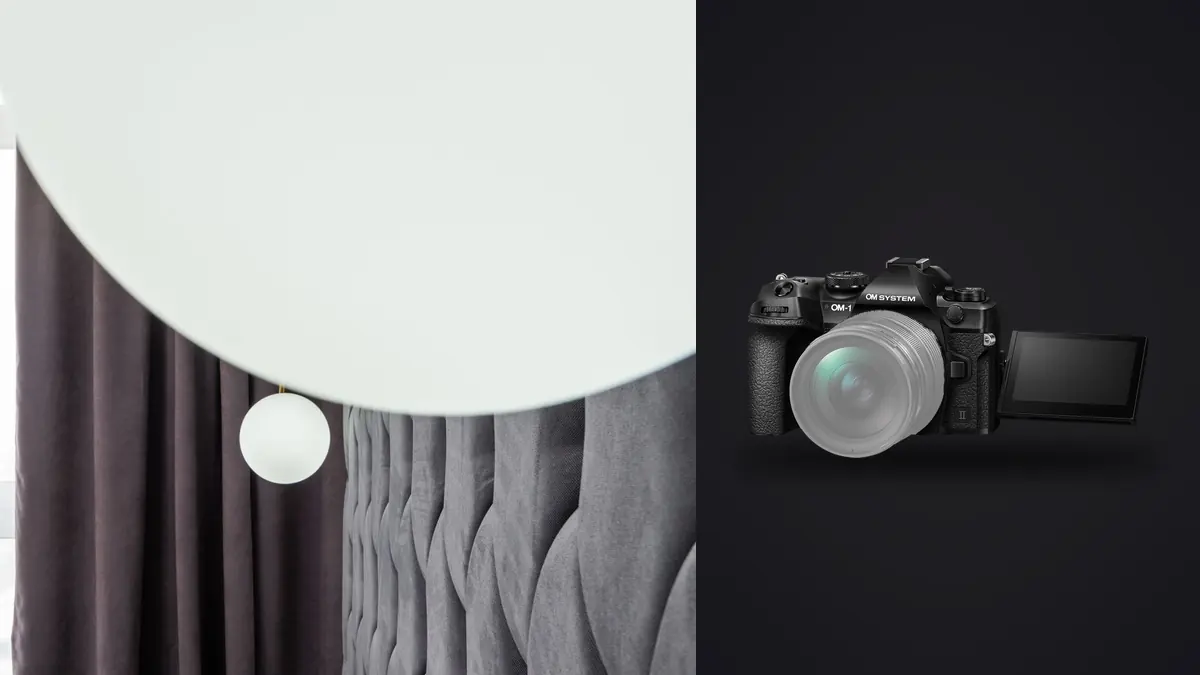
I get asked about camera choice for boudoir work more than almost any other genre, and the honest answer disappoints most people who ask. It's rarely about resolution or brand loyalty. It's about whether the camera helps you and the client forget it's there. The OM System OM-1 Mark II is an odd recommendation for this kind of session on paper (a Micro Four Thirds body competing against full-frame systems that dominate boudoir marketing) but after shooting a run of sessions with one over the past few months, I think the case for it is stronger than the spec sheet suggests, and weaker in a few places that matter more than people admit.
The Sensor Size Conversation Nobody Wants to Have Honestly
Micro Four Thirds runs a 2x crop factor. That means the OM-1 Mark II's 20.4-megapixel sensor gives you the field of view of roughly double the focal length compared to full frame, but it does not give you double the depth-of-field control. A 45mm f/1.2 lens on this body frames like a 90mm on full frame, but its background blur behaves closer to a 90mm shot at f/2.4. For boudoir, where a huge part of the visual language is that soft, almost liquid falloff behind the subject, this is the real trade-off, not the megapixel count everyone fixates on.
I won't pretend that doesn't matter. If your entire style leans on razor-thin focus planes and you're shooting wide open at f/1.4 on a 50mm full-frame lens for that specific look, the OM-1 Mark II will frustrate you. You can get close with the 25mm f/1.2 PRO or 45mm f/1.2 PRO, but "close" is the operative word. What you get back in exchange is a body and lens combination that's roughly half the weight and bulk of an equivalent full-frame kit, which sounds like a minor convenience until you're holding a session in a client's bedroom for ninety minutes and trying to look relaxed while doing it.
Lenses That Actually Earn a Spot in the Bag
I've cycled through most of the relevant glass in this system, and for boudoir specifically, the list narrows fast. Here's what I keep reaching for and why, with the full-frame equivalent focal length included since that's what most people actually think in.
| Lens | Full-frame equivalent | Max aperture | Where it earns its keep |
|---|---|---|---|
| M.Zuiko 25mm f/1.2 PRO | 50mm | f/1.2 | Default lens for most of a shoot. Natural perspective, works in small rooms without distortion. |
| M.Zuiko 45mm f/1.2 PRO | 90mm | f/1.2 | Tight, compressed portraits from across the room. Best separation from cluttered backgrounds this system offers. |
| M.Zuiko 17mm f/1.2 PRO | 34mm | f/1.2 | Environmental frames where the bed, window light, and room need to read together. Gets tight in cramped hotel rooms otherwise. |
| M.Zuiko 12-40mm f/2.8 PRO II | 24-80mm | f/2.8 constant | Location scouting and any shoot that also involves behind-the-scenes or walkthrough shots. Less separation, more flexibility. |
| M.Zuiko 40-150mm f/2.8 PRO II | 80-300mm | f/2.8 constant | Outdoor boudoir at a discreet distance. Rarely leaves the bag for indoor work, too much lens for the room. |
If I had to keep one lens for this genre, it's the 45mm f/1.2. It's the closest thing this system has to the "buttery 85mm" look boudoir photographers chase, and on the OM-1 Mark II's smaller body it doesn't feel front-heavy the way it can on older Olympus bodies.
Shooting Without Flash in a Room You Don't Control
Most boudoir sessions happen in bedrooms, hotel rooms, or small home studios where you're working with whatever ambient light exists: a lamp, a window, maybe one softbox if the client's space allows it. Flash breaks the mood fast in this genre. A pop of light in a dim room reads as clinical, and clients who are already nervous about being photographed intimately tend to flinch, literally, at the sound and burst. The OM-1 Mark II's in-body stabilization is rated up to 8.5 stops with certain PRO lenses, and in practice I've handheld shutter speeds down to a quarter second and still pulled sharp frames when the subject held still, which happens more than you'd expect during a boudoir shoot since a lot of the posing is slow and deliberate rather than fast movement. That stabilization is what lets me push ISO down instead of up in a dim room, which matters more on this sensor size than on full frame.
Here's the part I'll say plainly: high ISO on a Four Thirds sensor is not full-frame high ISO. I keep this body under ISO 3200 whenever I can and treat 6400 as a "only if there's no other option" setting, whereas a full-frame body from the same generation gives you another stop or two of comfortable headroom. The stabilization is what closes most of that gap by letting you shoot slower instead of louder, but it doesn't erase the difference entirely.
Why the Camera Itself Changes How the Client Behaves
This is the part that doesn't show up in review videos. Boudoir and intimate portrait sessions are, for most people, one of the more vulnerable experiences they'll have in front of a stranger. The camera in the room is part of that psychology whether photographers want to admit it or not. A smaller mirrorless body with a compact prime attached reads very differently than a full-frame DSLR with a battery grip and a lens the size of a coffee thermos pointed at someone in various states of undress. The OM-1 Mark II is a genuinely small camera. Paired with the 25mm f/1.2, the whole rig is light enough that I can hold it one-handed while adjusting a pose or moving a light with the other, without the session stalling every time I need both hands free. The fully electronic shutter is silent too, which matters more here than in almost any other genre I shoot. No clack, no mirror slap, nothing that makes a client aware of the exact moment they're being captured mid-expression. Subjects often forget they are being photographed for stretches of the session, and I think the quiet, unobtrusive gear is a real part of why.
What a Boudoir Shoot Does to Your Card, and Your Evening
A typical boudoir session for me runs 300 to 600 frames once you count wardrobe changes and pose variations, and a huge chunk of those are near-duplicates: three or four frames of the same pose while I chase a slightly better hand position or a more relaxed expression before the shutter finishes rolling. That's not a complaint about the camera, it's just how this genre works. Nobody nails an intimate, relaxed expression on the first frame of a pose. Sorting that volume by eye used to eat two or three hours per shoot before I ever touched an edit. I run everything through imagic now specifically because it handles that first pass locally, on my own machine, without any of the files leaving my laptop. That's not a small detail for this genre. These are sensitive images, often shot for a partner or purely for the client herself, and the idea of a folder of boudoir frames getting bounced through a cloud server for AI processing is a real concern for a lot of clients once you explain how most culling tools actually work. imagic's sharpness scoring flags the genuinely soft frames from that flurry of near-identical poses, and it clusters the burst variations together so I'm choosing between four thumbnails instead of scrolling through forty. If you want the mechanics behind how that culling actually works, I wrote a longer breakdown at /blog/how-ai-photo-culling-works.
Keeping the Color Consistent Once You're in the Edit
Skin tone consistency is where a lot of otherwise strong boudoir sets fall apart, especially when a shoot moves between window light, lamp light, and a softbox across an afternoon. The white balance shifts, the color temperature drifts, and if you're editing fifty final images from a single session, keeping them looking like they belong together takes real attention. I built a starting edit for this genre a while back (warmer shadows, slightly desaturated highlights, skin tones pulled just shy of golden) and imagic's apply_my_style feature learns that from a batch of my own already-edited frames rather than applying a generic preset. It gets me most of the way to a consistent look across a full set before I go in and fine-tune the handful of images that actually matter, like the cover shot or the ones going into an album.
It's not magic and I don't treat it that way. Editing intimate work still requires a human pass, particularly around retouching decisions that are genuinely personal to the client. But having a starting point that already matches your own editing habits, generated locally instead of a subscription tool phoning home with client photos, saves real time on a genre where turnaround expectations tend to be tighter than they are for weddings.
Settings I Actually Use
For anyone bringing this body into a boudoir session for the first time, a few settings changes save trouble. I shoot aperture priority almost exclusively here, usually between f/1.4 and f/2, because full manual control isn't worth the trade-off when light is shifting as a subject moves near a window. Auto ISO with a ceiling around 5000 keeps exposure honest without letting the camera wander into ugly noise territory. Face and eye detection AF works well on this body for a single subject, though I've had it hunt occasionally when hair or fabric partially covers the face, which happens constantly in this genre, so I keep a habit of half-pressing to confirm the focus box before committing. I also turn the electronic shutter's sound simulation off entirely rather than down. A quiet artificial click is still a click, and the whole point of going silent is to remove that cue completely.
Where It Falls Short
I'd be underselling this if I didn't mention the real limitations. Battery life sits around 500 shots per charge with the BLX-1, which is fine for a single session but means carrying a spare for back-to-back bookings. The buffer and card slots are excellent, but the smaller sensor means you're working harder in genuinely dark rooms than you would on full frame, and there's no getting around that with software or technique alone. If your business is built around dramatic, deep-shadow boudoir work lit by a single candle or string lights, this isn't the ideal tool. It's much better suited to soft, window-lit, natural-feeling sessions than to moody low-key work.
Frequently Asked Questions
Is the Micro Four Thirds sensor a dealbreaker for boudoir photography?
Not for most working styles, but it depends on your look. If your brand leans on extremely shallow depth of field and deep-shadow low light, a full-frame body will get you there more easily. If your style is softer, window-lit, and closer to editorial than moody, the smaller sensor is rarely the limiting factor in the final images.
Do I need the f/1.2 primes, or will the 12-40mm f/2.8 kit lens work for boudoir sessions?
The 12-40mm is a fine scouting and backup lens, but for the genre's signature soft background separation, one of the f/1.2 primes is worth the investment. Most photographers I know who own both end up using the f/2.8 zoom for maybe one in ten frames of a session.
How does the silent shutter actually affect client comfort during a shoot?
More than most people expect going in. Clients who are new to boudoir or intimate portraiture are often hyper-aware of the camera at first, and removing the audible click removes one of the clearest signals that a photo is being taken at that exact second. It won't fix nerves on its own, but it takes away one obvious trigger.
What's the realistic file management load from a typical session, and how do you handle it?
Between 300 and 600 RAW files per shoot is typical once you count wardrobe and pose changes, with a lot of near-duplicate bursts mixed in. I run the take through imagic first to flag soft frames and group the burst clusters, which cuts the manual sorting time down to something closer to thirty minutes instead of a couple of hours, all processed locally rather than uploaded anywhere.