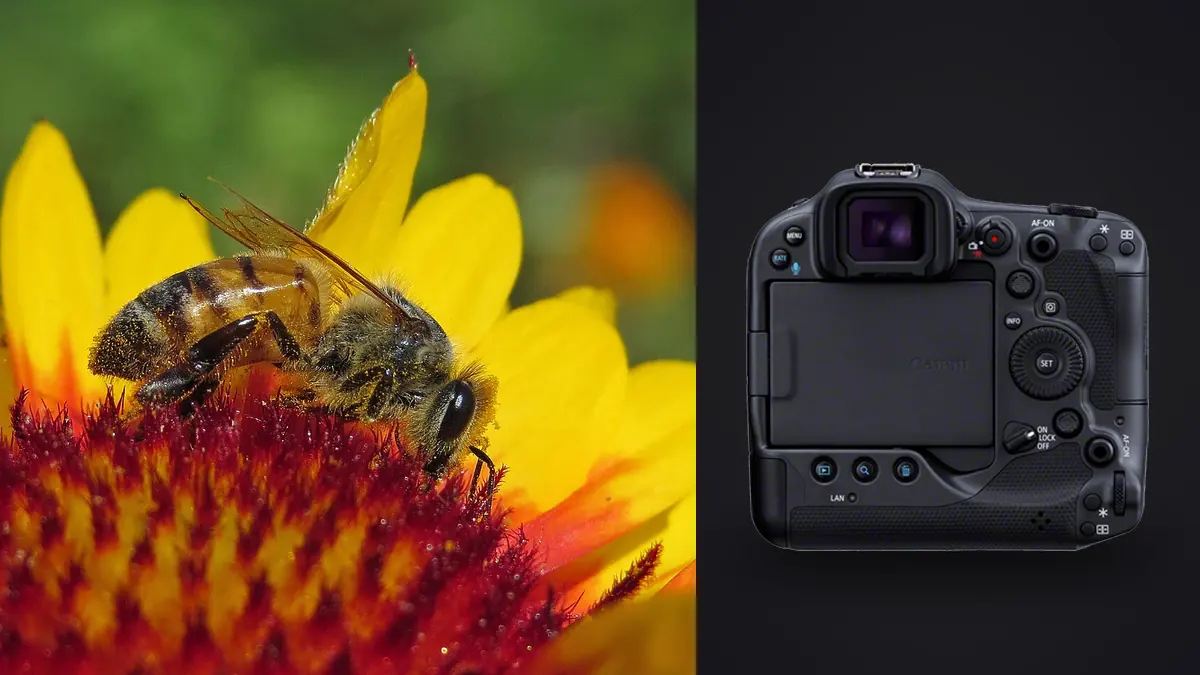
Most Canon EOS R3 bodies spend their working life at a sideline or a hide, chasing football or ospreys at 30 frames a second. Very few get pointed at a dew-covered spider web at six in the morning. I've done both with the same camera, and the R3 handles insect macro fine, just not for any of the reasons Canon actually built it.
If you already own an R3 for sports or wildlife and want to know whether it's worth dragging into the meadow at sunrise, this is a straight answer, including the places where a body designed for 30fps action genuinely fights you when the subject is four millimetres long and standing on a leaf.
Why a Sports Flagship Ends Up in the Macro Bag
Nobody buys an R3 for insects. It's a $6,000 (at launch) action body with a built-in vertical grip, a stacked 24.1MP sensor, and an AF system tuned for tracking a receiver or a peregrine falcon. But a lot of the people who do own one are wildlife and sports shooters who also spend early mornings chasing dragonflies along a canal, or who get roped into shooting a butterfly garden for a client and would rather not carry a second body.
The stacked sensor turns out to matter more here than you'd expect. Rolling shutter on a stacked sensor is close to nonexistent, which means the electronic shutter doesn't smear a damselfly's wings mid-beat the way it would on a body with a slower sensor readout. And because the R3 can shoot fully silently in electronic mode, you can fire a burst on a basking hoverfly without the shutter clack sending it off before you get the frame you want. Insects react to sound and vibration more than most people expect, especially anything in the fly or bee family sitting in direct light.
The Autofocus Reality on Small, Fast Subjects
Dual Pixel CMOS AF II on the R3 is excellent in general terms, rated down to -7.5 EV with a fast lens, which is genuinely useful under tree canopy or in the low, flat light of early morning when most of the interesting insect behaviour happens. That part holds up.
Where it falls apart a little is subject detection. The R3's AI subject tracking covers people (with the eye-controlled AF that Canon built this camera around), and animals split into dogs/cats and birds, plus vehicles. There is no insect category, and none of the major mirrorless systems I've used have trained their subject detection on insects specifically, so this isn't a Canon-only gap. Point the R3 at a jumping spider with Animal priority selected and it will either ignore it completely or lock onto a leaf vein it's decided looks like an eye. Eye Control AF, the feature Canon markets hardest on this body, is calibrated for a human eye looking through the viewfinder at a human subject; it does nothing for you here and I turn it off entirely for macro work since it occasionally hijacks the focus point mid-shot.
In practice, insect macro on the R3 comes down to two techniques depending on the subject. For anything stationary (a resting butterfly, a spider in dew, a beetle that hasn't noticed you) I use One-Shot AF with a single small AF point, back-button focus, and then rock the camera forward and back by a few millimetres to walk focus through the eye rather than relying on the lens to nail it, because at high magnification the AF motor is often hunting through a depth of field measured in fractions of a millimetre. For anything moving (dragonflies patrolling a perch, bees working a flower head) Servo AF with a small zone and the full 30fps buffer gets you enough frames to pick the one where the compound eye is actually sharp.
Lens Choices That Actually Matter
The RF 100mm F2.8L Macro IS USM is the obvious pairing and the one I'd point most people toward first. It reaches 1.4x magnification at its closest focus with the built-in Spherical Aberration Control ring set toward the sharper end, and the Hybrid IS (which corrects for both angular and shift shake, the kind you get from your own pulse and breathing at close range) genuinely helps handheld work. Combined with the R3's in-body stabilisation, Canon rates the pairing up to 8 stops with some lens/body combinations, which in real terms means you can shoot a stationary insect handheld at 1/60s instead of bracing against a beanbag.
At 1.4x magnification the field of view on the R3's full-frame sensor narrows to roughly 26mm by 17mm. A 15mm beetle nearly fills the frame vertically without cropping. A 4mm jumping spider does not, and that's where the R3's comparatively low 24.1MP count starts to bite, because you're now cropping a file that was never generous in resolution to begin with.
For flightier subjects, dragonflies and damselflies especially, I often skip the dedicated macro lens entirely and shoot the RF 100-400mm with a 25mm extension tube instead. It only gets you to around 0.4x magnification, nowhere near 1:1, but it buys working distance, and working distance is what actually determines whether a dragonfly lets you get the shot or bolts. For the truly tiny stuff (ants, springtails, anything under 5mm) the old EF-mount MP-E 65mm still adapts to the R3 via the EF-EOS R adapter and gets you to 5x life-size, but it's manual focus only with no electronic contacts doing anything useful, so all the R3's AF sophistication is irrelevant on that lens. You're back to a focus rail or your own steady hands.
Where the R3's Own Lineup Works Against It
This is the part Canon's marketing understandably skips: within Canon's own current range, the R3 is not the strongest choice for macro if resolution or crop reach is what you care about most, and for insect work it usually is. The table below is how I'd actually lay out the decision for someone choosing a body for this specifically, rather than someone who already owns an R3 and is making do.
| Camera | Sensor | Continuous shooting | In-camera focus stacking | Body weight | Best for |
|---|---|---|---|---|---|
| Canon EOS R3 | 24.1MP full-frame | 30fps (e-shutter) / 12fps (mech) | Bracketing captured, merge done in post | ~1015g | Owners who already shoot sports/wildlife on it and want macro on the side |
| Canon EOS R5 Mark II | 45MP full-frame | Up to 30fps (e-shutter) | Yes, in-camera depth composite | ~746g | Buying new specifically for macro/insect detail and cropping room |
| Canon EOS R7 | 32.5MP APS-C, 1.6x crop | 15fps (mech) / 30fps (e-shutter) | Bracketing captured, merge done in post | ~612g | Extra reach on a budget with existing RF glass |
| OM System OM-1 Mark II | 20.4MP Four Thirds, 2x crop | Up to 50fps AF-tracking (e-shutter) | Yes, plus handheld high-res mode | ~599g | Dedicated macro/insect shooters, built-in stacking workflow |
The R5 Mark II is the one that actually stings if you're comparing on paper: nearly double the resolution of the R3, lighter, and it merges a focus-stacked sequence into a single image in-camera, something the R3 simply can't do (the R3 will capture a focus bracket sequence for you, step size and shot count included, but you still open the files in Helicon Focus or Photoshop afterward to combine them). If I were buying a body today with insect macro as the primary use case and no existing investment in R-mount glass, I'd have a hard time justifying the R3 over the R5 II or, honestly, over an OM-1 II if reach and a lighter kit mattered more to me than staying in the Canon ecosystem. The case for the R3 here is entirely "I already own one," which is a perfectly good reason, just not a technical argument.
Weight, Weather, and Battery in the Field
The built-in vertical grip that makes the R3 so good for a full day of sports shooting is a genuine liability for macro. Insect photography puts you on your stomach in wet grass or crouched at an awkward low angle for long stretches, and a 1015g body with no way to shed the grip gets tiring fast in a way a 600-700g mirrorless body doesn't. I've had mornings where my forearm was the limiting factor before my patience was.
On the upside, the weather sealing is genuinely reassuring for dawn macro work, which almost always means dew, damp grass, and occasionally a light drizzle right as the light gets good. I haven't babied the R3 in conditions that would have made me nervous with a lesser-sealed body. The LP-E19 battery is also overkill in a good way; a slow, patient macro session sipping power in single shots and short bursts barely dents it compared to a day of continuous sports tracking, so battery anxiety isn't something you need on this camera. Dual CFexpress Type B and SD UHS-II slots mean the buffer clears fast enough that a long 30fps burst on a fidgety bee doesn't leave you locked out for the next ten seconds while the card catches up, which matters more than people expect when a subject only gives you a two-second window. It also means you come home with genuinely large card dumps most evenings, which is the other reason I don't cull by eye anymore and let imagic do the first pass overnight instead.
Flash and the Electronic Shutter Trade-Off
Macro insect work at f/11 to f/16 (needed for any usable depth of field at high magnification) usually means flash, whether that's a single diffused speedlight, a ring flash, or a twin-flash bracket either side of the lens. The R3's built-in radio Speedlite transmitter is genuinely handy here, since it lets you control off-camera flash groups and ratios without an ST-E3-RT sitting in the hot shoe.
The catch is that fully electronic, fully silent shutter and flash don't mix well on this body. Once you need flash sync, you're back on the mechanical shutter (or electronic first curtain), which brings back the shutter noise you were trying to avoid in the first place. In practice that means picking a lane per subject: silent electronic shutter and natural or continuous LED light for skittish, light-sensitive insects, or mechanical shutter and flash for anything that's already tolerating your presence, like a moth at night or a beetle that's settled in for the morning.
Sorting What You Actually Shot
A 30fps burst on a single dragonfly take-off produces sixty or more nearly identical frames in two seconds, and a full morning of that adds up to thousands of files that all look the same at a glance. This is the part of shooting the R3 for macro that nobody warns you about: the culling afterward takes longer than the shoot did. I run those cards through imagic afterward specifically because its duplicate and burst clustering groups that kind of near-identical sequence automatically instead of making me scroll past frame after frame of the same wing position, and its sharpness scoring runs locally on the actual pixel data rather than guessing from the file's focus-point metadata, which matters a lot when you were rocking the camera by hand to find focus rather than trusting the AF box. Everything happens on the laptop with no upload step, which is one less thing to think about when you're doing this at a campsite with no signal.
For the edit pass afterward, I've also leaned on imagic's apply_my_style preset feature to carry over the look I use on macro work specifically (a slightly cooler, higher-contrast treatment than my wildlife edits) once it's trained on a batch of my own past macro edits, rather than starting from a generic preset every time. If you're weighing tools for this kind of high-volume culling in general, how AI photo culling actually works and a broader comparison of photo culling software are both worth a look before you commit to a workflow.
Frequently Asked Questions
Should I buy a Canon EOS R3 specifically for insect macro photography?
Not if you're starting from nothing. The R5 Mark II gives you nearly double the resolution, in-camera focus stack merging, and a lighter body for less money, and the OM-1 Mark II gives you more effective reach from its 2x crop plus a macro/insect ecosystem built by Olympus over two decades. The R3 makes sense if you already own one for sports or wildlife and want to use it for macro on the side, not as a first purchase for this specifically.
Can I use Canon's MP-E 65mm extreme macro lens on the R3?
Yes, via the EF-EOS R mount adapter, and it still gets you up to 5x magnification. But it's a manual-focus-only lens with no autofocus motor, so none of the R3's AF system does anything for you on it. You're focusing with a rail or by rocking the camera, same as you would on any other EOS body.
Does shooting silently with the electronic shutter cause problems with flash?
Yes, effectively. Full electronic shutter and flash sync don't work together cleanly on this body, so once you need flash for depth of field at f/11 or smaller, you're back on the mechanical or electronic-first-curtain shutter, and the shutter noise comes back with it. Decide per subject whether staying silent or getting flash-lit depth matters more.
What magnification does the RF 100mm Macro actually give me on the R3's sensor?
At its closest focus with Spherical Aberration Control engaged, the lens reaches 1.4x, which works out to roughly a 26mm by 17mm field of view on the R3's full-frame sensor. A beetle or wasp in the 12-15mm range will nearly fill the frame vertically at that setting. Anything smaller, like a 3-4mm jumping spider, still needs cropping afterward, and that's where the R3's 24.1MP count gives you less room to work with than a higher-resolution body would.