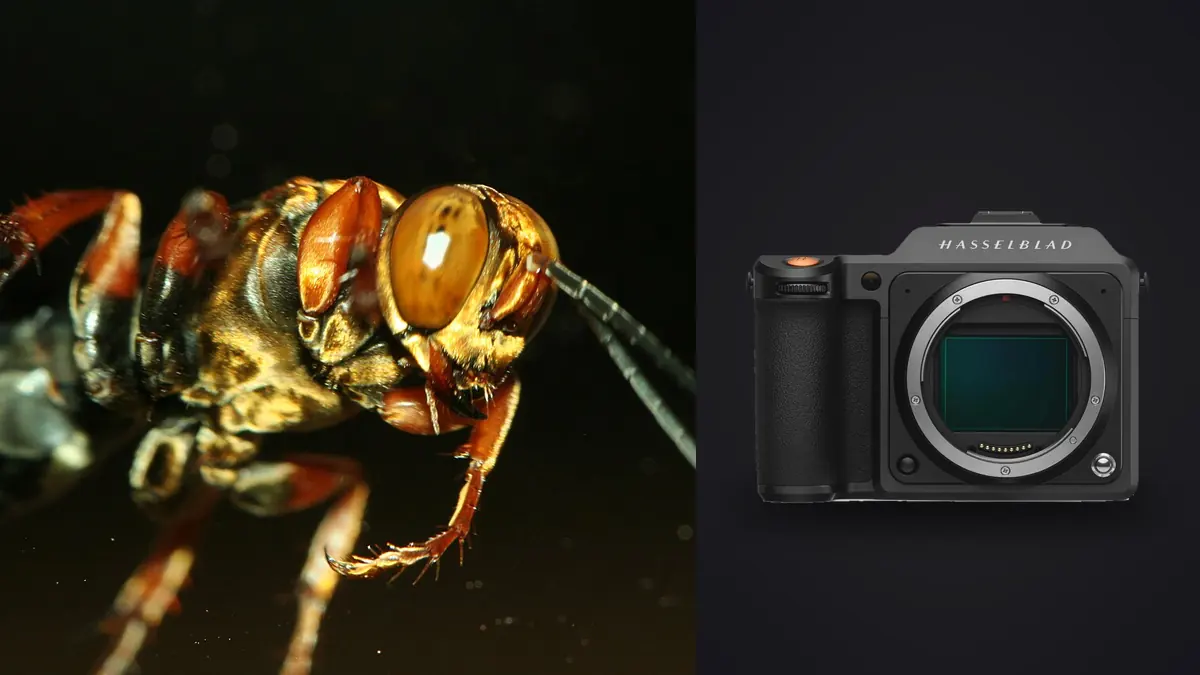
I took the X2D 100C into a garden for the first time expecting the same experience I get with a mirrorless full-frame body and a macro lens: crouch, focus, shoot a burst, move on. Two hours later I had eleven usable frames of a hoverfly and a very sore back. That gap between expectation and reality is basically the whole story of shooting insect macro on this camera, and it is worth unpacking properly rather than repeating the marketing line that a 100-megapixel medium format sensor automatically means better bug photos.
The lens situation nobody mentions upfront
The obvious pairing for insect work is the XCD 4/120mm Macro, and it's a genuinely lovely piece of glass optically. But it caps out at 1:2 magnification, half life-size on the sensor. That's fine for a stag beetle or a big robust hoverfly. It is not fine for the things most macro shooters actually chase: jumping spiders, small skipper butterflies, the fine hair detail on a bee's thorax. Every other serious macro system I've used in the last five years, Canon's RF 100mm, Sony's 90mm and 50mm macros, the OM System 60mm and 90mm, ships as native 1:1 minimum, and several go well past that.
Hasselblad doesn't currently sell an XCD extension tube. There are a couple of third-party adapters floating around that break autofocus and metering communication, which for a system this expensive feels like an odd corner to leave unaddressed. If you want true 1:1 or higher on the X2D, you're improvising, and improvising with a lens that costs more than most people's entire camera kit is not a relaxed way to spend an afternoon in the undergrowth.
Autofocus and insects that won't hold still
The X2D uses a contrast-detection based hybrid AF system tuned more for landscape, portrait, and studio work than for erratic subject tracking. It's accurate when the subject sits still, which describes maybe half of insect photography (dew-cooled damselflies at dawn, torpid moths, anything you find before 7am). It describes almost none of the other half. A wasp working a flower head, a fly that keeps rotating on its perch, a bee that lifts off the second the shutter fires: the X2D hunts, and by the time it locks, the moment is usually gone.
I don't think this is a fixable complaint with a firmware patch. It's a consequence of a sensor and processing pipeline built around Hasselblad's core customer, who is shooting architecture, product, or fashion, not insects at 0.5x with three centimeters of working distance. If continuous tracking AF on fast, small, unpredictable subjects is your top priority, this isn't the tool, full stop.
Manual focus, magnified live view, and why that actually helps
Where the camera claws some of that back is manual focus assistance. The 3.6-inch tilting touchscreen and the 5.76-million-dot EVF both support strong focus peaking and clean digital magnification, and because the sensor resolves so much detail, peaking is unusually precise even at high zoom levels. For stationary subjects, or for the "rock the camera gently forward on a focus rail" technique that a lot of studio insect photographers use, this is genuinely nice to work with. It's just a different workflow than chasing a live subject through a lens.
Depth of field, diffraction, and why stacking becomes mandatory
Medium format gives you shallower depth of field at a given aperture and framing than smaller formats, which is wonderful for portraits and miserable for macro. At 1:2 on the 43.8×32.9mm sensor, usable depth of field at f/8 is measured in fractions of a millimeter across an insect's face. Stop down to f/16 or f/22 to claw some of it back and diffraction softening becomes visible well before you'd expect it on a full-frame or APS-C rig, because you're asking more of the same aperture to cover a bigger imaging circle.
Practically, that means single-frame macro on this camera rarely looks as crisp edge-to-edge as the file size promises. Focus stacking stops being optional and becomes the default method. Hasselblad added in-camera focus bracketing to the X2D through a firmware update, which steps the focus point across a defined range and fires the sequence automatically. Good, but it doesn't composite the stack for you the way an OM System body does in-camera. You're bringing every frame home and blending in software regardless.
| System (body + macro lens) | Native max magnification | Combined weight (approx.) | AF on erratic subjects | Flash sync speed | Approx. system cost |
|---|---|---|---|---|---|
| Hasselblad X2D 100C + XCD 120mm f/3.5 Macro | 1:2 (0.5x) | ~1,975g | Weak, contrast-based hunting | Up to 1/2000s (leaf shutter) | ~$12,900 |
| Canon EOS R5 + RF 100mm f/2.8L Macro IS USM | 1.4x | ~1,470g | Strong, fast phase-detect | ~1/200s native, HSS available | ~$4,700 |
| OM System OM-1 II + M.Zuiko 90mm f/3.5 Macro IS PRO | 2x (4x full-frame equivalent) | ~1,050g | Strong, plus in-camera stacking | ~1/250s native, HSS available | ~$3,900 |
Lay it out like that and the X2D's case for insect macro specifically, as opposed to macro in general, gets thin fast. It costs roughly three times what the OM System combination does, weighs almost double, tops out at half the native magnification, and loses on autofocus. What it wins on is raw file quality once you've nailed focus and lighting, which is a real thing, but it's a narrower win than the sticker price suggests.
The one place the X2D genuinely pulls ahead: flash sync
XCD lenses use integrated leaf shutters, and that gives the X2D flash sync speeds up to 1/2000s rather than the roughly 1/200-1/250s ceiling on typical focal-plane shutter mirrorless bodies. For insect macro shot outdoors in daylight, this matters more than it sounds. A lot of us use flash not for illumination but to freeze wing beats and suppress the wind-shake that ruins otherwise sharp frames, while dialing the ambient exposure down with a fast shutter speed so the background doesn't blow out or go muddy. On a focal-plane body you're stuck choosing between high-speed sync (which eats two or three stops of flash power) or living with the native sync ceiling. On the X2D you just set 1/2000s and shoot. It's the one spec in this whole comparison where the medium format system is unambiguously better suited to live insect work, and it doesn't get talked about nearly enough.
Carrying the thing
Body alone is about 895g. Add the 120mm macro at roughly 1,080g and you're close to two kilos before a flash bracket, diffuser, or focus rail goes anywhere near it. Insect macro is a crouching, kneeling, holding-your-breath-over-a-leaf kind of activity, and two kilos of camera held at arm's length or braced against a knee for twenty minutes gets old. My forearm was noticeably more tired after a session with this rig than after a comparable session with a mirrorless full-frame macro setup, and considerably more tired than with a Micro Four Thirds rig built for exactly this kind of fieldwork. If you're shooting from a tripod with a focus rail, none of this matters. If you're chasing subjects handheld through a meadow, it matters a lot.
What you actually get back for the effort
When everything lines up, subject cooperates, light is right, focus stack is clean, the files are extraordinary. The lack of an anti-aliasing filter combined with the sensor size resolves compound eye facets and setae (the tiny hairs on an insect's exoskeleton) with a clarity I haven't matched on smaller formats at native resolution. Sixteen-bit color depth also gives you real room to push shadow detail on a backlit wing without banding, which matters when you're trying to show translucency in something like a lacewing.
The cost of getting there is volume. A stacked sequence at 100 megapixels per frame, sixteen or twenty frames per stack, produces something like three to four gigabytes of raw data for one finished image. Do that across a two-hour session and you're sorting through hundreds of near-duplicate frames, most of them slightly different focus planes of the same pose, looking for which stack is actually usable before you even open a stacking program. I run everything through imagic before it touches Lightroom now, mostly because its duplicate and burst clustering groups each stack together automatically instead of me scrolling through a flat filmstrip trying to remember where one sequence ends and the next begins. The local sharpness scoring is also blunt enough (in a good way) to flag which frames in a stack are actually in focus versus which ones the peaking display lied to me about, which happens more than I'd like to admit at high magnification. Because it processes everything on the machine rather than uploading to a cloud service, the 200MB-plus raw files never leave the laptop, which matters when a single field session can produce forty or fifty gigabytes of material.
Once I've picked the keepers, I lean on imagic's apply_my_style preset to get a consistent starting point across a batch, since insect macro edits tend to follow the same pattern session to session (slight shadow lift on the exoskeleton, controlled highlight roll-off on wings, restrained saturation so it doesn't look like a nature documentary poster). Having that trained on my own past edits rather than a generic macro preset saves a genuine amount of time on a 100MP file where every adjustment takes a beat longer to render. If your workflow is currently a flat folder of thousands of near-identical frames, it's worth reading through how AI photo culling actually works before you build a stacking habit around this camera, because the culling step is where most of the real time gets lost, not the shooting.
Who this setup is actually for
Controlled studio insect photography (specimens, terrarium subjects, anything you can light and pose on a focus rail) is where the X2D earns its keep. Field photography of fast, skittish, wild insects is where it struggles, not because the files are bad but because the autofocus and native magnification are working against you before you've even framed the shot. If your macro work is mostly opportunistic, handheld, chasing whatever lands on a flower while you're out for a walk, a lighter APS-C or Micro Four Thirds macro rig will put more usable frames in your folder per hour in the field, even if any single X2D frame, stacked and processed well, will out-resolve it.
Frequently Asked Questions
Does the XCD 120mm Macro actually reach 1:1 magnification?
No. Native magnification tops out at 1:2 (half life-size). You'd need an extension tube or close-up adapter to push past that, and Hasselblad doesn't currently make an official XCD extension tube, so you're relying on third-party options that may not preserve autofocus or aperture communication.
Is the X2D 100C fast enough to photograph live insects in flight?
Generally, no. Its contrast-based hybrid AF is built for deliberate, composed shooting, not tracking small, fast, erratic subjects. It works well for insects that are still or moving slowly (early morning, cool weather, resting subjects) but struggles against anything mobile in warm afternoon light.
Why does flash sync speed matter for insect macro specifically?
Because insects rarely hold still even when they look stationary, and macro magnification amplifies any motion blur from wind or micro-movement. A fast sync speed lets you use flash to freeze that motion while keeping the shutter speed high enough to control ambient light, without the power loss that high-speed sync workarounds cost you on focal-plane shutter cameras.
How many raw frames should I expect from a typical stacked insect shot?
Anywhere from eight to twenty-five frames per stack depending on magnification and how shallow the depth of field is at your chosen aperture. At 100 megapixels per raw file, that's routinely three to four gigabytes of data for a single finished composite, which is why sorting and culling tools matter as much as the stacking software itself once you're back at the desk.