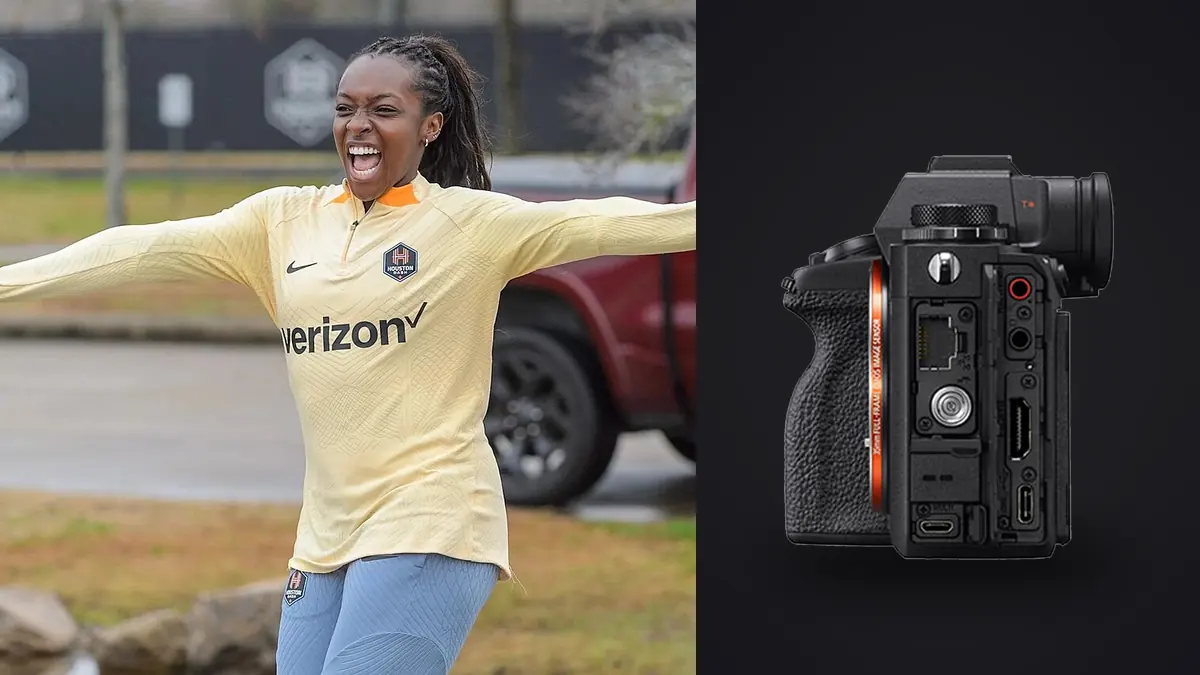
I shot my first full track meet with the Sony A1 in a college conference championship, eight events running back to back on a two-hour block, and I came home with 4,200 frames from a single body. That number is the real story of this camera at the track: it is less about whether the autofocus is good enough (it is) and more about whether you, the human being holding it, have a plan for what happens after the gun goes off thirty times a second.
Why the A1 earns its keep on an infield
Track and field is a strange sport to shoot because it is really eight or ten different sports happening in the same stadium at once. A 100m final lasts under ten seconds. A hammer throw cage rotation happens in about a second and a half. A pole vaulter's plant, swing, and release is over before you can consciously react to it. What all of these have in common is that the decisive frame is a small slice of a much longer, mostly uninteresting motion, and you rarely know in advance exactly which slice it will be.
The A1's 30fps blackout-free electronic shutter is built for exactly that problem. You are not trying to time the shutter release to the peak of the action anymore, you are trying to bracket the peak inside a burst and let the frame rate do the timing for you. The blackout-free viewfinder matters more than people give it credit for here, because on a mechanical-shutter body you lose the moment-to-moment feedback loop during a burst, and on a track that means you can drift off a sprinter's stride or lose a vaulter against the sky without noticing until you chimp the card. With the A1 you keep watching the actual subject the whole time, which changes how you frame mid-burst instead of just spraying and praying.
Autofocus behavior across different events
The marketing language around the A1's autofocus (human/animal/bird eye detection, real-time tracking) undersells how differently it behaves depending on what you point it at during a meet.
On sprinters and hurdlers, human eye AF locks fast and holds well once a runner is isolated against the track surface, but in a crowded start it will occasionally hop between athletes in adjacent lanes if you're using a wide tracking area. I've had better luck starting with Expand Flexible Spot on the lead runner's torso rather than trusting full-frame tracking in the first thirty meters of a race, then letting tracking take over once the field strings out.
Field events are a different problem entirely. Long jump and triple jump runways put the athlete against a busy background of officials, sandpit rakes, and other athletes warming up, and eye AF can get pulled off by whoever happens to walk through frame. For jumps I generally drop to a single expand spot and manually reposition it between attempts rather than leaving tracking engaged the whole competition. Throws (shot put, discus, hammer, javelin) move fast in a small radius, and here Zone AF with a fairly tight zone tends to outperform full tracking because there's rarely a second person close enough to confuse it.
Pole vault sits in its own category because the athlete goes from horizontal sprint to vertical flight to (hopefully) clearing a bar 5+ meters up, all in the same continuous action. Tracking through that transition asks a lot of any AF system, and the A1 does hold on reasonably well, but I've missed the bar-clearance frame more often here than anywhere else on the infield, simply because the subject's apparent size and position change so fast relative to the frame.
The buffer problem nobody mentions until it bites you
Sony rates the A1's buffer at roughly 155 compressed raw frames before the camera throttles down from 30fps, and on paper that sounds like plenty. In practice, a single messy start-to-finish burst on a 400m hurdles race, where you're holding the shutter through the whole first turn because you don't know which hurdle clearance is going to be the frame, can eat most of that buffer in five seconds. Do that twice in a row without a gap to let the card catch up and you'll watch your frame rate visibly sag right when you need it most, usually right as the athletes come off the final hurdle.
Card choice matters more here than most people assume going in. A fast CFexpress Type A card clears the buffer in a handful of seconds once you let off the trigger, a slower one takes noticeably longer, and under stadium floodlights at a night meet where you're also fighting for shutter speed, that recovery time is exactly when you miss the next race starting on an adjacent track. I've settled into a habit of shooting shorter, more deliberate bursts (two to three seconds around the moment I actually want) rather than holding the shutter for the entire event, partly for buffer health and partly because it cuts down what I have to sort through afterward, which turns out to be the bigger cost anyway.
Settings by event, roughly what I actually dial in
This isn't a universal chart, lighting and your own risk tolerance for missed frames will shift these, but it's close to what ends up on the back of my camera at a typical outdoor meet.
| Event | Drive mode | Shutter speed | AF area | Lens I reach for |
|---|---|---|---|---|
| 100m / 200m sprint | Hi+ 30fps electronic | 1/2000s | Expand Flexible Spot → tracking | 300mm f/2.8 GM |
| 4x100 relay handoff | Hi 20fps mechanical | 1/1600s | Zone | 70-200mm GM II |
| 110m/100m hurdles | Hi+ 30fps electronic | 1/2500s | Expand Flexible Spot | 300mm f/2.8 GM |
| Long/triple jump | Hi 20fps mechanical | 1/2000s | Single spot, manual reposition | 200-600mm G |
| Pole vault | Hi+ 30fps electronic | 1/1600s | Flexible Spot M | 70-200mm GM II |
| Shot put / discus | Hi 20fps mechanical | 1/2000s | Zone (tight) | 70-200mm GM II |
| 800m and up | Mid 10fps | 1/1000s | Wide tracking | 200-600mm G |
A few of those choices need explaining. I drop to mechanical shutter for throws and the relay zone deliberately, not out of habit, because the stadiums I shoot most often still run older sodium or metal-halide floodlight fixtures for evening meets, and electronic shutter under that lighting can produce visible banding across the frame at certain shutter speeds. The A1's anti-flicker shooting helps, but I'd rather not stack two variables when a discus release only gives me one real shot at the frame. On daylight sprints under a clean sky I don't think twice about running 30fps electronic the whole way.
Rolling shutter, or the lack of it
This is the one place I'll actually push back on some of the online skepticism about electronic-shutter sports shooting. The A1's stacked sensor reads out in roughly 1/260 of a second, which is fast enough that even hard horizontal pans following a sprinter at full stride don't produce the skewed, leaning-tower distortion you'd get on an older non-stacked sensor at comparable shutter speeds. I've gone back and pixel-peeped panned sprint sequences specifically looking for it and it just isn't there in any way that matters for a usable sports frame. Where I have seen mild rolling shutter artifacts is on very fast rotational subjects at close range, mainly hammer throw cage rotations shot from near the circle, where the wire and the athlete's arm are moving at genuinely different angular velocities within that readout window. It's minor and only shows up if you're cropping in hard.
Lenses that actually make sense for a track infield
Most infield credential zones restrict you to specific positions, so lens choice on the day is often decided for you by where you're allowed to stand. That said, across a full season the combination I lean on most is a 300mm f/2.8 GM for track events and one end of the infield's throws, a 70-200mm GM II for anything close (relay zones, medal presentations, pole vault runway if you're positioned near the pit), and a 200-600mm G for long jump and distance events shot from the far side of the infield where you can't get close. The 300mm f/2.8 in particular earns its weight for track events specifically because the extra stop over a 70-200 lets you hold faster shutter speeds under stadium lights without pushing ISO into territory where the extra resolution of the 50MP sensor stops paying off.
I'd stop short of saying you need the exotic glass to get usable meet coverage. A 70-200mm f/2.8 covers a surprising amount of a track meet if your credential gets you infield access, and the A1's tracking is good enough that the limiting factor is usually your positioning, not your reach.
What actually happens to the card after the meet
Here's the part that changed how I think about the whole workflow. A single evening meet with eight events shot in bursts, at 50 megapixels a frame, routinely leaves me with somewhere between 60 and 100GB of raw files and several thousand individual exposures, the overwhelming majority of which are near-duplicates from the same burst with only marginal differences in exactly where a foot or an arm landed relative to the frame. Sorting that by eye, at full resolution, one race at a time, used to eat an entire evening after a meet that only took two hours to shoot.
This is the actual reason I moved my culling pass over to imagic instead of doing a first pass in Lightroom like I used to. It runs entirely on the machine, no upload step, which matters when you're trying to turn a gallery around for a coach or an athlete's parent the same night from a hotel room with mediocre wifi. The sharpness scoring catches the obvious misses (front leg soft because tracking briefly hopped to the runner behind), and because it's scoring focus locally rather than just looking at exposure or composition, it's genuinely useful for separating "sharp but not the peak moment" from "the peak moment." The burst clustering is the bigger time saver though. Instead of scrolling through 40 nearly identical frames of a hurdles clearance one at a time, it groups the burst and surfaces the sharpest 3-4 candidates, which is realistically all I need to pick from for a race that lasted 13 seconds.
Once I've picked the keepers, I run them through an apply_my_style preset built from a season's worth of my own track edits (a specific way I pull down highlights on synthetic track surfaces and warm up skin tones under stadium sodium lighting), so a gallery delivered from three different meets in a week still looks like one consistent body of work instead of three separate editing sessions. If you're trying to tighten your own turnaround time on a shoot-heavy workflow, the culling stage is genuinely where the hours disappear on a burst-heavy sport like this one, more than the actual editing.
What I'd tell someone buying an A1 specifically for track
It's not a cheap way to solve this problem, and if your track shooting is occasional rather than a real part of what you do, a 20fps body with good tracking will get you most of the way there for a lot less money. Where the A1 earns its price for me is the combination of resolution and speed together: 50 megapixels means I can crop a distance shot taken from the far side of the infield down to a tight frame and still deliver a print-usable file, which a 24MP sports body simply can't do without visible softness at the same crop ratio. If you mostly shoot close, credentialed, trackside positions where you don't need to crop, that advantage matters less and the case for the A1 over something cheaper gets thinner.
Frequently Asked Questions
Do I actually need 30fps, or is 20fps mechanical shooting enough for track events?
For anything under about two seconds of decisive action (a hurdle clearance, a baton exchange, a bar clearance in the vault) 30fps genuinely helps you land the exact frame rather than the one before or after it. For longer sustained action like a distance race, 10-20fps captures plenty because the interesting moments (a lean at the tape, a surge past another runner) unfold more slowly and you have more time to react.
Will electronic shutter cause banding under stadium floodlights?
It can, depending on the fixture type. Modern LED stadium lighting is generally fine. Older sodium or metal-halide fixtures, still common at a lot of high school and small-college venues, can produce banding at certain shutter speeds even with anti-flicker shooting enabled. I switch to mechanical shutter for those venues rather than troubleshoot it mid-meet.
Is a 70-200mm enough, or do I need something longer for track and field?
If your credential gets you infield or trackside access, a 70-200mm f/2.8 covers relays, hurdles from a reasonable distance, throws, and podium moments comfortably. Longer glass (300mm f/2.8 or a 200-600mm) mainly earns its place for events shot from the far side of the infield or general grandstand access where you can't get physically close, particularly distance races and long/triple jump.
How do you realistically manage the number of frames a full meet produces?
Mostly by not trying to review everything manually at full resolution. I shoot shorter, more deliberate bursts rather than holding the shutter for an entire race, and I lean on automated culling to cluster bursts and surface the sharpest candidates before I ever sit down to make a subjective call. Doing that first pass by eye across several thousand near-duplicate frames from a single evening just isn't a good use of the hours between the meet ending and a gallery going out.