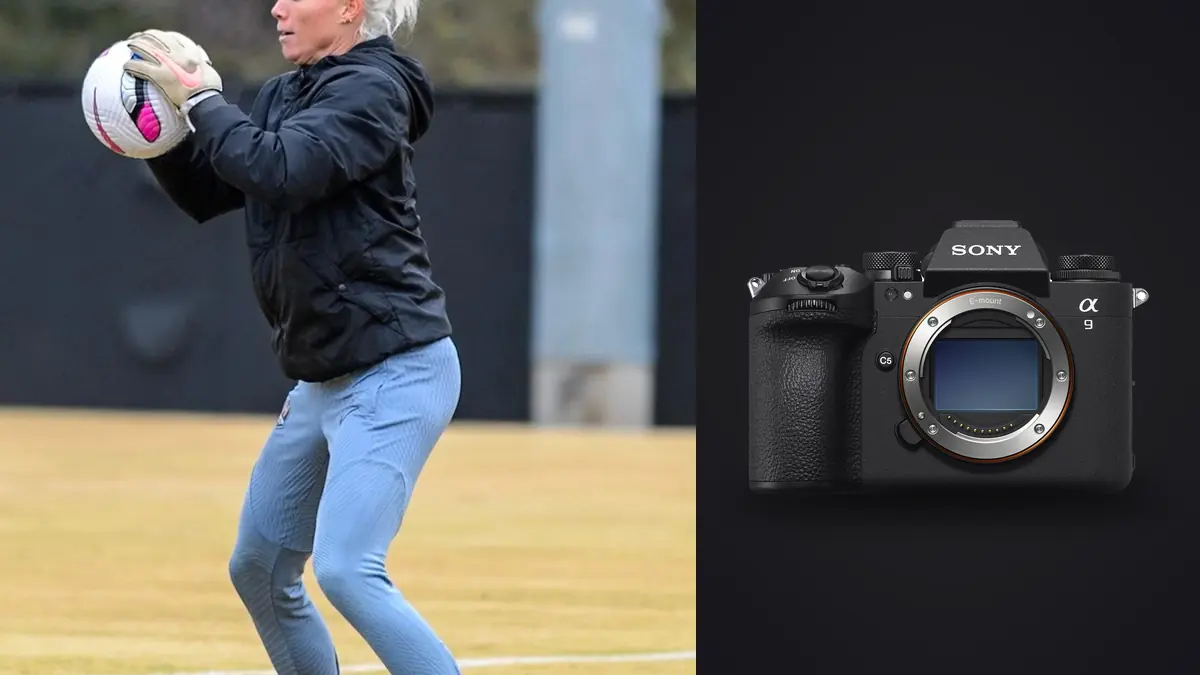
Track and field is one of the least forgiving sports to shoot. You've got sprints that resolve in under ten seconds, field events where the entire action happens in a two-second window, and a schedule that jumps between the backstretch and the infield every twenty minutes. The Sony A9 III showed up in this world with one change that actually matters more than the marketing headline suggests: a full global shutter. Everything else on the spec sheet, the 120fps bursts, the 120 autofocus calculations per second, the flash sync at any shutter speed, flows from that one sensor decision. This is a practical rundown of what that means for a meet day, how to set the camera up per event, and where the real time sink ends up being once you're home with a card full of frames.
Why the global shutter actually matters at a track meet
Rolling shutter has always been the quiet tax on electronic-shutter sports shooting. Pan with a sprinter at 1/4000s on a stacked-sensor camera and you'll still see the lane markings skew slightly, or a spinning bike wheel warp into an oval. It's subtle enough that most viewers never notice, but it shows up hard in anything with fast horizontal motion relative to the frame, which describes basically every sprint photo you'll ever take. The A9 III reads every pixel at the same instant instead of scanning top to bottom, so that distortion is gone completely, not reduced. Track surfaces, hurdle bars, javelin shafts in flight, they all stay geometrically correct even when panning at 1/2000s or faster.
The second, less obvious benefit is flash sync. Field events under stadium floodlights or at dusk finals benefit from a burst of fill flash, and on a mechanical or even a stacked-sensor electronic shutter you're capped at your sync speed, usually 1/250s, unless you're running high-speed sync and eating a couple of stops of flash power. The A9 III syncs flash at any shutter speed up to 1/80000s because there's no shutter curtain traveling across the frame to worry about. That matters most for pole vault and high jump finals held under lights, where you want a fast enough shutter to freeze the bar clearance but still want a flash pop to separate the athlete from a dark sky.
Autofocus setup: sprints and field events want different brains
Sony's subject recognition on the A9 III includes a human pose model that prioritizes the head and torso, which is genuinely good for sprint finishes where the runner's face is turned toward the tape and other bodies are crowding the frame. For the 100m and 200m I run Tracking: Spot S with Human recognition on, and I let the camera pick the runner closest to the center point rather than trying to manually steer a joystick at 1/2000s. It locks on well before the athlete crosses the focus point and holds through the lean.
Field events are a different problem entirely. Long jump and triple jump happen fast but along a predictable, mostly linear path from the board to the pit, so Wide tracking with recognition on works fine and lets you keep shooting during the run-up without babysitting a focus point. Pole vault is the one event where I turn recognition off and go back to a single expanded flexible spot locked near the bar height, because the camera's human-tracking logic gets confused by the pole itself passing through the frame and will occasionally snap focus to it instead of the vaulter. Throws (shot put, discus, javelin) are close to a static recompose-and-shoot situation. The athlete's position in the circle barely changes until release, so a locked spot point beats any tracking mode, and it avoids the AF hunting you sometimes get when a tracking system tries to follow a spinning body through a discus turn.
Frame rate and buffer math for a full meet day
120fps in full-resolution RAW sounds incredible until you do the math on card space and, more importantly, on how many frames you'll actually need to look at afterward. A four-second sprint burst at 120fps is 480 frames of essentially the same finish. Nobody needs 480 near-identical frames of a 100m final, and shooting that way at every event of a multi-event meet turns a single day into 15,000+ RAW files by the time finals wrap up.
In practice I drop to 60fps for sprints (still more than enough to catch the exact stride and lean you want) and reserve the full 120fps for the events where the decisive instant is genuinely unpredictable, like pole vault bar clearance or the exact moment a relay baton changes hands in a crowded exchange zone. Field events like long jump and shot put get 20 to 30fps, because the release or takeoff position matters more than having 40 near-duplicate frames of the follow-through. The buffer on the A9 III at 120fps with the CFexpress Type A cards is deep enough that you won't hit a wall mid-burst, but your SD card slot (if you're using one) will bottleneck you well before the buffer does, so pack CFexpress for anything you're shooting at the higher frame rates.
| Discipline | Drive mode | Shutter speed | AF area / mode | Field note |
|---|---|---|---|---|
| 100m / 200m sprint | 60fps | 1/2000-1/3200s | Spot S, Human recognition | Track the lean through the tape, not just at the line |
| Long jump / triple jump | 20-30fps | 1/2000-1/2500s | Wide, Human recognition | Board-to-sand arc is under two seconds; start the burst on the last three run-up strides |
| Pole vault / high jump | 60-120fps | 1/1600-1/2000s | Expanded flexible spot, recognition off | Meter for the sky behind the bar, not the athlete, or clearances go dark |
| 4x100 / 4x400 relay | 60fps | 1/2000s | Wide, Human recognition | Pre-focus on the exchange zone line; AF will hunt between two runners otherwise |
| Distance / steeplechase | 20-30fps | 1/1250-1/1600s | Zone | Water jump splash is the frame people want; time it a beat after takeoff, not at it |
| Shot put / discus / javelin | 20-30fps | 1/1600-1/2500s | Spot, locked recompose | Release is a half-second window; start the burst on the wind-up, not the release |
Lens choices that actually work from the stands and the infield
Most track meets restrict media and photographers to specific zones, so your lens choice depends heavily on where you're allowed to stand. From the backstretch or a corner vantage the 300mm f/2.8 GM is close to ideal for sprints and hurdles: light enough to hand-hold for a full session, fast enough to isolate the runner from a busy background of other lanes and spectators. For field events where you're often closer, on the infield rail for jumps or set back from the throwing circles, the 70-200mm f/2.8 GM II covers most of what you need and lets you recompose quickly when an athlete's position in the circle shifts between attempts.
If you can get infield access (credentialed meets, college invitationals, some high school sectionals) the 400mm f/2.8 GM II earns its size for finish-line work shot nearly head-on, which is the angle that produces the strongest sprint images but also the one that's hardest to get positioned for. A 1.4x teleconverter on the 300mm f/2.8 turns it into a reasonably fast 420mm option for throws when you can't get infield access and need the extra reach from a fixed press position. I'd avoid going past 1.4x on this body for anything with fast subject motion; autofocus speed drops noticeably with a 2x, and track and field rarely gives you the luxury of a second attempt at the same frame.
Positioning: the meet dictates the photo more than the settings do
The single biggest factor in whether your sprint photos look good has nothing to do with the camera. It's whether you're shooting from a low angle near the finish line or from a raised photographer's platform looking down. Low and slightly off-axis to the finish tape gives you the classic lean shot with a clean background of just track surface and lane lines. Shooting straight down from a stand gives you a flatter, more documentary angle that's fine for results coverage but rarely the frame anyone wants printed.
For field events, get to know the meet referee or event coordinator before the session starts. Long jump and triple jump photographers who set up at the pit edge (with permission, always with permission) get the clean side-on takeoff shot; everyone shooting from the stands 80 meters back gets a compressed, athlete-sized-postage-stamp version of the same jump. Pole vault is the one event where distance actually helps: standing back with the 300mm or 400mm lets you fit the full arc over the bar without cutting off the pole or the landing mat, which happens constantly to photographers who try to shoot vault up close with a shorter lens.
The part nobody warns you about: what happens after the meet
A full day covering a multi-event meet at 20 to 120fps across a dozen disciplines routinely leaves you with 8,000 to 15,000 RAW files by the time the last relay finishes. That number is the actual bottleneck in track and field photography, not the camera. Sprint bursts in particular produce long runs of frames that are nearly identical except for a millimeter of stride difference, and manually clicking through them one at a time to find the sharpest, best-timed frame from each burst is a multi-hour job on its own before you've even started editing.
This is where I run everything through imagic before touching a single edit. It groups burst sequences and near-duplicate frames automatically, so a 60-frame sprint burst collapses down to the handful of genuinely distinct moments (the start reaction, mid-race stride, the lean) instead of forcing you to scroll past 55 frames that differ by a few pixels of arm position. Within each group it scores sharpness and eye/focus accuracy so the frame it surfaces first is the one actually in focus on the athlete's face rather than the one that happens to be first in the sequence. Because it runs entirely on the local machine, none of the meet's files get uploaded anywhere while you're culling, which matters when a school district or meet organizer has rules about where athlete images can travel.
Once the culling pass is done, the edit itself is usually fast if you've built a look you like across previous meets. imagic's apply_my_style feature trains on edits you've already made to your own photos, so a consistent track-and-field color treatment (the specific way you handle stadium lighting mixed with daylight, or how you pull back highlights on a bright tartan track) gets applied automatically to the new selects instead of you rebuilding presets meet after meet. If you haven't settled on a culling workflow yet, the walkthrough at how AI photo culling actually works covers the scoring approach in more depth, and these workflow tips are worth a look if a single meet is currently eating your entire evening.
Frequently Asked Questions
Does the A9 III's global shutter actually eliminate rolling shutter distortion for sprint panning shots?
Yes, completely, because every pixel is read at the same instant rather than scanned across the frame. Lane lines, hurdle bars, and spinning limbs stay geometrically correct even at fast shutter speeds and aggressive pans, which is a real, visible difference from stacked-sensor cameras under the same conditions.
Is 120fps overkill for most track and field events?
For most of them, yes. Reserve it for genuinely unpredictable moments like a pole vault bar clearance or a crowded relay exchange, and shoot sprints at 60fps and field events at 20 to 30fps. Shooting everything at 120fps mostly just multiplies your card usage and your culling time without adding usable frames.
What's the minimum lens reach for shooting a track meet from the general spectator area?
A 300mm f/2.8 or a 200-600mm zoom covers sprints and most field events reasonably well from standard spectator or backstretch positions. Anything shorter than 200mm will leave you cropping heavily on finish-line frames unless you have infield credentials.
How do I stop flash from washing out pole vault finals shot under stadium lights?
Meter for the ambient sky behind the athlete first, then bring in flash as fill rather than as the primary light source. The A9 III's full-range flash sync means you can keep a fast shutter speed to freeze the clearance while still using flash to separate the vaulter from a dark background, without the power loss that high-speed sync usually costs you.