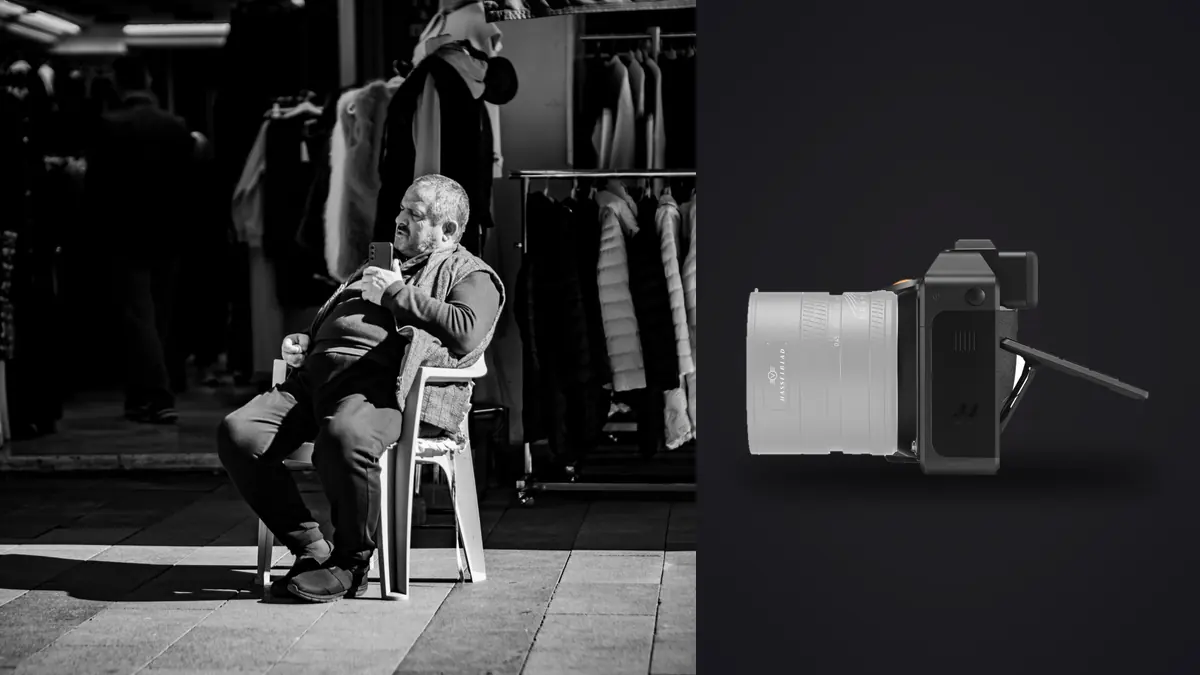
Nobody builds a street photography kit around a medium format body. The genre runs on speed, discretion, and a willingness to lose the occasional frame to bad focus or a blown highlight. The Hasselblad X2D 100C is built around the opposite set of priorities: total control, enormous files, and a shooting pace that rewards patience over reflex. And yet a small, stubborn group of documentary photographers has been carrying one through markets, transit stations, and protest lines for the past couple of years, and the results argue for themselves. I've covered an earlier pass at this exact pairing, and this piece picks up where that one left off. This isn't a camera you grab because it's convenient. It's a camera you grab because you've decided the image quality is worth the compromises, and you've made peace with what those compromises actually cost you on a working day.
Why anyone would carry a medium format camera onto the street
The case for the X2D 100C in documentary work has almost nothing to do with resolution for its own sake. Yes, the 100-megapixel sensor lets you crop a loose frame into a tight one without the file falling apart, which matters when you're shooting from the hip or through a bus window and can't always compose precisely. But the real draw is dynamic range. Urban light is brutal: deep shadow under an awning three feet from blown-out pavement in full sun, neon signage against a dark storefront, a face lit from one side by a phone screen and the other by sodium streetlight. The X2D's sensor holds detail in both ends of that range in a way that APS-C and even most full frame bodies simply don't match. You can expose for the highlights on a harsh midday street and still pull a printable shadow back in the edit, which changes how conservatively you have to meter in the moment.
There's also the matter of how the files hold up under heavy processing. Documentary work often means pushing exposure, recovering color casts from mixed lighting, or converting to black and white with real tonal separation instead of a flat conversion. Fourteen-bit color depth and the sheer amount of information in each raw file gives you more room to do that without banding or noise creeping into midtones. If you shoot a lot of interiors, backrooms, and dim transit corridors as part of a documentary project, that headroom is not a luxury feature. It's the difference between a usable frame and a throwaway.
The one thing that actually makes this camera plausible for candid work: no mechanical shutter
The X2D 100C has no mechanical shutter at all. Every exposure is read off the sensor electronically, capped at roughly 1/4000 sec depending on lens and mode. On paper that's a spec line. In practice, standing three feet from someone in a doorway, it's the single feature that makes this camera plausible for candid documentary work in the first place. There is no clunk, no mirror slap, no leaf-shutter click to announce the frame. You press the shutter button and the only sound is the very faint whir of the in-body stabilization settling, which most subjects never register at all.
Compare that to a DSLR or even a mechanically-shuttered mirrorless body, where the shutter sound is often the thing that breaks a candid moment. A subject who hears the click turns, stiffens, performs for the camera instead of continuing whatever they were doing. With the X2D, you can work close, which medium format street work almost demands given the modest maximum apertures on the XCD lenses, without giving yourself away acoustically. The trade-off is that fully electronic shutters can introduce rolling-shutter skew on fast-moving subjects or under certain artificial lighting (banding under some LED and fluorescent sources), so this isn't a free lunch. For a cyclist crossing the frame at speed you'll sometimes see a slight lean in the wheels. For the pace most documentary work actually happens at, walking subjects, market stalls, people sitting and talking, it's rarely an issue.
Autofocus: built for careful work, not chaos
This is where the X2D 100C shows its lineage most clearly. Hasselblad's hybrid phase and contrast detection system is a genuine improvement over the X1D II, and it will lock onto a static or slow-moving subject reliably in good light. But it is not a system designed to track a kid running through a crowd or a dog cutting across a plaza. If you come to this camera expecting Sony or Canon levels of subject tracking, you'll spend your first week frustrated and your second week adapting.
The adaptation, for most photographers who make this camera work on the street, is a return to zone focusing and pre-visualization rather than reactive autofocus hunting. Set a moderate aperture, roughly f/5.6 to f/8 depending on the lens and available light, pre-focus to a distance you expect your subject to occupy (a doorway, a crosswalk, a market stall), and wait for the moment to arrive at that plane rather than chasing it with the AF system after the fact. This is a slower, more premeditated way of shooting than what most street photographers coming from a Fuji X100 or a Ricoh GR are used to, but it's also closer to how documentary photographers worked for decades before continuous autofocus existed. The camera rewards anticipation over reaction, which either suits your process or doesn't. It's worth handling one for an afternoon before committing, because this single trade-off determines more about whether the camera works for you than any spec on the sheet.
Manual focus is not a fallback, it's often the better tool
Because the AF system isn't built for erratic movement, a fair number of X2D street shooters end up leaning on manual focus more than they expected to. The focus-by-wire XCD lenses have a reasonably smooth throw, and the camera's focus peaking and magnified live view make nailing critical focus on a static or slow subject genuinely easy, if slower than a rangefinder's mechanical coupling. For deliberate, composed documentary frames (a portrait made with consent, a still life inside someone's home, a landscape within a larger essay) manual focus with peaking is often faster and more reliable than waiting on the AF module to confirm.
Lens choice for documentary work: the V-series primes
Hasselblad introduced a lighter line of XCD lenses, the V-series, alongside the X2D 100C, specifically aimed at photographers who wanted something closer to a walking-around kit than the original XCD lenses' bulk. For street and documentary work, three of them cover almost everything you'd want, plus a compact zoom for days when you don't want to swap glass mid-shoot.
| Lens | Full-frame equivalent | Approx. weight | Best use on the street |
|---|---|---|---|
| XCD 38V f/2.5 | ~30mm | 365g | Environmental scenes, tight interiors, working close without distortion |
| XCD 55V f/2.5 | ~43mm | 400g | General-purpose documentary, closest to natural eye framing |
| XCD 90V f/2.5 | ~71mm | 490g | Candid portraits, isolating subjects from a distance, market and crowd work |
| XCD 35-75mm f/3.5-4.5 | ~28-59mm | 745g | One-lens days where recomposing beats swapping glass |
Most documentary shooters gravitate to the 38V or 55V as a primary, with the 90V riding along for moments where getting physically closer isn't possible or wise. None of these are fast apertures by full frame standards, f/2.5 is roughly equivalent to f/2 in full-frame depth-of-field terms given the sensor size, but that's actually useful for street work: you get a little separation from the background without razor-thin depth of field that throws half a two-person frame out of focus. The zoom is heavier and slower to open up, but on days covering a long event where changing lenses on a crowded street isn't practical, it earns its keep.
What this actually costs you, honestly
The body alone weighs about 895 grams. Add a lens and you're routinely carrying 1.2 to 1.3 kilograms around your neck or in hand for six, eight, ten hours. That's not disqualifying, but it's a different physical experience than a Fuji X100VI at 521 grams or even a Leica Q3 at 743 grams. On a single afternoon it's fine. On a multi-day documentary assignment where you're walking fifteen kilometers a day with the camera in hand rather than in a bag (because you need it ready, not stowed), the weight becomes a real factor in how long you can keep shooting before fatigue starts affecting your attention.
Battery life is modest too, around 420 shots CIPA rated, which in real street shooting with a lot of chimping and screen use often comes in lower. Carry at least one spare, two if you're out for a full day. The single CFexpress Type B card slot plus the 1TB internal SSD is a reasonable safety net (you can mirror to internal storage as backup) but it's not the dual-card redundancy some photographers expect for irreplaceable documentary moments.
| Hasselblad X2D 100C | Leica Q3 | Fuji X100VI | |
|---|---|---|---|
| Sensor | 100MP medium format | 60MP full frame | 40MP APS-C |
| Shutter | Electronic only, silent | Mechanical + electronic | Leaf shutter, near-silent |
| Body weight | ~895g | ~743g | ~521g |
| Raw file size | 100-180MB | ~75MB | ~40-45MB |
| Lens system | Interchangeable XCD | Fixed 28mm | Fixed 23mm (35mm equiv.) |
| Approx. street kit price | $10,000+ | ~$6,000 | ~$1,600 |
That price gap matters for how you shoot, not just what you can afford. Carrying ten thousand dollars of gear into a dense crowd, a protest, or an unfamiliar neighborhood changes your risk calculus. Some photographers who use the X2D for documentary work report shooting more conservatively than they did with a cheap point-and-shoot, staying more aware of their surroundings, avoiding the tightest, most chaotic scrums where a camera could get knocked or grabbed. That's a real behavioral cost that doesn't show up in any spec sheet, and it's worth thinking through before you commit a project to this body.
Color and the Hasselblad look, applied to real streets
Hasselblad's Natural Colour Solution has a reputation built mostly on studio and landscape work, but it holds up well on skin tones under mixed, unflattering street lighting too, which is a harder test than most people give it credit for. Fluorescent-lit interiors, sodium streetlights, neon reflections off wet pavement: these are exactly the conditions that produce ugly color casts on cameras tuned primarily for daylight accuracy. The X2D's out-of-camera color rendering handles them with less correction needed than most systems, which speeds up the edit for anyone shooting hundreds of frames a day and doesn't want to spend an hour on white balance per image.
For black and white documentary work, the tonal separation in the raw files is genuinely excellent. You get smooth gradation from highlight to shadow without the stepping or banding that shows up when you push a smaller sensor's files hard. If your documentary work leans monochrome, this is one of the strongest arguments for the system regardless of what it costs you elsewhere.
What 100-megapixel files actually do to your evening
Here's the part nobody mentions in the marketing copy: a full day of street shooting on the X2D produces a punishing amount of data to sort through. A modest 400-frame day at 120-180MB per raw file is 50 to 70 gigabytes before you've even started editing. Multiply that across a multi-day documentary project and you're looking at storage and review time that dwarfs what the same coverage would take on a 24-megapixel body.
This is where the culling step stops being a chore and becomes the actual bottleneck of the workflow. Scrolling through hundreds of near-identical burst frames at full resolution, on a laptop, at the end of a twelve-hour shooting day, is where most photographers lose the will to finish the edit properly. I run these sessions through imagic specifically because it processes everything locally, no upload queue for gigabyte-plus folders, and its sharpness and focus scoring catches the soft frames in a burst faster than my eye does after a long day. Given how close focus margins get at f/2.5 on a 100MP sensor, that scoring genuinely finds misses I'd otherwise only notice back at a full-size monitor, by which point the moment is long gone and there's nothing to reshoot.
The duplicate and burst clustering helps just as much on a documentary shoot, where you naturally fire two or three frames of the same scene to guard against a blink or a bad hand position. Instead of manually comparing near-identical frames side by side, the clustering groups them so you're choosing between three or four real candidates instead of scrolling past the same moment repeatedly. And because the whole thing runs offline, there's no concern about client or subject images sitting on someone else's server while you're working through sensitive documentary material, which matters more than it sounds like it should once you've actually shot in someone's home or at a vulnerable moment in a stranger's day.
Once you've settled on a consistent color and contrast treatment for a project, the apply_my_style feature is worth setting up early rather than late. It trains on your own prior edits rather than a generic preset pack, so a look built around how you actually treat street light and skin tones on this sensor carries forward automatically across the rest of the project instead of you re-tuning curves on every single session. For anyone comparing culling tools more broadly, it's worth reading through what separates how AI photo culling actually works from simple duplicate detection, since the sharpness scoring is doing more work than people expect on a high-resolution sensor with a shallow focus margin.
Frequently Asked Questions
Is the Hasselblad X2D 100C too slow for real street photography?
It's slow relative to a mirrorless body built for sports and wildlife tracking, but "too slow" depends on what kind of street work you shoot. If your documentary approach is built on anticipation, pre-focusing, and waiting for a scene to arrive rather than chasing fast unpredictable action, the camera's pace matches your process. If you shoot reactively, chasing kids on bikes or crowds surging through a station, you'll fight the AF system more than you'll enjoy it. It rewards a specific, patient shooting style rather than working equally well for every approach.
Which XCD lens should I start with for documentary work?
The 55V is the closest to a natural, general-purpose focal length and is the lens most photographers reach for first. If you tend to work physically closer to your subjects, in tight interiors or crowded markets, the 38V is worth starting with instead. Save the 90V for once you know whether your documentary style leans toward observed distance or immersed proximity, since it's the least flexible of the three for everyday carry.
How many raw files can I realistically shoot in a day before storage becomes a problem?
A full working day of active street shooting, several hundred frames including bursts, will regularly produce 40 to 70 gigabytes of raw data. That's manageable with a decent CFexpress card and an external drive for backup, but it means your review and cull process needs to be efficient, because scrolling through that volume of full-resolution files manually at the end of a long day is where most people's editing discipline breaks down.
Does the lack of a mechanical shutter actually change how people react to the camera?
Noticeably, yes. Subjects who don't hear a shutter click tend to continue whatever they were doing rather than turning toward the sound, which is the single biggest behavioral difference from shooting with a mechanically-shuttered body at close range. It doesn't make the camera invisible (it's still large and obviously expensive-looking), but it removes the one audio cue that most commonly breaks a candid moment.