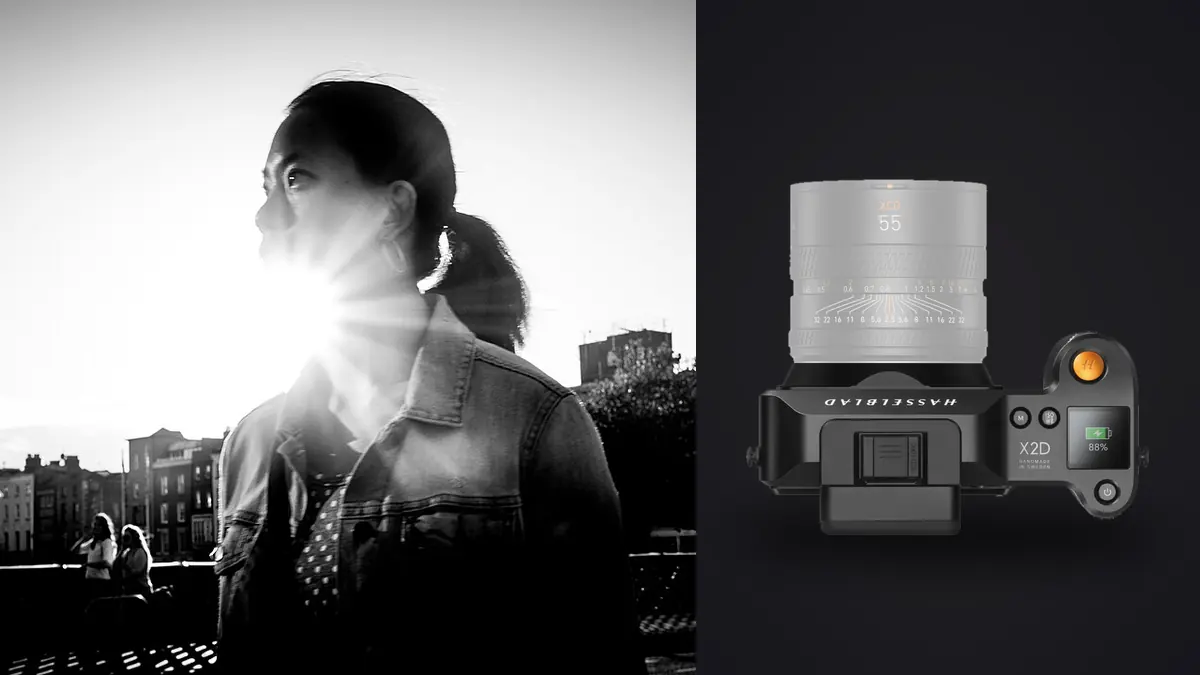
Nobody hands a medium format camera to a street photographer as a first suggestion. The genre has spent seventy years built around cameras you can forget you're holding: a Leica M, a Contax, more recently a Fuji X100 in someone's jacket pocket. So when a photographer shows up to a market or a protest with a Hasselblad X2D 100C around their neck, the first reaction from other photographers is usually "why." This piece is an answer built from actual time with the camera on actual assignments, not a spec sheet rewritten as prose.
Why bring a body this size to a street corner
The case for the X2D 100C in documentary work isn't speed or discretion, because it loses on both fronts to almost anything smaller. The case is what the 43.8 x 32.9mm sensor gives you when a moment only happens once and you didn't have time to walk closer. A 100-megapixel file lets you crop a wide environmental frame down to a tight portrait after the fact without the image falling apart. On a assignment covering a fishing town in the north of Portugal last spring, I shot wide because getting closer meant stepping into a net being hauled in, and the crop I pulled afterward held detail in the fisherman's hands that would have been mush from an APS-C sensor at the same distance. That's the trade the camera is making: you give up agility, you get insurance.
Handling: the parts that help and the parts that fight you
The body is boxy and it announces itself. At 895 grams for the body alone, before a lens, it is not light, and it does not disappear under a jacket the way a rangefinder does. People notice it. Some of that is bad for candid work, and some of it is oddly useful: in a lot of documentary situations, especially ones involving strangers who deserve to know a camera is pointed at them, being visible is not a flaw.
The waist-level tilt screen trick
The 3.6-inch tilting touchscreen turns out to be the most useful street tool on the camera, more than any dial or button. Angled down and shot from chest height, the X2D becomes a modern echo of a Rolleiflex TLR: you're not raising a viewfinder to your eye, which is the single gesture that changes a scene the fastest when people are nearby. I used this constantly at a market in Marrakech, framing off the screen at waist level while walking at a normal pace. It's slower to compose this way and you'll miss some frames you'd have caught eye-level, but you gain a genre of photograph, the ones where nobody clocked they were being photographed, that the viewfinder approach makes much harder.
No shutter, no giveaway click
The X2D has no mechanical shutter in the body at all; exposure is fully electronic, and the XCD lenses carry integral leaf shutters that sync at any speed up to 1/2000. Practically, this means the camera makes no sound when you fire it. None. In a quiet interior, a church, a small shop, a hushed room during a wake, that silence matters more than almost any other spec on this list. Cameras with a mechanical curtain, including the Fujifilm GFX line, give away every frame with a click that draws eyes in a silent room. The X2D doesn't. It's the one place where this camera actually out-performs the classic street bodies on discretion, even while losing to them on size.
Autofocus and the rhythm of decisive moments
Hasselblad added phase-detection autofocus to the X2D generation, a real improvement over the original X1D's contrast-only system, and it's fast enough for walking-pace street work: someone stepping into frame, a hand gesture, a head turn. It is not fast enough for a kid on a bike weaving through a crowd, or a skateboarder dropping into a bowl. I tried tracking a group of pigeons scattering off a plaza and the hit rate was rough. If your documentary work leans toward Cartier-Bresson style anticipation, watching a scene build and firing at the peak, the AF keeps up fine. If it leans toward sports-adjacent action, bring a different camera or accept a lower keeper rate.
Where this actually costs you time is back at the desk. A 100-megapixel file makes a near-miss on focus painfully obvious at 100 percent zoom in a way it simply isn't on a 24-megapixel file viewed the same way. A frame that looked sharp enough on the tilting screen in the field can reveal itself as front-focused once you're looking at full resolution on a monitor. This is where I started leaning on imagic's local sharpness scoring rather than trusting my own eye on the back-of-camera preview, because with files this large, eyeballing a thumbnail grid for focus accuracy is a losing game, and it's the single biggest workflow adjustment this camera forced on me compared to shooting a mirrorless APS-C body for the same job.
What 100 megapixels does to your evening
A day of documentary shooting on the X2D produces files in the 70 to 100MB range per compressed RAW (3FR), and a working day of street coverage can easily mean 400 to 600 frames once you're chasing light and moments rather than composing carefully for each shot. That's 30 to 50 gigabytes off a single card before you've opened a single image. Import alone becomes a coffee-break-length task, and scrubbing through that volume of full-resolution files on a laptop screen to find the keepers is where most of an evening on assignment used to go.
Because everything in imagic runs locally, there's no upload step standing between a memory card full of 100MP proprietary Hasselblad files and a first pass at culling; nothing leaves the laptop, which matters when a day's shoot might include faces you don't have blanket release for yet. It also matters for a duller reason: a folder of 500 files at 80MB each is genuinely painful to push through any cloud-based tool on hotel wifi, so keeping the whole pass local isn't a preference, it's the only version of the workflow that finishes before your flight.
Color, and building a style worth repeating
Hasselblad's Natural Color Solution produces a specific, slightly muted, accurate-skin-tone rendering straight out of camera that a lot of photographers either love immediately or spend a year fighting. For documentary work I lean toward pushing contrast harder and desaturating a touch further than the default profile gives you, closer to a printed-newspaper feel than a clean commercial look. Once I had a folder of 40 or 50 images edited to a look I was happy with, I used imagic's apply_my_style feature, which trains on your own past edits rather than shipping a generic preset pack, to carry that same grading decision across the rest of a 600-frame shoot without redoing the same three sliders 600 times. It's not a substitute for editing the hero frames by hand, but it closes the gap on the other 550 images fast enough that it changes how late you're up the night before a deadline.
How it stacks up against the cameras actually built for this
The honest comparison isn't medium format versus medium format, it's the X2D against the cameras documentary and street photographers actually reach for day to day. Here's how the numbers actually sit against three cameras I've shot the same kind of coverage with in the last two years.
| Camera | Sensor | Body weight | Shutter sound | Continuous AF | Typical RAW size | Body price (approx.) |
|---|---|---|---|---|---|---|
| Hasselblad X2D 100C | 43.8 x 32.9mm, 100MP | 895g | Silent, fully electronic | Hybrid, good for walking pace only | 70-100MB (3FR) | ~$8,199 |
| Fujifilm GFX100S II | 43.8 x 32.9mm, 102MP | 883g | Mechanical, audible click | Hybrid, noticeably better tracking | 60-90MB (RAF) | ~$4,999 |
| Leica Q3 | 36 x 24mm, 60MP | 743g | Near-silent leaf shutter | Contrast + phase, fast for a fixed lens | 60-80MB (DNG) | ~$5,995 |
| Fujifilm X100VI | 23.5 x 15.6mm, 40MP | 521g | Whisper-quiet leaf shutter | Hybrid, solid subject tracking | 35-45MB (RAF) | ~$1,599 |
The X2D wins on nothing except sensor size and body silence. It loses on weight, on price by a wide margin, on tracking AF, and on how much attention it draws walking down a crowded street. What it offers instead is a print-quality ceiling none of the others can touch, which matters if the end product of your documentary work is a gallery wall or a large-format book rather than a scrolling feed.
Lens choices that actually work on foot
The XCD 38V (roughly a 30mm full-frame equivalent) became my default for documentary work, wide enough to include context around a subject without needing to back into traffic, and it's the lightest prime in the lineup at around 490 grams. The XCD 55V (about 43mm equivalent) is the closer match to a classic normal lens and renders faces without the slight distortion a wider lens introduces at close range, which matters for portrait-driven documentary sequences. I'd avoid the 90V for street work entirely unless you're deliberately shooting compressed, isolated frames from across a street; at that focal length and with this AF system, you'll lose more moments than you gain in reach.
A week on assignment, plainly
I carried the X2D for six days covering a harvest festival, alongside a Fuji X-T5 as backup for anything fast-moving. The Hasselblad came out for the procession, the market stalls, and portraits with people who had time to be photographed properly. The Fuji came out for the actual bonfire lighting and the kids running around it, because I knew I'd miss those frames on the slower AF system. That split ended up defining how I'd recommend using this camera for documentary work generally: not as your only body, but as the one you reach for when a scene has slowed down enough to reward the extra resolution, and you can live with a lower shutter-per-minute count in exchange for files that hold up printed three feet wide.
One thing worth saying plainly: at nearly eight thousand dollars for the body before a single lens, this is not a camera you buy to try street photography. It's a camera you buy once you already know the genre and have decided you want the print quality badly enough to carry the extra weight and slower autofocus every day you shoot. If that's not you yet, a used Q2 or an X100VI will teach you more about the genre for a fraction of the outlay, and you can always pick up imagic once for a one-time fee regardless of which camera ends up in your bag, since the culling and editing workflow doesn't care what sensor produced the files.
Frequently Asked Questions
Is the Hasselblad X2D 100C too slow for real documentary work?
It's slow for anything involving fast, unpredictable motion, but documentary photography is often about patience and anticipation rather than reaction speed. For processions, portraits, market scenes, and quieter moments, the AF keeps up. For kids on bikes or anything you'd normally shoot in continuous burst, it falls behind cameras built for tracking.
How much does the silent shutter actually matter on the street?
More than it sounds like on paper. In genuinely quiet settings, indoors, small shops, funerals, places of worship, a camera that makes zero sound changes what you're able to photograph without drawing attention. Outdoors in normal street noise it matters less, since ambient sound already covers most shutter clicks anyway.
Which XCD lens should I start with for street and documentary use?
The 38V for general coverage and environmental context, the 55V if you're doing more portrait-forward documentary work and want a natural, undistorted rendering of faces. Save the 90V for a second body or a very specific compressed-perspective project.
What's the realistic file management overhead compared to a smaller sensor camera?
Expect roughly double to triple the storage and import time of an APS-C or full-frame street setup for the same number of frames. Running culling entirely locally, rather than through a cloud-upload tool, is the difference between finishing a first pass the same evening and still waiting on uploads the next morning.