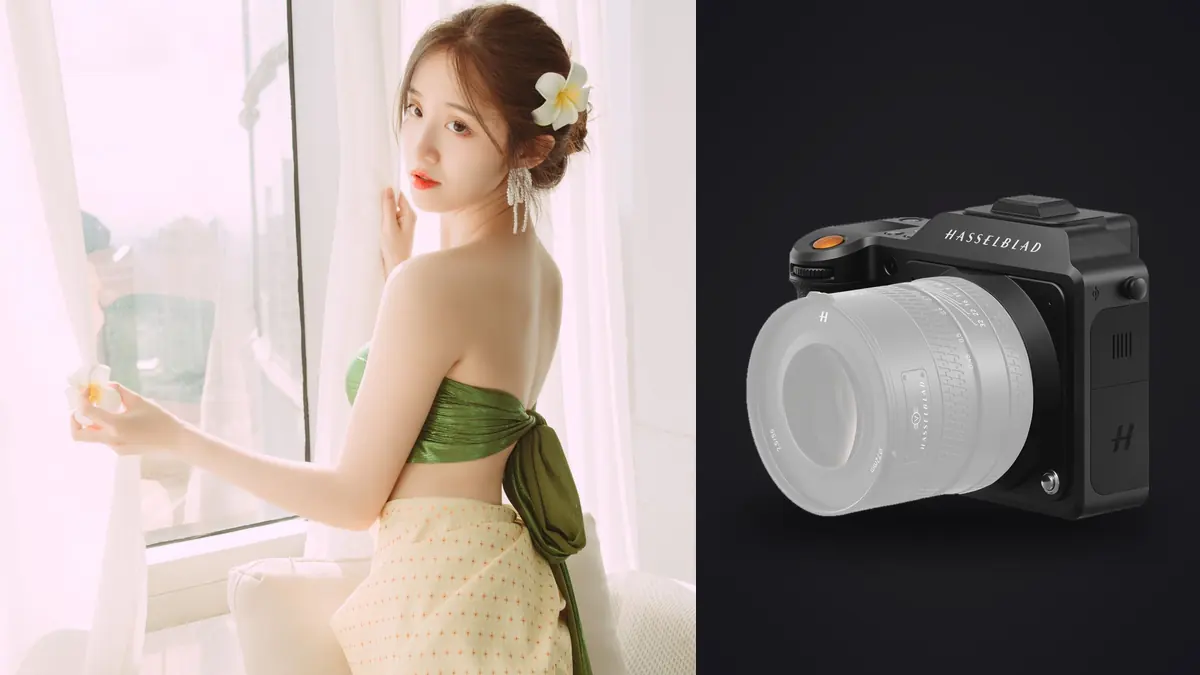
Boudoir is one of the least forgiving genres for a gear decision. You are photographing skin at close range, in low light, and skin does not lie about a camera's color science, a lens's sharpness falloff, or a sensor's tendency to turn shadow detail into mush at higher ISOs. So when a photographer tells me they are weighing a Hasselblad X2D 100C for boudoir and intimate portrait work, my first reaction is never "can it do the job." A 100 megapixel medium format sensor can obviously resolve a bedroom scene. The real question is whether this camera's specific tradeoffs fit how a boudoir session actually runs: quick wardrobe changes, subjects who move in small increments rather than across a room, dim ambient light in bedrooms and hotel suites, and clients who judge the results by how their skin looks, not by a resolution chart.
I have shot boudoir portraits with the X2D 100C for a little over a year, alongside a full frame body I still keep as backup for anything fast-moving. This is not a spec sheet rehash. It is what changed in my actual workflow, what I would tell someone before they spend eight thousand dollars on a body alone, and where the camera earns that price versus where it is just expensive for the sake of it.
Why Medium Format Even Enters the Conversation Here
The X2D 100C carries a 43.8mm by 32.9mm CMOS sensor, roughly 1.7 times the area of a full frame chip, shooting 16-bit color instead of the 14-bit most mirrorless bodies output. For most genres that extra bit depth is academic. For boudoir it is not, because low-key lighting is the house style: one window, one soft modifier, deep shadow falloff into the background or across the sheets. Pull those shadows in post and a 14-bit file starts showing banding and color shifts around 30 to 40 percent recovery. The X2D files hold together noticeably longer before that happens. I now light a full stop darker than I used to with my old full frame kit specifically because I trust the shadow recovery, which changes how a room actually looks in camera and cuts down on modifiers I have to carry.
The tradeoff nobody advertises: 100 megapixels resolves everything, including things you may not want resolved. Stray hairs, fabric texture, skin texture that a lower resolution sensor would soften slightly just by virtue of pixel pitch. I had to adjust my retouching pass after switching, mostly softening my sharpening defaults and being more deliberate about frequency separation, because straight-out-of-camera sharpening at full resolution on skin looks clinical fast.
Autofocus for a Genre That Moves in Inches, Not Feet
The X2D 100C was Hasselblad's first X-series body with on-sensor phase detection, replacing the contrast-only system in the older X1D II. That matters more for boudoir than people assume. Nobody is sprinting across the frame, but a subject shifting weight, adjusting a strap, or turning their chin two degrees toward the light is exactly the kind of small, continuous movement that contrast-detect AF used to hunt on. Phase detection catches it. I still do not trust continuous tracking for this work though. I shoot single-point AF on the eye almost exclusively and recompose sparingly, because the wide apertures on XCD lenses combined with close working distances produce genuinely thin depth of field, and a missed focus point at f/2.5 a foot and a half from someone's face is not something you talk your way around later.
Worth saying plainly: this is not a sports or event AF system, and Hasselblad has never marketed it as one. For boudoir, where the fastest thing moving is usually a hand reaching for a robe, that ceiling has never once been the limiting factor for me. It would be, immediately, for anything with real motion.
Lens Choices That Actually Come Up on a Shoot
XCD lenses do not chase fast apertures the way full frame glass does. There is no f/1.4 equivalent in the lineup, so background separation comes from sensor size and camera-to-subject distance rather than a wide-open aperture number. In practice that means working closer than I would on a full frame body to get the same falloff, which changes how a session feels for the person being photographed. Here is what I actually reach for and why.
| Lens | Full-frame equivalent | Max aperture | Typical use in a boudoir session | Working note |
|---|---|---|---|---|
| XCD 38V | ~30mm | f/2.5 | Room-establishing frames, hotel suites | Some barrel distortion up close, keep it for wider context shots |
| XCD 55V | ~44mm | f/2.5 | General coverage in tighter bedrooms | The closest working distance of the four before distortion shows |
| XCD 65 | ~51mm | f/2.5 | Default lens for most of a set | Sharpest wide open of the lineup in my experience, lives on the body |
| XCD 90V | ~71mm | f/2.5 | Compression for detail and close-crop frames | Needs a larger room, rarely usable in small hotel suites |
Leaf Shutter Sync and Why Window Light Gets Easier
Every XCD lens uses a leaf shutter that syncs flash at any speed up to 1/2000s. This is the single most underrated reason to use this system for boudoir specifically. A huge share of intimate portrait work happens next to a bright window, where the photographer wants to keep the window as a bright, blown-out background element while still lighting the subject with a small strobe for shape and catchlight. On a focal-plane shutter body that means either dropping to a 1/200 to 1/250 sync speed and stacking ND filters over the window, or burning through high-speed sync flash power at close range, which eats batteries fast during a session with dozens of setups. With the X2D I just set my shutter speed to whatever kills the window exposure I want and sync normally. No ND gel taped to a window, no HSS flicker in the highlights, no recycle-time lag between frames while a speedlight recovers.
The File Weight Problem Nobody Warns You About
A compressed 3FR raw off this sensor runs somewhere in the 80 to 130MB range depending on scene detail, and a two-hour boudoir session with five or six outfit changes routinely produces 500 to 800 frames once you count the safety bursts around each pose. That is 50 to 80GB in a single shoot day, before any TIFF exports for retouching. The camera does help here in one specific way: it has a built-in 1TB SSD in addition to the CFexpress slot, so I am not juggling card swaps mid-session the way I used to, and I get an automatic backup copy without extra hardware.
The harder problem is culling that volume of near-identical frames by eye. Boudoir posing changes are subtle, a chin drop of an inch, a hand resting slightly differently, and after the third outfit change your eyes stop reliably catching which frame in a burst of six actually has the sharpest focus on the eyes. This is the part of the workflow where I stopped trying to do it manually. I run the day's card through imagic before I touch a single retouch, and its local sharpness and focus scoring flags the genuinely sharp frame in each burst instead of me squinting at six nearly identical thumbnails at 100 percent zoom. The burst and duplicate clustering also groups those posing variations together automatically, which on a 700-frame day saves real hours, and because it processes everything on my own machine none of these files ever touch a cloud service, which for this genre is not a minor detail. Clients booking boudoir sessions are trusting you with the most sensitive images they will ever have taken, and being able to tell them honestly that the culling and editing never leaves a local drive is a real selling point, not a technicality. If you want the mechanics of how that kind of local scoring actually works, I wrote about it separately at how AI photo culling works.
Color Rendering and Keeping a Consistent Look
Hasselblad's Natural Colour Solution renders skin tones warmer and less saturated out of camera than what I get from most full frame bodies, which means less time fighting magenta or orange casts before a grade even starts. That said, "closer to right out of camera" is not the same as "done," and a boudoir portfolio lives or dies on a consistent look across dozens of different bedrooms, skin tones, and lighting setups. I built my own preset by working through a run of edits I was happy with and feeding that into imagic's apply_my_style feature, which trains on your own past edits rather than a generic filter. It gets me most of the way to my grade automatically on a fresh import, and I finish with manual adjustment on the frames going into an album rather than starting every single image from a flat baseline. If color grading workflow for portrait work is something you are still dialing in, the broader process is covered in this color grading guide.
Is the Cost Actually Justified for This Genre
The body alone runs around $8,200, and XCD lenses add roughly $2,300 to $3,700 each, so a two-lens kit puts you past $13,000 before a single card or bag. That is a real number to sit with. For a working boudoir photographer selling premium album packages and large wall prints, where clients are paying $1,500 to $4,000 for a full experience, the print-quality ceiling and the leaf shutter workflow genuinely earn their keep. For someone starting out doing $200 mini sessions to build a portfolio, this is not the camera that gets you there faster, and I would not recommend it as a first serious body for the genre. A used full frame body with a fast 85mm would teach the same lighting and posing skills for a fraction of the outlay, and you can always move up once the business supports it.
Frequently Asked Questions
Is the X2D 100C fast enough to catch natural movement during a boudoir session?
For the kind of movement boudoir actually involves, yes. It is not built for tracking a runner or a toddler, but the on-sensor phase detection reliably locks onto a subject shifting weight or turning their head, which covers nearly everything that happens in a posed intimate session. I still favor single-point AF over continuous tracking given how thin depth of field gets at close range.
Do I need studio strobes, or is available light enough with this camera?
Available window light works well thanks to the sensor's dynamic range, but I still bring at least one small strobe or continuous LED for fill on darker days or interior rooms without a strong window. The leaf shutter sync makes mixing flash with bright window light far easier than it was on my previous full frame setup, so I use flash more often now, not less.
How much storage should I budget for a full boudoir shoot day on this camera?
Plan for 60 to 90GB per session once you account for outfit changes and safety bursts. The built-in 1TB SSD covers a full day on its own, but I still offload to a card and a drive before leaving the location, since a single storage failure on shots this personal is not a risk worth taking.
Is a full-frame mirrorless body actually the smarter choice for boudoir work?
For most photographers starting out or shooting high volume, yes. Faster continuous AF, cheaper fast primes, and lower cost per shoot make more sense until the business is consistently selling premium print and album packages. The X2D earns its place specifically when clients are paying for output quality that shows up in a large print, not just a phone screen.