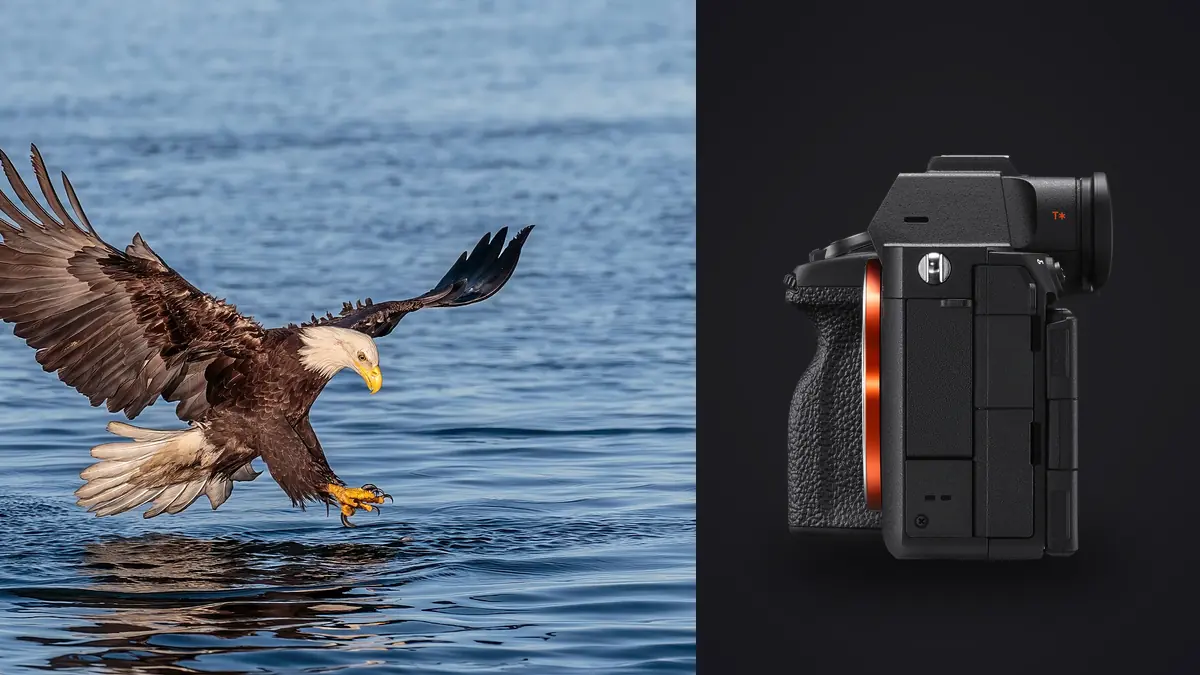
I spent most of March and April this year lying flat on a riverbank waiting for ospreys to fold their wings and drop, and the camera underneath me for nearly every session was a Sony A7R V. That's not the obvious pick. Sony's own lineup has two bodies built specifically for exactly this kind of work, the A9 III and the A1 II, and neither carries a 61-megapixel sensor that was designed first for landscape and studio detail and only adapted afterward for tracking a bird against moving branches. So the question I kept getting from other photographers at the hide was some version of: does the A7R V actually hold up for birds in flight, or are you fighting the camera the whole session to get files a dedicated sports body would hand you without effort?
The honest answer sits in the middle, and it depends heavily on which shooting mode you pick, which lens is on the front, and how willing you are to let the buffer, not the autofocus, be the limiting factor. Here's what I found out over a full spring of osprey dives, swift chases, and a lot of missed swallows.
The resolution-versus-speed tension that never goes away
The A7R V's 61-megapixel Exmor R sensor is the same core resolution as the A7R IV, and it's genuinely excellent for what it's built to do: studio work, landscapes, anything where you need to crop hard and still print big. For birds in flight that resolution has a real upside. A swift at forty meters that would fill a quarter of the frame on a 24-megapixel body still leaves you enough pixels after a tight crop to make a usable image. I've pulled keepers out of A7R V files where the bird occupied less than ten percent of the frame, something that would have looked soft and blocky from a lower-resolution sensor pushed that hard. The cost of that resolution shows up the moment you start shooting bursts. Sony's own spec sheet puts the buffer at around 583 frames in compressed raw shot in APS-C crop with a fast CFexpress Type A card, but switch to full-frame uncompressed raw on the same card and that number drops to somewhere around 80 frames before the buffer chokes and the frame rate audibly stutters. On a bird that gives you six or seven seconds of usable action, that's not always as tight as it sounds, but on an extended chase, like a kestrel hovering and repositioning for thirty seconds, you will hit the wall, and the camera will visibly slow down mid-sequence. I learned to watch the buffer indicator the same way I watch shutter speed.
Bird Eye AF in conditions that aren't a demo reel
Sony's dedicated AI processing unit, the same one introduced on the A7 IV and refined here, is where the A7R V earns back a lot of the ground it loses on raw speed. Bird detection isn't a gimmick. Against open sky it locks onto an eye almost instantly and holds it through fairly aggressive banking turns. Where it gets harder is exactly where you'd expect: a small bird against a cluttered background of leaves and branches, or a bird flying directly at the lens where the eye is barely resolved as more than a dark speck. In practice I found the system reliable once the subject occupies a reasonable portion of the frame, roughly the size of a thumbnail held at arm's length or larger. Below that threshold it will happily lock onto a patch of contrasty foliage instead, and you won't always notice until you're reviewing files back home. Swifts and swallows, which are both small and unpredictable in their flight path, were the hardest subjects I threw at it all season. Larger, more linear fliers like herons, ospreys, and geese were a different story; once the tracking box found the bird it rarely let go, even through a full stoop. One thing worth knowing before you buy long glass expecting miracles: subject recognition doesn't compensate for a slow or hunting lens. Pair the AI tracking with something that focuses fast and you get the benefit. Pair it with a lens that's already struggling in low light and the system just tracks the hunting more confidently.
Picking a shutter mode without regretting it later
The A7R V shoots up to 10 frames per second on either the mechanical or electronic shutter, but that number hides an important difference. This sensor is not stacked, unlike the ones in the A9 III or A1 II, which means the readout speed is meaningfully slower. On the electronic shutter that translates into visible rolling shutter distortion during a fast horizontal pan, most noticeable as a subtle skew on straight background elements like a fence line or the edge of a building, and as a slight warping of fast-moving wingtips at the top of a downstroke. It's not something you'll see on every frame, but during a fast diving raptor pan I've caught it often enough to plan around. The mechanical shutter avoids that skew entirely and is my default for anything with a hard directional pan, like a stooping falcon. The tradeoff is shutter shock at very long focal lengths on slower shutter speeds, and it's audibly loud, which matters if you're photographing anything shy, ground-nesting shorebirds especially. For approach shots or perched-to-flight takeoffs where I don't want to spook the subject, I switch to fully silent electronic shutter and accept the small rolling shutter risk in exchange for not flushing the bird before the shot I actually wanted.
| Shooting mode | Effective resolution | Approx. buffer (CFexpress Type A) | Best use on this body |
|---|---|---|---|
| Full-frame, uncompressed raw | 61MP | ~80 frames | Static or slow-moving subjects, print-quality perched portraits |
| Full-frame, compressed raw | 61MP | ~130-150 frames | General BIF in good light when file quality still matters |
| APS-C crop, compressed raw | ~26MP | ~580 frames | Extended chases, small fast fliers needing the extra 1.5x reach |
| APS-C crop, JPEG fine | ~26MP | 1000+ frames | High-volume passes where you'll cull heavily and reshoot raw later if needed |
My own habit settled into APS-C compressed raw as the default for anything airborne. You lose the outright resolution advantage that makes the A7R V interesting in the first place, but you get a buffer deep enough to actually hold a full flight sequence, plus the extra reach the crop gives a shorter lens. I only switch back to full-frame when the bird is close, slow, or I already know I want the file for a large print.
Lenses that actually make sense on this body
The 200-600mm f/5.6-6.3 G is the lens I used for probably 70 percent of my sessions this spring, and it's a sensible match: light enough to hand-hold for a full afternoon, cheap enough that a scratch on the coating doesn't ruin your week, and fast enough to focus that the A7R V's tracking has something to work with. Add a 1.4x teleconverter and you're at 840mm f/9, which still autofocuses reliably in decent light but starts to hunt noticeably once the sun drops or you're shooting into overcast sky. The 100-400mm GM is the better everyday travel option if you're not exclusively chasing birds, and it focuses faster than the 200-600 in my side-by-side tests, but you're giving up reach that matters for small subjects at distance. If budget allows, the 400mm f/2.8 GM paired with a 1.4x or 2x teleconverter is the combination that lets the A7R V's autofocus perform closest to its ceiling, because you're feeding it more light and a faster native aperture. That's a five-figure investment for the lens alone though, and most people chasing birds seriously don't start there. One underrated pairing: because the crop mode still nets you a very usable 26 megapixels, a shorter, faster lens like a 400mm f/2.8 or even a 300mm f/2.8 with a teleconverter can outperform a longer, slower zoom once you factor in autofocus speed and low-light performance. Reach isn't only about focal length on this body.
What 61 megapixels costs you after the shutter closes
Here's the part nobody mentions when they're excited about resolution: a single afternoon chasing an osprey through repeated dives can leave you with three or four thousand 61-megapixel raw frames, each one somewhere between 60 and 95MB depending on compression. That's not a hard drive problem so much as a time problem. Scrolling through four thousand near-identical frames of the same six-second dive, trying to spot which one nailed focus on the eye a fraction before the wing crossed in front of it, is genuinely the least enjoyable part of this whole hobby. This is where I stopped trying to cull by eye in a normal file browser and started running sessions through imagic instead. It clusters burst sequences automatically, so instead of four thousand individual thumbnails you're looking at maybe sixty grouped bursts, each one expandable when you actually need to compare frames within it. The local sharpness scoring is what saves the most time on bird-in-flight work specifically, because it flags which frame in a twelve-shot wingbeat burst has the sharpest focus on the eye, which isn't always the frame you'd guess just from thumbnail size. Because it processes everything on the machine rather than uploading to a cloud service, you're not sitting there pushing gigabytes of raw files over a home connection before you can even start reviewing, which matters a lot when a single session's take is pushing 300GB. Once you've got a season of keepers graded the way you like, backlit shots handled one way, flat overcast shots handled another, imagic's apply_my_style feature carries that same edit character forward onto the next batch automatically, since it's trained on your own past edits rather than a generic preset pack somebody else built for a different kind of light. It's a small thing but it adds up over a season when you're grading hundreds of bird photos a week and don't want each batch to look like it came from a different photographer. If you're weighing culling tools generally, the breakdown in how AI photo culling actually works is worth a read before you commit to a workflow, and it's a one-time purchase rather than a subscription, which matters if you're already sinking money into CFexpress cards and glass.
Where the A9 III and A1 II still win
I don't want to oversell what the A7R V can do, because it genuinely is the wrong tool for some of this work. The A9 III's global shutter eliminates rolling shutter entirely and shoots at up to 120 frames per second, which is a different category of tool for something like a hummingbird's wingbeat or a duck exploding off water. Neither the A9 III nor the A1 II is available on the A7R V, and that alone is a real limitation if you're chasing fast, erratic subjects like swifts where a fraction of a second either way is the difference between a clean frame and a blurred one. Autofocus tracking sensitivity is also a notch behind on paper, though in my actual sessions the gap mattered less than the spec sheets suggest, mostly because good technique (panning smoothly, keeping the subject in the tracking zone, using a lens that focuses quickly) closes most of it. Where the A7R V clearly loses is buffer depth at full resolution and burst speed on demanding subjects, full stop. If your primary subject is small, fast, and erratic, and you're shooting professionally where missed frames cost you money, the resolution advantage of the A7R V isn't worth the frame rate you're giving up.
Frequently Asked Questions
Does the Sony A7R V have pre-capture for catching a bird's takeoff?
No. Pre-capture buffering, where the camera continuously holds recent frames in memory before you fully press the shutter, is reserved for Sony's newer stacked-sensor bodies like the A9 III and A1 II. On the A7R V you're relying on anticipation and a fast trigger finger, not a buffer that reaches backward in time.
Is 61 megapixels overkill for photographing birds in flight?
It depends what you do with the files afterward. If you're cropping hard on distant, small subjects, the extra resolution genuinely helps. If you're mostly sharing images online or printing at moderate sizes, you're carrying a lot of file weight and buffer penalty for detail you'll never use. I'd say it's overkill for casual shooting and genuinely useful for anyone regularly working with subjects under a certain size in frame.
Should I shoot in APS-C crop mode for birds in flight on this camera?
Most of the time, yes. The crop mode drops resolution to roughly 26 megapixels but multiplies your buffer depth several times over and gives you an effective 1.5x reach boost on whatever lens is mounted. Unless the bird is already close and slow, or you specifically need the full-frame file for a large print, crop mode is the more forgiving choice for actual flight sequences.
What's the biggest workflow mistake people make after a day shooting BIF on a 61-megapixel body?
Trying to cull thousands of near-identical burst frames manually in a standard file browser. It's slow, it's tiring, and it's easy to pick a frame that looks sharp at thumbnail size but isn't actually the sharpest one in the sequence. Grouping bursts and scoring sharpness automatically before you sit down to edit saves hours, and it's worth pairing with a broader look at faster photo workflow habits if culling volume is a recurring bottleneck for you.