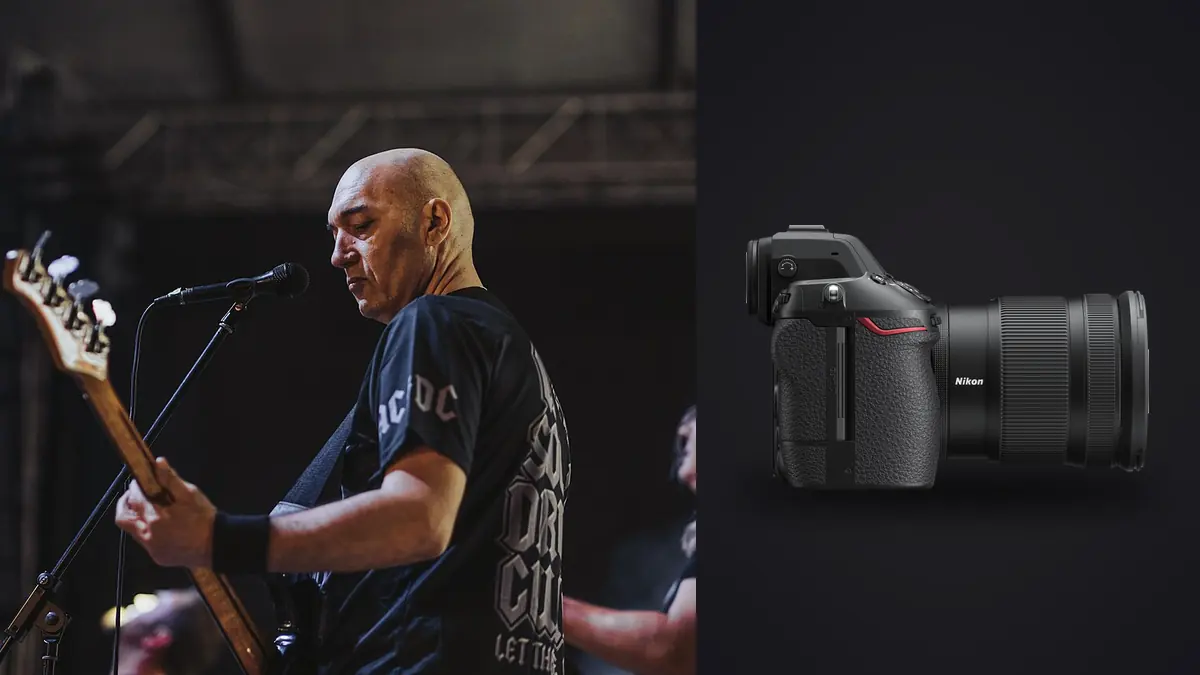
I switched to a Nikon Z8 about eighteen months ago after years on a D850, and the camera that finally sold me on the move wasn't the resolution or the video specs everyone talks about. It was standing in a packed photo pit at a 2,000-capacity theater, three songs to get the shot, and realizing I hadn't heard a single shutter click the whole time. Nobody around me had either. That's the part nobody mentions until you've actually worked a pit with one.
Why the pit changes what matters about a camera
Concert photography has a specific, brutal set of constraints that most gear reviews don't test for. You usually get the first three songs and no flash, full stop, because that's the standard agreement most artist management teams require. The light is never where you want it, it changes color and intensity every few seconds if there's a lighting designer worth their salt, and you're often shooting over someone's shoulder or through a gap in a barrier with forty seconds to nail a shot of a singer who just decided to sprint to the far side of the stage. None of that cares about megapixels. It cares about whether the autofocus holds when a magenta wash suddenly goes to near black, whether the buffer clears before the next chorus, and whether you can shoot without being the person whose shutter noise gets you a dirty look from the front row during a quiet acoustic break.
The Z8's stacked 45.7-megapixel sensor and Expeed 7 processor solve more of that than I expected. It's essentially the Z9 sensor and AF system in a smaller, lighter body, which matters a lot when you're crouched at rail height for three hours a night, four nights in a row on a festival weekend. Full mechanical shutter is gone entirely on this camera, everything is electronic, which is what makes truly silent shooting possible without the rolling-shutter smearing you'd get on an older, slower-readout sensor. I've shot a violinist mid-bow-stroke at a hushed seated show without a single audience member turning around.
Settings I actually use, by venue
I get asked constantly for "the settings" as if there's one correct exposure triangle for live music. There isn't. What I use in a 200-cap basement club is nearly the opposite of what works on a festival main stage at 6pm in July. Here's what I've actually landed on across the venue types I shoot most, based on logged EXIF from real gigs rather than guesswork.
| Venue type | Typical stage light | ISO range I use | Shutter floor | Lens I reach for |
|---|---|---|---|---|
| Small club (under 300 cap) | One or two washes, often a single saturated color, frequently under 50 lux | ISO 6400 to 25600 | 1/250s, 1/320s if there's a drummer in frame | 50mm f/1.8 S or 35mm f/1.8 S |
| Mid-size theater (1,500 to 3,000 cap) | Programmed LED rig, 200 to 800 lux, cues change every few bars | ISO 3200 to 10000 | 1/320s to 1/500s | 70-200mm f/2.8 VR S from the pit rail |
| Arena show | Full LED wall plus moving heads, 500 to 2000 lux at the wash, far less on a dark verse | ISO 1600 to 6400 | 1/500s to 1/800s, beams sweep fast | 24-70mm f/2.8 S, body-swap to 70-200mm f/2.8 |
| Outdoor festival main stage, daylight set | 2000 to 20000+ lux depending on sun angle, drops off a cliff at dusk | ISO 64 to 800 by day, climbing fast after sundown | 1/1000s+ in daylight | 24-120mm f/4 S for one-lens flexibility in a crowded fenced pit |
| Seated acoustic or classical-crossover set | Single spotlight or warm wash, silence expected from the audience | ISO 3200 to 12800 | 1/160s to 1/250s, using fully silent shutter | 85mm f/1.8 S from a fixed seat |
A few things jump out once you log this over dozens of shows. The ISO ceiling I'm comfortable with on the Z8 sits noticeably higher than it did on my old D850, and it's not just sensor generation, the Expeed 7 noise reduction pipeline handles the color-shifting concert lighting more gracefully than I expected going in. I'll push to ISO 20000 in a dark club without much hesitation now, something I would have avoided on the older body except as a last resort.
Autofocus in light that keeps lying to the camera
Subject detection is where the Z8 earns its keep at gigs, and also where it occasionally trips over itself. The 493-point AF system with people, animal, and vehicle detection modes locks onto a singer's face reliably even when a lighting cue drops the scene to near black for a beat and then floods it with white strobe. Where it struggles is haze. A lot of touring productions run heavy fog for atmosphere, and when a hazer is going full blast and a moving head sweeps through it, the camera occasionally hunts, latching onto the haze itself rather than the face behind it. Switching from wide-area AF to a smaller dynamic-area zone around the singer's head fixes it most of the time, but it's a manual correction I've had to make often enough that I now expect it at any arena show with a big lighting budget.
Low-light AF is rated down to -9EV with an f/1.2 lens attached, and while I'm not usually shooting an f/1.2 prime in a pit, even paired with the f/1.8 or f/2.8 glass I actually carry, the camera keeps finding eyes in light so dim I'd have needed to manually focus on my old body. Backlighting from a hazy stage wash pointed straight at the lens is still the one condition that reliably beats it, but that beats most cameras.
Buffer, cards, and not choking mid-chorus
At 20fps in 14-bit lossless-compressed raw with a fast CFexpress Type B card in the primary slot, I have genuinely never hit a hard buffer wall shooting a three-song pit set, and that's not a claim I could have made with most previous bodies I've owned. I still keep the second slot loaded with an SD UHS-II card as backup, not because I've needed it for buffer overflow, but because losing a card during a one-time-only pit set is the kind of mistake you don't get to redo. Battery life is rated modestly on paper for a mirrorless body doing this kind of work, but in practice a single EN-EL15c comfortably gets me through a full pit set plus backstage portraits without a swap, and I carry a spare in a jacket pocket purely out of habit from years of getting burned by older gear.
One thing worth knowing before you rely on it: the high-speed frame capture modes that shoot at 30fps or higher drop you to a reduced-resolution JPEG rather than full raw. I use those modes almost never for concert work specifically because I want the full sensor raw file for cropping a wide festival shot down to a tight portrait later, but they're genuinely useful for catching a stage dive or a drumstick toss where timing matters more than pixel count.
What actually fills a card in one night
Between the three-song pit at an arena show and a couple of support acts I might also be covering, I'll walk out with anywhere from 1,800 to 4,000 frames on a busy festival day. Most of that volume comes from leaning on continuous high-speed shooting through a chorus rather than trying to time single frames, which the blackout-free viewfinder makes much easier to do accurately since you're never losing sight of the framing between shots the way you would with a mechanical shutter body.
Getting through the take without losing the rest of your night
The unglamorous truth about concert photography is that the shoot is the fast part. Sorting four thousand nearly identical frames of a guitarist mid-riff, most of them separated by a fraction of a second and differing only in whether his eyes were open or his pick hand was mid-strum, is where the actual hours go. I edit on imagic for this specifically because it runs its sharpness and focus scoring entirely on my machine, no upload queue, which matters when I'm sorting an unreleased tour's images before a publicist has cleared anything for the internet. Given how much of a night's shoot is 20fps burst sequences of the same three seconds of a song, its burst clustering is the feature I lean on hardest, it groups those near-duplicate frames together instead of making me scroll through forty versions of the same jump to find the one where the singer's eyes are actually open and the guitar neck isn't clipping their face.
I also built out a custom style in imagic trained on my own past concert edits, the contrast curve and color balance I gravitate toward for stage lighting, so a fresh batch from a new gig gets a first pass in something close to my usual look before I go in and hand-finish the dozen or so images that are actually worth sharing. It's saved me the better part of an evening on more than one festival weekend, which is the difference between shooting three days back to back and actually being able to shoot the third day rather than falling behind on editing from the first.
The lenses that earn their space in the bag
If I could bring exactly one lens to every gig I shoot, it would be the 24-70mm f/2.8 S. It covers a wide stage shot and a reasonably tight portrait from most pit positions without a lens change, which matters when you've got three songs and no time to fumble a swap in the dark. The 70-200mm f/2.8 VR S comes out for anything with real rail-to-stage distance, arenas especially, and its VR is good enough that I've handheld usably sharp frames at shutter speeds I wouldn't have trusted on an older stabilization system. For clubs where I'm often close enough to touch the stage, the 50mm f/1.8 S and 35mm f/1.8 S are both light enough to carry as a pair without the bag becoming a liability, and the extra stop or two of light over the f/2.8 zooms genuinely changes what ISO I can shoot at in a dark basement room.
Where the Z8 still has limits worth knowing about before you buy one for this
It isn't magic. Extremely fast-moving colored beams still occasionally confuse the auto white balance enough that I shoot raw and correct in post rather than trust the in-camera JPEG preview for anything I plan to share. Weight is better than a D850 with an equivalent lens but it's still a substantial camera to hold overhead for a crowd shot for the length of an entire festival day, and by the third day my wrist knows it. And if you're deciding between this and the Z9, the honest answer is that for pit work specifically, the AF system and buffer performance are close enough that the Z8's smaller size and lower price make it the better buy for most working concert photographers. The Z9's bigger battery and integrated grip matter more for people shooting sports or wildlife for entire days than for a photographer who's in and out of a pit in fifteen minutes.
Frequently Asked Questions
Is the Z8 actually quiet enough for a seated acoustic show, or is "silent mode" marketing?
It's genuinely silent in the sense that matters here, there's no mechanical shutter to make noise in the first place, the whole exposure is read electronically off the sensor. I've shot a seated string set from four rows back without anyone turning around to see where a click was coming from. The only sound at all is if you leave AF beep or a simulated shutter sound on in the menu, both of which I turn off before every show out of habit.
Do I need f/2.8 glass for concert work, or can I get away with the kit zoom?
For anything past a well-lit theater show, you'll want at least f/2.8, and in small clubs I'd honestly rather have an f/1.8 prime than a 2.8 zoom. The 24-120mm f/4 S is a lens I genuinely like for festival days with strong sun, but I wouldn't want it as my only option once the light drops after dark. Renting a fast zoom for one big show before committing to buying is a reasonable way to test this before spending the money.
How many keepers should I expect from a typical three-song pit set?
From roughly 400 to 700 frames shot during three songs, I'll usually end up with somewhere between 15 and 30 that I'd actually keep and share, after running everything through a first sharpness and expression pass. That ratio is fairly normal for pit work generally, the volume comes from shooting through movement rather than nailing every single frame, and it's exactly the kind of ratio that makes fast culling software worth having rather than optional.
Does the crop mode or the high-speed 30fps mode matter for concerts specifically?
Rarely, in my experience. The 30fps and faster modes drop you out of full raw into a reduced-resolution JPEG capture, which I only reach for chasing something genuinely unpredictable like a crowd surf or an instrument toss where I'd rather have more chances at the exact instant than full resolution. For the bulk of a set, 20fps raw at full sensor width gives me room to crop a wide stage shot into a tighter portrait afterward, which I use constantly since pit positions rarely let you frame exactly how you'd like in the moment.