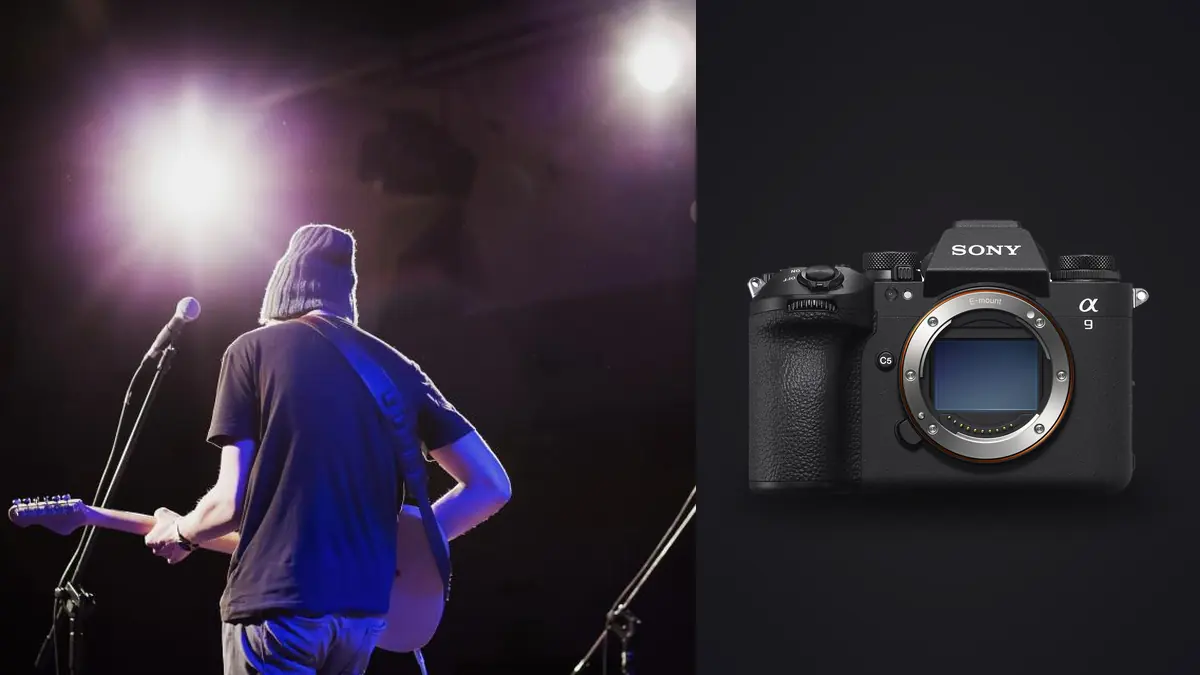
Picture the first three A9 III gigs in the same week: a 400-capacity club show with a single moving-head rig, a festival side stage with LED walls running behind the band, and an arena support slot with a photo pit for exactly three songs and nothing else. Those three nights would tell you more about this camera than any spec sheet does, because concert lighting is where cameras usually fall apart. Flicker, mixed color temperature, strobes timed to the kick drum, a follow spot that swings from key light to nothing in half a second. The A9 III's global shutter sensor is the first sensor I've used that doesn't visibly care about any of that, and that single change reorders a lot of decisions I used to make without thinking.
This isn't a spec dump. It's what changed in my actual workflow, pit to laptop, once I started shooting shows with a global shutter body instead of the stacked-sensor cameras I'd used for the previous six years.
The banding problem, and why it's suddenly gone
Every venue I shoot has some mix of LED video walls, moving heads, and cheap PAR cans running on dimmer packs that flicker at frequencies that don't line up with a rolling shutter readout. With my old A9 II, a wall behind the drummer would show horizontal bands in maybe one frame out of five at 1/1000s and faster. Not a huge deal with a single frame, a real problem when I'm cropping a burst down to the sharpest shot and the sharpest one happens to have a band cutting across the singer's face.
Global shutter reads every pixel at the same instant instead of scanning top to bottom, so that specific failure mode is gone. Not reduced, gone. I shot a set with a wall running fast-cutting content behind a DJ and didn't get a single banded frame across roughly 900 images. That's the headline feature for anyone shooting under LED walls or cheap disco lighting, and it's the reason I stopped avoiding backlit compositions I used to steer clear of on purpose.
What it doesn't fix
Global shutter doesn't fix color shift from a strobe firing mid-exposure, and it doesn't fix a moving head sweeping through a frame and leaving one half lit and one half dark, because that's a real difference in the scene, not a sensor artifact. I still watch the light and time my trigger the same way I always did. The camera just stopped adding its own distortion on top of what the lighting rig is already doing to me.
120fps and the three-song rule
Most photo pits give you the first three songs, no flash, then you're escorted out. That's maybe nine to twelve minutes of usable time depending on how the band paces the set. At 120fps with full AF and AE tracking and zero viewfinder blackout, I can hold a burst through an entire drum fill or a guitarist's jump and know I've got the exact peak frame somewhere in there, not just close to it.
I don't shoot at 120fps constantly, that would be an absurd number of files for three songs. I use it in short bursts, half a second to a second and a half, on moments I know are coming: a jump at the end of a chorus, a drum break, a guitarist swinging the neck up. For everything else I sit around 20-30fps, which is still faster than most bodies' top speed and gives me a real edit, not a slideshow.
| Shutter mode | Max frame rate | Blackout | Banding under LED/strobe | When I actually use it |
|---|---|---|---|---|
| Global (electronic) | 120fps | None | None observed | Peak-action bursts, LED wall backdrops, strobe-heavy sets |
| Global, lower rate | 20-30fps | None | None observed | General set coverage, crowd shots, wides |
| Silent single/low burst | Up to 10fps | None | None observed | Acoustic sets, between-song moments, small rooms |
| Old rolling-shutter body (A9 II, for reference) | 20fps electronic | None | Occasional under video walls/fast strobes | Retired for this specific use case |
Autofocus in a pit that's actively trying to confuse it
Concert autofocus has to deal with haze, a singer moving in and out of a single hard spotlight, and a crowd of arms and phones between you and the stage if you're shooting from the barrier instead of the pit. The A9 III's eye AF holds onto a performer's face through lighting changes that used to make older bodies hunt, including the moment someone walks from a lit area into near darkness and back. It's not magic, if the subject is fully backlit with no separation from the background it will still occasionally grab the wrong thing, but the hit rate on a moving singer under changing key light is noticeably better than what I got from the A9 II.
Where I still don't fully trust it: haze-heavy stages where the beam itself becomes the brightest object in frame, and it will occasionally lock onto the beam instead of the person standing in it. I've learned to switch to a smaller focus area in that specific situation rather than leave it on wide tracking.
Low light, honestly
I want to be straightforward here instead of pretending a stacked global shutter sensor beats a dedicated low-light body, because it doesn't. Base ISO is 250, not 100, which matters less at a show where you're rarely near base ISO anyway, but it does mean the noise floor at your working ISOs is a touch higher than what I got from cameras built around maximizing dynamic range at low ISO. In practice I'm shooting most club sets between ISO 3200 and ISO 12800 depending on the rig, and the files clean up fine in post. Past ISO 20000 I start being more selective about which frames I keep rather than assuming I'll fix it later, because grain gets busy quickly at that point and busy grain reads badly on a small support-act stage where 80% of the frame is black anyway.
None of this is a knock specific to concert work, it's just where the sensor design trades off, and worth knowing before you buy the body expecting Milky-Way-shooting levels of clean high ISO.
Lenses I actually reach for
Pit access changes what lens makes sense more than any other variable. If I'm in the pit for three songs and can get close, I live on the 24-70mm f/2.8 GM II for two songs and switch to something longer for the last one if the barrier allows a step back. If I'm shooting from front-of-house or a raised platform with no pit access, it's the 70-200mm f/2.8 GM II the whole night, and increasingly I add the 1.4x teleconverter for headline slots on bigger stages.
| Lens | Typical use | Trade-off worth knowing |
|---|---|---|
| 24-70mm f/2.8 GM II | Pit work, wide stage shots, crowd-and-band context frames | Too short once you're pushed past the first three songs and out of the pit |
| 70-200mm f/2.8 GM II | FOH shooting, tight performer portraits, isolating a soloist from a busy stage | Heavy to hold overhead for a full set, monopod recommended for anything past two hours |
| 85mm f/1.4 GM | Acoustic sets, small rooms, moments between songs | Single focal length, you're moving your feet all night instead of zooming |
| 35mm f/1.4 GM | Environmental shots, wide crowd-plus-stage, backstage | Not a stage lens on anything but the smallest club rooms |
What a full tour night actually costs you in files
A three-song pit set at a mixed frame rate lands me somewhere around 1,200 to 1,800 frames. A full headline set where I have stage access the whole night, closer to 4,000, and a festival day covering four or five acts can push past 8,000 by the time I load out. That volume is the real tax of shooting global shutter at high frame rates, not the camera itself, the camera is fantastic, it's the two hours after the show when you're sitting in a green room or a hotel room trying to find the fifteen images actually worth delivering.
This is where I stopped doing the culling manually. I run the card straight into imagic and let it group the burst sequences from each big moment (the drum fill, the jump, the crowd surf) into clusters instead of making me click through four hundred nearly-identical frames one at a time. Inside each cluster it scores focus and sharpness locally on the machine, no upload, which matters to me because a lot of the acts I shoot have unreleased material and I don't want frames sitting on someone else's server before a show's even been reviewed by the band's team. I still make the final call on which frame has the right expression or the right hand position, the software isn't picking my favorites, it's just cutting the four hundred down to the dozen I actually need to look at. If you've never sat down and worked out what a culling pass is actually doing to your night, this breakdown of how AI photo culling works covers the mechanics better than I can in a paragraph here.
The other piece I lean on afterward is the apply_my_style preset, trained on how I've actually graded my own concert work rather than a generic film-look preset pack. Stage lighting swings so hard between songs that a single fixed preset either blows out the reds under a strobe-heavy chorus or leaves a blue-lit verse looking flat, so having something trained on my own prior edits gets me a much closer starting point per image than a one-size preset ever did, and I'm not retraining my eye every time the lighting rig changes moods.
Battery, cards, and the boring stuff that actually ends your night
The A9 III eats through a battery faster at 120fps than it does at 20fps, which is obvious but worth planning around, I carry three batteries for anything past a two-hour set and I've used all three on a long headline night with an opener I also shot. CFexpress Type A cards are non-negotiable at this frame rate, a slower card means the buffer fills and you miss the next burst while it clears, and I found that out the expensive way on my second night out with the camera when I'd grabbed an older card as backup.
Where it still comes up short
Dynamic range at base ISO is genuinely excellent, but the moment you're pushing shadows from a deep-blue-lit verse back up in post, you'll notice it's not the same latitude as a body tuned purely for landscape or studio dynamic range. And the body itself is dense, a long night holding the 70-200 up over a barrier is a different kind of tired than a lighter APS-C rig. Neither is a dealbreaker for what this camera is built to do, but I'd rather say it plainly than pretend the camera has no trade-offs at all.
Frequently Asked Questions
Does the global shutter actually matter if I'm not shooting under LED walls?
Less, but it's not nothing. Even under plain tungsten wash lighting I noticed steadier exposure across a fast burst and no rolling artifacts when a moving head swept through frame mid-sequence. If your venue is mostly warm wash lighting with no video walls or fast strobes, a stacked-sensor body will get you most of the way there for a lot less money. The gap widens fast the moment LED walls or DJ-style strobing enters the picture.
Is 120fps overkill for a typical club show?
For the whole set, yes. I use it in short, deliberate bursts around moments I can predict, a jump, a drum fill, a mic-stand swing, and shoot the rest of the set at a lower continuous rate. Running 120fps the entire night just means a much longer culling session for no real gain in keeper rate.
What's the realistic ISO ceiling for a dark club set?
I'm comfortable through about ISO 12800 for delivery-quality work, and I'll shoot as high as ISO 25600 for moments I want a record of even if the grain is more visible. Past that I treat the frames as backup coverage rather than portfolio candidates.
How do I stop drowning in files after a multi-band festival day?
Cull in clusters, not frame by frame. Grouping each burst around a single moment and picking one or two winners per cluster, rather than reviewing every frame in isolation, is the only way I've found to get through 8,000 festival images in a night instead of three days. That's exactly the workflow imagic's burst clustering is built for, and it's a faster habit to build than most people expect once you stop second-guessing the grouping.