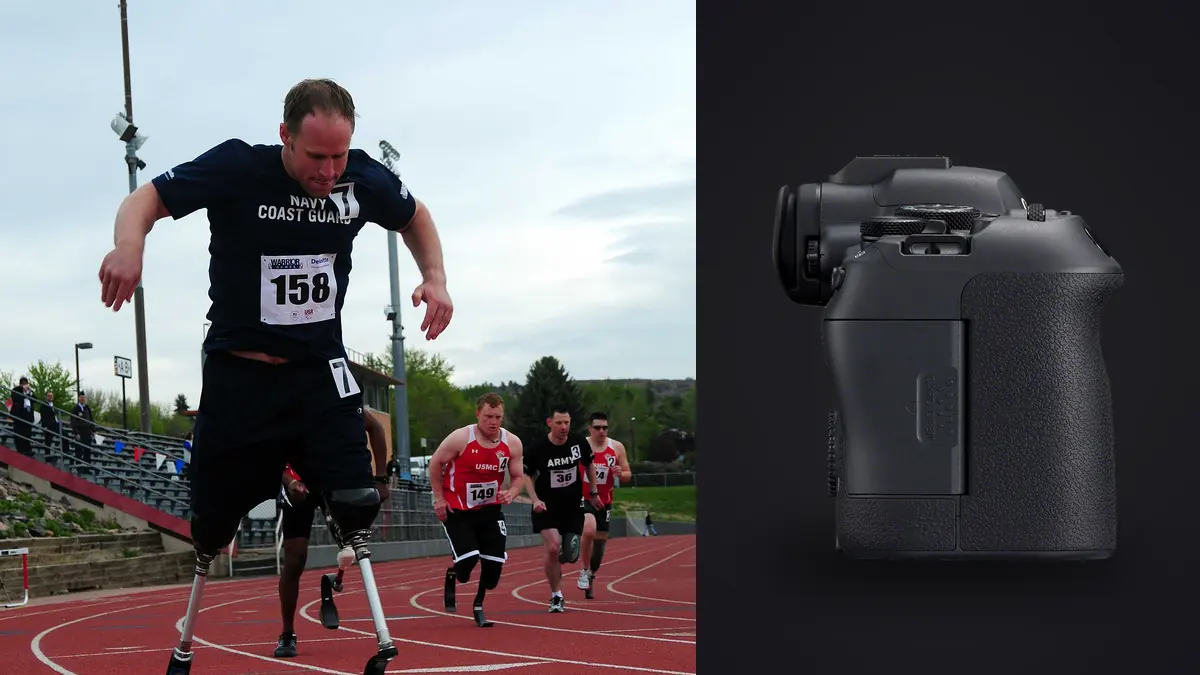
My first meet with the R6 Mark II was a regional qualifier in April, cold enough that my hands were stiff by the 4x100m relay. I'd swapped over from an R6 (the original) mostly for the buffer, and by the second event I already knew the upgrade was going to change how I shot the 100m final. Track and field is a strange discipline to photograph because it's really six or seven different sports happening on the same infield: a sprint lasts ten seconds, a javelin throw is a single explosive motion, and a 5000m race is forty minutes of mostly nothing punctuated by a handful of moments that matter. The R6 II handles all of it, but not with the same settings, and figuring out which settings go with which event is most of the job.
What actually changed from the original R6
Canon sports shooters spent two years complaining about the first R6's buffer, and the Mark II is a direct answer to that. RAW buffer depth at the top electronic shutter speed went from roughly forty frames to something closer to seventy on a fast UHS-II card, which sounds like a spec-sheet number until you're mid-race and realize you didn't hit the wall before your subject crossed the line. The sensor also went from 20.1 to 24.2 megapixels, which matters more than people expect at a track meet because you're rarely close enough to fill the frame with a 400m runner in lane one, and that extra resolution buys you a real crop without the file falling apart.
The other quiet win is Dual Pixel CMOS AF II picking up subjects faster after they re-enter frame, which happens constantly in relays and in field events where an athlete steps in and out of your composition. It's not flashy, but it's the difference between a clean sequence and three throwaway frames while the camera re-acquires focus.
The buffer ceiling is still real
Don't mistake "better" for "unlimited." At 40fps electronic shutter with RAW, I've clocked the camera choking down to a crawl around the 55-65 frame mark on a UHS-II card that's been through a full day of shooting and hasn't been reformatted. Canon didn't give the R6 II a CFexpress slot, which is the one spec I genuinely wish they'd changed, because a faster card would push that number meaningfully higher. If you're shooting a 100m final at 40fps, that buffer will run out before the race is over if you hold the shutter down from the gun. The fix isn't a firmware trick, it's discipline: burst in short, deliberate bites timed to the stride cycle instead of holding the button through the whole race.
Matching settings to the event, not the camera
Sprinters, distance runners, and field event athletes ask for genuinely different camera behavior. I stopped trying to run one AF and drive configuration for an entire meet after missing a pole vault clearance because I still had Case 2 dialed in from the 200m heats twenty minutes earlier.
| Event type | AF Case / area | Shutter mode | Drive speed | Why |
|---|---|---|---|---|
| Sprints (100m-400m) | Case 2, Flexible Zone AF (medium) | Electronic, 20-40fps | Short bursts, timed to strides | Fast, mostly lateral motion; wide zone keeps the runner covered as they enter frame |
| Distance (800m+) | Case 1, Zone AF | Mechanical or electronic, 8-12fps | Sustained but sparse | Speed is lower and predictable; save buffer and battery for the bell lap and finish |
| Relays / exchanges | Case 4, Whole Area AF with subject priority | Electronic, 20fps | Burst on the exchange zone only | Two runners, unpredictable spacing; wide tracking recovers focus fast when a baton pass goes wrong |
| Jumps (long, triple, high) | Single point or small Zone | Mechanical, 8-12fps | Burst from approach through landing | Predictable run-up line, but you want a fixed point, not the camera hunting on a cluttered pit background |
| Pole vault | Single point, manually placed high | Mechanical, 8-12fps | Burst from plant through bar clearance | The bar and standards will steal AF from a wide zone every time |
| Throws (shot, discus, javelin) | Zone AF, centered | Mechanical, 10-12fps | Short burst on release | One explosive moment; you don't need 40fps, you need to be ready for it |
The line I'd underline twice is that 40fps is not the default answer. It's a tool for the sprints, where a stride cycle happens in a fraction of a second and you genuinely want the extra frames to pick the exact moment a foot leaves the block. For a discus throw, 40fps just means you're deleting thirty-nine more photos of a person standing in a circle.
Lenses that make sense for a meet
Track access varies wildly by venue. Some high school meets let you walk the infield rail. Championship meets put you in a photographer's box thirty meters back with a rope between you and the track. Plan lens choice around the venue, not the other way around.
My go-to combination is an RF 100-500mm f/4.5-7.1 on the R6 II body and a 70-200mm f/2.8 as a second body or quick swap for anything happening close, like a long jump pit or the start of a sprint if I'm allowed trackside. The 100-500mm's variable aperture is a real compromise once the sun drops and you're at f/7.1 on the long end needing ISO 6400 to hold a fast shutter speed, but the reach is worth it for a stadium where the far turn is genuinely far. If budget is the constraint, the RF 800mm f/11 is tempting for distance events on the far side of the oval, but I'd steer away from it for anything under lights; f/11 at a night meet pushes ISO into territory where you're fighting noise on top of everything else.
For field events specifically, a mid-range zoom like the RF 24-105mm earns its keep. Long jump run-ups, shot put circles, and high jump approaches often happen closer than people assume, and being locked onto a 500mm lens means you can't react when an athlete or coach walks into a more interesting frame ten feet away.
Settings I actually dial in before the first gun
A few specifics that aren't obvious from the manual:
- Minimum shutter speed on Auto ISO. I set a floor of 1/2000s for sprints and jumps, 1/1000s for distance and throws. Track lighting outdoors is forgiving enough that ISO rarely climbs past 800 in daylight, so there's little cost to keeping the floor high.
- Flicker detection, on, always. Indoor meets under sodium or older LED fixtures will band exposure and color across a burst if this is off. I learned this the hard way with a set of otherwise perfect indoor 60m frames that alternated between warm and slightly green.
- Pre-continuous shooting with electronic shutter. The R6 II can buffer up to half a second before you fully press the shutter when you half-press first, which has saved starting-gun reaction shots more than once. It eats into your usable buffer faster, so I only turn it on for the blocks and turn it off again for everything else.
- Back-button AF, no exceptions. Track photography involves a lot of recomposing while an athlete is mid-motion, and separating focus from the shutter button means a stumble or a false start doesn't cost you the whole sequence.
Where the R6 II still trips me up
Rolling shutter is the honest weak point. At 40fps electronic, fast lateral motion, especially panning with a sprinter at full stride, will occasionally skew straight lines in the frame: lane markings bend slightly, and a baton held out mid-pass can look subtly warped if the pan speed and shutter speed aren't well matched. It's not something you'll see on social media at reduced size, but it shows up in a full-resolution crop. Switching to the mechanical shutter for anything under about 12fps sidesteps it entirely, which is one more reason I don't default to 40fps everywhere.
Battery life is the other real-world constraint nobody puts on a spec sheet. A single LP-E6NH gets me through a morning session comfortably, but a full day meet with finals in the evening under lights will drain two batteries, especially if you're chimping between heats and running Wi-Fi transfer. I carry three and charge in the car between sessions.
The part that happens after the gun goes off
Here's the number that surprised me the first time I actually counted: a single 100m final shot at 40fps from the gun to the line is close to four hundred frames. Multiply that across heats, semis, and finals in one sprint event, then add relays, and a meet where I'm covering six or seven events can leave me with twelve to fifteen thousand frames by the time I pack up the tripod. Going through that manually used to eat an entire evening, clicking through burst after burst of the same stride looking for the one frame where the front foot is fully planted and the face is turned toward the lens.
That's the workflow problem the buffer improvements on the R6 II actually create, and it's why I run everything through imagic before I open a single frame in an editor. It scores sharpness locally on the machine and clusters each burst so I'm reviewing one representative frame per sequence instead of scrolling through four hundred nearly-identical shots of the same 100m final. Nothing leaves my laptop to do it, which matters at meets involving minors where I'm not interested in uploading a folder of kids' faces to somebody's cloud service to get it culled. If you want the mechanics of how that scoring actually works rather than taking my word for it, this breakdown of AI photo culling covers the technical side in more depth than I will here.
The other piece that's become part of my meet routine is the apply_my_style preset. I shoot most outdoor meets with a fairly consistent look, slightly cooler shadows, a bit more contrast in the greens of the infield, and rather than rebuild that grade from scratch on every import, I trained it once on a batch of edits I was already happy with and it now applies automatically as a starting point. It's not a substitute for actually editing the handful of frames I'm delivering, but it means the four hundred frames I didn't cull don't sit there flat and untouched while I only grade the dozen keepers.
Frequently Asked Questions
Is 40fps actually necessary for track and field, or is 12fps mechanical enough?
For most of a meet, 12fps mechanical is plenty, and it's kinder to your buffer and your card. The 40fps electronic mode earns its place specifically for sprints and the takeoff phase of jumps, where the difference between frames is genuinely a fraction of a stride. If you shoot 40fps for an entire meet out of habit, you'll spend far more time culling than the extra frames were worth.
Can the R6 II handle a full day meet without overheating, given the original R6's reputation?
Overheating on the original R6 was mostly a video-recording issue, and stills shooting at a track meet, even at 40fps in bursts, doesn't come close to triggering it on either camera. I've run full eight-hour meets, stills only, without a single thermal warning on the R6 II.
Do I need CFexpress cards, or is the R6 II fine with SD?
The R6 II only has dual SD UHS-II slots, so CFexpress isn't an option regardless of preference. A fast UHS-II card (rated around 300MB/s write) is what actually determines how quickly your buffer clears between bursts, and it's worth paying for the fastest UHS-II card you can find rather than settling for a budget one.
What ISO range is realistic for an evening track meet under stadium lights?
With an f/2.8 lens I typically land between ISO 3200 and 6400 for evening finals under decent stadium lighting, and the files hold up well through that range with modest noise reduction. Push past ISO 12800 at smaller, poorly lit venues and you'll start losing shadow detail worth recovering in post, so I try to protect shutter speed and aperture first before letting ISO climb that high.