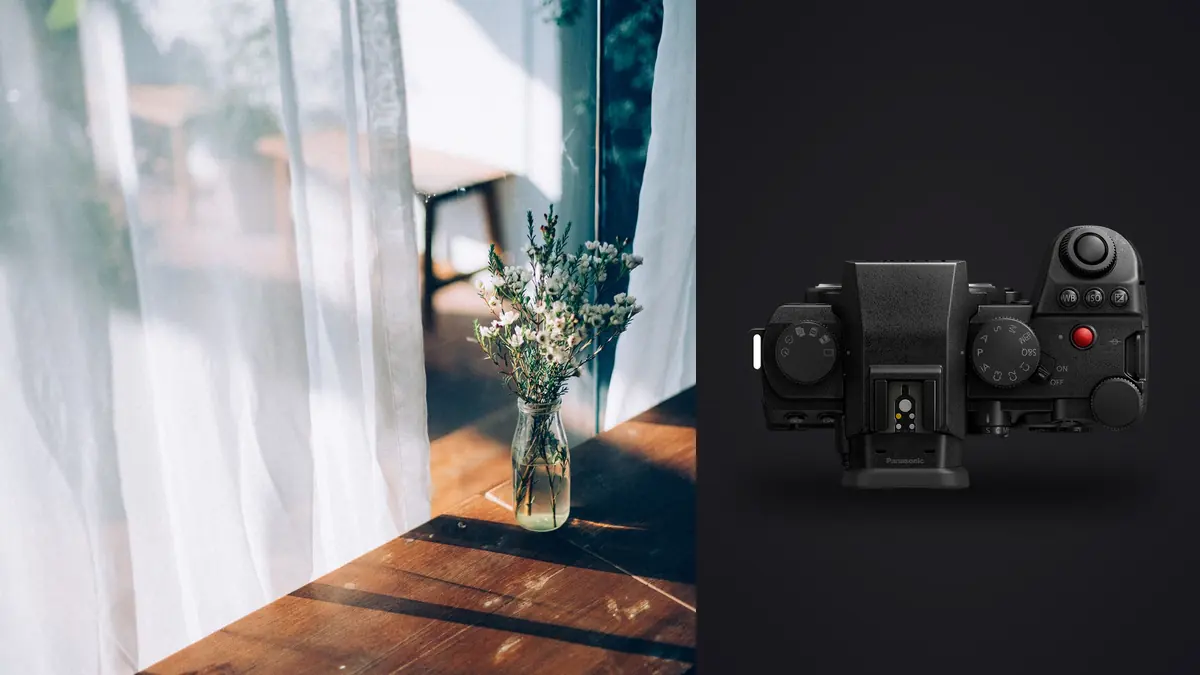
Boudoir is a strange genre to buy gear for. You're not chasing eight frames a second of a moving subject, you're not fighting bad light at a stadium, and you don't need 45 megapixels for a billboard. What you actually need is a camera that stays quiet, handles well in a room the size of a hotel bathroom, renders skin honestly under mixed light, and doesn't make the person in front of it more self-conscious than they already are. The Panasonic Lumix S5IIx gets brought up a lot in boudoir forums and Facebook groups, usually next to the Sony a7 IV and the Canon R6 Mark II, and it deserves the conversation. It also gets recommended for reasons that don't actually apply to this kind of shooting, so it's worth separating what matters here from what matters in, say, wedding or sports work.
After a couple of years on an S5 original, the jump to a rented S5IIx body for boudoir is bigger than the spec sheet suggests once you're actually working in a dim bedroom with one continuous light source and a subject who has never been photographed like this before.
Why the sensor and the dual native ISO actually matter here
Most boudoir sessions happen in one of three lighting situations: window light with sheer curtains pulled across (the most common, and the most flattering when it works), a single softbox or continuous LED panel because the client's space has no natural light worth using, or a deliberately underexposed low-key setup built around one hard source and a lot of negative fill. None of these are bright. You're routinely working at ISO 1600 to 6400, sometimes higher once the sun drops or the client wants a moodier set of images toward the end of the session.
This is where the "x" in S5IIx earns its keep over the standard S5II. Both cameras share the 24.2 megapixel full-frame sensor and the same autofocus system, but the S5IIx runs dual native ISO, with a second base sensitivity point around ISO 2500 instead of a single native ISO of 100. In practice that means grain at ISO 3200 to 6400 looks cleaner and more evenly distributed than it does on a camera without that second gain stage, which matters a lot when half your frames are shot in a curtained room with one 60W-equivalent LED bounced off a wall. On the standard S5II, or on most APS-C bodies people start out with, that same ISO range gets noisy and blotchy in the shadow areas that boudoir photography leans on constantly, since so much of the genre is built around soft falloff into darkness.
The in-body stabilization is the other piece that's easy to undervalue until you're using it. Panasonic rates the 5-axis IBIS at up to 8 stops with certain L-mount lenses, which sounds like marketing until you're handholding a 50mm at 1/15s because the client is holding a pose and you don't want the shutter clatter of firing off ten quick frames to break the moment. I wouldn't build a whole workflow around slow shutter speeds, but the stabilization buys you real flexibility to keep ISO down when the light gets thin, which for skin tones is worth more than most people give it credit for.
Handling that doesn't get in the way of the session
The shutter sound problem
Nobody talks about this enough. A mechanical shutter clacking away next to someone in an intimate, vulnerable pose is disruptive in a way it just isn't for a landscape or a product shot. The S5IIx has a fully silent electronic shutter mode, and I use it for probably 70 percent of a typical session, especially anything shot wider than f/2.8 where rolling shutter distortion isn't a concern because nothing in the frame is moving fast. The tradeoff is banding under certain flicker-prone LED panels, so if a client's space has cheap continuous lighting, test for banding before you commit to silent shooting for the whole set. I keep the mechanical shutter as a fallback specifically for that scenario.
Size, weight, and the awkwardness of small rooms
Boudoir sessions happen in bedrooms, home offices converted for an hour, and hotel rooms that were not designed with a photographer, a light stand, and a reflector in mind. The S5IIx body is around 740g with battery, which is lighter than an R6 Mark II with an equivalent L-glass lens and noticeably easier to work handheld for the two to three hours a full session can run. You can shoot full sessions crouched on a bed, backed into a closet doorway for extra distance, or even shoot through a doorway from an adjoining room, and the compact grip and relatively flat top plate make it less of an obstacle between you and the client than a battery-gripped full-frame body would be.
The vari-angle screen earns its place
A fully articulating screen gets dismissed by a lot of stills photographers as a video feature, but for boudoir work shot from low angles (a common choice for elongating the body and shooting up toward soft window light) or from tight, awkward positions where you can't get your eye to the viewfinder, being able to flip the screen out and shoot from the hip or from floor level without contorting yourself is genuinely useful. It also lets the client see the screen when you want to show them a frame mid-session, which does more for their comfort than almost anything else you can do with the camera.
Lenses that make sense for this work
The L-mount lineup from Panasonic, Sigma, and Leica has grown enough that you're no longer stuck choosing between two options. For boudoir specifically, focal length choice matters more than usual because you're often working in a room too small to back up in, and because compression at longer focal lengths flatters the body in a way that's worth planning for rather than discovering by accident.
| Lens | Focal length | Max aperture | Best for | Price tier |
|---|---|---|---|---|
| Lumix S 50mm F1.8 | 50mm | f/1.8 | General session work in average-size bedrooms; closest to a "normal" perspective | Budget |
| Sigma 65mm F2 DG DN | 65mm | f/2 | Flattering compression for full-length and three-quarter poses; needs more room to back up | Mid |
| Lumix S 85mm F1.8 | 85mm | f/1.8 | Close, detail-focused portraits; tight rooms make this hard to use for anything but headshots | Mid |
| Sigma 35mm F1.4 DG DN | 35mm | f/1.4 | Environmental frames that include the room; riskiest for flattering the body, best used sparingly | Mid |
| Lumix S 24-70mm F2.8 | 24-70mm | f/2.8 | One-lens sessions where you don't want to swap glass mid-shoot; loses a stop versus the primes | Premium |
My honest recommendation, if you're building a two-lens kit for this specifically, is the 50mm F1.8 and the 65mm F2. That covers nearly everything a boudoir session needs without forcing you to back into a wall to get a full-length frame, and both are small and light enough that swapping between them mid-session doesn't kill momentum. The 85mm is lovely glass but in a genuinely small room (and a lot of client bedrooms are genuinely small) you'll find yourself unable to back up far enough to use it for anything beyond a face or shoulders frame.
Autofocus for a genre that moves slowly, until it doesn't
Boudoir subjects hold poses, which sounds like it should make autofocus easy, but the reality is trickier. Fabric, hair, hands, and shifting weight between poses mean the eye you locked onto a second ago is now half-obscured by a strand of hair or a raised arm. The S5IIx uses the same phase-hybrid autofocus system introduced on the S5II, which was a real step up from the original S5's contrast-only DFD system that hunted visibly in low light. Eye and face detection tracks reliably through the kind of soft, low-contrast light boudoir sessions are usually shot in, though I still switch to a single focus point and back-button focus for close, detail-oriented frames where I want control over exactly which eye, or which part of the face, gets the plane of focus. Full-face auto-detect is great for a fast-moving session but occasionally picks the wrong point when a client's head is tilted or partially turned away, so don't treat it as fully hands-off for the tightest crops.
Camera settings by lighting scenario
| Scenario | Aperture | ISO range | Shutter | Notes |
|---|---|---|---|---|
| Window light, sheers pulled | f/1.8-f/2.8 | 800-3200 | 1/125-1/250 | Watch the ISO 2500 native point; a slight push here often looks cleaner than pulling back to base |
| Single continuous LED/softbox | f/2-f/4 | 1600-4000 | 1/100-1/160 | Test for flicker banding in silent shutter mode before committing to a whole set |
| Low-key, single hard source | f/2.8-f/5.6 | 800-3200 | 1/125 | Underexpose the background deliberately; the dual native ISO keeps shadow noise controlled |
| Backlit silhouette (window behind subject) | f/2.8-f/4 | 400-1600 | 1/160-1/250 | Spot meter on the rim of the body, not the background, or you'll lose the shape entirely |
The part nobody plans for: what happens after the shoot
A typical boudoir session produces 400 to 800 frames across four or five outfit and lighting changes, and a huge share of those frames are near duplicates: the same pose held for three or four shutter presses so you can pick the one where the expression lands. Sorting through that volume by eye, at full resolution, twice for every set you shoot, is genuinely the slowest part of the job, slower than the shoot itself most weeks. This is the part of the workflow I actually changed after switching to the S5IIx, not the camera settings.
I run everything through imagic before I open a single frame in an editor. It scores sharpness and eye closure locally, groups the near-identical burst frames from held poses together instead of making me scroll past all of them individually, and flags the sharpest, best-expression frame in each group so the first pass through a set takes a fraction of the time it used to. Because it runs entirely on the machine with nothing uploaded anywhere, that also matters more here than it would for a landscape or product shoot. Boudoir images are about as sensitive as photography gets, and not sending a client's session through a cloud service for culling is a real, practical reason to prefer a local tool over the AI-tagging features built into a lot of cloud-based catalog software now.
Once a set is culled, the S5IIx's fairly consistent color rendering across a session (helped by the fact that white balance and exposure tend to stay stable once you've dialed in a lighting setup) makes batch color work faster too. I built a look in imagic from a set of edits I was happy with and now apply that same starting grade with apply_my_style across a whole session in one pass, then adjust individual frames from there rather than grading four hundred images one at a time. It's a small thing, but on a genre where consistency across a client's final gallery matters as much as any single image, it saves real hours. For a broader look at how automated culling actually works under the hood, our guide to how AI photo culling works covers the scoring and grouping logic in more detail than makes sense to repeat here.
A few things I'd flag before buying one specifically for this
The S5IIx has an active cooling fan built in, mostly there for the long unlimited video recording it's designed to support. It's near-silent in normal use, but in a completely quiet bedroom with no music or ambient noise, a sensitive client might notice a faint whir during longer sessions. It's not a dealbreaker, most clients don't register it at all once they're talking and posing, but if you shoot in very controlled, quiet spaces it's worth knowing about before you're mid-session and hear it for the first time.
It's also worth being honest that the S5IIx is built and priced as a hybrid stills-and-video body, with features like ProRes recording and USB-SSD capture that a stills-only boudoir photographer will likely never touch. If you're not planning to shoot any video content (boudoir reels and short-form video have become a real part of a lot of studios' offerings), the standard S5II costs less and gives up almost nothing for stills work except that second native ISO point. I'd only pay the premium for the IIx if video is genuinely part of your business, or if that dual native ISO advantage in low light is worth it to you on its own, which for a lot of boudoir work, it honestly is.
Frequently Asked Questions
Is the Panasonic Lumix S5IIx good enough for boudoir photography without extra lighting gear?
You'll still want at least one continuous light source or a single softbox for consistent results, since relying purely on window light limits you to certain times of day and certain rooms. The camera's low-light performance means you can get away with a smaller, cheaper light than you might need on an APS-C body, but it's not a replacement for having some control over the light in the room.
Does the silent electronic shutter cause any quality tradeoffs for boudoir work?
For static or slowly posed subjects, which describes most boudoir photography, rolling shutter distortion from the electronic shutter is a non-issue. The one thing to watch is banding under flickering LED lights, so test your specific light source in silent mode before relying on it for a full paid session.
How does the S5IIx compare to the Sony a7 IV for this kind of work?
Both are capable full-frame bodies with similar resolution and reliable eye detection. The a7 IV has a larger native lens ecosystem, but the S5IIx's dual native ISO gives it an edge specifically in the dim, mixed-light conditions boudoir sessions are usually shot in, and its IBIS rating is a stop or two ahead on paper. Body handling comes down to personal preference more than either camera having a clear advantage.
What's the fastest way to cull a large boudoir session without spending hours in Lightroom?
Grouping near-duplicate burst frames automatically, rather than scrolling through every held pose one image at a time, is the single biggest time saver. Tools built specifically for that, including imagic's local culling pass, cut the first review of a session down considerably compared to sorting everything by eye, and it does that without uploading any of the images anywhere in the process.