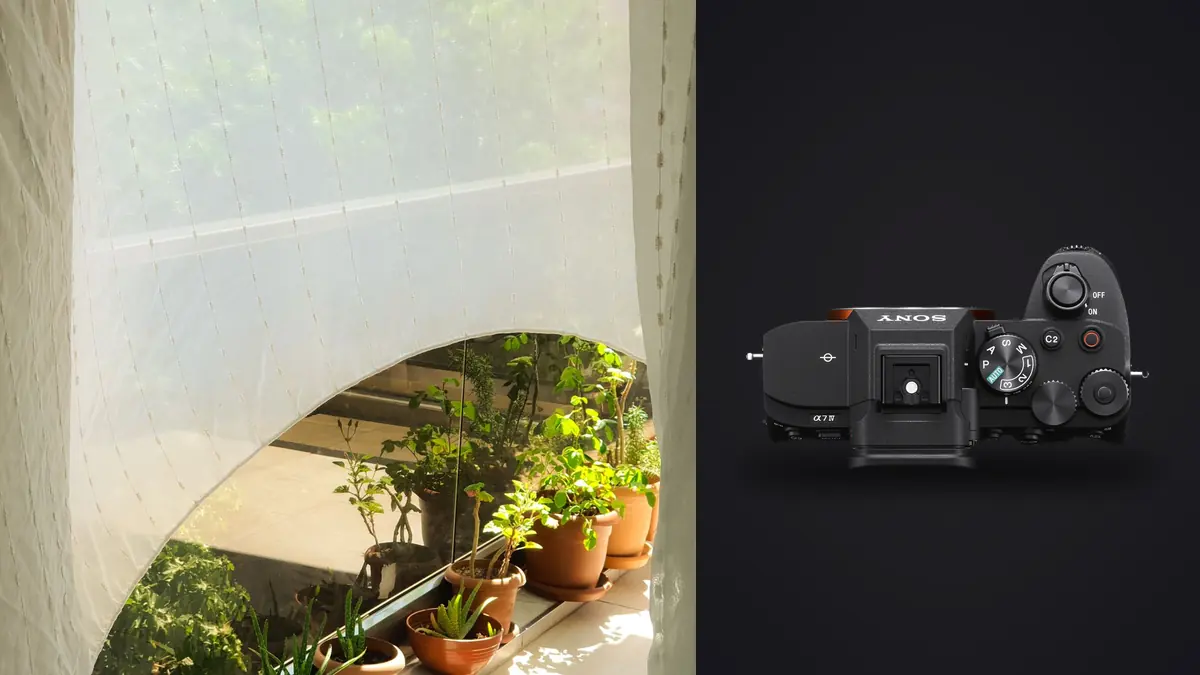
A boudoir client walks into the room already a little nervous, and the last thing that session needs is gear noise, hunting autofocus, or a laptop the next morning full of eight hundred nearly identical frames staring back at you. I picked up the Sony A7 IV about a year and a half ago, and ended up leaning on it hardest for boudoir and intimate portrait sessions, which wasn't the plan when I bought it. The reasons turned out to be pretty specific to what this genre actually demands: quiet operation, forgiving low light behavior, eye tracking that holds on to a face half covered by hair or a hand, and enough dynamic range to hold detail in pale skin and a dark backdrop in the same frame. This is what stands out from running the A7 IV through boudoir and intimate portrait sessions, plus what I'd tell a photographer trying to decide if it's worth the money for this specific kind of work.
Low light is the whole ballgame in a bedroom or hotel suite
Most boudoir sessions happen in rooms that were never built for photography. Window light, maybe one continuous LED panel bounced off a ceiling or a wall, sometimes nothing but a lamp with a warm gel taped over it. Big strobes are mostly off the table because a flash pop breaks the mood right when you're trying to keep someone relaxed enough to stop sucking in their stomach and actually breathe. That means ISO is doing real work for most of the session, not just filling in shadows.
In practice I stay under ISO 3200 on this body before I start seeing luminance noise creep into midtone skin in a way that shows up at 100% crop. I'll push to 6400 for a darker, moodier set and just accept I'm going to lose a little texture, adding grain back deliberately in the edit rather than fighting noise reduction that smears skin into plastic. That's a meaningfully higher comfortable ceiling than the A7 III I was shooting before, where 3200 already felt like the edge for anything with visible skin texture. The 33-megapixel sensor isn't a low light specialist compared to something like the A7S III, but for boudoir work where you're rarely printing billboard-sized, the tradeoff toward resolution is the right one.
Eye AF holding on through hair, hands, and fabric
Boudoir compositions lean heavily on hands near the face, hair falling across an eye, a sheet pulled up over a shoulder. Real-time Eye AF on the A7 IV handles this better than I expected. It'll pick the eye back up through a curtain of hair moving in a slow turn, and it generally chooses the near eye correctly even when a hand is partially blocking the other side of the face. It's not flawless. Strong backlight from a window will occasionally make it grab an eyelash or a stray hair instead of the pupil, so I still check focus peaking on frames I know are important rather than trusting the green box blindly. But compared to the A7 III's older AF system, which lost the eye entirely the moment hair swept across it, this is a real, usable improvement for a genre where hands and hair are doing half the composition.
The silent shutter question, honestly answered
The fully electronic shutter on the A7 IV is genuinely silent, no mechanical clack at all, and that matters more here than on almost any other job I shoot. Home studios and hotel rooms tend to have thin walls, and a loud shutter every few seconds makes a client hyperaware of being photographed in exactly the way you're trying to avoid. Worth knowing: turning off the shutter sound doesn't turn off the AF confirmation beep or the menu chirps, so go into the sound settings and kill those separately, or you've solved half the problem and left the annoying half running.
The catch is rolling shutter. For slow, deliberate movement, which is most boudoir posing, the electronic shutter is fine. For anything genuinely fast (a hair flip, fabric twirled quickly, a quick shift of weight) you'll get skew, a diagonal smear on a moving jawline or edge of fabric that reads as a bad warp once you're editing at full size. On sequences where I know there's real motion I flip back to the mechanical shutter, or at least first-curtain electronic, and eat the very faint sound rather than deal with distortion I can't fix later.
In-body stabilization changes how you light the room
The 5.5-stop IBIS is the feature I undersold before I actually used it for this. It lets me handhold at 1/15 or even 1/8 of a second with a 55mm lens in a window-lit room without flash, which means I'm not dragging a strobe stand into a bedroom that's already tight on floor space, and the light in the room stays exactly as moody and consistent as it looked when the subject walked in. That consistency matters for the client's comfort as much as for the final image. Nobody relaxes faster when a flash keeps popping in their face.
Lens choices that work in a bedroom, not a rented studio
Most boudoir happens in rooms under twelve feet across, and lens choice has to respect that or you spend the whole session backed against a wall. Here's how the lenses I actually rotate through for this work compare in that context.
| Lens | Focal Length | Best For | Working Distance in a Small Room | Watch For |
|---|---|---|---|---|
| Sony FE 55mm f/1.8 ZA | 55mm | Three-quarter and full-length poses, the session workhorse | 6-8 ft, fits most bedrooms | No optical stabilization of its own; relies on IBIS, occasional slow hunt in low contrast light |
| Sony FE 85mm f/1.8 | 85mm | Close portraits, flattering compression on the face | 10-12 ft, cramped in a small room | Often means shooting from a hallway or through a doorway |
| Sigma 35mm f/1.4 DG DN Art | 35mm | Environmental frames that include the bed, window, whole room | 3-5 ft | Limbs near the frame edge stretch; keep hands and feet away from borders |
| Tamron 28-75mm f/2.8 G2 | 28-75mm | One-lens sessions, fast client turnaround | Flexible | Skin rendering wide open isn't as soft or flattering as the primes |
| Sony FE 90mm f/2.8 Macro G | 90mm | Detail shots: lace texture, rings, tattoos, skin | 12-18 inches for true macro | Slow to lock focus in dim light without a small added light source |
The 55mm ends up mounted for probably 60% of a typical session because it's the only prime that lets you work a small room without backing into furniture. The 85mm is worth carrying but plan the session around it rather than expecting it to work everywhere, and the 90mm macro comes out for maybe five or six frames near the end, once the client is comfortable enough that close detail shots don't feel invasive.
Color across a session that moves between three light sources
A single boudoir session might move a client from daylight near the window to a lamp-lit corner to a spot lit only by a phone flashlight for a "moody" set, and the white balance shift between those is not subtle. The A7 IV's auto white balance is decent but I don't trust it for skin tones across a mixed-light session; I'll set a custom white balance per lighting setup rather than let the camera guess and fix it in post. The 14-bit raw files hold detail in both directions well, retaining texture in sheer white fabric near a bright window while still pulling shadow detail out of a dark backdrop in the same frame, which matters because boudoir compositions frequently have both extremes sitting together.
Once I've dialed in a warm, low-contrast grade that matches how I want a session to feel, I don't want to rebuild that look from scratch for every new session. This is where imagic's apply_my_style feature actually saves real time: it's trained on your own previously edited images rather than a generic preset pack, so it carries your specific grading choices, skin tone warmth, shadow lift, the whole look, into a fresh set of raw files instead of starting over. If you want a deeper look at building a consistent grade in the first place, our complete guide to photo color grading covers the fundamentals I'd apply before leaning on any automated preset.
What actually eats your time after the shoot
A two-hour boudoir session at 10fps burst rate, shot the way most photographers actually shoot it (short bursts through slow movement, breathing, small expression changes), regularly produces 500 to 900 frames. The brutal part is that most of them are technically fine. The eyes are sharp, the exposure is close, and the only difference between frame 12 and frame 13 of a burst is a slightly better hand position or a fraction more openness in the eyes. Sorting that by hand, at full resolution, is the part of this job that quietly eats an entire evening.
This is the actual reason I run imagic on every session now rather than culling manually in a raw browser. Its local sharpness and focus scoring flags which frame in a burst has the sharpest eye focus without me pixel-peeping through twelve near-duplicates one at a time, and the duplicate and burst clustering groups those "same pose, twelve times" sequences together so I'm choosing one best frame per cluster instead of scrolling past all twelve individually. It runs on the laptop itself, no queue, no waiting on a cloud job to finish. If you want the mechanics of how sharpness scoring actually distinguishes a genuinely sharp eye from a merely close one, we've written that up in how AI photo culling works.
Buffer and card choice for movement sequences
For slow fabric movement, hair flips, or a breathing sequence shot in short bursts, buffer depth matters less than people assume, because nobody sustains a ten-second continuous burst during a posing sequence anyway. Where it does matter is the card slot. With a fast CFexpress Type A card in slot one the buffer essentially doesn't become a problem during normal shooting. Drop down to a UHS-II SD card shooting compressed raw and you'll hit a wall after four or five seconds of sustained 10fps, which is rarely an issue in practice but worth knowing before you're mid-session and the camera stalls. Keep the second slot mirroring raw to a backup card for every boudoir session, since these aren't shoots you can casually reschedule if a card fails. Hair, makeup, and a client's willingness to feel comfortable in front of a camera don't line back up easily on a second date.
Why where your files go matters more here than on most jobs
Boudoir images sit near the top of the list for content a client trusts you to actually protect. Model releases and locked storage cover part of that, but the software doing your culling and editing matters too. I moved my culling workflow to imagic specifically because it processes everything locally on the machine, sharpness scoring, burst clustering, the style transfer, all of it, with no upload step to a third-party server in the process. For a wedding gallery that's a nice-to-have. For a boudoir client, being able to say the images never left your laptop during editing is often the actual deciding factor in whether they trust you with the session at all.
Frequently Asked Questions
Is the Sony A7 IV too heavy to hold and reposition constantly through a two-hour session?
Paired with the 55mm f/1.8, the combo comes in under 1.1kg, which is manageable for a couple of hours of constant repositioning. It gets noticeably more tiring with the 85mm attached for an extended period, mostly because you're also backing up and crouching more to compose in a tight room. I keep a strap on even during handheld sequences, less for weight and more so I'm not gripping the body constantly between poses.
Does the electronic shutter actually stay silent, or is that overstated?
The shutter mechanism itself is genuinely silent, that part isn't marketing. What catches people out is that the AF confirmation beep and menu sounds are separate settings that don't turn off automatically with the shutter sound. Go into the audio signals menu and disable those individually before a session, or you'll still get an audible chirp every time focus locks.
What ISO ceiling should I actually plan around for skin tones?
I treat ISO 3200 as the comfortable working ceiling before noise starts showing in midtone skin at full resolution, and ISO 6400 as usable if I'm planning to add deliberate grain in the edit rather than fight it with heavy noise reduction. Past that, skin texture starts to smear in a way that reads as obviously digital rather than film-like, even after grading.
How many keepers should I expect out of a session, and how long should culling realistically take?
Out of 500 to 900 frames from a typical two-hour session, a delivered gallery usually lands between 35 and 60 final images once duplicates, blinks, and near-misses on focus are removed. Culling that manually in a raw browser can eat two to three hours. With sharpness scoring and burst clustering doing the first pass, I'm usually down to a shortlist in under thirty minutes, leaving the rest of the time for the part that actually needs a human eye: picking which frame in a cluster has the better expression.
None of this makes the A7 IV a boudoir-specific camera. Sony never marketed it that way, and it wasn't built with this genre in mind. But the specific combination of a genuinely silent shutter, a sensor that holds up through the low, warm light most of these sessions are shot in, and eye tracking that survives hair and hands covering half the face happens to line up with what this kind of work actually needs, more than most general-purpose bodies I've used before it.