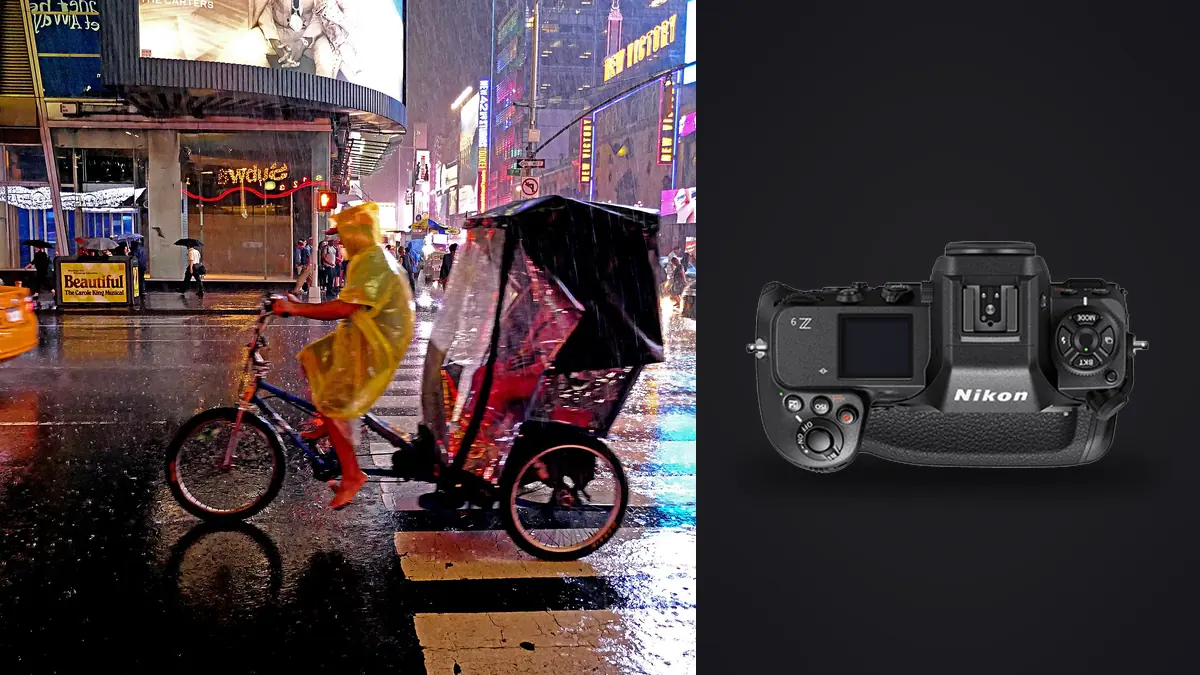
The Nikon Z9 is not what most people picture when they think "street camera." It's a integrated-grip body built for sports and wildlife shooters, the kind of camera you'd expect on a sideline with a 400mm lens bolted to the front, not slung under someone's arm on a market street in Marrakesh. And yet a growing number of documentary photographers have picked it up for exactly that kind of work. Having spent the better part of a year running one through both street sessions and a longer documentary project, I think the case for it is real, but it comes with some genuine trade-offs that the marketing copy skips over.
The shutter is the whole story
Start with the one spec that actually changes how you shoot: the Z9 has no mechanical shutter at all. Not "primarily electronic with a mechanical backup," none. Every exposure is read off the stacked sensor electronically, which means there is no shutter to be heard, no shutter to wear out over a hundred thousand actuations, and no mirror slap to worry about because there was never a mirror. For street work this matters more than any resolution figure. You can shoot a market vendor mid-gesture, a kid mid-jump, an argument on a subway platform, and the only thing that moves is your finger.
The readout speed on that sensor is fast enough that rolling shutter distortion, the classic worry with electronic-only shutters, is rarely visible in normal street shooting. Whip pans and very fast-moving subjects close to the lens can still show a bit of skew, and I've caught faint banding under certain flickering light sources, mostly older fluorescent tube lighting and some cheap LED shopfront signs, when shooting at high shutter speeds. Nikon's anti-flicker shooting mode handles most of it, but it's worth testing in whatever specific venues you shoot in rather than assuming it's a solved problem everywhere.
The blackout-free viewfinder is the other half of this. In a burst of a fast, unpredictable moment (someone turning to look at you, a door opening, a hand reaching for something) you never lose the subject in a black frame between shots the way you do with a mechanical shutter's mirror or blade cycle. You watch the moment happen continuously while the camera is recording it. For catching a specific facial expression at 20 frames per second, that continuity is worth more than the frame rate number itself.
About that size and weight
Here's the part that's hard to argue around: with a battery and two CFexpress cards loaded, the Z9 body alone weighs about 1,340 grams. Pair it with something like the 35mm f/1.8 S and you're carrying close to 1.6 kilograms before you've added a strap or a second lens. Compare that to a Fujifilm X100VI at around 521 grams or a Leica Q3 at 743 grams, cameras built from the ground up to disappear into a jacket pocket or hang unnoticed off a shoulder, and the Z9 is simply a different category of object. That said, I've come around to the view that raw discretion isn't purely a function of size. A large camera raised quickly and confidently, used and lowered without hesitation, often draws less suspicion on a street than a small camera held low and lingering, because the behavior reads as more legitimate. People clock hesitation and secrecy faster than they clock bulk. That's not an argument for ignoring the weight problem, just a note that the psychology of being noticed is more complicated than body dimensions alone.
Where the size actually costs you is stamina and speed of movement. Ten hours of documentary work with the Z9 and a couple of lenses in a bag is a different physical experience than the same day with a Q3. I've started leaning on the 4-axis tilting rear screen for a lot of candid work, shooting from chest height or below with the screen angled up rather than raising the camera to my eye every time. It's not a fully articulating screen, so extreme low angles or vertical shooting from the hip are more limited than on cameras with vari-angle screens, but for the classic waist-level candid shot it works well and keeps the whole interaction lower-profile.
The integrated grip does pay off in one way that's easy to underrate: battery life. The EN-EL18d is rated around 700 shots by CIPA standard, which understates real-world performance badly for stills-heavy work. On a full documentary shooting day I've gone twelve hours without swapping batteries. On a genre where the best moments happen when you least expect them, not fumbling with a battery door at the wrong second is worth something.
Autofocus for moments you can't stage
Street and documentary photography share one hard constraint: you rarely get a second take. The Z9's subject detection, tuned for human eyes, faces, and bodies, is genuinely useful here because it removes the need to pre-focus on a spot and hope someone walks into it. Point the camera at a scene with people in it and the camera finds faces on its own, even fairly small ones in a crowd, and tracks them through movement. It isn't flawless. In dense groups the camera occasionally jumps to the wrong person mid-burst, especially when two faces are similar in size and distance from the lens, and it can hunt slightly in very low, contrasty light like a single streetlamp at night. For planned documentary portraits, where I have a beat to compose, I still switch to a single AF point and back-button focus rather than trusting wide-area auto-detection. For true candid, unscripted street frames, letting the camera hunt for faces on its own catches things I would have missed manually.
How it stacks up against the usual street cameras
None of this happens in a vacuum. Most photographers weighing a Z9 for this kind of work are also looking at smaller, purpose-built alternatives. Here's how they actually compare on the things that matter for candid shooting, not just spec-sheet numbers.
| Camera | Body weight (loaded) | Shutter type | Blackout-free EVF | Approx. raw file size | Body-only price (2026) |
|---|---|---|---|---|---|
| Nikon Z9 | ~1,340 g | Fully electronic (no mechanical shutter) | Yes | ~50-65 MB | ~$5,299 |
| Nikon Z8 | ~910 g | Fully electronic (no mechanical shutter) | Yes | ~50-65 MB | ~$3,799 |
| Sony A9 III | ~703 g | Global electronic shutter | Yes | ~35-45 MB | ~$5,999 |
| Leica Q3 | ~743 g | Leaf + electronic, fixed 28mm f/1.7 | No (standard blackout) | ~65-80 MB | ~$5,995 |
| Fujifilm X100VI | ~521 g | Leaf + electronic, fixed 35mm equiv. | No (standard blackout) | ~35-45 MB | ~$1,699 |
The Z8 is worth calling out directly here: it shares the Z9's sensor, its electronic-only shutter, and most of its autofocus system in a body a third lighter, without the integrated grip. For pure street work, plenty of photographers I know who own both reach for the Z8 more often for exactly that reason. The Z9's case gets stronger specifically when documentary work is part of the job, not just still frames.
The documentary half of the equation
What separates the Z9 from a pure street camera is that it's also a genuinely capable video tool, and a lot of modern documentary work now means coming home with both stills and footage from the same day. The Z9 records internal 8K RAW (Nikon's N-RAW) and ProRes RAW without an external recorder, which matters if you're building short-form video segments to run alongside a photo essay and don't want to carry a separate cinema camera or an Atomos box. Dual CFexpress Type B slots also mean you can mirror recording across both cards, which is not a small thing when you're documenting something that will never happen again and a single corrupted card would mean losing it for good.
One habit change: the Z9 doesn't have a traditional PASM mode dial at all. Mode is set through the i-menu, and configuration is handled through Photo and Custom Setting Banks that you can preload for different situations. I keep one bank tuned for fast candid street work (auto-area AF with people detection, continuous high-speed release, minimal exposure delay) and another for slower documentary portrait setups (single-point AF-C, back-button focus, a narrower auto-ISO ceiling). Switching between the two is a couple of button presses instead of digging through menus mid-scene, which matters when the scene in front of you isn't going to wait.
The file problem nobody warns you about
Here's the part that surprises people who move to the Z9 from a smaller street camera: the volume of files it produces. A 45.7-megapixel sensor at 20 frames per second in raw means a single five-second burst of someone crossing a street can generate over a hundred nearly identical frames. Do that across a full day of documentary shooting and you can easily come home with four or five thousand images, most of them variations on the same handful of moments. Sorting through that manually is where a lot of the time savings from a fast camera get eaten right back up at the editing desk. This is the part of the workflow where I actually lean on imagic. Its local sharpness and focus scoring will flag which frame out of a twenty-shot burst actually has the subject's eyes in focus, which matters a lot with a face-tracking AF system that occasionally locks onto the wrong person for a frame or two, and its duplicate and burst clustering groups those near-identical sequences together so I'm reviewing one representative thumbnail instead of scrubbing through a hundred frames one at a time. Because it runs entirely on the machine rather than uploading anything to a server, it also fits how I'd want to handle documentary subjects generally: people photographed on the street or during sensitive work haven't consented to their faces going through a cloud pipeline, and keeping the whole process local sidesteps that question rather than needing to think about it.
The other piece that's become part of the routine is imagic's apply_my_style feature. Once I've graded the first real pass of selects from a documentary set, usually somewhere around fifteen or twenty images, applying that same trained look to the rest of the day's take gets me to a consistent first-pass edit in a fraction of the time it used to take working image by image. It's not a substitute for finishing individual frames by hand, particularly hero images that will run large, but for getting a full day's documentary output to a presentable state quickly, it's made a real dent in the backlog. If you're new to culling workflows generally, our breakdown of how AI photo culling actually works covers the mechanics in more depth, and there are a few more habits worth adopting in our piece on speeding up the overall photo workflow.
Lens choices that actually fit this kind of work
The body is only half the equation, and a Z9 with the wrong lens undoes a lot of the discretion argument. The 40mm f/2 SE is my most-used lens for pure street work: small, light, and a natural angle of view for walking around without constantly zooming with your feet. For documentary assignments where I need a bit more reach and don't want to swap lenses mid-scene, the 24-120mm f/4 S covers a huge range of situations from a single lens, at the cost of being noticeably front-heavy on a body that's already substantial. The 28mm f/2.8 SE is the closest thing Nikon makes to a true pancake for this system, and it's the pairing I reach for when I actively want the kit to look less like professional gear and more like something a tourist would carry.
Where I've landed on it
The Z9 is not the camera I'd recommend to someone starting out in street photography, or to anyone whose primary goal is staying invisible. For that, a Fujifilm X100VI or a used Nikon Z8 will serve you better and cost you less in both money and neck strain. But for documentary work specifically, where stills and video need to come from the same body, where a corrupted card can mean losing an irreplaceable moment, and where the silent, blackout-free shooting experience actually changes what you're able to capture in an unguarded moment, the Z9 earns its size. I wouldn't carry it every day. I would absolutely carry it on an assignment.
Frequently Asked Questions
Is the Nikon Z9 too big for discreet street photography?
It's bigger and heavier than purpose-built street cameras like the Fujifilm X100VI or Leica Q3, and you'll feel that over a long day. But discretion on the street depends more on how confidently you handle the camera than on its physical size, and the fully electronic shutter means it's completely silent regardless of how large the body is. If minimizing weight and visual footprint is your top priority, a smaller body will still serve you better.
Does the Z9's electronic-only shutter cause banding or rolling shutter distortion?
Rarely in typical street shooting speeds. The stacked sensor reads fast enough that rolling shutter skew mostly shows up only with very fast pans or subjects moving quickly close to the lens. Banding is more of a concern, and it can appear under flickering artificial light sources like older fluorescent tubes or certain LED signage at high shutter speeds. Nikon's built-in anti-flicker mode resolves most of it, but it's worth testing in the specific locations you shoot.
What lens pairs best with the Z9 for combined street and documentary work?
For pure street shooting, a compact prime like the 40mm f/2 SE or 28mm f/2.8 SE keeps the kit as light and unobtrusive as this body allows. For documentary assignments where flexibility matters more than discretion, the 24-120mm f/4 S covers a wide range of situations without a lens change, though it adds noticeable weight up front.
How do you manage the huge number of files a Z9 produces on a shooting day?
Realistically, you need a culling step before you touch full edits. At 20 frames per second and 45.7-megapixel raw files, a single day of documentary shooting can produce thousands of near-duplicate frames. Running those through imagic's local sharpness scoring and burst clustering, entirely offline as a one-time purchase rather than a subscription, cuts that pile down to genuine selects before any real editing time gets spent, and its apply_my_style feature can carry a consistent grade across the rest of the day's selects once the first pass is done.