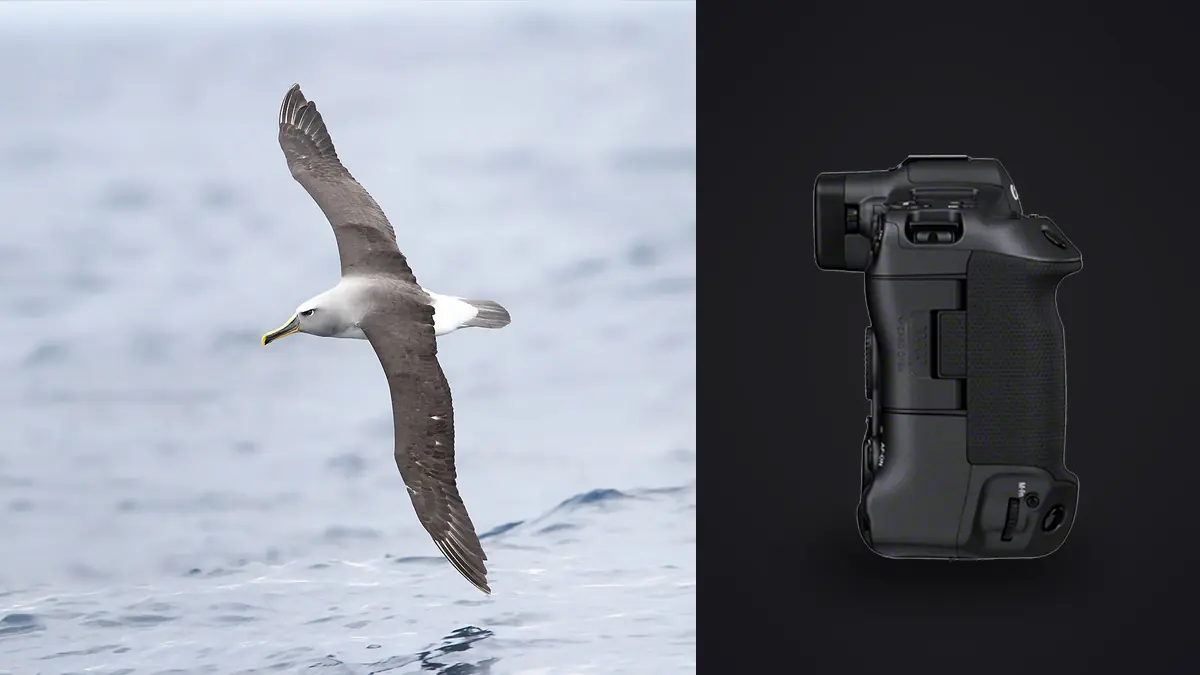
Three summers ago I spent most of April sitting in a floating hide on a reservoir in Norfolk, waiting for ospreys to stoop for fish. That trip is what finally pushed me off my old 1D X Mark III and onto the Canon EOS R3. I did not buy it for the megapixels, because 24.1MP is a step down from what a lot of wildlife shooters expect out of a flagship body these days. I bought it because everything I had read about the sensor readout and the tracking suggested it would actually hold focus on a wingtip through an entire dive, not just the first half of one. After two full breeding seasons shooting terns, ospreys, and one memorable week photographing peregrines off a cliff in Pembrokeshire, here is what actually held up in the field and what did not.
The Sensor Readout Is the Real Story
Most of the marketing around the R3 leans on the 30fps top speed, but the number that actually matters for flight photography is the readout speed underneath it. The R3 uses a stacked, back-illuminated 24.1MP sensor, and stacked sensors read out far faster than a conventional BSI chip because the pixel array and the processing circuitry sit on separate layers instead of competing for the same silicon. In practice that means less rolling shutter skew when you're panning hard on a fast-moving subject.
I noticed this most clearly with peregrines. During a stoop, a falcon's wings are moving fast enough that a slow sensor readout will visibly bend or smear them, especially toward the frame edges where the pan speed relative to the sensor is highest. I had shot the same cliff the year before with an R5, which is not a stacked sensor, and on a handful of frames the wingtips had a soft diagonal skew that looked like a focus problem until I looked closer and realized it was a readout artifact. The R3 at the same shutter speed and the same pan speed did not show it. That single difference, more than the frame rate, is why I'd point a serious BIF shooter toward a stacked-sensor body before anything else.
Eye Control AF, My Honest Experience
Eye Control AF gets talked about like a gimmick until you actually calibrate it properly, and even then it is polarizing among the birders I shoot with. The idea is that the camera tracks where your eye is looking inside the viewfinder and moves the active AF point there, which sounds perfect for erratic subjects like swallows working a hedge line, where you don't have time to thumb the joystick to a new zone.
When it works, it is genuinely useful. I ran the calibration profile three separate times on three separate days (Canon recommends redoing it if lighting or your seating position changes) and once dialed in, it correctly followed my eye onto a tern about seven times out of ten during a fast chase sequence over open water. The other three times it drifted onto a wave crest or a gull in the background, which meant losing the shot entirely.
The catch is glasses. I wear prescription lenses, and Eye Control AF works fine with clear glasses but gets noticeably less reliable with polarized sunglasses, which is exactly what you want on the water to cut glare off the surface when you're photographing herons or kingfishers. I ended up shooting without polarizers on fast-action days just to keep Eye Control working, which is a real trade-off, not a footnote. If you don't wear polarized lenses in the field, this is a bigger win than the reviews give it credit for. If you do, budget time to decide whether it's worth giving up.
Frame Rate vs Buffer, Where the Numbers Actually Land
12fps mechanical and 30fps electronic both sound great on paper, but the buffer is what decides whether those numbers mean anything during a real sequence. Shooting RAW (not C-RAW) on a CFexpress Type B card, I can hold 30fps for a genuinely long burst, long enough to cover an osprey's full descent, splash, and climb-out without the camera stuttering. Switch to a UHS-II SD card in the second slot and that ceiling drops hard, enough that I stopped using the SD slot for anything except a JPEG backup.
Here's how the R3 compares to the other bodies I've either owned or borrowed for the same kind of work, based on what I've actually clocked in the field rather than lab numbers:
| Camera | Sensor readout | Top mechanical fps | Top electronic fps | Wingtip skew at full e-shutter | Approx. RAW burst before slowdown (CFexpress) |
|---|---|---|---|---|---|
| Canon EOS R3 | Stacked BSI, 24.1MP | 12fps | 30fps | Minimal, hard to spot even on fast wingbeats | ~150 frames |
| Canon EOS R5 | Non-stacked, 45MP | 12fps | 20fps | Visible on fast subjects like falcons and swifts | ~180 frames (but files are nearly double the size) |
| Canon EOS R6 Mark II | Non-stacked, 24.2MP | 12fps | 40fps | Noticeable skew, worse than the R5 despite the higher fps number | ~75 frames |
| Sony a9 III | Global shutter, 24.6MP | No mechanical shutter | 120fps | None, global shutter reads every pixel simultaneously | Very deep, effectively not a limiting factor |
The R6 Mark II's headline 40fps looks like it should beat the R3, but a non-stacked sensor pushed that hard actually produces more visible skew than the R3's 30fps, not less. Frame rate without a fast readout is a trap for BIF work. The a9 III solves the readout problem entirely with a global shutter, and if I were building a kit from scratch today with no existing Canon glass, that's a genuine argument for switching systems. But I already had five RF lenses, and the R3 closed enough of the gap that I didn't feel the need.
Glass That Balances on This Body
The R3's integrated vertical grip changes how it balances compared to a body where you bolt on a battery grip separately, and it matters more than people expect once you're holding a long lens up for twenty minutes at a stretch. My two most-used lenses on this body are the RF 100-500mm F4.5-7.1 and the RF 200-800mm F6.3-9.
The 100-500mm is the one I reach for on foot, following waders along a shoreline or working a mixed flock where birds are moving unpredictably close and far. It's light enough to hand-hold all day and fast enough at the wide end that autofocus rarely hunts. The trade-off is reach. For anything genuinely distant, like a raptor circling a thermal a few hundred meters up, 500mm at F7.1 starts to feel short, and you're cropping a 24MP file down to something you'd hesitate to print large.
The 200-800mm solves the reach problem but costs you two stops of aperture at the long end, and I noticed real autofocus hesitation in low light or under heavy cloud cover, the kind of overcast that's actually common during the best bird activity at dawn. Stack a 1.4x teleconverter on either lens and you're at f8 to f11 depending on zoom position, which the R3 handles fine for continuous AF (its AF system works down to f22 in theory), but you're trading AF speed and viewfinder brightness for reach every time. I keep the 1.4x on for perched, stationary subjects and take it off before I expect a flight sequence, because the difference in tracking confidence is real.
The integrated grip does make the body noticeably front-light-biased when paired with something like the RF 600mm F4, so if you shoot prime glass regularly, expect to lean on a gimbal head rather than hand-holding for long stretches. It's not a complaint about the R3 specifically, just a reality of pairing any big prime with a body this size.
Where It Falls Short
I want to be straight about the parts that didn't win me over. 24.1MP is genuinely limiting if your style depends on heavy cropping, which a lot of bird photography does when you can't physically get closer to the subject. I've had shots where I loved the composition and the sharpness but ended up with a file too small to print past 11x14 after cropping to fill the frame with a distant bird. If cropping room is your top priority over frame rate and readout speed, the R5 or even the R5 Mark II's larger sensor is a legitimate counter-argument, rolling shutter concerns aside.
Weight is the other one. At just over a kilogram body-only, plus a 200-800mm lens, this is not a kit you forget you're carrying after a six-hour day in a hide. And at launch pricing the R3 sat well above the R6 Mark II for a frame rate advantage that, as the table above shows, doesn't always translate to a real-world image quality win once you factor in readout speed. If you're not shooting fast, erratic subjects like swifts, terns, or raptors regularly, I don't think the price difference is justified by the spec sheet alone.
What 30fps Does to Your Editing Time
Nobody warns you clearly enough about the downstream cost of a 30fps buffer. A single good flight sequence, say four seconds of an osprey's dive, produces around 120 RAW files. A decent morning at a tern colony with several of those sequences back to back can leave you with four to six thousand frames by lunch, and the overwhelming majority of them are near-duplicates of each other separated by a thirtieth of a second.
This is the part of the R3 experience that actually changed my workflow, not the camera itself. I switched from culling manually in Lightroom to running everything through imagic first, because scrolling through six thousand nearly identical frames by eye is how you either burn an entire evening or miss the one frame where the wing position and the catchlight both land right. imagic scores sharpness and focus locally on the machine and groups burst sequences and near-duplicates together, so instead of comparing every frame to every other frame I'm looking at maybe fifteen clustered groups from that morning's shoot and picking the sharpest frame out of each one. It runs entirely offline too, which matters more than it sounds like it should when you're editing from a hide with no signal, or on a laptop in a rental car between locations with no wifi to lean on.
Once I've got my picks, I lean on imagic's apply_my_style preset, which I trained on a batch of about two hundred bird images I graded by hand over a previous winter. It applies my usual white balance and contrast starting point automatically to new keepers before I do the finer per-image work in Lightroom, which saves the repetitive part of grading without pretending to replace judgment on the images that actually need it. If you want the fuller picture of how automated culling tools score sharpness and group bursts, I'd point you to how AI photo culling works, since the mechanics apply to any high-burst body, not just this one.
Settings I Actually Use in the Field
A few specifics that took me longer to land on than I'd like to admit. I run AF Case 2 for erratic subjects (fast acceleration, sudden direction changes), which suits terns and swallows better than the default Case 1. For anything with a predictable flight line, like an osprey's return path to a favorite perch, Case 3 with tracking sensitivity biased toward "locked on" keeps the AF from jumping to a passing gull in the background.
Shutter speed is subject-dependent in a way that's easy to get lazy about. 1/2000s is enough to freeze a heron's slow wingbeat, but I need 1/3200s or faster for terns and swifts, whose wings move fast enough to blur even at 1/2500s in good light. I cap Auto ISO around 12800 on this body, since the stacked sensor holds up better at high ISO than I expected going in, noticeably cleaner than my old 1D X Mark III at the same settings. And I shoot back-button AF exclusively now, which isn't R3-specific advice, but it matters more here because it lets me toggle Eye Control on and off with a separate control without accidentally re-triggering focus mid-toggle. For more general habits around trimming time out of a heavy shooting day, these workflow tips cover ground beyond just camera settings.
Frequently Asked Questions
Is 24.1MP enough resolution for cropping into distant birds?
It's enough if you're disciplined about getting physically closer or using longer glass, but it is genuinely tighter than a 45MP body if your style leans on heavy cropping. I'd call it adequate for web use and moderate prints, and limiting if you regularly print large from distant subjects. This is the single biggest trade-off buyers underestimate before switching to the R3.
Does Eye Control AF work reliably with sunglasses?
In my experience, clear prescription glasses work fine after calibration, but polarized sunglasses noticeably reduce reliability, sometimes causing the AF point to drift off the subject entirely. If you rely on polarizers to cut water glare, plan to test this yourself before trusting Eye Control on an important shoot.
How many RAW frames can the buffer actually hold during a long flight sequence?
With a fast CFexpress Type B card and full RAW (not C-RAW), I've consistently gotten around 150 frames before the camera starts to slow down, which covers most real flight sequences comfortably. Using the SD card slot instead drops that number substantially, so treat SD as backup storage rather than your primary card for burst work.
Is the R3 worth choosing over the R5 or R6 Mark II specifically for birds in flight?
If rolling shutter skew on fast wingbeats bothers you and you shoot erratic, fast subjects like raptors or swifts regularly, yes, the stacked sensor's readout speed is a real, visible advantage over both. If your subjects are slower-moving or you value cropping room and resolution more than burst speed, the R5 is a legitimate alternative, and the R6 Mark II is a reasonable budget option despite its higher fps number underperforming on actual image quality during fast action.