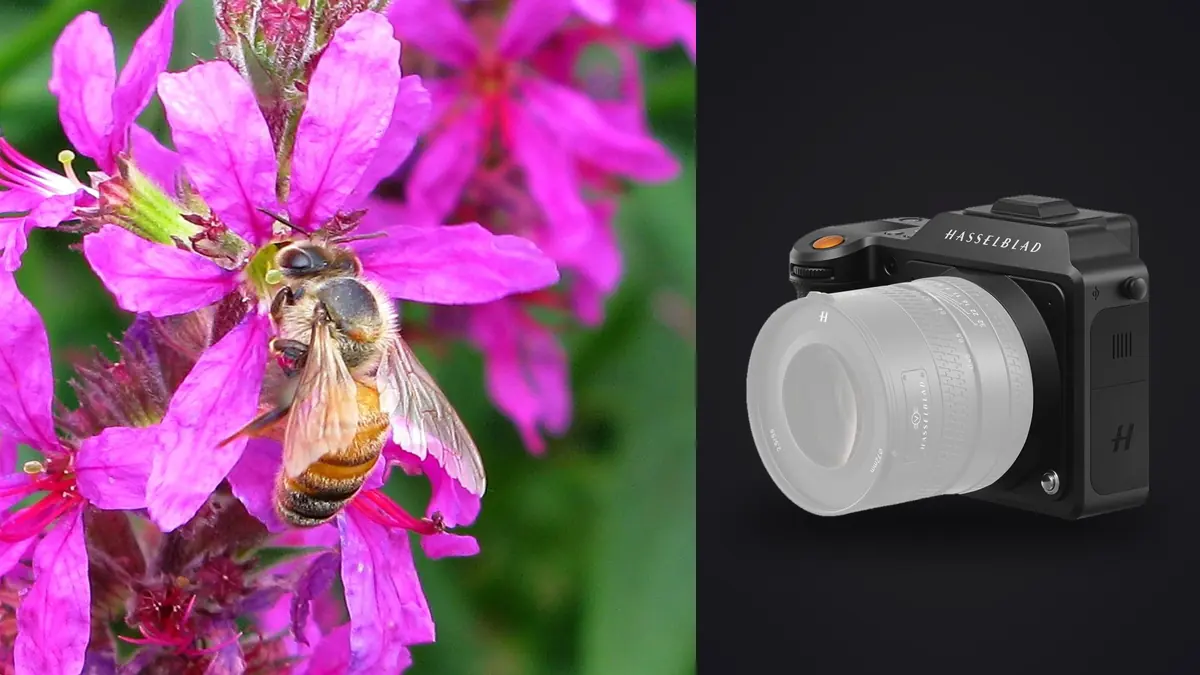
A friend who shoots weddings on the X2D 100C asked me, half joking, whether it was insane to bring a $13,000 medium format kit to photograph jumping spiders in his backyard. I didn't have a clean answer at the time, so I borrowed the body and the XCD 120mm Macro for six weeks and actually tried to work with it: dawn dew shoots, a couple of studio sessions with chilled specimens, and one thoroughly frustrating afternoon trying to track a robber fly in flight. This is what I found, including the parts Hasselblad's marketing copy conveniently skips.
What the sensor actually buys you
The X2D 100C's 43.8 x 32.9mm sensor is roughly 1.7x the area of full frame, and at 100 megapixels the pixel pitch works out to about 3.76 microns, similar to what you'd get on a 24MP APS-C sensor but spread across a much bigger area. For insect work, that matters less for raw sharpness (a well-corrected macro lens on any modern sensor resolves plenty) and more for cropping headroom. Almost every macro shot gets cropped in post anyway, because you're rarely composing the eye of a jumping spider dead-center in the frame with nothing to spare. Starting from 100MP means you can lose 60% of the frame to cropping and still print at a reasonable size, or push in tight on a compound eye's ommatidia pattern without the file falling apart.
The dynamic range is genuinely useful too. Backlit dragonfly wings, dew on a leaf catching direct morning sun next to a shadowed thorax, that's a rough scene for most sensors, and the X2D's 16-bit files give you real room to pull shadow detail back without banding. I'd put it ahead of what I get from full frame files in the same light, though not by a margin that alone justifies the price difference.
The tradeoff nobody mentions until they've filled a card: a single 3FR raw from this camera runs 150 to 220MB depending on scene complexity. A 30-frame focus stack of one dragonfly, which is a modest stack by macro standards, is 5 to 6GB before you've even opened the stacking software. Do that ten times in a morning and you understand why culling stops being optional busywork and becomes the actual bottleneck of the day.
The magnification problem the spec sheet buries
Here's the thing that would have saved me a wasted first outing if I'd known it going in: the XCD 120mm Macro does not reach 1:1 magnification. Its maximum reproduction ratio at minimum focus distance is 1:2, meaning a 36mm subject fills the same frame width a true macro lens would need for a 72mm subject. For a lot of insect subjects, jumping spiders under 6mm, small native bees, aphids, that's simply not enough reach to fill the frame the way a dedicated 1:1 macro lens does on a smaller sensor.
You can work around it two ways. One is cropping hard into the 100MP file, which the sensor genuinely supports better than most, and in practice this is what I ended up doing most often. The other is stacking on extension, but as far as I've found there's no official Hasselblad extension tube for the XCD mount, so you're relying on third-party rings that break the electronic contacts between lens and body, meaning you lose autofocus and aperture control entirely and shoot fully manual. Neither is a dealbreaker, but both undercut the idea that this is a purpose-built macro setup out of the box. If your subjects are larger, praying mantises, large moths, cicadas, the 1:2 ratio is much less of an issue and the lens performs beautifully.
Autofocus and the shutter situation with live subjects
The X2D 100C uses contrast-detection autofocus only, no phase-detect pixels on the sensor. At normal shooting distances this is a non-issue; it's accurate and reasonably fast for portrait and landscape work. At macro distances with a razor-thin depth of field, contrast AF hunts more than I'd like, and it has no eye-detection or subject tracking of any kind. For a stationary or slow-moving insect (a resting butterfly, a spider sitting in its web at dawn when temperatures keep it sluggish) this is manageable if you're patient and use single-point AF plus a bit of manual fine-tuning on the focus ring. For anything moving with intent, a wasp working a flower, a fly taking off, I missed far more frames than I kept. This is not a camera built to chase live action at high magnification.
The body itself has no mechanical focal-plane shutter; everything is either electronic shutter or, on lenses that include one (the 120mm Macro does), a leaf shutter built into the lens itself. The leaf shutter is actually the better tool for insect work because it syncs with flash up to 1/2000s, which matters a lot if you're using a ring flash or twin macro flash to freeze wing motion or work handheld without a tripod. Pure electronic shutter, by contrast, reads the sensor slowly enough that fast wing beats can show rolling shutter skew, so for flight shots I stuck to the leaf shutter and flash rather than relying on ambient light and the electronic-only mode.
How it stacks up against two systems macro shooters actually reach for
I put the X2D setup side by side with two rigs I use regularly for insect work, to make the tradeoffs concrete rather than abstract.
| System | Sensor | Native macro magnification | Autofocus | In-camera focus stacking | Approx. body + macro lens | Typical raw file size |
|---|---|---|---|---|---|---|
| Hasselblad X2D 100C + XCD 120mm Macro | 43.8 x 32.9mm, 100MP | 1:2 (0.5x) | Contrast-detect only, no tracking | Yes, added via firmware, manual bracket setup | ~$13,000 | 150-220MB |
| Sony A7R V + FE 90mm F2.8 Macro G OSS | Full frame, 61MP | 1:1 | Phase-detect with AI subject recognition | Yes, built-in bracketing menu | ~$4,700 | 60-90MB (compressed raw) |
| OM System OM-1 Mark II + M.Zuiko 60mm f/2.8 Macro | Four Thirds, 20MP | 1:1 (2:1 equivalent field of view) | Phase-detect with animal/subject AI, Pro Capture | Yes, robust in-body stacking + focus-bracket auto merge | ~$2,800 | 20-25MB |
The OM-1 II is the one most working insect photographers actually reach for, and after using all three back to back I understand why: the smaller sensor's crop factor effectively doubles your working reach, the autofocus tracks a moving subject instead of just hunting for one, and Pro Capture buffers frames before you even fully press the shutter, which catches a bee's takeoff in a way none of the other two bodies can. The X2D wins decisively on file quality and tonal depth for static, controlled subjects. It loses badly on speed, reach, and total system cost for anything that moves fast.
Where the X2D actually earns its keep in the field
After the frustrating flight-shot afternoon, I changed approach entirely and started treating this as a studio and dawn-macro tool rather than a general insect camera. Two setups worked well:
Cold mornings with dew, shooting damselflies and beetles before the sun warms them up enough to move. Subjects sit still for ten or fifteen minutes at a stretch, which is exactly the window you need for a proper focus rail stack. I'd set the camera on a geared macro rail, dial in 25 to 40 frames at roughly 0.3mm steps, and let the firmware's focus bracketing handle triggering. The resulting stacked composites, once merged, show detail in individual setae (the hair-like bristles on an insect's exoskeleton) that I genuinely don't get from smaller-sensor systems at the same working distance.
Studio work with humanely chilled specimens (a common, low-stress technique many macro photographers use: a brief spell in a refrigerated container slows an insect's metabolism enough for a controlled shoot before it's released) is the other place this camera shines. Controlled lighting, a copy stand or focus rail, and a subject that isn't fighting you removes autofocus speed from the equation entirely and lets the sensor's resolution and color depth do the work.
What I would not do again is bring this rig somewhere expecting to track live flight or fast foraging behavior. That's a job for a camera with real subject-tracking autofocus and a longer effective reach per gram of gear carried.
The part that actually slowed me down: managing the files
Six weeks of stacking sessions left me with several thousand raw frames, most of them near-duplicates of the same insect at a slightly different focus distance, plus the usual scattering of missed-focus and motion-blurred rejects mixed in. Sorting that by eye in a standard raw browser at 200MB per file is genuinely painful; the previews alone take a beat to render. I ended up running everything through imagic, mainly for the local sharpness and focus scoring, which flags which frame in each stack actually nailed the eye or the antenna tip before I bother opening the stack merge software, and the duplicate and burst clustering, which groups near-identical frames from a rail sequence automatically instead of leaving me to eyeball forty thumbnails that all look the same at a glance. Because it's a one-time purchase that processes everything locally rather than a subscription tool uploading files to someone's cloud, it didn't choke on the file sizes or add a monthly bill on top of an already expensive kit, which matters when you're already down $13,000 on the camera body and lens. Once I had a keep set, I used the apply_my_style preset trained on my own past edits to get a consistent color and contrast starting point across the whole batch before fine-tuning each stack individually. If you're new to the idea of automated culling generally, our explainer on how AI photo culling actually works covers the mechanics in more depth than I can here.
If you shoot enough volume that sorting frames is eating into actual shooting or editing time, it's worth reading through our broader workflow speed tips, several of which came directly out of sessions like this one where the gear wasn't the bottleneck, the sorting was.
Is it actually worth it for insect macro specifically
Honestly, only in a narrow case: if you already own the X2D system for other paid work (product, portrait, landscape) and want to add controlled, static insect macro as a specialty using existing glass and a rail, it's a strong tool with real image quality advantages. If insect macro is your primary or only interest and you're deciding what to buy first, I would not start here. The 1:2 magnification ceiling, contrast-only autofocus, and total cost make it a poor entry point compared to systems built with fast-moving small subjects specifically in mind.
Frequently Asked Questions
Can the XCD 120mm Macro reach true 1:1 magnification with any workaround?
Not natively; at closest focus it tops out at 1:2 (0.5x). Third-party extension tubes can push the magnification higher, but they break the electronic connection between lens and body, so you lose autofocus and electronic aperture control and have to shoot fully manual, which is workable on a tripod but awkward handheld.
Does the lack of a mechanical shutter cause problems photographing fast wing movement?
The body has no mechanical shutter, but the XCD 120mm Macro has its own integrated leaf shutter, which syncs with flash up to 1/2000s and avoids the rolling shutter skew you can get from the pure electronic shutter mode. For anything with fast wing beats, use the leaf shutter with flash rather than ambient light and electronic shutter alone.
Is the in-camera focus stacking reliable enough for serious insect work?
The focus bracketing feature, added by firmware update after launch, does the job of triggering a sequence at set focus increments, but it's manual in setup (you dial in step size and frame count yourself) rather than the more automated bracket-and-preview systems on cameras like the OM-1 II. It works well for static or chilled subjects on a rail; it won't help you with a moving insect since it assumes the subject stays still between frames.
How much should I actually budget to shoot insect macro on this system?
Realistically around $13,000 for the body and the 120mm Macro lens alone, before a focus rail, flash system, or storage for the file sizes involved. That's roughly 3x what a full frame macro setup with true 1:1 reproduction and tracking autofocus would cost, and closer to 5x a Micro Four Thirds macro rig with comparable or better in-camera stacking support.