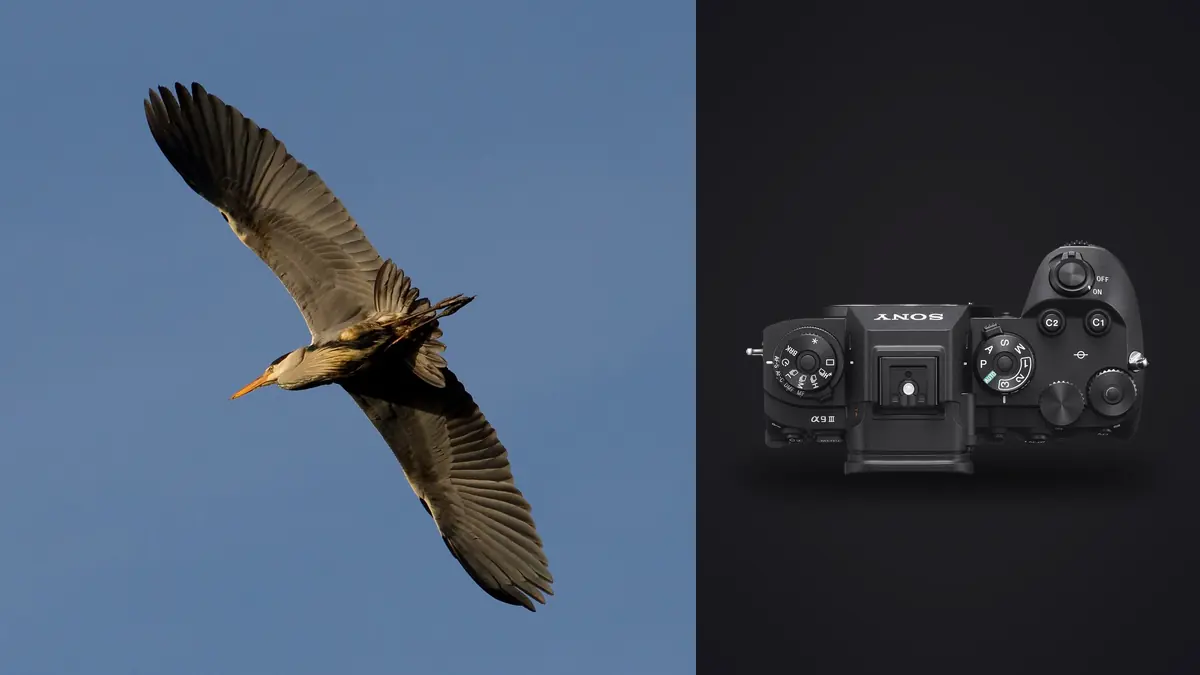
The first time I flew a peregrine stoop through the Sony A9 III's viewfinder, I forgot to check my settings for almost a minute because there was nothing to check. No blackout between frames, no rolling shutter smear on the wingtips, no jello wobble on a bird cutting sideways at forty miles an hour. That's the thing about this body that spec sheets undersell: it's not really a "faster A9 II." It changes what you can attempt with a long lens pointed at something that doesn't sit still.
The global shutter is the actual headline, not the 120fps
Every marketing bullet for this camera leads with the frame rate, but the sensor readout is the part that matters for birding. A conventional stacked sensor still scans line by line, just very fast. At the shutter speeds you'd use for a swallow doing acrobatics over a reservoir, that scan is still slow enough relative to the wingbeat that you get skew: the leading edge of a wing can shift several pixels from the trailing edge by the time the sensor finishes reading the frame. On an A9 II or a Z9 shooting at 1/4000s panning hard, I've seen it show up as a faint diagonal smear on primaries, subtle but there if you pixel-peep.
The A9 III reads the entire sensor at once. There's no scan direction to skew against, so a wing beating at any speed comes out geometrically correct no matter how fast you're panning. The second, less talked-about benefit is flash sync. Because there's no rolling curtain to worry about, you get full flash sync at any shutter speed, all the way up to 1/80000s. For anyone shooting hummingbirds or backlit raptors with a flash for fill, that removes a limitation that's been baked into every mirrorless body until now. You're no longer choosing between freezing wing motion and getting flash exposure right.
There's a quieter win too: shooting under LED-lit hides or artificial light near feeding stations used to mean hunting for a shutter speed that didn't produce banding. The global shutter sidesteps that entirely since there's no rolling exposure window for the LED's flicker cycle to interact with.
Frame rate you can actually use, and the buffer that decides if you can afford it
120fps with full autofocus and autoexposure tracking sounds absurd until you're trying to nail the exact instant a heron's foot leaves a branch. In practice I don't shoot 120fps for general flight tracking, I use 30fps for most passes and reserve the top speed for genuinely unpredictable moments: a kingfisher's dive, a raptor's strike, anything where the decisive frame is a fraction of a second wide and I can't predict which fraction. At 120fps the viewfinder shows a continuous, blackout-free feed rather than a slideshow, which sounds like a gimmick until you're tracking a bird against a cluttered treeline and realize you never lost visual contact with it between frames.
The tradeoff is data. A CFexpress Type A card is not optional if you intend to use the top frame rates for more than a second or two, UHS-II SD cards throttle the buffer hard and you'll feel the camera stall mid-burst. Even with a fast Type A card, if you shoot at 120fps for three or four seconds chasing a tern diving on bait fish, you'll walk away with 400+ frames from a single pass. Do that six or seven times in a morning at a colony and you're looking at several thousand frames before lunch, most of them redundant wing positions of the same bird.
Pre-capture actually solves a real problem
The pre-capture buffer, which continuously holds up to roughly a second of frames before you fully press the shutter, is the single feature I didn't know I needed until I used it on ospreys. You half-press to track the bird circling over water, and the instant it commits to a plunge dive you fully press. Frames that happened before your brain registered the dive and told your finger to move are already sitting in the buffer. I've gotten the exact moment of talons hitting water on a dive I would have missed by a quarter second on any previous body, human reaction time simply isn't fast enough for that shot otherwise.
Autofocus that holds on to small, fast, and awkwardly backlit subjects
The 759-point phase-detection array covering roughly 92% of the frame is less interesting on paper than how it behaves on a bird that's thirty pixels tall against open sky. Sony's subject recognition will pick up eye, head, and body even when the bird occupies a tiny fraction of the frame, and it's noticeably better at holding a lock through a branch or a reed passing in front of the subject than the A9 II was. It still isn't magic against a marsh background full of similarly textured reeds, or when a bird flies directly at camera silhouetted against a bright white sky, those remain genuinely hard scenarios and I still miss shots there.
What I changed in my own settings after a few weeks: I moved off full-frame tracking and toward a smaller flexible spot for anything smaller than a heron, then let subject recognition do the rest once it locks. Back-button focus with AF-C locked to the thumb button, shutter fully dedicated to firing, is still the setup I'd recommend, nothing about the new sensor changes that basic discipline.
How it stacks up against the other bodies people actually cross-shop
If you're choosing between this and a Nikon Z9 or Canon R3 for bird-in-flight work specifically, the spec sheet comparisons that matter aren't the usual megapixel and ISO charts. Here's how the four bodies I get asked about most often actually compare on the things that show up in a real BIF sequence.
| Camera | Sensor readout | Fastest AF/AE-tracked burst | Wingtip skew on a fast pan | Flash sync ceiling | Realistic buffer on a fast card |
|---|---|---|---|---|---|
| Sony A9 III | Global (whole sensor at once) | 120 fps | None, geometrically correct at any pan speed | 1/80000s | 390+ compressed RAW frames before it throttles |
| Sony A9 II | Stacked, fast rolling scan | 20 fps (electronic) | Mild, visible on fast primaries at extreme pan speeds | 1/500s (mechanical) | Around 240 RAW frames |
| Nikon Z9 | Stacked, fast rolling scan | 20 fps RAW / 30 fps JPEG | Minor but present under hard panning | Roughly 1/200s effective | Deep, effectively card-limited, rarely stalls in normal use |
| Canon EOS R3 | Stacked, fast rolling scan | 30 fps (electronic only) | Minor, better than most stacked sensors but not zero | Around 1/180s (mechanical shutter present) | Roughly 150 RAW frames before slowing |
The Z9's buffer is genuinely excellent and its 45.7MP sensor gives you cropping room the A9 III can't match, that's the real tradeoff here rather than one camera simply beating the others. If your subjects are small and distant and you crop hard in post, the Z9's extra resolution is a legitimate reason to look past the A9 III. If your priority is geometrically perfect fast wingbeats and flash freedom, nothing else on this list touches the Sony.
Lenses that make sense on this body
The 200-600mm f/5.6-6.3 G is still the lens I recommend to anyone starting out with this camera for birding, it's light enough to hand-hold for a full morning at a heronry and the reach is enough for most perched and flight work without a teleconverter. Once you're serious about small songbirds or distant raptors, the 400mm f/2.8 GM with a 1.4x or 2x teleconverter earns its weight, and the extra stop of light matters more than people expect when you're shooting into a hide with a dark background at dawn. The 600mm f/4 GM is the one I reach for at established nest sites where I can set up on a gimbal head and don't need to carry the rig on a hike.
Worth knowing: the A9 III's APS-C crop mode still gives you roughly 10 effective megapixels, which is usable for web and modest prints, so a 600mm lens effectively becomes a 900mm equivalent in a pinch without buying more glass. I use this more than I expected to for small birds at the edge of my longest lens's reach.
The resolution tradeoff nobody wants to hear
24.6 megapixels is a step down from the 50.1MP Sony A1 and roughly level with the outgoing A9 II, and if your workflow depends on cropping a distant bird to a third of the frame, you'll notice it. For most flight photography where you're already filling a reasonable portion of the frame with a 600mm lens, it's plenty, files hold up fine for double-page magazine spreads and large prints of a well-framed subject. Where it gets tight is the classic "tiny bird, big sky" shot where you're cropping to 20% of the original frame for a print larger than a screen. If that's your regular subject matter, the resolution ceiling here is a real consideration, not a rounding error.
What 120fps does to your evening, not just your morning
Nobody warns you about this part before you buy the camera: a single good session at a colony can leave you with four or five thousand frames, and the vast majority of any wingbeat burst is redundant, the bird in a slightly different wing position with the same background. Sorting that by eye in a traditional catalog, scrubbing through burst after burst looking for the one frame with the wingtip in the right position and the eye catchlight lit, is the part of owning this camera that actually eats your evenings.
This is where I lean on imagic rather than my old habit of manually flagging in a DAM. It runs local sharpness and focus scoring across a folder of RAW files and groups near-identical burst frames together, so instead of scrubbing four hundred frames of one pass by hand, I'm looking at the handful it's flagged as the sharpest per cluster. Because it processes entirely on the machine rather than uploading anything, I can run a first pass on a laptop at the hide with no signal at all, which matters more than I expected at some of the remote sites I shoot.
Once I've got the shortlist, I use imagic's apply_my_style feature, which is trained on my own past edits rather than a generic preset, to get a fast preview of how each keeper will look before I commit to a full develop pass in my main editor. It's not a replacement for a proper grade, but it turns "is this frame even worth opening in Lightroom" into a five-second decision instead of a guess. If you want more detail on how the underlying scoring actually works, I wrote about that separately in how AI photo culling works.
Settings I've settled on after a season with it
Continuous compressed RAW rather than lossless, the file size difference matters when you're already generating thousands of frames per outing and the quality difference is not visible in real-world use. Drive mode set to 30fps as the default with a custom button mapped to jump to 120fps only when I consciously want it, otherwise the top speed just multiplies my culling workload for no benefit on slower passes. Auto ISO with a floor shutter speed around 1/2500s for flight, faster for small fast fliers like swifts. And I keep the pre-capture buffer active at all times now, there's essentially no downside to it once you've missed one dive because you were half a beat slow on the trigger. For more general speed habits that carry over from other high-volume shoots, my earlier piece on faster photo workflow habits covers a few that apply directly here.
Frequently Asked Questions
Does the global shutter actually improve image quality, or is it only about the shooting experience?
Both. The blackout-free viewfinder and flash-at-any-speed are experience improvements, but the elimination of rolling shutter skew is a genuine image quality difference you can see on fast wingbeats and hard pans, frames that would show subtle geometric distortion on a rolling-shutter body come out clean on the A9 III.
Do I need CFexpress Type A cards, or will fast SD cards keep up for bird-in-flight bursts?
UHS-II SD cards will work at moderate frame rates but they throttle noticeably at 120fps, the buffer fills and the camera slows to card speed mid-burst. If you plan to use the top frame rate for anything beyond very short bursts, CFexpress Type A is effectively required, not optional.
Is 24.6 megapixels enough resolution for cropping small, distant birds?
It's adequate for web use and moderate prints when you're cropping to roughly half the frame or more. If your typical shot is a small songbird occupying a tiny corner of a wide frame and you need a large print from that crop, a higher-resolution body like the Z9 or A1 will hold up better under that kind of aggressive cropping.
What's a sensible first lens for birds in flight on this body?
The 200-600mm f/5.6-6.3 G is the practical starting point for most people, light enough for hand-held flight tracking over a long session and versatile enough for perched portraits too. Reserve the big primes like the 400mm f/2.8 GM for once you know you're shooting flight regularly enough to justify the weight and cost.