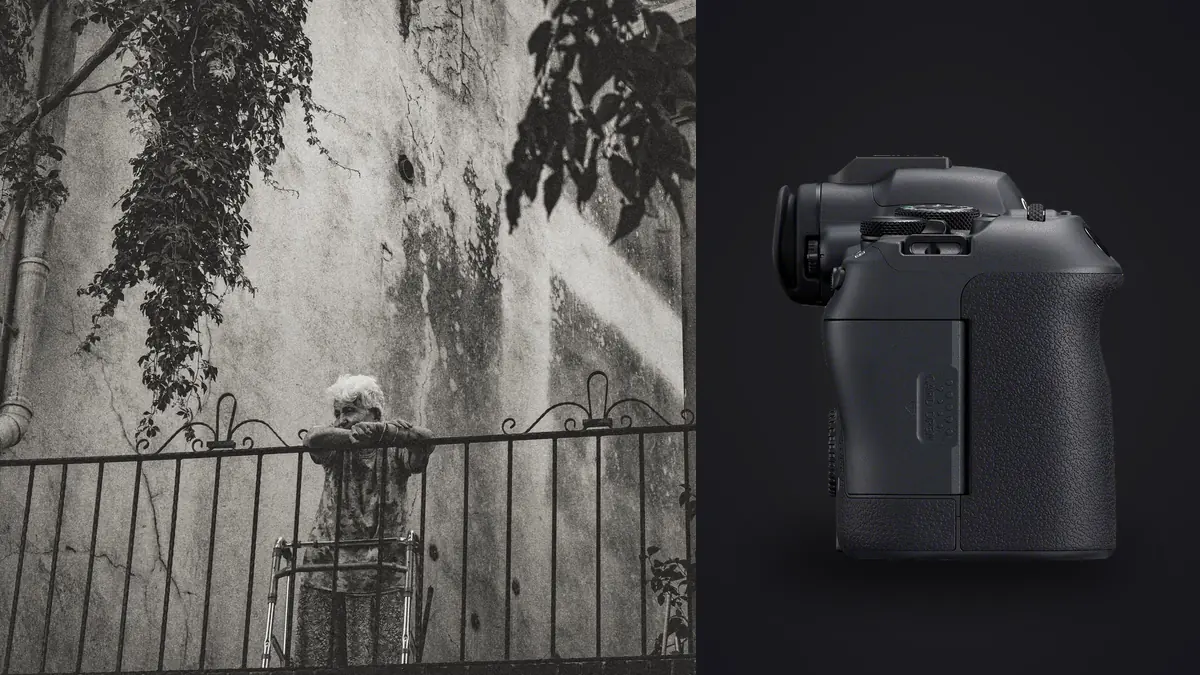
I picked up the EOS R6 Mark II for a three-day documentary job covering a union march that turned into a sit-in outside a city council building, and it stayed my main street camera long after that assignment ended. Canon didn't design this body as a rangefinder-style street shooter, it's closer in size to a small DSLR, but the sensor, autofocus, and buffer depth turn out to matter more on unpredictable streets than pocketability does. This isn't a spec-sheet rundown. It's what actually changes when you're following a person through a crowd, guessing whether they'll turn left or right, and you have about four-tenths of a second to decide.
The Sensor Trade-Off Nobody Complains About
Canon kept the R6 II at 24.2 megapixels while competitors chase 33, 45, even 61MP full-frame sensors. For documentary and street work this is the right call, not a compromise. A day of chasing a march or a market produces anywhere from 1,200 to 3,000 frames once you count every burst. At 24MP, a full card of RAW files stays manageable on a laptop with no external drive nearby, and you're not waiting forty seconds for a single image to render in Lightroom on a five-year-old machine. The files are also small enough that culling software doesn't choke on them, which matters more than it sounds when you're triaging thousands of frames the same night to file images to an editor.
ISO performance is the other half of the story. I'll shoot at 6400 without hesitation and push to 12800 when the alternative is missing the shot entirely, which happens constantly once the sun drops and you're working under sodium streetlights or inside a dim community hall. Noise at those settings is fine-grained rather than blotchy, and it cleans up without turning faces into plastic. That headroom is what lets you keep shooting handheld into blue hour instead of packing up when the light gets difficult, which on a documentary assignment is often when the actual story happens.
Handling: Comfortable for Twelve Hours, Not Invisible
Be honest with yourself about what this camera is. It weighs about 590 grams body-only, and with an RF 35mm attached you're carrying roughly a kilogram around your neck for a full shift. That's noticeably more than a Fuji X100-series body, and it does not disappear into a crowd the way a compact rangefinder can. What it gives you instead is a grip deep enough to hold one-handed for hours without your fingers cramping, which matters more than most people admit after the eighth hour of a wedding-adjacent documentary shoot or a twelve-hour protest coverage day.
The mechanical shutter has an audible clack, not loud, but present enough that you'll hear it in a quiet room or a hushed courtroom hallway. Switch to full electronic shutter for those situations and the camera goes essentially silent, which changes how subjects behave around you. People stop performing for the camera within a minute or two once they can't hear it firing. The catch is that electronic shutter can produce banding under flickering LED signage or older sodium streetlights, so I keep the anti-flicker setting on by default and only turn it off if I notice the shutter speed hunting. The 40fps electronic burst mode gets a lot of marketing attention, but for street work it's mostly a party trick. Anyone moving at a normal walking pace generates rolling-shutter skew on their legs at that frame rate, and you end up deleting most of the sequence anyway. Twelve frames per second in mechanical mode is where I actually shoot, because it gives you real frame-to-frame separation for a decisive-moment sequence without drowning you in near-duplicates.
Autofocus for Subjects Who Won't Hold Still
Dual Pixel CMOS AF II with 1,053 selectable zones is the feature that made me trust this body for documentary work in the first place. Eye detection locks onto a face through a gap in a crowd, holds it through a partial occlusion (someone's shoulder crossing the frame), and doesn't wander off to the background the way older systems sometimes did. For street portraits grabbed in passing, this is the difference between a sharp eye and a sharp shoulder. Body detection kicks in usefully too, picking up a subject from behind or in profile when there's no face to track at all, which happens constantly in documentary work where you're often shooting people mid-motion rather than posed.
Where it still asks something of you: in genuinely chaotic scenes with a dozen moving bodies overlapping, the tracking box can jump between subjects if you're not deliberate about your initial subject selection. I've learned to tap or half-press onto my actual subject early and trust the camera to hold it, rather than letting whole-area AF pick for me. Left alone, it tends to favor whoever is closest or most contrasty, which isn't always the person telling the story.
Lens Pairings That Actually Get Used
RF 35mm f/1.8 Macro IS STM
This is the lens that lives on my R6 II more than any other. It's small, it's under 500 grams combined with the body, and the built-in stabilization lets you shoot handheld at a quarter-second in dim interiors without a tripod, which comes up more than you'd expect in documentary work where you can't always control the location.
RF 28mm f/2.8 STM
The pancake option, and it genuinely changes how the camera reads to strangers. With this lens mounted the whole rig is thin enough to hang flat against your chest, and people register it as a smaller, less threatening camera even though the sensor behind it is identical. I reach for this specifically on jobs where minimizing visual presence matters, like inside places of worship or during sensitive community events.
RF 50mm f/1.8 STM
Cheap, sharp, and the focal length forces you physically closer to your subject than a wider lens would, which for documentary work usually produces a more honest frame. It's also the lens I hand to an assistant or second shooter because there's very little to go wrong with it.
Third-party glass finally became a real option on RF mount once Canon opened AF licensing to Sigma and Tamron, so a Sigma 24mm f/1.4 is now a legitimate low-light option if you want more speed than the native primes offer, at a lower price than Canon's own L-series equivalents.
Built for a Full Day, With One Real Limitation
Weather sealing on the R6 II held up through a light rain during that council building sit-in with no issues, and the dual UHS-II SD slots mean you can mirror RAW files to a backup card in real time on a job where losing footage isn't an option, like a one-time public event that won't happen twice. Buffer depth is generous enough for the format: Canon rates it around 190 RAW frames at 12fps with a fast card, which is roughly fifteen seconds of continuous shooting before it slows down, plenty for any single decisive-moment sequence you're likely to catch on the street.
Battery life is the honest weak point. CIPA rates it in the 320 to 450 shot range depending on viewfinder use, and that number is optimistic once you factor in chimping shots on the rear screen and leaving the camera powered on between scenes, which you inevitably do when you're following a moving story and can't afford the second it takes to wake from sleep. I carry two spare LP-E6NH batteries on any assignment longer than four hours and have run one dry by mid-afternoon on high-burst days.
Where It Sits Against the Alternatives
People considering the R6 II for street or documentary work usually cross-shop it against the cheaper R8, the original R6, or a fixed-lens option like the Fuji X100VI. The trade-offs are specific enough that a table is more honest than a paragraph of hedging.
| Camera | Body weight | Discretion (mechanical shutter) | Max silent e-shutter fps | IBIS | Approx. street price (2026) |
|---|---|---|---|---|---|
| Canon EOS R6 Mark II | ~590g | Audible clack, moderate | 40fps | Yes, up to 8 stops | ~$1,900 body |
| Canon EOS R6 (original) | ~598g | Audible clack, similar | 20fps | Yes, up to 8 stops | ~$1,300 used |
| Canon EOS R8 | ~461g | Quieter, lighter mechanism | 40fps | None | ~$1,300 body |
| Fuji X100VI | ~521g | Near-silent leaf shutter | 20fps (crop) | Yes, up to 6 stops | ~$1,600 |
The R8 undercuts the R6 II on price and weight by dropping in-body stabilization entirely, which you'll feel the first time you're shooting a dim interior scene handheld at 1/15s. The original R6 is a genuine budget option now on the used market if you can live with a shallower buffer and older-generation autofocus tracking. The X100VI wins on discretion outright, its leaf shutter is close to silent even in mechanical mode, but you're locked to a single 35mm-equivalent focal length, which becomes limiting the moment a documentary story calls for a tighter or wider frame than that lens allows.
What Happens After the Shoot
A three-day documentary shoot on this camera routinely leaves me with four to six thousand frames once every burst is counted, and the honest bottleneck was never the shooting, it was getting through that pile fast enough to reach the keepers. This is where the R6 II's habit of firing off six or eight near-identical frames per burst becomes a real problem if you're sorting manually. I run the take through imagic before touching Lightroom, letting its local sharpness scoring flag which frame in each burst actually has the sharp eye (useful given how often eye-AF is tracking a subject mid-turn) and its duplicate and burst clustering group the sequences so I'm reviewing one representative frame per moment instead of eight. Because it processes everything on the machine rather than uploading to a cloud service, it's also the only culling approach I'm comfortable using when photographing vulnerable subjects or sensitive locations, where sending images off-device isn't something a subject would sign off on.
The other piece that's saved real time is imagic's apply_my_style feature, which trains an AI preset on edits you've already made rather than a canned filter pack. After tagging a few hundred frames from earlier documentary work with my usual contrast and color choices, it applies a consistent starting point across a new take, so four thousand frames from a chaotic three-day shoot land somewhere close to my usual look before I do any manual grading. If you're trying to tighten a workflow that's currently eating your evenings, our workflow speed guide covers the culling and editing side in more detail, and this breakdown of how AI culling actually works is worth reading if you want to understand what the sharpness scoring is doing under the hood rather than just trusting it.
Frequently Asked Questions
Is the Canon EOS R6 Mark II too big for discreet street photography?
It's bigger and heavier than a rangefinder-style compact, and it will never disappear the way a Fuji X100VI or a Ricoh GR does. What it gives up in pocketability it makes up in AF reliability and buffer depth, so the real question is whether you're prioritizing being unnoticed or not missing the shot. Pairing it with the RF 28mm pancake closes some of that gap.
Which RF lens should I actually buy first for documentary work?
The RF 35mm f/1.8 IS STM is the most versatile single choice, wide enough for environmental context, close enough for portraits, and light enough to carry all day. Add the 28mm pancake later specifically for situations where the smaller footprint matters more than the extra reach.
Does the electronic shutter cause problems shooting at night under city lighting?
It can. Older sodium streetlights and some LED signage flicker at a rate that produces banding in electronic shutter mode. The R6 II's anti-flicker setting handles most of this automatically, but on tricky mixed-lighting scenes I'll switch back to mechanical shutter rather than fight it, accepting the audible clack as the trade.
How many frames does a full documentary shoot day actually produce, and how do you get through them?
Between 1,500 and 3,000 frames is typical for a single busy day once bursts are counted, more on multi-day assignments. Manually reviewing that volume the same night isn't realistic on a deadline, which is why I run the card through local culling software first to flag sharp frames and group burst duplicates before I open an editor at all.
Is It the Right Camera for This Kind of Work
I wouldn't call the R6 II the obvious pick for someone whose only priority is disappearing into a crowd. But for documentary work, where you're often committed to a subject for an entire day and need the autofocus to hold through motion, occlusion, and bad light without babysitting it, it's earned its place as my default body. The weight and the audible shutter are real costs. The tracking, the buffer, and the ISO ceiling are what let me stop worrying about the camera and pay attention to what's actually happening in front of it, which is the only part of this job that matters once you're on location.